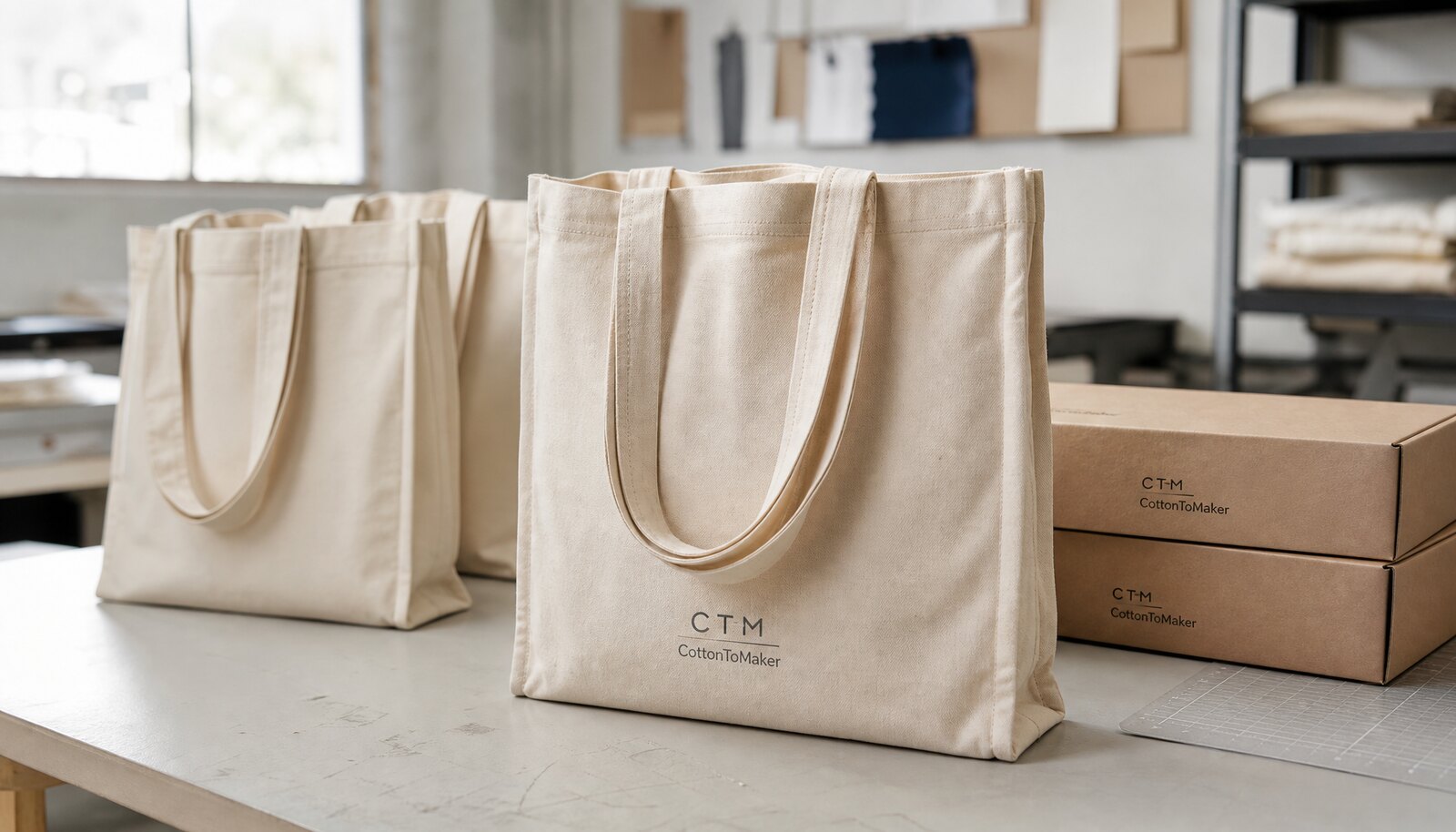
What Retail Chains Actually Need From A Book Fair Tote
Canvas book fair totes for retail chains are not just carry bags. They are low-cost retail SKUs or event supplies that have to look consistent, fold the same way every time, carry books without distorting, and survive repeated handling in stores and distribution centers. If the tote is treated as a print job instead of a sewn-goods program, the first problems usually show up in size variation, crooked logos, and packing errors.
The buying question is simple: what must the bag do after it leaves the sample room? A shelf-resale tote needs cleaner presentation, tighter color control, and a packing format that works for retail display. A book-fair bundle may need lower unit cost, simpler decoration, and a carton plan that supports fast issue to stores. A promo tote may care more about deadline and logo visibility than about premium construction. If the use case is not clear, the factory will default to its cheapest assumptions, and those assumptions tend to surface later as receiving problems or unplanned rework.
For procurement buyers, the right order guide is not generic tote advice. It has to answer the questions that actually affect the PO: what to specify, what to compare, what to sample, and what to reject before bulk production begins.
- Define the use case before discussing decoration.
- Treat repeatability as a core requirement, not a nice-to-have.
- If the tote is a retail SKU, include packing and labeling needs from the start.
Lock The Spec Before You Ask For Pricing
A usable RFQ starts with a short but precise spec sheet. At minimum, include finished width, finished height, gusset depth, handle length or drop, fabric weight, base color, print size, and print location. If the tote uses a pocket, zipper, snap, woven label, contrast binding, or a reinforced bottom, include that too. Those details directly affect sewing time, material consumption, carton density, and final cost.
Canvas weight is one of the first choices to settle. For many chain programs, 12 oz canvas, roughly 340 to 410 GSM, is a practical baseline because it gives enough body for books and catalogs without pushing the price and freight too high. Heavier fabric can be right for premium positioning or higher load requirements, but it should be a deliberate choice. Do not ask suppliers to guess the weight from a photo or a short description.
Construction notes should be equally specific. State whether the bag is open top or closed with a zipper, whether the gusset is on the side, bottom, or both, and how the handles are attached. If the tote needs a retail look on shelf, say so. If it needs to collapse flat for DC packing, say that instead. A factory can only quote accurately when the spec tells it what the bag is expected to do.
- A solid baseline is 12 oz canvas, self-fabric handles, open top, one-color screen print, and flat-fold bulk packing.
- Use 14 oz or heavier only when the load or the brand position justifies it.
- Name the fabric shade as natural, bleached, dyed, or white because the base color changes both appearance and price.
Choose The Supplier Route That Matches The Order Size
The right sourcing route depends on control needs, not just the lowest unit price. A direct factory is usually the strongest fit for a chain rollout because it gives the buyer direct visibility into fabric, sewing, printing, and packing. That is especially valuable when the tote will be reordered. The same screens, thread color, fold method, and carton plan can usually be held from one run to the next without renegotiating the basics.
A trading company or sourcing agent can still make sense when the order includes multiple SKUs, mixed product categories, or buyers that want one point of contact. The tradeoff is accountability. If the quote is vague, the buyer may not know where the bag is actually being made or who owns QC. A local decorator using stock blanks is faster for small programs, but that route limits fabric choice, size control, and construction options. It is a speed play, not a control play.
The useful comparison is not who says yes first. It is who can explain the same spec, timeline, and packing plan without changing the quote later. If a supplier cannot tell you whether printing is in-house, what blank it is using, or how the cartons will be packed, treat that as a sourcing risk.
- Direct factory is usually best for repeat programs and larger chain volumes.
- Trading companies help with coordination, but the buyer still needs factory-level detail.
- Stock-blank decorators are best for pilot runs, not for a chainwide standard SKU.
Read Quotes On Landed Cost, Not Unit Price
A tote quote that shows only a single unit price is not enough to make a sourcing decision. For canvas book fair totes, the hidden cost usually sits in setup, sample fees, packing, labeling, carton size, and freight assumptions. One supplier can look cheap because it excluded print setup or polybagging. Another can look expensive because it included the exact packing standard the distribution center needs. Those quotes are not comparable until the variables are normalized.
Ask each bidder to quote the same Incoterm, the same carton count, the same sample terms, and the same overrun policy. Request line items for fabric weight, print method, label application, carton dimensions, and gross weight. If a supplier will not break those out, the risk is being buried in the margin. On retail chain programs, that margin often comes back later as rework, repacking, or unexpected freight.
The buyer should also think about receiving cost, not just factory cost. A slightly higher bid can be the better choice if it delivers better carton marks, cleaner fold consistency, and fewer DC exceptions. Procurement wins when it compares the tote as a received SKU, not as a factory price line.
- Normalize every quote to the same Incoterm, carton count, and print method before comparing.
- Ask whether setup, thread changes, label application, and final packing are included.
- Do not compare a loose bulk quote against a retail-ready packed quote as if they were equivalent.
Match Material And Decoration To How The Tote Will Be Used
For this category, construction choices should support daily handling, not just sample-day appearance. Screen print is usually the best option for retail chain logos because it is durable, readable, and cost-efficient on simple artwork. If the design is one or two colors and does not need gradients, screen print usually gives the best balance of price and wear. Heat transfer can work for smaller runs or more complex art, but it needs tighter approval on edge quality and adhesion. Embroidery is usually reserved for premium positioning because it adds cost and can distort the fabric hand if the design is large.
The handle system deserves the same attention. Self-fabric handles with bar-tack or X-box reinforcement are generally the safest default for a tote that will be carried repeatedly. Ask for handle width, attachment method, and the distance from the top edge to the handle seam. If the bag needs a gusset, define it separately. If you want a zipper, magnet, or snap closure, say so early, because those additions change labor, hardware sourcing, and lead time.
Canvas shade and finish also matter more than many buyers expect. Natural unbleached canvas gives an honest, low-finish retail look, but it will show fiber variation. Bleached or dyed stock gives more visual consistency, but it can add shade-control complexity and cost. The right answer depends on the chain's positioning, not on what the factory already keeps in stock.
- Use screen print for simple retail chain logos when durability and cost matter.
- Use heat transfer only when artwork complexity or run size justifies the added control work.
- Specify handle reinforcement and attachment style instead of assuming the factory will standardize it.
Treat The Sample As A Production Gate
A preproduction sample is a decision point, not a courtesy item. It should represent the final bag as closely as possible in fabric, thread, print method, and packing style. If a supplier submits a sample with substitute material, the buyer should know exactly what was substituted and why. Otherwise the approval is weak, because the production bag can shift in hand feel, color, or seam behavior once the actual bulk materials are used.
Review the sample with a ruler and a checklist, not just by eye. Measure the finished body, gusset, handle drop, and print position from a fixed reference point. Check whether the handles lay flat, whether the bag folds the way the distribution center expects, and whether the logo stays readable after light handling. If the tote is meant to stand on shelf, test that behavior with the approximate load the store will put inside it. If the tote is a giveaway, the sample still matters because a crooked logo or poor fold can turn a low-cost item into a reject.
Keep a signed approval package with the sample photos, the measured spec sheet, and any agreed exceptions. That record matters when a reorder is placed months later or a new buyer inherits the program. Strong approval is the kind that leaves no room for the factory to reinterpret what was approved.
- Approve samples by measurement, not only by appearance.
- If any sample material is substituted, make the substitution explicit before approval.
- Keep the approved sample photo set and spec sheet with the PO for reorder reference.
Set QC And Packing Rules Before Bulk Starts
Retail chain buyers should keep QC rules tight and simple. The goal is not a huge inspection manual. The goal is to define what counts as a reject, what counts as rework, and what can be accepted as cosmetic variation. For canvas book fair totes, the most important checks are size, print accuracy, seam integrity, and packing consistency. If those are controlled, the bag is usually commercially acceptable. If they are not, the defects become obvious in a store stack or in DC receiving.
Use an agreed inspection standard, commonly AQL 2.5 for major defects and 4.0 for minor defects unless your retailer requires tighter limits. Critical defects should include wrong artwork, severe print misregistration, a seam failure, wrong size outside tolerance, or the wrong barcode or SKU label. Major defects usually cover weak stitching, poor print adhesion, or bag-to-bag inconsistency that would be visible to a buyer on opening. Minor defects can include loose thread ends or slight fold variation if they do not affect resale presentation.
Packing has to be defined with the same discipline. Flat-fold bulk packing is usually the most efficient option unless the tote will be sold as an individual gift item. Ask for carton dimensions, gross weight, and count per carton before you approve the order. If the tote needs polybags, confirm the warning label, barcode sticker, and any hangtag requirement. For palletized freight, follow the retailer's DC standard and avoid overhang, unstable stack patterns, or carton labels that do not match the receiving system.
- Flat-fold bulk packing is usually best for chain replenishment.
- Confirm carton dimensions, gross weight, and count before freight is booked.
- Match carton labels and pallet marks to the retailer's receiving system, not just to the factory's internal code.
Protect The Schedule And Reorder The Same Bag
Lead time should be broken into sample time, bulk production time, inspection time, and transit time. Retail launches fail when those phases are blended into one optimistic estimate. A supplier may quote a fast production window, but that number is only meaningful if the artwork is final, the fabric is in stock, and the packing spec is already approved. Once the buyer starts changing the logo, handle length, or carton count, the schedule becomes a moving target.
For a chain program, freeze the spec before the PO is released and use a change-control rule for anything after that date. Every change should trigger a written re-quote and a revised schedule. That sounds strict, but it is cheaper than discovering after production starts that the factory has to rework screens, repack cartons, or source a different fabric lot. If the bag is a reorder, ask the supplier to confirm that it is using the same approved screen, same thread color, same bag construction, and same packing method as the last run.
The safest way to protect a launch date is to build a buffer between the quoted date and the store deadline. Do not plan the rollout on the best-case end of the supplier range. If the tote matters to a seasonal reset or a promotional window, the hidden schedule risk is usually not sewing time. It is approval latency and late scope changes.
- Separate sample timing, bulk timing, inspection, and transit in the project plan.
- Freeze artwork and packing before production starts.
- For reorders, confirm that the factory is reusing the approved construction and print setup.
Use A Short RFQ Packet And Compare Suppliers Fairly
A usable RFQ packet is short, but it has to be complete. Include the finished size, gusset, handle length, canvas weight, artwork file, logo placement, packing instructions, target delivery date, shipment destination, and quantity by SKU. If the chain expects different colorways or store-specific versions, list those separately. A supplier that has to guess at the split will pad the price or ignore the variation, and neither outcome helps procurement.
When the quotes come back, compare them on the same basis. One bid may be lower because it assumes a lighter canvas or a loose fold standard. Another may be higher because it includes exact carton marks, retail-ready packing, and a more durable print method. The right comparison is not which factory can hit the lowest number on paper. It is which bid gives the chain the cleanest receiving experience, the least rework, and the best chance of a stable reorder.
If you want the quote to be actionable, ask for it to be line-itemed. Product cost, setup, sample, packing, carton, and freight should be visible. That keeps procurement from negotiating blind and gives operations a document they can actually use after the PO lands.
- Send one RFQ sheet, one artwork file set, one packing instruction, and one target date.
- Ask for line-item pricing so setup and packing do not hide inside the unit price.
- Keep the approved sample, quote, and PO aligned so later disputes are easy to resolve.
Specification comparison for buyers
| Sourcing route | Typical price band | Typical lead time | Control level | Best fit |
|---|---|---|---|---|
| Direct factory | Usually lowest at larger volumes once sampling is approved | About 4 to 8 weeks after sample approval, plus transit | High on fabric, sewing, print, and packing when the factory owns the process | Repeat retail chain programs with stable specs and reorder potential |
| Trading company or sourcing agent | Usually mid-range, sometimes higher after fees and coordination are added | About 5 to 9 weeks depending on factory load and handoffs | Medium, because control depends on the underlying plant | Multi-item programs, buyers that need sourcing support, or mixed-category orders |
| Local decorator using stock blanks | Usually highest unit price, but practical for very small runs | About 1 to 3 weeks if stock blanks are available | Low to medium, because fabric and construction are fixed by inventory | Pilot launches, short-dated events, or small store tests |
| Domestic kitting or fulfillment partner | Usually mid to high, depending on domestic labor and handling | About 1 to 4 weeks after goods are in country | High on final labeling, kitting, and retailer-specific packing | When the tote needs relabeling, kitting, or DC-ready case packs |
| Material | 8-12 oz cotton canvas, 120-220 gsm cotton, recycled cotton, or blended fabric selected by use case and target price | Before price comparison | Different cloth weights, backing, or certification claims make quotes hard to compare | |
| Construction | bag size, gusset, handle drop, seam allowance, stitch density, reinforcement patch, and loading expectation | Before sampling | Weak stress points create returns and failed inspections | |
| Decoration | screen print, heat transfer, embroidery, woven label, or hangtag matched to fabric texture and brand durability needs | Before artwork approval | The wrong method can crack, bleed, pucker, or fail on the chosen fabric | |
| MOQ | Base MOQ plus change drivers | During quote review | Custom colors, trims, and packing can change minimums |
Buyer checklist before sampling
- Start with the finished size, gusset depth, handle length or drop, fabric weight, and base color. Do not ask suppliers to infer any of these.
- State the end use clearly: shelf resale, book-fair bundle, in-store promotion, or gift-with-purchase. The use case changes the bag spec and the packing standard.
- Attach vector artwork and define the exact print area from fixed reference points, not from approximate visual placement.
- Name the decoration method up front: screen print, heat transfer, embroidery, woven label, or a blank panel. Ask for the exact method the factory plans to use.
- Specify whether the back side is blank or printed, and whether the artwork must sit centered, offset, or aligned to a seam or pocket.
- Include folding method, polybag need, barcode label, inner carton count, master carton count, and any pallet requirement in the RFQ.
- Ask for a preproduction sample built from production-intent fabric, thread, and print method before bulk starts.
- Set written tolerances for dimensions, print placement, stitching, carton count, and label placement in the PO or spec sheet.
- Ask every bidder to quote the same Incoterm, the same sample terms, the same carton plan, and the same overrun policy so the comparison is real.
- Freeze artwork and product spec before production. Any change after approval should trigger a written re-quote and a revised schedule.
Factory quote questions to send
- What exact finished dimensions, gusset depth, handle length, and canvas weight are you quoting?
- Which print method will you use for this artwork, and is it done in-house or subcontracted?
- What is the MOQ by colorway, artwork version, and packing configuration?
- Please separate sample fee, setup cost, packing cost, carton cost, and freight cost in the quote.
- What overrun and underrun tolerance do you use for this tote, and will you confirm it in writing on the PO?
- Will the preproduction sample use production fabric, final thread, and the final print method?
- What is the packed carton count, carton size, gross weight, and pallet plan?
- What tolerance do you hold on the finished bag body, handle drop, and print placement?
- What inspection standard do you use, and can you quote to an AQL level such as 2.5 major and 4.0 minor?
- What documents can you provide for material traceability, origin marking, QC records, and shipping marks?
Quality-control points to confirm
- Use an agreed inspection standard, commonly AQL 2.5 for major defects and 4.0 for minor defects unless your retailer requires tighter limits.
- Measure the finished body, gusset, and handle drop against the spec sheet with a ruler or template. Do not accept eyeballed approval.
- Treat wrong artwork, wrong size outside tolerance, broken seams, open stitching, and handle failure as critical defects.
- Check print placement from a fixed reference point so the logo sits in the same position across cartons and reorders.
- Run a print adhesion check after curing, such as tape pull or rub testing, and reject visible lifting, cracking, or flaking.
- Inspect handle attachments, bottom corners, and gusset joins for skipped stitches, loose threads, weak reinforcements, and seam puckering.
- Check the fabric face for heavy shade breaks, oil marks, broken yarns, and visible weaving defects in the customer-facing area.
- Verify carton marks, SKU labels, barcode stickers, and count labels against the approved packing list before shipment release.
- Confirm the fold pattern and pack count match the retailer receiving plan so the bags open consistently on shelf or in DC receiving.
- If the tote carries compliance labeling, verify country of origin, fiber content, care label, or any destination-specific marking before freight is booked.