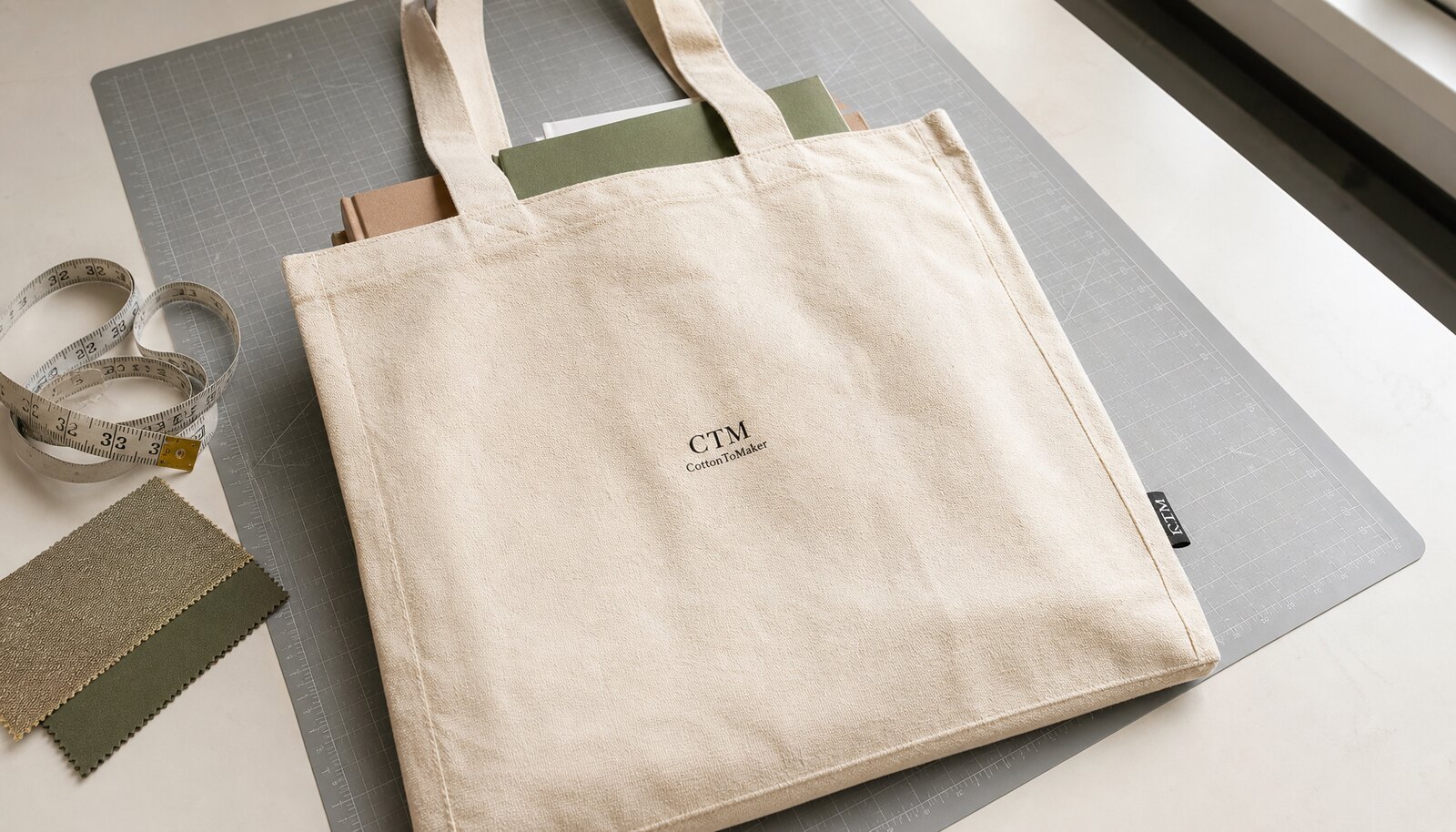
Start With the Hotel Workflow, Not the Tote Sketch
Canvas book fair totes for hotels are usually bought for a specific workflow: guests arrive, the bag is handed over, the guest loads books or event collateral, and the item leaves the property within hours. That sounds simple, but it changes the spec. A bag that looks fine on a design proof can become annoying if it is too floppy for a display table, too bulky for storage behind the front desk, or too weak to carry a stack of hardcovers.
Procurement teams get better quotes when they describe the actual path the bag will take. Is it a giveaway at a book fair, a conference handout, a retail item in the gift shop, or an amenity paired with literature in a guest room? Each use case changes the tolerable price, the packaging method, and the amount of finishing work the supplier should include. If the hotel team will unpack cartons on property, a flat-fold bulk pack is usually the cleanest option. If the tote will sit on a retail shelf, the packaging needs to do part of the selling.
- Name the distribution path: check-in handout, event table, gift shop shelf, or conference merch.
- State the load type: books, brochures, room collateral, or mixed items.
- Decide whether the bag needs to stand on a table or only function as a carry item.
Write the Finished Size and Construction Spec in Quoting Language
Most hotel book fair programs can start from a practical finished size around 14 x 15 x 4 in or 35 x 38 x 10 cm, with a handle drop near 9 to 10 in. That is large enough for books and brochures without turning into an oversized beach bag. For smaller collateral or a more compact amenity presentation, a 13 x 14 x 3 in format can work. If the tote is meant to be a stronger retail item, a deeper gusset and heavier handle can make it look more intentional without changing the logo.
The real value is in the tolerances. Buyers should not ask only for size; they should ask for the acceptable variance after sewing and trimming. A practical quoting target is +/- 0.5 in on finished body dimensions, +/- 0.25 in on handle length, and a clear print placement tolerance. Handles should also be specified by construction, not just length. Say whether the handle is cotton webbing or self-fabric, whether it is sewn into the side seam, and whether it uses an X-box, bartack, or double-row reinforcement. For canvas, stitch density is worth specifying too. A common target is 7 to 9 stitches per inch with even seam allowance and no puckering at the top edge.
- Quote finished dimensions and acceptable tolerance, not just the nominal size.
- Specify handle width, handle drop, attachment method, and reinforcement pattern.
- Ask the factory to confirm the cut size before sewing so the approved sample matches production.
Use Fabric Weight, GSM, and Finish to Match the Load
Canvas buyers often talk in ounces while factories talk in GSM. The conversion matters because a number that sounds substantial in one system may not mean much in the other. As a rough guide, 10 oz canvas is about 340 GSM, 12 oz is about 407 GSM, 14 oz is about 475 GSM, and 16 oz is about 542 GSM. Those numbers are only a starting point. Weave density, yarn count, and finishing can make two bags with the same weight feel very different in the hand.
For hotel book fair totes, 10 to 12 oz usually covers standard use: books, brochures, and moderate daily handling. If the bag needs a more premium feel or must carry heavier hardbacks, 14 to 16 oz is safer, but it adds sewing effort, freight weight, and sometimes a stiffer drape than the hotel wants. Natural canvas is the easiest place to start if the artwork is simple. Bleached canvas can make logos read cleaner. Washed canvas softens the hand but can introduce size movement, so the buyer should ask whether the factory has already accounted for shrinkage or post-finish variation.
- 10 to 12 oz works for most hotel giveaway programs.
- 14 to 16 oz is better for premium resale or heavier loads.
- Ask whether the factory is quoting raw canvas, washed canvas, or finished canvas, because the price and dimensions can change.
Decide on Print, Labels, and Decoration Early
Decoration is not a cosmetic afterthought. It affects setup cost, lead time, and how carefully the factory can place the logo. For canvas book fair totes, one-color or two-color screen print is usually the most practical option when the artwork is simple. It keeps the print opaque, durable, and easier to repeat on reorder. A screen print quote should clearly state whether the setup charge is included, how many colors are covered, and whether color matching is to a sample, a Pantone reference, or factory standard ink stock.
Transfer print and digital print are useful when the artwork has gradients, small type, or a multi-color event graphic, but they should be chosen deliberately. They may be right for a short run or a launch event, yet the buyer should check how the print feels on canvas, how it wears under handling, and whether the factory can hold registration on a heavier fabric. If the tote also needs a side label, woven tag, or brand patch, that should be treated as part of the decoration spec. The print face, the label face, and the placement distance from the seam should all be locked before bulk cutting begins.
- Use screen print for simple logos and repeat orders.
- Use transfer or digital print only when the artwork complexity justifies the tradeoff.
- Define placement in numbers: distance from top edge, distance from side seam, and logo size in inches or millimeters.
Build the Packaging BOM and Carton Math Into the RFQ
Most tote problems in procurement show up after the bag is sewn. The carton is too heavy, the fold is inconsistent, the barcode is on the wrong face, or the hotel receives a pile of loosely packed bags that take too long to count. Packaging needs to be written as a bill of materials, not a casual note. At minimum, the RFQ should say whether each bag is flat-folded or stuffed, whether it gets a polybag, what warning text is required, whether there is an insert card or belly band, and what label goes on the polybag or master carton.
Carton math matters because it changes freight and receiving speed. If a tote is folded to about 14 x 11 x 0.25 in, the factory may fit 25 to 50 pieces per carton depending on fabric weight and whether accessories are included. The buyer should ask for carton dimensions, net weight, gross weight, and a packing list format. As a rule, hotel distribution is easier when cartons stay under a practical handling weight, often around 15 to 18 kg gross, unless the receiving team has pallet equipment and a warehouse process already in place. If the bags are going to a retail store, ask for shelf-ready packaging separately from bulk shipping packaging so the unit economics stay visible.
- Write the packaging BOM line by line: bag, polybag, label, insert, carton, and pallet if needed.
- Ask the factory to quote at least two pack counts so you can compare freight and handling cost.
- Request carton dimensions and gross weight before sample approval, not after production starts.
Use a Sample Plan That Proves the Bag Works in the Hotel Setting
A canvas tote should not be approved because it looks good on a desk. It should be approved because it works in the distribution path the hotel actually uses. The fastest way to test this is simple: load the sample with the real books or collateral the tote will carry, then look at the handle stretch, bottom sag, side seam twist, and how the bag folds back into the chosen pack format. That test often reveals whether the spec is too light, whether the gusset is too shallow, or whether the handle is placed too far inboard to feel comfortable.
The sample process should have stages. A swatch or material confirmation comes first. Then a pre-production sample proves the sewing method, print method, and packing method. A shipment sample then shows that the actual lot matches the approved version. Keep one sealed golden sample for future reorders and one working sample for field use or inspection. If the bag is for a hotel chain with more than one property, make sure the approval includes the exact logo version, tag version, and carton mark version so the reorder does not drift.
- Approve a material swatch before the factory cuts bulk fabric.
- Test the bag with the real load, not an empty tote.
- Keep a golden sample and a shipment sample for reorder comparison.
Compare Supplier Routes on Control, Not Only on Unit Price
A buyer-facing tote should be sourced by control level, not by the cheapest headline number. A direct canvas factory with in-house sewing and screen print usually gives the best visibility into fabric, stitching, and packing. That route is strongest when the buyer wants repeat orders, a stable spec, and reliable carton packing. A trading company can make the process easier if the hotel needs room collateral, lanyards, and tote bags in one shipment, but the added margin layers can hide where the real cost sits. Local decorators are useful when speed matters more than exact construction control, especially if the tote is already a stock body.
The quote itself should tell you which route you are dealing with. A useful supplier comparison separates bag cost, print setup, packing labor, carton cost, and freight assumptions. It also shows whether a price break comes from fabric weight, less labor, fewer colors, or a simpler pack format. If two suppliers quote the same bag size but one includes a thicker webbing handle, tighter stitch density, and retail-ready packing, the numbers are not directly comparable. Procurement should normalize the quote to the same spec before judging unit price.
- Use a direct factory when you need repeatability and line-level QC visibility.
- Use a trading company when consolidation is more important than factory transparency.
- Use a local decorator when the run is short and the timeline is tight.
Compare Quotes as a Landed-Cost Problem, Not a Bag Price Problem
For hotel tote programs, the bag price is only one part of the landed cost. Packing can add labor, cartons can add volume, and freight can outweigh a small fabric savings if the fold is inefficient. The cleanest comparison method is to ask each supplier for a quote at the same specification, then compare the total to your receiving point. That means bag cost, decoration, packing, carton, palletization if used, and the freight or incoterm basis the supplier is using. If one quote looks cheap because it excludes packing or uses a loose assumption on carton count, it is not a real comparison.
A practical RFQ should ask for three or four volume points. That shows where the meaningful cost break happens and whether a pilot order is actually expensive because of setup or because the spec is too elaborate. Buyers should also ask what changes on a reorder. Can the same screens be reused? Can the same carton artwork be reused? Can the supplier hold fabric lot consistency? If the answer is no, the first order may be cheap but the second order could drift in both color and cost. For hotel procurement, that is exactly the kind of hidden risk that makes repeat programs messy.
- Compare quotes on the same size, same fabric, same decoration, and same pack format.
- Ask for the landed cost to the receiving point, not just factory EXW price.
- Check whether setup, screens, labels, and cartons can be reused on reorder.
Put QC on Measurable Terms Before Production Starts
The most useful quality control plan for canvas book fair totes is specific enough to be followed by an inspector who never saw the original email. Start with the measurable items: finished size tolerance, handle length tolerance, stitch density, reinforcement pattern, print placement, and carton count. Then define the acceptable defect categories. Loose threads, oil marks, shade variation, seam puckering, skipped stitches, misregistered print, and wrong pack count should not all be treated the same. The hotel may accept a tiny cosmetic issue on a giveaway tote, but not a handle reinforcement failure on a retail-facing product.
Inspection should follow a sampling plan. AQL 2.5 major and 4.0 minor is a common starting point for non-critical textile goods, but a retail hotel shop may justify a tighter plan. If the bag includes hardware, zippers, or metal labels, note whether a needle-control pass is required before carton close. Ask for a carton drop or transit test on the packed shipment sample when the bags are moving through a warehouse or by parcel rather than direct pallet. The point is not to create paperwork. The point is to make the factory prove that the bag, pack, and carton can survive the actual route to the guest.
- Define major and minor defects before the PO is issued.
- Use AQL 2.5 major / 4.0 minor as a baseline, or tighten it for retail-facing stock.
- Require a packed carton test if the product will face warehouse handling or parcel transit.
Turn the RFQ Into a Buying File the Team Can Reuse
A good RFQ for canvas book fair totes should not be a paragraph of general questions. It should be a buying file the team can reuse for the next property, the next event, or the next seasonal refresh. The file should include the spec sheet, artwork file, packaging BOM, carton target, test requirement, sample approval record, and the landed-cost comparison. If those items are in one place, procurement can compare suppliers without re-interpreting the brief every time. That is especially useful in hotel groups, where one property may want a bulk giveaway while another wants the same bag with retail labeling and a different carton count.
The most practical RFQ language is direct. Ask the supplier to quote one exact specification, list every assumption, and separate optional upgrades from the base offer. That forces the quote to reveal whether the factory is charging for the real bag or for a loosely defined concept. It also makes reorders faster because the production file already exists. For a product like canvas book fair totes for hotels, that is the difference between a one-off purchase and a repeatable procurement item.
- Keep one spec sheet, one approved sample, and one quote comparison file.
- Separate base spec from optional upgrades so the landed cost stays readable.
- Store the exact artwork, carton mark, and pack format used on the approved order.
Specification comparison for buyers
| Sourcing route | Typical quote structure | Pricing drivers | QC tradeoffs | Lead time implications |
|---|---|---|---|---|
| Direct canvas factory with in-house sewing and screen print | Bag cost, print setup, packing labor, carton cost, and freight quoted separately | Fabric weight, cut efficiency, handle webbing, stitch time, print color count, and carton pack count | Best control over seam consistency and packing, but only if the spec is written clearly | Usually the most predictable for repeat orders once the fabric and screens are booked |
| Cut-and-sew factory that outsources printing | Sewing price from the factory, decoration price from a print partner, packing and cartons separate | Handoffs between vendors, screen or transfer setup, and extra handling between steps | More coordination risk because print placement and production timing can drift between vendors | Can be slower if print scheduling is not reserved early, especially on color-matched work |
| Trading company or sourcing agent | Single bundled quote, often with margin embedded across bag, packing, and freight | Volume spread, margin layers, and whether the agent can consolidate other hotel items | Convenient for mixed shipments, but line-level visibility into fabric and stitch control is weaker | Often flexible on paperwork, but longer to clarify if the quote is missing production detail |
| Local decorator or print shop | Bag or decoration quote, usually simple packing, often no carton engineering detail | Local labor, short-run setup, and whether the bag is stock or made to order | Fast and easy for small runs, but structure, seam strength, and carton consistency can vary | Shortest path for urgent events, but usually limited on volume and repeatability |
| Nearshore or domestic short-run maker | Higher unit labor, lower shipping complexity, easier sample loops, clear change control | Labor rate, material sourcing, and how much of the packing is manual | Usually stronger communication and faster sample approval, but higher landed cost | Shorter transit and simpler issue resolution can offset slower material sourcing in some cases |
| Material | 8-12 oz cotton canvas, 120-220 gsm cotton, recycled cotton, or blended fabric selected by use case and target price | Before price comparison | Different cloth weights, backing, or certification claims make quotes hard to compare | |
| Construction | bag size, gusset, handle drop, seam allowance, stitch density, reinforcement patch, and loading expectation | Before sampling | Weak stress points create returns and failed inspections | |
| Decoration | screen print, heat transfer, embroidery, woven label, or hangtag matched to fabric texture and brand durability needs | Before artwork approval | The wrong method can crack, bleed, pucker, or fail on the chosen fabric |
Buyer checklist before sampling
- State the hotel use case in one line: check-in giveaway, event handout, gift shop retail, or conference resale.
- Define finished size, gusset depth, handle length, and whether the dimensions are measured after sewing or after trimming.
- Quote fabric in oz and GSM where possible, and note the conversion target so procurement and factories are speaking the same language.
- Specify weave and finish: natural, bleached, dyed, washed, or coated canvas, plus whether shrinkage has already been accounted for.
- Lock handle construction: webbing width, sewn-in length, reinforcement style, seam allowance, and whether the handle sits inside or outside the side seam.
- State stitch expectations: stitch per inch range, topstitch rows, bartack length, and any minimum seam strength requirement.
- Define the decoration method, logo size, Pantone or spot color reference, placement from seam and top edge, and acceptable registration tolerance.
- Write the packaging BOM: 1 pc/polybag or no polybag, polybag thickness, warning text, insert card, belly band, barcode label, and tissue if used.
- Give the carton spec: pieces per carton, carton dimensions target, maximum gross weight, carton mark language, and whether palletization is required.
- Request sample stages: material swatch, pre-production sample, shipment sample, and a retained golden sample for repeat orders.
Factory quote questions to send
- What finished size do you recommend for this hotel book fair tote, and what cut size will you use before sewing allowance is added?
- What fabric weight in oz and GSM are you quoting, and what tolerance do you allow lot to lot?
- Is the canvas natural, bleached, dyed, or washed, and does the finish change after cutting or laundering?
- What handle width, handle length, and handle drop are included in the quoted price?
- How are the handles attached: side-seam insert, inside reinforcement patch, X-box stitch, bartack, or a combination?
- What stitch density do you run on this bag, and how many reinforcement rows are included at the stress points?
- Does the price include one-color screen print, two-color screen print, transfer print, or digital print, and what is the setup charge for each option?
- What are the artwork placement tolerances for print centering, top margin, and seam clearance?
- Can you quote bag only, bag plus polybag, bag plus insert card, and bag plus retail-ready labeling as separate lines?
- What carton pack count keeps the gross carton weight under our receiving limit, and what carton dimensions do you recommend?
Quality-control points to confirm
- Finished size matches the approved sample within +/- 0.5 in on body dimensions and +/- 0.25 in on handle length and print placement.
- Fabric weight matches the quote spec within the factory tolerance and the hand feel is consistent across the lot.
- Seam allowance is even, stitching does not wander, and the stitch density stays in the agreed range, typically 7 to 9 stitches per inch for canvas work.
- Handle attachment uses the approved reinforcement pattern, such as X-box or bartack, with no skipped stitches or loose ends at the stress point.
- Handle pull test meets the agreed working load without seam opening, with the factory and buyer aligned on the test method and duration.
- Print color, opacity, and placement match the golden sample, with no visible misregistration, ghosting, or ink bleed at the seam.
- No stains, oil marks, broken needles, loose threads longer than the agreed trim limit, or puckering along the top edge or gusset.
- If metal trims or zippers are present, needle detection or equivalent metal control is completed before carton close, and the record is kept with the lot file.
- Packed cartons pass the agreed drop or transit test, commonly an ISTA 1A-style or equivalent carton drop standard, with no open seams or carton failure.
- Carton count, master carton marks, barcode labels, and packing list quantities match exactly, with no mixed SKUs unless the RFQ allows it.