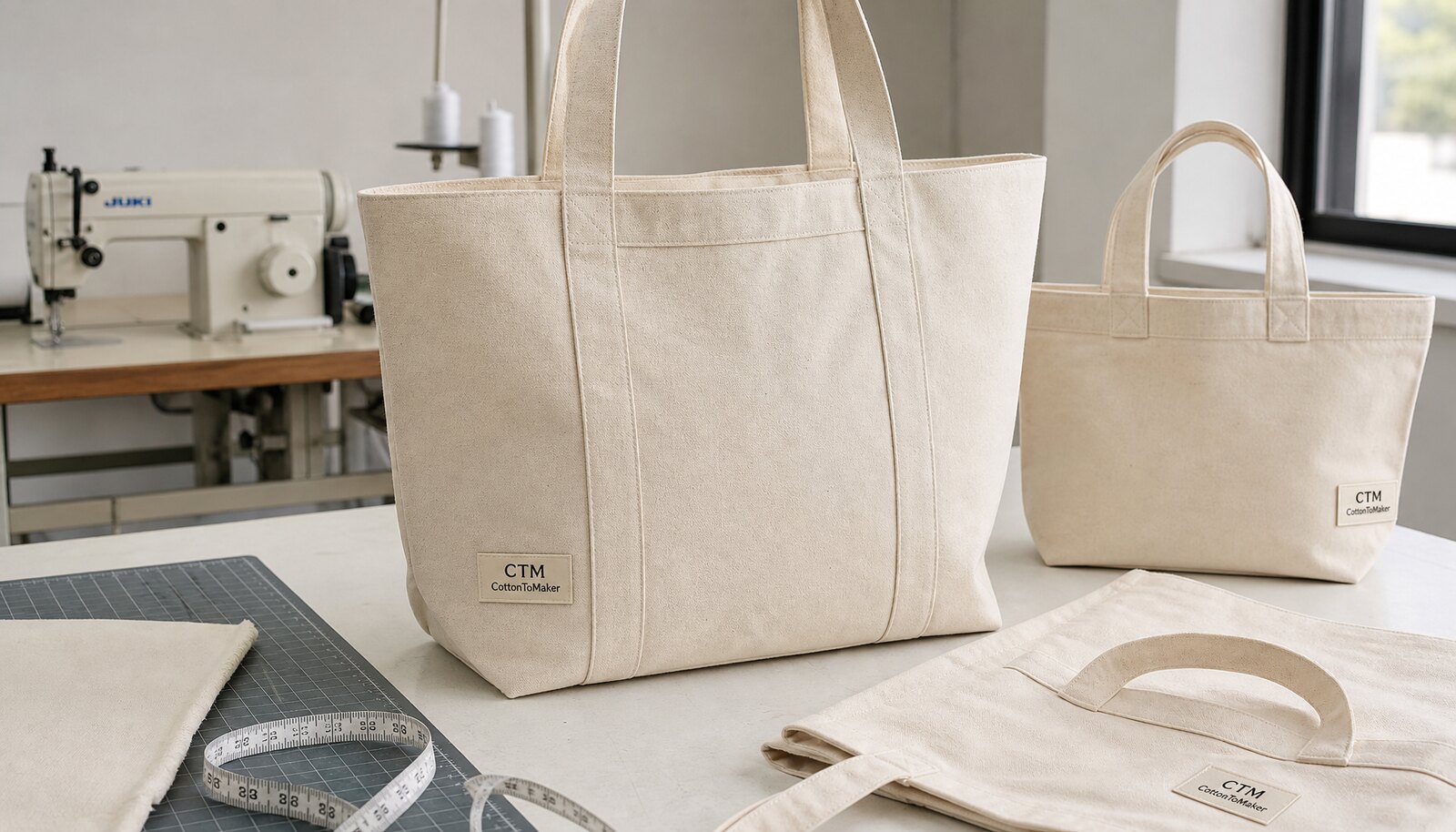
Why canvas book fair totes need a procurement spec, not just a design file
When ecommerce brands source canvas book fair totes for event giveaway planning, the first failure mode is usually not the tote itself. It is the spec. Buyers often approve a pretty mockup, then discover too late that the bag cannot hold books upright, the print breaks up on coarse canvas, or the finished cartons are too bulky for the freight plan. A tote for a book fair has to do several jobs at once: carry weight, look credible on a crowded table, print cleanly, pack efficiently, and survive handling by people who are not treating it gently.
The right procurement approach starts with use case. If the tote is only meant for a single-day giveaway, the buyer can optimize for cost and speed. If the same bag will also be used as retail merch, media kit packaging, or a long-tail brand item, the spec has to move closer to a commercial carry bag. That is where finish, stitch quality, and consistency matter more than a low quote. The more exact the use case, the less likely the supplier is to substitute a weaker fabric, thinner handle, or looser tolerance just to hit a price point.
- Start from the contents the tote must carry, not from the logo artwork.
- Treat fabric, handle, print, and packing as one linked spec.
- Assume the bag will be folded, stacked, and reopened multiple times before the event.
Set the tote size from the payload, not from a generic promo template
A useful canvas book fair tote is usually around 14 x 16 in. to 15 x 17 in., with a 3 to 5 in. gusset. That range gives enough room for paperbacks, hardbacks, a flyer stack, and a small sample pack without turning the bag into a rigid box. The gusset is not decoration. It determines whether the tote can stand open at a table, whether books sit flat, and how much the bag balloons when loaded. If the gusset is too shallow, the tote becomes book-shaped and awkward. If it is too deep, you may pay for extra fabric and freight volume you do not need.
Handle geometry matters just as much as the body size. For hand carry only, a shorter handle drop can reduce cost, but it also limits real-world use. For book fairs and ecommerce event giveaways, many buyers prefer a longer handle that still works over the shoulder after the bag is filled with books and inserts. Ask the supplier to state raw strap length, finished drop, strap width, and reinforcement method. A vague statement like 'long handle' is not enough to compare one supplier against another.
- For books and catalogs, confirm the usable internal width after seam allowance is deducted.
- For shoulder carry, verify handle drop with a loaded sample, not only on an empty bag.
- For dense giveaways, keep gusset depth high enough that the bag can stand without collapsing.
Fabric weight, weave, and finish should be chosen together
For this category, 12oz to 16oz canvas is the practical range, which is roughly 340 to 450 GSM depending on the mill and finishing method. Lighter canvas lowers cost and folds smaller, but it can look soft or flimsy when loaded with hardbacks. Heavier canvas feels more premium and usually handles load better, but it raises sewing difficulty, freight volume, and unit cost. Buyers should not treat weight as an isolated decision. The same fabric weight can feel very different depending on weave tightness, wash treatment, and whether the surface has been softened or brushed.
Finish is where many supplier comparisons become misleading. Natural canvas can vary from cream to ecru to a warmer beige tone, and dyed or washed canvas can show more lot-to-lot variation than buyers expect. If your brand requires consistent color, ask for a physical pre-production swatch and confirm whether the shade target is based on Pantone, a lab dip, or an approved reference sample. Also ask about odor control. A strong oil, dye, or finishing smell may not show up in photos, but it becomes a receiving problem and, in some cases, a customer complaint if the tote is distributed immediately at an event.
- 12oz or about 340 to 360 GSM: cost-conscious and suitable for lighter giveaway loads.
- 14oz or about 380 to 420 GSM: a balanced choice for most ecommerce event programs.
- 16oz or about 430 to 450 GSM: better for premium feel, heavier books, or resale use.
- If the fabric is washed or softened, clarify whether the quoted weight is before or after finishing.
Compare print methods by artwork, durability, and inspection risk
Screen printing is usually the best fit for simple logos, one or two spot colors, and repeat event orders. It gives strong opacity on natural canvas and a clean brand read from a short distance. The limitation is flexibility. Every extra color, oversized graphic, or design change adds setup complexity, and fine text can fill in if the canvas surface is too rough. If the artwork includes tiny legal copy, thin lines, or a QR code, ask the supplier to show a print proof at actual size before you approve production.
Heat transfer and digital methods are more useful when the artwork is complex, the order is short-run, or the campaign changes frequently. They are also practical when a buyer wants variable data, regional versions, or a more photographic look. The buyer tradeoff is durability and feel. On some canvas surfaces, these methods sit more visibly on top of the fabric, which can make the tote feel less integrated. If print durability matters, ask the supplier how they test cracking, color bleed, and abrasion after folding and rubbing. A good sample should be judged after the tote has been opened, folded, and loaded a few times, not only when it is fresh out of the bag.
- Screen print: best for stable logos, bold type, and higher volume.
- Digital or transfer: best for detailed art, variable messaging, or short runs.
- Always confirm print size, location, and edge distance in inches or cm.
- Ask for an actual print proof on the same canvas type used for bulk, not on a substitute fabric.
Use a supplier comparison that separates factory capability from price
The comparison table below is meant to help procurement teams compare sourcing routes, not just unit prices. For canvas book fair totes, the supplier type changes the risk profile. A direct factory may give better control over cutting, stitching, and packing, while a trading company may offer flexibility across multiple SKUs or delivery destinations. A domestic decorator can be a sensible choice when time is tight, but the buyer should expect a higher unit cost and fewer fabric options. The right choice depends on which constraint matters most: lead time, cost, quality control, or customization.
A strong sourcing decision comes from asking how the order will move through the supply chain. Who buys the fabric? Who prints it? Who confirms the finished bag against the signed sample? If the answer is scattered across three vendors, the buyer should expect more variance and slower problem resolution. For a book fair program, that can be acceptable if the date is flexible. For a fixed event launch, it is usually a mistake.
- Compare suppliers on process control, not only on quoted unit price.
- Ask for the exact production path from fabric to final carton.
- Keep one signed reference sample tied to the quotation version.
Ask quote questions that expose hidden cost and delivery risk
A good RFQ for canvas totes should let the supplier quote one comparable product, not a guess. Buyers should define size, fabric weight, finish, print method, handle spec, packing format, and delivery term before asking for price. Then ask the supplier to break the quote into base bag, decoration, packaging, and logistics. That separation makes it easier to see where one offer is cheaper because it excludes a color, a packing step, or a carton standard the buyer actually needs. It also helps procurement negotiate from facts instead of comparing loosely similar offers.
The most useful follow-up questions are the ones that force precision. Ask what tolerance the factory uses for dimensional variance. Ask how defects are classified and who signs off on the acceptance sample. Ask whether the quotation is based on EXW, FOB, CIF, or delivered terms, because that changes who pays for inland freight, export handling, and the ocean or air leg. Ask whether the factory can hold reorder stock or fabric reservation if the event program has a second drop. These are the details that protect the buyer after the first PO is approved.
- Confirm Incoterms and what costs are included at that term.
- Ask for a defect standard in writing, ideally with major, minor, and critical examples.
- Request carton math: dimensions, count per carton, gross weight, and estimated carton total.
- Confirm whether a reorder can reuse the same tooling, print screens, or setup files without extra charges.
Sample approval should test fit, print, and failure modes
A tote sample should be treated as a production gate. Measure the sample against the approved dimensions, not a rough visual estimate. Check handle length, gusset depth, body width, seam allowance at the side and bottom, and print placement from the edge. Then load the bag with the actual books, catalogs, or sample pack you plan to hand out. This is the fastest way to see whether the tote sags, tips over, or makes the handles dig uncomfortably into the hand or shoulder. If the bag is for ecommerce resale as well as giveaways, test whether it keeps its shape after a few folds and does not look wrinkled or tired too quickly.
Sample review should also cover surface and smell. Canvas can carry finishing residue, dye smell, or dust from cutting and packing, and those issues are easy to miss in a photo. Check for rough edges where stitching starts and ends, loose threads, puckering around the handle joins, and weak corners where the bag is most likely to fail under load. If the supplier offers multiple sample rounds, keep the first approved sample sealed and labeled as the reference standard. That reference matters when a bulk shipment arrives and the buyer needs to prove whether the run matches the approved sample.
- Measure the actual bag and compare it line by line with the spec sheet.
- Load test with the real event contents, not a generic weight guess.
- Inspect print clarity at the same viewing distance used on the event floor.
- Keep one reference sample on the buyer side and one with the factory.
QC should focus on load points, print durability, and carton accuracy
The biggest tote failures are usually mechanical, not cosmetic. Handles separate at the attachment point, corners distort under weight, or seams open where the gusset meets the body. That is why QC should pay special attention to stress points. Ask the supplier what stitch pattern they use at the handle joins, how many reinforcement passes are applied, and whether the thread tension is checked during production. A clean tote with weak reinforcement is not a finished good for procurement purposes; it is a hidden return risk.
Print durability deserves the same seriousness. Buyers should ask how the factory checks for smear, crack, and color transfer after folding. If the order uses a one-color screen print, ask whether the ink is cured enough to resist light rubbing without leaving residue. If the order uses a more complex digital or transfer process, ask how edge lift and surface tack are controlled. Finish the QC review at the carton level. Verify the SKU, print version, and count in each carton, and confirm that mixed lots are not shipped unless the PO explicitly allows it.
- Check handle symmetry and reinforcement before approving bulk release.
- Review seam behavior at the bottom and gusset after the bag is loaded.
- Confirm print does not smear, crack, or transfer under routine handling.
- Verify carton count, label accuracy, and lot separation before shipping leaves the factory.
Packing and freight planning can change the landed cost more than the tote itself
Canvas totes are bulky, so packing format has a direct effect on landed cost. Flat packing usually gives the best carton density for event giveaways and makes warehouse receiving faster. Individual polybags may be useful if the tote will be resold, inserted into a premium kit, or stored in a retail environment where presentation matters. But every extra layer of packaging adds labor, carton volume, and sometimes moisture-management risk if the goods sit in transit for long periods. The right packing format depends on the distribution path, not the factory's default habit.
This is also where carton math matters. Ask for units per carton, carton size, gross weight, and whether inner bundles are used. Small changes in folded width or handle orientation can affect how many units fit in a carton, which then affects pallet count, freight class, and warehouse handling time. For large event programs, ask the supplier to show the carton plan before packing starts. A quote that ignores carton structure may still look competitive on paper, but it can be more expensive once shipping and storage are added.
- Flat pack is usually the best option for event giveaway efficiency.
- Retail-style packing is acceptable when presentation matters more than freight density.
- Confirm carton markings, SKU separation, and whether mixed print versions are allowed.
- Request a simple carton packing diagram if the order is split across multiple delivery points.
Build a reorder and approval plan before the first order ships
For ecommerce brands, the first tote order is often only part of the real demand. Event schedules change, regions reorder at different speeds, and a product that performs well at a book fair may need a second run for a launch campaign or trade show. That is why the buyer should ask the factory to protect the approved spec, print files, and setup settings for the next order. If the supplier treats every repeat order as a new project, the buyer loses both time and consistency. Reorder protection is especially important when the tote has a branded label, a custom finish, or a limited-run campaign graphic.
A practical reorder plan should also define when the buyer can reorder from stock and when a fresh production run is required. If the program needs exact shade matching or the same carton configuration, the buyer should keep those details tied to the original sample approval. If the event calendar is seasonal, the buyer should reserve extra fabric or at least confirm the mill can repeat the same cloth construction later. For procurement, the win is not just getting the first shipment out the door. It is being able to reproduce the bag without rebuilding the spec from zero.
- Keep artwork, measurements, and approved sample photos tied to one version-controlled spec.
- Reserve the right to reorder the same construction without reopening the entire sourcing process.
- Confirm whether the factory can hold fabric, screens, or digital files for the next run.
Specification comparison for buyers
| Sourcing choice | Best fit | Main tradeoff | Buyer control to request |
|---|---|---|---|
| Direct factory with in-house sewing and printing | Repeat event programs, stable artwork, and buyers who need tighter control over stitch quality and carton packing | Usually stronger process visibility, but MOQs and lead times can be less flexible | Ask who owns cutting, printing, sewing, packing, and final inspection under the same PO |
| Trading company or sourcing agent | Mixed programs, multiple sizes or colorways, and buyers who need consolidation across suppliers | Can simplify purchasing, but may hide where quality responsibility sits | Ask for the named factory, sample provenance, and who signs off on defect claims |
| Domestic decorator or regional printer | Very short lead times, local event dates, or small urgent replenishment runs | Often higher unit cost and less fabric choice than offshore supply | Request the exact base tote spec, print method, and carton count before comparing pricing |
| Factory with pre-made blank stock | Rush orders where the same tote shape can be decorated quickly | Fast production, but less flexibility on size, fabric weight, or handle spec | Confirm blank stock lot, fabric GSM, and whether decoration is done before or after the blank is approved |
| Cut-and-sew custom tote program | When the brand needs a custom size, gusset, finish, or label placement for premium resale use | Highest control, but the most sampling steps and the highest chance of timeline drift | Lock a signed specification sheet and require a production sample before bulk release |
| Material | 8-12 oz cotton canvas, 120-220 gsm cotton, recycled cotton, or blended fabric selected by use case and target price | Before price comparison | Different cloth weights, backing, or certification claims make quotes hard to compare |
| Construction | bag size, gusset, handle drop, seam allowance, stitch density, reinforcement patch, and loading expectation | Before sampling | Weak stress points create returns and failed inspections |
| Decoration | screen print, heat transfer, embroidery, woven label, or hangtag matched to fabric texture and brand durability needs | Before artwork approval | The wrong method can crack, bleed, pucker, or fail on the chosen fabric |
Buyer checklist before sampling
- Final tote dimensions, gusset depth, and handle drop are matched to the books, catalogs, inserts, or sample packs you will actually hand out.
- Fabric specification is written in GSM or oz, and the buyer has confirmed whether the number refers to raw fabric, washed fabric, or finished fabric.
- Canvas finish is defined: natural, bleached, dyed, washed, or softened, with any expected variation in shade or surface texture noted in advance.
- Logo method, print size, print placement, and approved artwork file format are all fixed before sampling begins.
- Handle construction includes width, length, stitch pattern, reinforcement points, and seam allowance or seam wrap details where relevant.
- An acceptance standard is written for print registration, fabric cleanliness, odor, seam integrity, dimensions, and acceptable color variation.
- Packing format is specified: flat pack, folded with tissue or insert, polybagged, carton count, barcode label, and master carton marking.
- Freight planning includes carton size, gross weight, pallet plan if needed, delivery location, and an allowance for reorders or event-date changes.
Factory quote questions to send
- What is the exact canvas weight in GSM or oz, and is that before or after washing, softening, or coating?
- What finish is included in the quote, and how much shade variation should we expect between lots of natural or dyed canvas?
- How are the handles built, what width are they, and is reinforcement done with a box stitch, bar tack, or box-X stitch?
- What seam allowance do you use on the body panels, and are stress points reinforced at the gusset and handle joins?
- Which print method is included, what is the maximum number of colors covered, and how do you price extra print locations or oversize artwork?
- What are the accepted tolerances for size, print placement, and shade variation, and can you state them in writing on the quotation or spec sheet?
- What is your MOQ by color, print version, and packing style, and can one artwork be split across multiple event dates or delivery addresses?
- What sampling stages do you offer, what is the sample cost, and which sample becomes the production reference after sign-off?
- What is the expected AQL or equivalent defect threshold for bulk inspection, and how are major, minor, and critical defects defined?
- What are the carton dimensions, units per carton, gross weight, and estimated carton count for the quoted quantity?
Quality-control points to confirm
- Fabric weight matches the approved reference and stays within the agreed tolerance across the batch.
- Canvas shade, weave, and surface finish are consistent enough that one lot does not look visibly different from the signed sample.
- Handles are symmetrical, securely attached, and reinforced at the load points without skipped stitches, loose threads, or puckering.
- Seams are straight, the gusset is even, and the bag opens cleanly instead of twisting or collapsing under normal use.
- Print placement is centered within tolerance, with clean edges, no obvious bleeding, and no cracking or tacky feel beyond the approved method.
- The bag passes a practical load test using the actual books or giveaway contents planned for the event, not a generic placeholder weight.
- Finished bags are free from oil marks, loose fibers, broken stitches, hard creases, and any odor that would trigger a customer complaint.
- Cartons match the PO by SKU, print version, and count, with no mixed lots unless the buyer has approved carton-level assortment.
- Packing is consistent enough that the receiving team can count, verify, and distribute units quickly at the event or warehouse.
- AQL sampling, if used, is tied to named defect types and not left as a vague supplier promise.