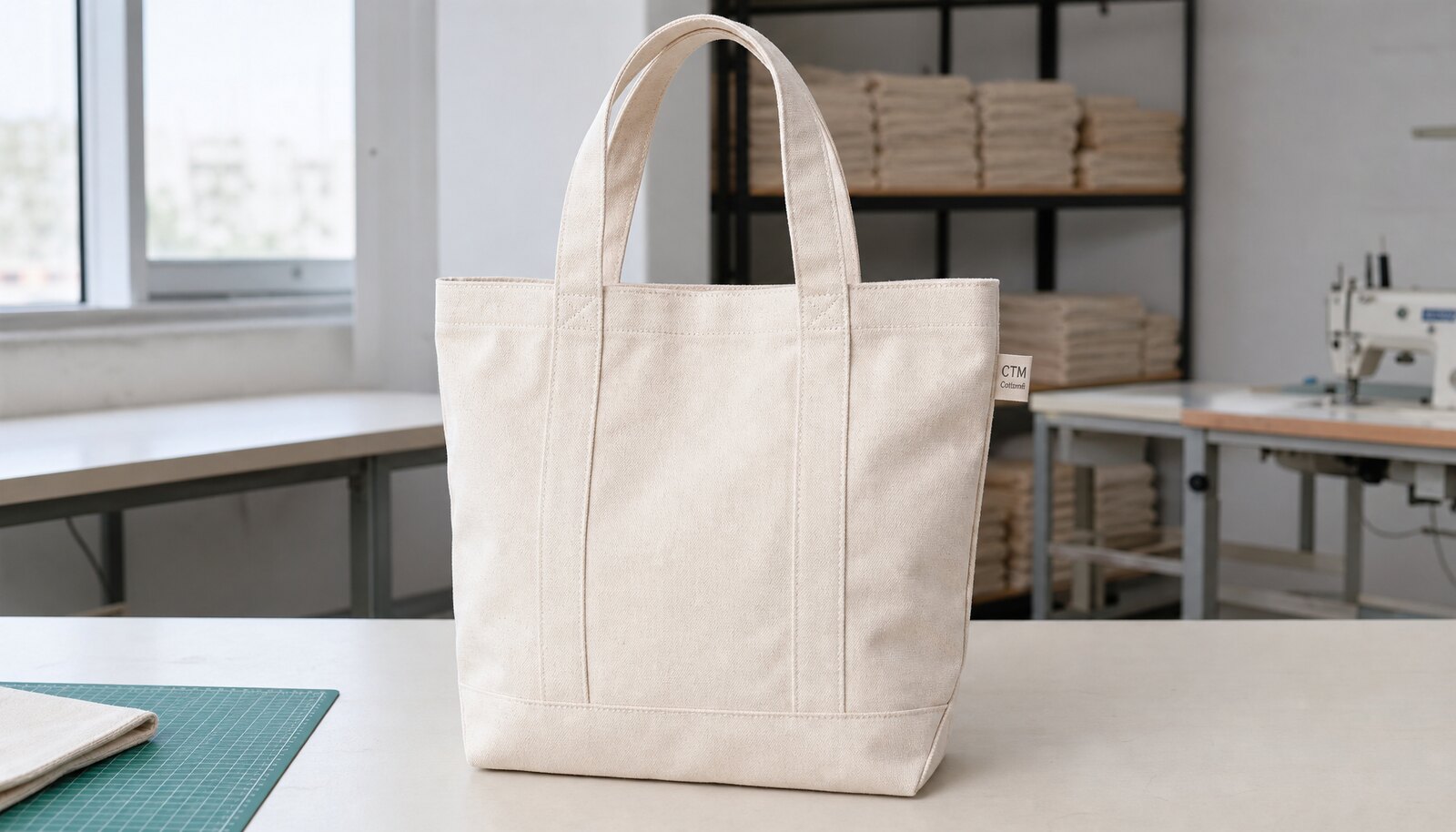
Start With the Tote's Job, Not the Quote
A canvas book fair tote for a cosmetic brand is not just a cheap carry bag. It may hold brochures, boxed skincare, tester kits, event handouts, or retail purchases, and the use case changes almost every line in the quote. If the bag only needs to hand out a sample card and a lightweight brochure, the factory can justify a lighter build. If it has to carry books, boxed product, or a multi-item press kit, the same quote becomes the wrong benchmark.
That is why procurement should write the RFQ around function first. State the finished size, gusset depth, handle drop, typical contents, and the maximum loaded weight the bag must survive without seam failure or obvious distortion. If the bag needs to stand upright for display, say so. If it must fit inside a kit box or shipping carton, include those dimensions too. The factory should not be guessing whether this is a giveaway tote, a retail accessory, or an event workhorse.
For cosmetic brands, the presentation expectation is often higher than for a generic promo tote. The bag sits next to packaging that has already been designed to look clean and intentional. That means the tote cannot arrive with warped seams, ugly print placement, or a body shape that collapses before it reaches the customer. A good RFQ makes that visible up front, which helps the supplier price the right material and construction instead of underquoting a weak version.
- Useful brief items: finished size, gusset width, handle drop, max load, print area, and delivery port.
- If the tote will be filled with product, specify the heaviest typical pack-out, not the lightest one.
- State whether the tote is for one-time event use or repeated consumer reuse, because that changes the acceptable build quality.
Choose Fabric Weight by Load, Hand Feel, and Presentation
For canvas totes in this category, the first pricing mistake is to choose fabric weight by habit. Lightweight 8 oz canvas can work for very short-life promotional use, but many cosmetic buyers move to 10 oz or 12 oz because the bag needs a cleaner hand feel, more body, and better visual structure. In GSM terms, those ranges are often used as a buying shorthand, but the exact numbers vary by weave, yarn count, finishing, and supplier method. Treat any GSM suggestion as a starting point, not a universal rule.
The quote should name the fabric in a way a factory can actually source and inspect: weight in oz or GSM, weave type, natural or bleached finish, whether the cloth is pre-shrunk, and whether the bag is meant to be washed or only dry-wiped. If the supplier cannot define the fabric clearly, they can usually substitute a cheaper cloth that looks similar in a photo but behaves differently in hand or after sewing. That is how buyers end up with a bag that passes the picture test and fails the retail test.
There is also a tradeoff that procurement teams should not ignore. Heavier fabric improves structure, but it raises material cost, can slow sewing, increases freight weight, and may require stronger handles or wider seam allowances. A 12 oz bag is not automatically better than a 10 oz bag if the end use is a light event handout. What matters is the match between contents, appearance, and cost tolerance. The best quote is the one that states those assumptions openly.
- 8 oz or roughly 270 GSM: light giveaways and short-life event use, but verify opacity and seam behavior carefully.
- 10 oz or roughly 340 GSM: common floor for book fair totes, retail inserts, and cosmetic brand event bags.
- 12 oz or roughly 400 GSM: better for heavier contents, premium feel, and repeated consumer reuse.
- Ask whether the fabric is pre-shrunk or stabilized; if not, note the expected tolerance after humidity exposure or handling.
Normalize Quote Inputs Before You Compare Any Price
A tote quote is only useful when the buyer has normalized the same assumptions across every supplier. The apparent unit price is made up of fabric consumption, cutting waste, sewing labor, handle material, print setup, packing, labeling, carton cost, and the amount of handwork needed to keep the bag consistent. If one supplier bundles all of those items and another shows only a naked ex-works unit price, the comparison is already distorted.
This is where procurement should force a clean line-item structure. Ask for separate pricing for fabric, handles, print setup or screen charges, packing, sample fees, and any carton marking or barcode work. If the supplier uses optional adders, those should be visible in the same quotation rather than hidden in email follow-up. A quote that does not disclose its assumptions creates commercial risk because the final invoice will expose the missing pieces later.
The most practical way to compare offers is to normalize them to the same spec sheet and the same commercial terms. That means the same finished size, same fabric weight, same print method, same packaging, same delivery point, and the same Incoterm. EXW often looks cheaper because it excludes export handling. FOB may appear higher because it includes more work at origin. Neither is inherently better. The right comparison is the landed cost into your warehouse or distribution center, adjusted for packaging and likely rejects.
When buyers skip normalization, they often reward the quote that is most incomplete. That is not a sourcing win; it is a reporting error.
- Ask for separate lines for fabric, handles, print setup, packaging, and sample fees.
- Use the same finished size, artwork version, carton plan, and Incoterm across all quotes.
- Convert all offers to landed cost before selecting a supplier.
- If the supplier offers optional upgrades, keep them visible so later change requests can be priced quickly.
Evaluate Supplier Route by Capability, Traceability, and Control
Not every supplier route creates the same sourcing outcome. Factory-direct sourcing is usually the strongest fit when the tote needs custom dimensions, repeat orders, and controlled decoration, because the buyer wants one production owner for sewing, printing, packing, and final release. A trading company or sourcing agent can still be useful if your team needs one contact across multiple categories, but the buyer must know who actually owns the line and who signs off on quality. If the answer is vague, the quote is carrying hidden execution risk.
The deeper due diligence is simple but often skipped. Ask for current photos of the sewing line, cutting tables, printing area, and final packing station. Ask whether the sample was made on the same line that will run bulk production. Ask how materials are received, inspected, and approved before they enter production. A supplier that cannot answer those questions cleanly may still be able to make the tote, but the buyer should treat the quote as higher risk and price that risk accordingly.
For procurement teams, the key question is not only 'Can they make it?' but 'Can they make it repeatedly to the same standard?' That is especially important for cosmetic brands, where campaign timing and presentation consistency matter. If the supplier cannot show traceability from fabric to finished carton, the buyer may have to absorb more inspection effort, more sample cycles, and more rework on the back end.
In practice, capability should be judged across four points: fabric control, sewing consistency, print control, and packing discipline. A supplier weak in one area can still be useful for a one-off, but for repeat branded programs, the weakest point tends to become the reason the shipment is delayed or rejected.
- Look for evidence of in-house cutting, sewing, printing, and final packing.
- Ask who approves incoming fabric and what happens if the cloth fails weight or appearance checks.
- If the supplier avoids plant details, assume the quote has hidden execution risk.
- Prefer suppliers who can show traceability for sample, bulk, and carton release.
Match Print Method to Artwork, Surface, and Acceptable Risk
Screen printing is usually the default choice for a cosmetic brand logo on a canvas book fair tote when the artwork is simple, bold, and limited to one or two colors. It tends to be more cost-effective for repeat programs and gives predictable coverage on natural canvas. But 'default' is not the same as 'automatic.' The buyer still needs to define whether the print is meant to be soft-hand, opaque, centered, and resistant to rubbing during distribution.
Heat transfer or transfer print can be practical for short runs, gradients, or artwork that does not suit screen setup. The tradeoff is that the finish often behaves differently in handling and flexing, so the quote should make clear what kind of transfer is being used, how it will be tested, and whether the edge finish is acceptable for a retail-facing bag. Buyers should not assume all transfer methods perform the same way.
Embroidery is usually not the first choice for a large tote face because it adds cost, weight, and potential distortion of lighter fabric. It can still be useful as a small premium mark on a patch, but procurement should not allow a decorative idea to override production logic. If the art has fine type, gradients, or a very large solid block, ask the supplier to confirm which method they recommend and why. The factory answer should be tied to printability, durability, and cost—not just to what they happen to have in-house.
The critical quoting discipline is to send vector artwork and specify the exact print area. Also define Pantone targets where color matching matters, and ask the factory to confirm whether the fabric base will influence color appearance. On natural canvas, the same ink can look warmer or duller than it does on coated material. That should be part of the approval, not a surprise after bulk production.
If the tote is premium-facing, it may be smarter to keep the decoration simple and spend the budget on cleaner stitching, better handles, and tighter finishing. Not every bag needs full-panel decoration to look good. Sometimes a woven side label, a sewn patch, or a crisp one-color mark gives the brand a better result at a lower execution risk.
- Use screen print for simple logos and repeat orders.
- Use transfer methods only when the artwork requires them and the bag can tolerate the finish.
- Keep text away from seams, gussets, and top edges so registration stays clean.
- Ask the factory how they cure or set the print and how they check adhesion before packing.
- For premium-facing programs, consider a woven label or sewn patch instead of a heavy full-panel design.
Turn Samples Into an Approval Tool, Not a Courtesy Stage
A photo approval is not enough for a custom canvas tote. The buyer should request a pre-production sample made from the same fabric, same handle build, and same decoration method that will be used in bulk. The sample exists to prove that the factory can translate the spec into a repeatable product. If the supplier sends a different cloth, different handle tape, or a print that is only 'close enough,' the sample has not actually de-risked the order.
Once the sample arrives, use it like a measurement and quality reference, not like a decorative object. Measure the body width, body height, gusset, handle drop, top-edge alignment, and print placement against the tech pack. Check the symmetry of the handles. Open and close the tote several times. Load it with a realistic pack-out and see whether the seams distort, handles twist, or the top edge buckles. For a brand-facing tote, that physical test matters more than a nice-looking photo.
The buyer should also inspect finish details that are easy to miss in a digital review: lint, oil spots, loose threads, chalk marks, seam waviness, crooked prints, and fabric contamination. If the sample uses heat transfer, flex the printed area to see whether edges lift or crack. If the sample uses screen print, check whether coverage is even and whether the ink sits cleanly on the weave without feathering. Cosmetics buyers should be especially careful here because the tote may sit beside premium product packaging and must look clean from the first touch.
Keep one approved golden sample and label it clearly. That sample should be used as the visual and dimensional reference for bulk inspection. If the factory changes anything after approval, the buyer needs a formal re-approval step, not an informal 'it will be the same' assurance.
A good sample process is not about being difficult. It is about reducing the chance that the first 5,000 pieces reveal a problem that the sample should have caught.
- Measure the sample against the tech pack, not against memory.
- Approve one golden sample and keep it as the bulk reference.
- Reject any sample that shows mismatch in print placement, seam balance, handle symmetry, or body dimensions.
- Load-test the sample with a realistic product bundle before approving bulk.
Write QC Criteria the Factory Can Actually Inspect Against
QC language such as 'small production variance' or 'properly finished' does not help a factory, a third-party inspector, or your internal team. The order needs measurable acceptance criteria. Start with the dimensions that matter most: finished height, width, gusset, and handle drop. Define the acceptable tolerance range for each. Buyers do not need to invent a perfect industry standard for every tote, but they do need a stated window that is tight enough to matter and broad enough to be realistic for mass sewing.
Next, define the stitching standard. The tote should have even stitch lines, no skipped stitches, no open seams, no broken thread at stress points, and no loose ends hanging at the handle joins or top edge. The handle attachment should be reinforced in a visible and repeatable way, such as bar-tacks or an equivalent construction detail, and the buyer should request a reference photo or sample annotation so the factory knows what is acceptable.
Print QC must be equally concrete. Specify placement tolerance, the acceptable color target method, and which print defects are major versus minor. For example, off-center placement, smearing, or obvious misregistration should be treated as rejectable. Light texture variation on a natural substrate may be acceptable if the artwork remains clean and readable. But the inspection rule should be written before the bulk order, not negotiated after defects appear.
For many tote programs, AQL-based inspection is the most practical way to structure the release decision. The key is not the acronym itself; it is the discipline. State the sample size basis, the defect classification, and the quality threshold that the shipment must pass. If your team uses a third-party inspector, give them a checklist that covers fabric, sewing, print, odor, carton counts, labels, and packaging. Without that list, inspection often becomes subjective and inconsistent.
Cosmetic brands should also treat cleanliness as a quality criterion. A tote with lint, dust, oil marks, or chemical smell may be technically usable but commercially wrong for a brand-sensitive launch. The same is true for carton integrity. If the product is moving through warehouse handling, master cartons should be strong enough to survive stacking, corner contact, and normal transit without crushing the bag or scuffing the print.
- Define tolerances for width, height, gusset, handle drop, and print placement.
- Use AQL or an equivalent inspection framework and state the defect threshold in the RFQ.
- Classify defects as critical, major, and minor before production starts.
- Inspect stitching, print quality, odor, labels, carton count, and carton condition before release.
- Add a simple loaded-bag test and carton drop or compression check for route-sensitive shipments.
Specify Packing So the Tote Arrives Usable, Not Just Shipped
Packing is a sourcing decision, not just a logistics detail. Flat-packed bags are usually more freight-efficient and often appropriate when the shipment is heading to a warehouse, distribution center, or kitting facility. Individual polybags can protect the print and create a cleaner retail presentation, but they add labor, material cost, and cube. The right answer depends on where the bags go next, not on what the supplier prefers to do by default.
The quote should spell out the packing structure in measurable terms: how many units per inner pack, how many per master carton, whether polybags are included, whether labels are applied to the bag or carton, and what carton marks will appear. Buyers should ask for gross weight, carton dimensions, and carton count because those details affect freight, warehouse handling, and receiving efficiency. If a carton is too heavy or the label layout does not match your receiving system, the supply chain cost rises even if the unit price looks fine.
A practical buyer should also think about abrasion and compression. Canvas can hold up well, but printed surfaces can scuff if bags are packed too tightly or if rough carton surfaces rub against the print. If the shipment will travel a long distance, pass through humid storage, or be handled multiple times before use, the packing method should protect the visible surface as much as possible. That may justify a better insert, a cleaner fold, or a more rigid carton than the lowest-cost option.
This is also where brands can avoid unnecessary surprises in downstream operations. If the tote is going into a campaign kit, the fold direction, pack count, and barcode format should match the kitting line's requirements. If it is going straight to retail, the outer presentation matters more. The quote should tell the supplier what the receiving team needs, not just what the freight forwarder can move.
- Flat-pack the tote unless the retail plan requires a different presentation.
- Use barcode labels and carton marks that match your receiving system.
- Keep carton weights manageable so warehouse handling does not damage the goods.
- Ask for a carton sample photo or packed-carton dimension confirmation before bulk release.
Use Lead Time as a Controlled Workflow, Not a Promise
Lead time on a tote order is usually more about workflow control than sewing speed. The schedule passes through artwork lock, material confirmation, sample production, sample feedback, bulk cutting and sewing, print curing or finishing, packing, and freight booking. If the supplier gives a fast date without confirming fabric availability and print capacity, the date is aspirational. It is not a manufacturing commitment.
For a cosmetic brand launch, the buyer should build in time for revision. That does not mean padding every milestone blindly. It means understanding that one changed artwork detail, one handle change, or one packing correction can force a new sample or a new setup. Lead time assumptions should be written in the RFQ: when the clock starts, what counts as approval, and which changes reset the schedule. Otherwise, the delivery date becomes a moving target that no one owns.
The practical sourcing move is to ask the factory what they need to begin without delay. In many cases, production cannot truly start until fabric is reserved, the print method is confirmed, and the sample has been approved. If any of those are outstanding, the quote's delivery promise should be treated as provisional. For buyers under launch pressure, that distinction matters more than a small unit-price difference.
A realistic timeline also depends on order complexity. One color, one artwork, one carton plan, and standard packing are easier to manage than a multi-SKU set with different print positions or retail packaging requirements. The more variants the program has, the more likely the lead time will extend. That is not a failure; it is normal production logic. The buyer's job is to surface those variables before award.
- Lock artwork before you start sample approval.
- Do not award the order until the supplier confirms material availability.
- State which event resets the clock: artwork change, sample revision, or packing revision.
- Use a schedule buffer if the tote must arrive before a launch, trade show, or seasonal retail date.
Compare Quotes by Landed Cost, Risk, and Rework Exposure
The final decision should not be based on the lowest unit price alone. A good procurement comparison includes landed cost, freight assumptions, packaging, expected reject rate, and the cost of rework if the first bulk run misses the mark. One quote may be cheap because it excludes sample charges or assumes simpler packing. Another may look more expensive but already includes carton labels, polybags, export packing, and more disciplined inspection. Those are not equivalent offers.
To compare fairly, build a side-by-side matrix with the same inputs: same tote size, same fabric, same decoration, same packing, same Incoterm, same delivery destination, and same sample requirement. Then normalize each offer to the same landed cost basis. That means adding freight, duty or tax where relevant, and any known origin charges that your internal team would otherwise have to absorb. It also means including the cost of supplier uncertainty. A supplier with a slightly higher quote but stronger traceability and cleaner sample control may produce the lower true cost if it saves one reprint or one delayed shipment.
Buyers should also pay attention to how the quote is written. If the supplier clearly identifies setup fees, secondary charges, and optional costs, they are usually easier to manage during execution. If the quote is vague and the supplier answers questions only after you ask, the order may still be viable, but procurement should assign it a higher oversight burden. That time cost is real and should be part of award thinking.
A useful internal rule is this: do not award until you can explain why the winning quote is the best landed-cost and risk-adjusted choice, not merely the cheapest one. That is the standard that stands up in sourcing reviews and keeps the tote program from becoming a hidden margin leak.
- Compare offers only after normalizing spec, packing, delivery point, and Incoterm.
- Include freight, duty or tax, sample fees, and likely rework cost in your landed-cost view.
- Treat incomplete quotes as higher risk, even if the unit price is lower.
- Use a side-by-side matrix so commercial and quality tradeoffs are visible in one place.
Specification comparison for buyers
| Option / decision | When it fits | Quote implications | Sourcing and QC tradeoffs |
|---|---|---|---|
| Factory-direct sewing + printing | Repeat programs, custom dimensions, and buyers who need one accountable production owner | Usually gives the clearest itemized quote because fabric, sewing, print, and packing can be priced separately | Best for traceability and sample control; verify the supplier truly runs the line instead of subcontracting without disclosure |
| Trading company or sourcing agent | Multi-category programs, smaller teams, or buyers needing consolidated communication | The unit price may include management margin or bundled services, so request sub-line breakdowns before comparison | Can simplify coordination, but ask who owns material inspection, rework decisions, and final carton release |
| 8 oz canvas / lighter build | Very light giveaways, mail inserts, or short-life event bags | Lower fabric cost, lower weight, easier sewing, but often less structure and lower perceived value | Higher risk of body transparency, weaker drape, and less premium presentation for cosmetic branding |
| 10 oz canvas / midweight build | Common floor for book fair totes, retail inserts, and cosmetic event bags | Material cost rises modestly versus 8 oz, but hand feel and structure usually improve materially | Usually the safest balance; still needs fabric verification so a lower-grade substitute is not slipped in |
| 12 oz canvas / heavier build | Heavier contents, premium positioning, or bags meant for repeated reuse | Expect more sewing labor, higher freight weight, and potentially slower line speed | Better structure and durability, but more strain on seams and handles means QC must be stricter |
| 1-color or 2-color screen print | Bold logos, large brand marks, and repeat orders | Lowest setup complexity among branded options, especially when artwork is simple and stable | Usually the most controllable for registration and durability; ask for cure-test and rub-test evidence |
| Heat transfer / transfer print | Short runs, gradients, or artwork that cannot be screened cleanly | Often carries a higher per-unit cost and can add setup or transfer-material charges | Check edge lift, adhesion, and crack resistance; not ideal if the bag will be folded and handled repeatedly |
| Self-fabric handles | Cost-sensitive programs or simple promo totes | Usually lower cost than woven webbing but may feel less premium and require careful reinforcement | Verify handle width, stitch length, and bar-tack placement because comfort and load-bearing depend on them |
| Cotton webbing handles | Heavier contents, retail use, or a more finished look | Adds material cost but often improves comfort and perceived quality | Need tight specs on width, color, and attachment method to avoid twist or uneven load distribution |
Buyer checklist before sampling
- State the tote's end use: book fair giveaway, retail insert, PR kit, event bag, or paid merchandise.
- Lock the finished size, gusset depth, handle drop, and target loaded weight before requesting quotes.
- Specify the minimum acceptable fabric weight in oz and GSM, and say whether pre-shrunk fabric is required.
- Define print method, artwork format, Pantone targets, print area, and whether artwork crosses seams or gussets.
- Choose handle style, attachment method, and reinforcement requirement before the RFQ goes out.
- State packing requirements: flat-packed, individual polybag, barcode label, carton count, and master carton limits.
- Ask for an actual pre-production sample made with the same fabric, handle build, and decoration method as bulk.
- Request itemized pricing for unit cost, setup, sample fees, packing, and any optional adders.
- Ask the supplier to identify the inspection standard they will use, including AQL level and key pass/fail criteria.
- Normalize all quotes to the same Incoterm, same packing basis, and same delivery point before comparing landed cost.
Factory quote questions to send
- What exact fabric composition, weave, weight in oz, and finished GSM are included in the quote, and how do you verify it at the mill or incoming inspection stage?
- Is the handle self-fabric or cotton webbing, what is the handle width and finished drop, and how is it attached to the body at the stress point?
- Which decoration method are you pricing, how many colors are included, what are the setup charges, and what is the incremental cost for a second print location?
- What MOQ applies per color, per artwork version, and per packing configuration, and which changes increase MOQ or trigger new setup fees?
- Does the price include pre-production sample, approved sample retention, cartons, barcode labels, inner bags, and standard export packing?
- What is your actual production lead time after artwork approval, sample sign-off, and material confirmation, and what events would move the date?
- What finished-size, handle-length, and print-placement tolerances do you accept, and how are those measured on bulk inspection?
- Which inspection method do you use, what AQL level is standard, and can you share a checklist for stitching, print, and packing acceptance?
- How do you test print durability, seam strength, and carton integrity before shipment, and do you record the results?
- Can you share photos of the cutting, sewing, printing, and final packing areas, plus a recent tote order with the same or similar construction?
Quality-control points to confirm
- Fabric verification: confirm the approved fabric weight with a GSM test or weighed swatch, and confirm weave and hand feel against the approved sample before bulk starts.
- Finished size tolerance: define allowable variance on body width, height, and gusset, and reject lots that drift outside the agreed measurement window instead of calling it 'small variance'.
- Handle construction: check handle length symmetry, bar-tack placement, stitch density, and attachment position; handles should not twist, gap, or pull unevenly when loaded.
- Stitching standard: inspect for skipped stitches, loose ends, broken seams, uneven seam allowance, and open stress points at the top edge and handle joins.
- Print control: verify centered placement, registration, opacity, edge sharpness, and Pantone target; check for smearing, ghosting, pinholes, or off-center artwork.
- Print durability: perform rub testing on the approved sample and bulk lot; if using heat transfer, inspect for edge lift, cracking, and peeling after flexing.
- Odor and cleanliness: reject bags with oil marks, dust, lint, chalk residue, or chemical odor if the tote will be used near cosmetic packaging or retail display.
- Carton integrity: inspect carton board strength, carton count, inner packing method, label accuracy, and shipping marks before release to the forwarder.
- Drop and compression checks: validate that packed cartons can survive normal handling without print abrasion, corner crush, or handle deformation; use a simple inbound drop test on sample cartons if the route is rough.
- Inspection standard: specify an AQL level, the sample size basis, and the defect categories that are critical, major, and minor so the factory knows what fails the lot.