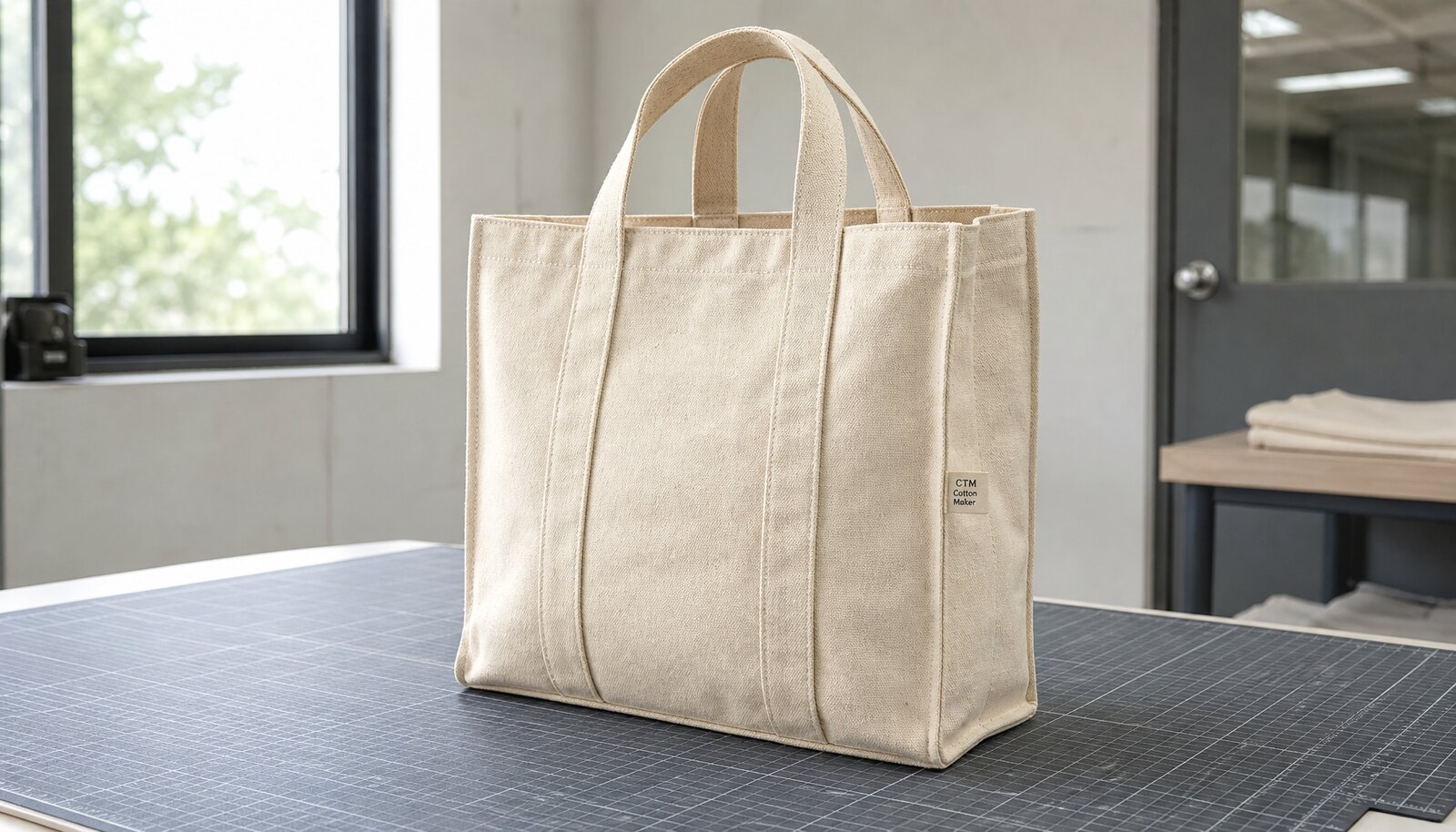
Why a boutique tote needs a product spec, not a generic tote request
A canvas book fair tote for a boutique launch has to do more than carry things. It sits in the same selling space as books, gifts, apparel, and home goods, so the bag is part of the retail presentation whether you want it to be or not. That changes the buying logic. A tote that is acceptable for an event handout can still fail in a boutique if it looks soft, under-finished, or too close to a promotional giveaway. The customer sees the bag next to paid merchandise, so the bag has to justify its presence on the shelf.
The fastest way to get a weak quote is to ask for a canvas tote and leave the rest vague. The factory will fill in the gaps with its default construction, default fabric, and default print method. That may be fine for bulk promo work, but it is not a buying strategy for a retail launch. For boutiques, the spec has to state the bag's job: is it a retail SKU, a gift-with-purchase item, or a support piece that ships with another product? Those three uses can justify different fabric weights, packing formats, and decoration choices.
The load case also matters. A book-fair-style tote that carries paperbacks and notebooks needs a different gusset and handle build than one that carries candles, wine, or folded apparel. If the tote must stand upright on a shelf or at checkout, write that into the brief. If the tote is going to be sold empty but photographed with a styled fill, make sure the actual structure still supports the look after customer use. The more concrete the use case, the easier it is to compare suppliers on the same basis.
- State whether the tote is a retail SKU, a launch support item, or a gift-with-purchase piece.
- Define the actual contents it must carry, not just a generic weight class.
- Write whether the bag must stand upright on shelf or only function in transit.
- Treat shelf appearance and customer handling as part of the spec, not a separate marketing issue.
Fabric, structure, and handle build are where retail value is won or lost
Fabric weight is one of the few choices that buyers can feel immediately. For many boutique programs, 10-12 oz canvas is the practical middle ground when the tote needs to feel sturdy without pushing cost or weight too far. Move into 12-14 oz if the bag should look structured, hold books or heavier goods, and keep its shape on display. That heavier range usually improves shelf impression, but it also increases fabric cost, sewing resistance, and shipping weight. If the tote is being sold at a modest price point, the margin hit can matter more than the visual gain.
Ask the supplier how the weight is measured. Finished fabric, raw fabric, and supplier estimate are not interchangeable, especially once finishing treatments change the hand feel. The same applies to weave and shrinkage. A bag that looks fine in an unwashed sample can pull out of shape after print curing or after a light wash by the customer. If shrinkage is a risk, ask whether the factory can prewash or at least pre-shrink test the cloth before cutting. That is especially useful when the bag has a logo placed close to the edges, where distortion shows quickly.
Structure should follow the use case, not the other way around. Flat tote bodies are cheaper and easier to pack, but a gusseted body usually performs better for books, notebooks, and gift bundles because it expands cleanly instead of ballooning awkwardly. Handle build deserves the same attention. Handle length and handle drop affect whether the bag feels comfortable over a coat or sweater, and reinforcement affects how often the bag survives repeated load cycles. If the tote is retail-facing, the handles should be drawn in the tech pack and measured in approval, not guessed during sampling.
A good launch spec is usually the simplest one that still looks deliberate. Reinforced handles, a clean bottom seam, and enough fabric weight to keep the bag from collapsing are often enough. Add lining, pockets, or trim only if those elements support the price point or the brand position.
- Use 10-12 oz for lighter retail use and 12-14 oz when you need a firmer hand and better shelf shape.
- Specify the canvas finish, not just the weight: raw, bleached, dyed, prewashed, or enzyme treated.
- Write handle length and handle drop in the tech pack and ask for a measured sample.
- Ask whether the bag stands upright when empty and when filled with your intended contents.
Decoration choice is a cost and risk decision, not only a design decision
For most canvas book fair totes, screen print remains the most efficient decoration method when the artwork is simple. It works well for logos, short text, and one- or two-color graphics, and it usually gives the cleanest economics once setup is amortized across a reasonable order size. The real question is not whether screen print is traditional. It is whether the design can survive the weave of the canvas and still read clearly after folding, shipping, and customer handling. If the logo depends on fine lines or tiny type, the factory should print a strike-off at actual size before the bulk run is approved.
Digital print can make sense when the art is complex or the run is too small to justify screens, but buyers should not assume it automatically fits canvas. The texture of the fabric can swallow detail, especially on natural or coarse weave cloth. If the tote is intended as a boutique retail piece, a clean, concise mark often performs better than a busy composition. The bag will be seen on shelf, in transit, and often under imperfect lighting, so decoration should be judged in those conditions, not only in a flat mockup.
A woven label or sewn patch is a good alternative when the brand wants a quieter look and wants to avoid a large graphic on the front panel. It can make the tote feel more restrained and durable, but it trades away visibility. That tradeoff matters. A label may feel premium in hand, yet it can disappear visually in a crowded retail environment. Buyers should choose based on shelf behavior and repeat exposure, not just aesthetic preference.
Whatever decoration route you choose, the sample has to be tested for rub resistance, fold lines, and cure quality. A print that looks fine on approval day can still fail if ink was under-cured or the bag was packed over a sharp crease. Build that test into approval before the first production carton is sealed.
- Use screen print for simple logos and predictable repeat orders.
- Use a woven label when you want subtle branding and lower print exposure risk.
- Insist on a strike-off or sample with the art at final size before bulk approval.
- Test rub resistance and fold lines before you sign off on the sealed sample.
Sourcing route and supplier geography change more than just freight
The supplier route you choose will affect communication speed, sample control, defect handling, and how easy the reorder will be. A direct cut-and-sew factory is usually the best fit when you care about stitch consistency, pattern stability, and repeatability across seasons. The factory is closer to the actual production process, so it can usually answer technical questions faster and correct issues without relaying messages through another layer. That benefit comes with a cost: the buyer needs a cleaner brief and a stronger tech pack because there is less room for interpretation.
Trading companies are useful when the buyer needs coordination across several upstream vendors or wants one contact for multiple product types. The practical advantage is convenience. The downside is visibility. You may not know exactly where the fabric came from, who is printing the bag, or who actually owns the pattern file. That matters when the order needs a quick correction, a defect rework, or a repeat run with the same materials. If the tote is tied to a retail launch date, that extra layer can be the difference between a fixable delay and a missed shipment.
Geography matters in a less obvious way. Coastal factories in China often have better access to trim suppliers, printing capacity, and export logistics, which helps when sample speed matters. Inland factories can be more cost aggressive, but the added movement of fabric and trims can slow corrections. South Asia can be very competitive for cotton-driven programs, but the buyer should expect more variation in sample turnaround when the fabric source, sewing unit, and print shop are not tightly linked. The right choice depends on what is more valuable for the launch: speed, cost, or control.
A stock blank route can still be smart if the tote is a support item and the deadline is fixed. Just do not mistake availability for suitability. The blank needs to be checked for exact size, blank consistency, label location, and print area. A blank that looks acceptable in a quote can still look generic once it is in a boutique display.
- Choose direct factory sourcing when repeatability and defect resolution matter most.
- Use a trading company only if the communication layer adds real value to your team.
- Ask where the fabric, trims, and printing are actually done, not only who invoices you.
- If you start with a stock blank, verify the blank's dimensions and print area before you commit.
A usable RFQ should let you compare suppliers on the same basis
A tote RFQ is only useful if it forces suppliers to quote the same thing. If one supplier includes polybags and carton marks while another assumes loose bulk packing, the price comparison is already distorted. The RFQ should require a breakdown: blank bag, decoration setup, each extra color, label sewing, packing materials, carton cost, and any documentation or testing fees. That separation matters because low-cost quotes often hide labor in packing or hide setup in the unit price. If the supplier will not break out the assumptions, you cannot compare the offer to another factory with confidence.
The RFQ should also pin down fabric and construction details. Do not ask for canvas tote pricing without specifying whether the cloth is 10 oz or 12 oz, whether the bag is lined or unlined, and what the handle reinforcement looks like. The same goes for dimensions. Finished width, height, gusset depth, handle length, and handle drop should be tied to the price, because many suppliers will otherwise quote on a generous interpretation and then quietly shift the dimensions in sampling.
Good procurement also means requesting more than one quantity tier. A 500-piece launch, a 1,000-piece launch, and a 3,000-piece reorder can have very different economics because setup costs are spread differently. The buyer should see whether the unit price drops meaningfully or whether the factory is simply pricing a one-off run with little scalability. That is how you decide whether to keep the opening order small or commit to a larger first buy. The RFQ should help you choose launch volume, not just collect numbers.
Finally, ask for quote validity and assumptions in writing. Lead time basis, exchange rate assumptions, fabric reservation, and overrun policy should all be explicit. If the tote launch is seasonal, a quote that expires quickly may not be useful if production slips even a week.
- Require separate lines for blank bag, print setup, label sewing, packing, cartons, and testing.
- Quote the same finished dimensions, fabric weight, and packing format across every supplier.
- Ask for at least three quantity tiers so you can see the real cost curve.
- Make the supplier state quote validity, fabric reservation, and overrun policy in writing.
Sample approval should work like a production gate
A sample is not just a preview. It is the reference that should control the bulk run. The first sample should be checked for size, structure, handle placement, print position, seam finish, and hand feel. If revisions are needed, the revised sample should become the sealed golden sample. That sample should be held by procurement and referenced by the factory so everyone is working from the same approved version. Without that discipline, bulk production can drift because the team is comparing finished goods against an early prototype that was never truly accepted.
The sample should be tested in use. Put books, notebooks, folded apparel, or whatever the tote is expected to carry inside the bag and see how it behaves. Some totes look balanced empty but twist once weight is added. Others look strong but have handles that pull the body out of shape. If the bag is retail-facing, reject small defects that will repeat across every unit, even if the tote is technically usable. Weak symmetry, sloppy thread trimming, or a print placed too close to the edge can make the product feel unfinished in a boutique setting.
Sample approval should include the packing method too. Fold style, polybag use, barcode location, and any hangtag or swing tag should be visible in the approval process. If packing is left open, the order can arrive in a format that requires rework before it can be received into store or warehouse. That rework is usually more expensive than it looks on paper because it creates labor, delays, and extra handling.
For launch programs, the sample process should end with a simple control set: approved bag, approved art, approved packing, and approved carton mark. If one of those items changes later, the factory should treat it as a controlled revision, not as a casual update.
- Keep one sealed golden sample with the date, artwork, and trim details recorded.
- Test the sample with the actual load it will carry in retail use.
- Approve packing, barcode placement, and carton marks along with the product itself.
- Treat any later change to art, fabric, or packing as a controlled revision.
QC thresholds need to be measurable or they will not be enforced
The defects that matter on a canvas tote are usually visible and preventable, which means the buyer should set measurable thresholds before production starts. Finished dimensions should have an allowed range, handle placement should have a defined offset tolerance, and seam allowance should be written clearly enough that the factory knows when a stitch is out of spec. If the only instruction is good quality, the line will make its own judgment, and that judgment will vary by operator and shift.
A useful QC plan combines measurement with simple physical tests. Measure random units from multiple cartons, check handle symmetry, inspect reinforcement at stress points, rub-test the print after curing, and fold-test the bag to see how it behaves in packing. If the logo sits on a hard crease or the ink transfers when rubbed, the tote should not be released just because it looks acceptable from a distance. Likewise, if the inside seam sheds thread or the label puckers, that issue will show up every time the customer opens the bag.
The inspection should happen in stages. A line check during production catches repeat mistakes before they multiply. A pre-pack check verifies the product before cartons are closed. A final carton audit confirms that the packed goods match the sealed sample and that the barcode, carton mark, and unit count are correct. If the order is large enough, sample from top, middle, and bottom cartons so you are not only seeing the easiest units to reach.
Boutique launches are more sensitive to visible inconsistency than generic promo runs. The tote may sit beside curated merchandise, which means stitch straightness, print alignment, and interior finish all affect perceived value. A retail-facing bag should therefore be judged like a product, not like an insert.
- Write the acceptable tolerance for size, handle placement, and print registration before bulk starts.
- Inspect random units from multiple cartons, not only the top layer.
- Use the approved sample as the standard for stitch finish and print cure.
- Require line checks, pre-pack checks, and final carton audit before release.
Packing details decide how much work happens after the shipment arrives
Packing is where a tote program can quietly lose money. A bag can leave sewing in good shape and still arrive wrinkled, dusty, or mislabeled if the pack spec is weak. For boutique retail delivery, decide whether the tote ships flat-folded, lightly stuffed, individually polybagged, or simply bulk packed into cartons. Every extra packing step adds labor and creates another chance for a defect to slip through. The right choice depends on where the bags land after import. If they are going straight to store, the pack should reduce handling at your warehouse. If they are going through a distribution center, the pack should support fast receiving and rework-free shelving.
Carton engineering matters more than most buyers expect. Carton count affects compression, crease risk, and receiving efficiency. If cartons are packed too tightly, a front print can crease and stay creased. If the cartons are too loose, bags shift, pick up dust, and get edge wear. Ask for carton dimensions, unit count per carton, gross weight, and photos of the packed arrangement before release. That information is not extra administration. It is the only way to know whether the tote will arrive in a retail-ready state or whether your warehouse will have to flatten and restack it.
Retail-ready packing also affects the launch calendar because barcode, hangtag, and carton mark details have to be correct before the shipment leaves the factory. If those details are fixed late, packing becomes a rework step and the launch date starts slipping. This is one place where small mistakes have outsized consequences because low-ticket goods like totes do not have much margin to absorb rehandling.
- Specify whether the tote ships flat, lightly stuffed, polybagged, or bulk packed.
- Require carton photos, carton dimensions, and carton count before release.
- Protect the print from crease pressure by checking fold direction and carton fill.
- Make sure barcode and carton mark placement is set before packing starts.
Landed cost and reorder logic should be planned together
The cheapest factory quote is not always the best landed cost. A low ex-factory number can hide packing labor, freight inefficiency, weak QC, or a decoration method that causes rework. For a boutique tote launch, the right comparison is the finished retail-ready unit, not the bag body alone. That means comparing total cost to the point where the tote is saleable or warehouse-ready, including packing materials, carton efficiency, transit mode, and likely defect allowance. A slightly higher factory quote can still be the better deal if it reduces rework and arrives in a sellable condition.
Reorder planning is the other half of the same decision. If the first run sells through, the second run should be easy to reproduce because the factory already has the approved sample, artwork files, stitch spec, and packing method. That only works if those records are kept cleanly. The approved sample, quote breakdown, QC notes, and carton format should become the control file for the next order. Otherwise the reorder becomes a new project, and the product can drift just enough to become visibly different from the first run.
A sensible launch approach is to keep the first order small enough to limit inventory risk but large enough to justify the production setup. Then use the sales data to decide whether the tote should stay a niche support item or move into a repeat program. The goal is not to find the lowest tote price in isolation. The goal is to build a repeatable product that can be bought again without surprises in quality, appearance, or packing.
- Compare suppliers on landed cost for a finished retail-ready unit, not only on ex-factory price.
- Keep the approved sample, quote breakdown, and packing spec so the reorder does not restart from zero.
- Track freight mode, carton efficiency, and defect allowance when comparing suppliers.
- Use the first run to learn, then scale only if the bag and the supply chain hold up.
Specification comparison for buyers
| Decision | Recommended option | Typical MOQ / price effect | Lead-time effect | Failure mode to check |
|---|---|---|---|---|
| Direct factory vs trading company | Direct factory if you need tighter control over fabric, stitching, and repeat orders; trading company if you want one contact for several product lines | Direct factories often start around 500-2,000 pcs and may price lower by 5-15%; trading companies may accept smaller starts but usually add margin | Direct sourcing can be 3-7 days faster after sample approval because there is one fewer handoff | Hidden subcontracting, slower issue resolution, and unclear ownership of the approved pattern or sample |
| Coastal China factory vs inland China factory vs South Asia cut-and-sew | Coastal China for sample speed and print repeatability; inland China for cost pressure and larger volume; South Asia when cotton sourcing, duty structure, or regional capacity matter | Coastal China is usually the middle price point; inland China can save about 3-8% on labor but may have higher material transit cost; South Asia can be competitive on fabric but varies by program | Coastal factories often turn samples in 7-14 working days; inland and South Asia programs commonly add 3-10 days depending on trim and print inputs | Longer color matching cycles, trim shortages, and slower corrections when the fabric mill, sewing unit, and printer are not in the same region |
| Stock blank vs fully custom body | Stock blank with local print for a fast launch; custom body only when the tote is part of the brand identity or shelf presentation | Stock blanks can launch from 50-500 pcs; custom bodies usually need 500-3,000 pcs depending on fabric and decoration | Stock blank programs often save 2-4 weeks because pattern development and body sampling are reduced | Generic look, limited print area, and inconsistent blank dimensions if the supplier is buying from multiple upstream sources |
| 10-12 oz vs 12-14 oz canvas | 10-12 oz for value launches and lighter retail use; 12-14 oz when the bag must look structured and hold books or heavier goods | Heavier canvas usually raises fabric and sewing cost by about 5-12% and increases shipping weight | Heavier fabric can add a few days if the mill or sewing line needs denser material and slower machine speeds | Too-light canvas shows contents, wrinkles quickly, and can read as promotional rather than retail-grade |
| Screen print vs digital print | Screen print for simple logos and one- to two-color artwork; digital print only when the art is complex or the run is very small | Screen print usually becomes cheaper at 300-500 pcs and up; digital print can be practical for short runs but often costs more per unit at volume | Screen print adds setup time for screens and color approval; digital can start faster but may need extra curing and test passes on coarse canvas | Poor registration, under-cured ink, weak edge definition, or artwork that disappears into the weave |
| Woven label vs front print | Woven label when you want restrained branding and lower visual risk; front print when you need shelf visibility and fast brand recognition | A woven label usually adds a modest per-unit cost and a small sewing step; front print is usually cheaper for simple graphics at scale | Label sewing can add 2-5 days if the placement is custom or requires extra inspection | Puckering, crooked placement, or a label that looks premium in isolation but disappears in a retail setting |
| Single-wall vs lined construction | Single-wall unlined for a clean, low-friction launch; lining only if the brand position or interior finish justifies the extra cost | Lining can increase cost by about 10-25% depending on fabric and labor, and it often raises MOQ because the line needs more components | Add 3-7 days if the lining fabric or binding is sourced separately | Bulk, extra wrinkles, hidden seam quality issues, and higher reject risk if the inner finish is not controlled |
| Bulk pack vs retail-ready pack | Retail-ready pack for boutique delivery or direct-to-store; bulk pack only if your warehouse will rework cartons and apply labels | Retail-ready pack adds material and labor cost, often 0.05-0.20 per unit depending on barcode, polybag, and hangtag requirements | Packing can add 2-4 days because it creates a second QC gate and more labor | Creased prints, unreadable barcodes, moisture risk, and receiving delays when pack specs are vague |
| Sea freight vs air freight | Sea freight for forecasted volume and reorder runs; air only for urgent samples or emergency top-up stock | Sea protects margin on low-ticket totes; air can raise landed cost by 20-60% or more on small orders | Sea usually needs 3-5 weeks in transit plus origin and destination handling; air is faster but still needs booking and clearance | Last-minute margin erosion, missed launch dates, and freight assumptions that make a low ex-factory quote look better than it really is |
Buyer checklist before sampling
- Define the exact finished size, gusset depth, handle length, and handle drop, then state whether the tote must stand upright when loaded with books or retail items.
- Specify fabric weight in oz and GSM, and ask whether the canvas is raw, bleached, dyed, prewashed, or enzyme treated.
- Write print placement in millimeters or inches, not general terms, and state the exact color count, Pantone references, and acceptable misregistration tolerance.
- Decide the sourcing route before quoting: direct factory, trading company, stock blank with local print, or a mixed program that starts with blanks and moves to custom later.
- Ask for a preproduction sample, then a sealed golden sample after revisions, and make the supplier confirm which sample controls bulk production.
- Set packing requirements up front: polybag yes or no, barcode format, carton markings, units per carton, and whether each tote needs a hangtag or swing tag.
- Request quote splits for blank bag, print setup, each extra color, label sewing, inner packing, outer carton packing, test fees, and export documentation.
- State QC expectations with measurable thresholds for stitching, seam allowance, print cure, odor, loose threads, handle symmetry, and carton damage.
- Confirm lead time separately for sample making, bulk sewing, packing, and freight so the launch date is not based only on the factory production estimate.
- Ask whether the factory can reserve the fabric lot, archive screens and artwork files, and support a true reorder without a new sample cycle.
Factory quote questions to send
- Please quote against a written spec with finished bag size, gusset depth, handle length, handle drop, fabric weight, print size, and packing format.
- What is your MOQ by colorway, artwork version, and packing style, and how does the MOQ change if we add a woven label or a second print color?
- Is the canvas weight quoted as finished fabric or raw fabric, and can you state the weave type, fabric finish, and any prewash or softening process?
- Please separate the quote into blank bag, print setup, screen or plate cost, each color charge, label sewing, inner packing, carton, and documentation.
- What is the typical turnaround for first sample, revised sample, and sealed golden sample, and what happens if the sample needs a second correction?
- What tolerance do you hold for finished dimensions, handle placement, and print registration, and what is the standard if the sample must match a sealed reference?
- Can you share close-up photos of handle attachment, side seams, bottom reinforcement, and inner seam finish from a similar canvas tote run?
- What is your normal overrun and underrun allowance, and do you notify the buyer before producing outside the ordered quantity?
- How do you control print cure, color consistency, and rub resistance across the full order, especially on natural canvas with visible weave?
- What is your packing recommendation for boutique retail delivery, and how many units per carton can you ship without crushing the print or distorting the shape?
Quality-control points to confirm
- Measure finished width, height, and gusset on random units and define the acceptable tolerance before bulk starts, not after the first cartons are packed.
- Check handle symmetry and handle anchor placement; a small offset becomes obvious when the bag is displayed upright in a boutique.
- Inspect stitch density and reinforcement at the top edge, handle anchors, and bottom seams, and reject any skipped stitches in stress points.
- Rub-test the print after curing with a cloth or tape test so you can catch weak ink adhesion before cartons leave the factory.
- Fold-test the tote to see whether the print lands on a hard crease and whether the fold creates a crack line across the logo.
- Verify that the fabric lot is consistent across the order and that there are no visible dye streaks, heavy slubs, or patchy weave unless the look is intentional.
- Open cartons from the top, middle, and bottom of the stack so you are not only inspecting the easiest-to-reach units.
- Check that the inside seam finish is clean, with trimmed threads and no fraying that sheds into the bag when opened by a customer.
- Confirm barcode readability, hangtag placement, carton marks, and any store-specific labels before the shipment is released.
- Smell-test packed goods for excessive odor from ink, coating, or packaging materials, especially if the bags are going straight to retail.