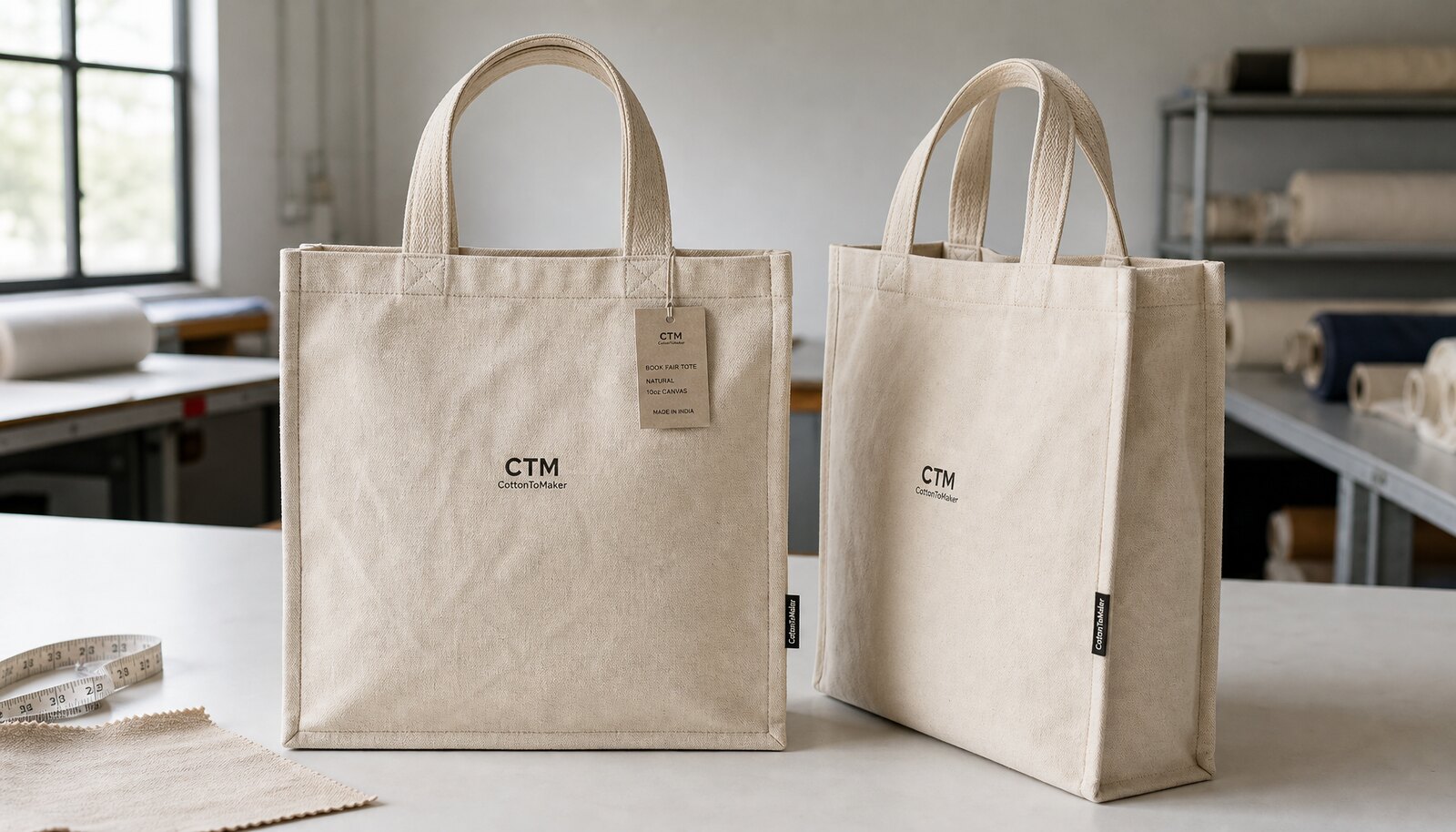
Why bookstore totes fail at launch when the spec is too vague
Canvas book fair totes look simple until the first production lot shows up with a weak body, crooked print, or handles that feel wrong in hand. For bookstores, the launch product has to do three jobs at once: sit well on shelf, carry books without sagging, and leave enough margin to justify retail pricing. If the spec only says “natural canvas tote with logo,” the supplier will fill in the blanks with whatever fabric and construction is easiest for them to run that week.
The best launch failures are not dramatic; they are commercial. A bag can be technically acceptable and still disappoint because the canvas is too thin for hardcover books, the print looks washed out on the natural fabric, or the packaging is too loose for store receiving. The fix is to define the buyer-critical details before quoting starts, not after the first sample looks off.
- Set the use case first: event giveaway, retail impulse buy, premium bookstore souvenir, or everyday carry.
- Tie the product to a price band before choosing the fabric weight and print method.
- Write the receiving format into the RFQ so the factory prices retail-ready packing, not just bulk bags.
Choose fabric weight for the way the tote will actually be used
For canvas book fair totes, the fabric weight drives nearly everything the buyer will care about: stiffness, print appearance, carrying comfort, and freight density. A 10 oz / 280 gsm canvas can work for a budget-friendly launch or a lighter gift tote, but it will not feel as stable when loaded with several hardcovers. A 12 oz / 340 gsm canvas is usually the safer retail standard because it looks more substantial on shelf and hides small stitching variations better.
If the tote is intended for heavier books, journals, or bundled merchandise, consider 14 oz / 475 gsm canvas only if the price point can support it. Heavier canvas raises the unit cost and can make the bag feel too rigid for some customers. The right answer is rarely the heaviest fabric available; it is the lowest weight that still supports the functional and brand expectations.
- 10 oz / 280 gsm: lower cost, softer hand-feel, better for light event use.
- 12 oz / 340 gsm: strong default for bookstore retail launch and repeat carry.
- 14 oz / 475 gsm: premium feel, higher cost, better if the tote is positioned as a durable long-life item.
- Request the supplier’s fabric swatch with weight confirmation, not a generic canvas description.
Construction details matter more than most first-time buyers expect
A tote that carries books needs more than a stitched rectangle. The gusset should be deep enough to hold a stack of books without forcing the side panels outward, and the bottom seam should be reinforced so the tote does not collapse or twist. Flat-bottom construction improves shelf presence and helps the tote stand up when merchandised near checkout or at a book fair table.
Handle length is another common mistake. Too short and the tote feels like a giveaway. Too long and it swings awkwardly, especially when hung on displays. For bookstore retail, a total handle length around 22-24 inches is a workable starting point, with a little extra if customers will wear coats or carry the tote cross-body over one shoulder. If the supplier offers webbing handles, specify the webbing width and stitch pattern; a cheap handle can ruin an otherwise solid product.
- Ask for reinforced handle joints with visible bar-tack or dense box-X stitching.
- Define gusset depth in millimeters, not only by product photos.
- Require a clean seam finish inside the bag so printed inserts and books do not snag.
Compare sourcing routes before you compare prices
The cheapest quote is not useful unless you know how the supplier is structured. A direct factory quote usually gives the best control over fabric weight, print method, and packaging, but it expects the buyer to manage approvals and timing. A trading company or importer may be faster for small launches and can combine multiple SKUs into one shipment, but the price often includes extra margin and less visibility into the actual production lot.
For a bookstore retail launch, route choice affects reorder behavior as much as cost. If you think the tote could become a core seasonal item, direct factory sourcing is usually the better long-term route. If the launch is a one-off event tied to a book fair or seasonal promotion, a smaller stock-supported route may be acceptable even at a higher unit price, because the primary risk is missing the date, not maximizing margin.
- Direct factory: best for stable artwork, controlled QC, and better repeat-order economics.
- Trading house/importer: best for lower internal workload and faster consolidation.
- Local stock seller: best for urgent launch timing, but usually the weakest fit for exact branding needs.
What a usable quote should break out line by line
A serious quote for canvas book fair totes should not hide everything inside one bag price. You need to see what the factory is charging for the body, the print, the trim, the label, the inner packing, and the outer carton. When these items are merged, the supplier can look cheaper on paper while quietly reducing canvas weight or changing the packing format later.
The cleanest comparison is to request a quote that separates base bag cost, one-color setup, each additional print color, label cost, barcode or sticker cost, and cartonization. That makes it easier to compare suppliers who use different print methods or different QC standards. It also gives you a better landed-cost picture once freight and duty are added.
- Separate bag body price from print cost.
- Separate retail packing from bulk packing.
- Request carton dimensions and carton weight alongside the unit price.
- If one supplier includes more stringent stitching or a heavier canvas, make that visible in the quote comparison.
Use a comparison table that exposes sourcing tradeoffs, not just specs
When buyers compare canvas book fair totes, the useful question is not whether one bag is ‘nicer.’ It is whether the supplier route fits the launch plan. A direct factory can win on repeat order economics, but only if your artwork, dimensions, and pack format are stable. A local stock route can win on speed, but it may miss the exact tone of natural canvas or provide looser print control. The decision should be made with the retail calendar in mind.
If the launch includes store displays, promotional bundles, or a book fair handout, compare the options on the things that change sell-through: hand-feel, shelf-ready presentation, artwork consistency, and the likelihood of reordering the same spec later. Those are the hidden commercial variables that determine whether the tote becomes a one-season item or a repeat SKU.
- Compare routes on repeatability, not only on first-order price.
- If you expect reorder demand, preserve the same fabric code and print method from day one.
- Do not approve a quote until the supplier states what could change at bulk scale.
Sample approval should prove the bulk will look the same
A sample is only useful if it reflects the real production setup. For canvas book fair totes, that means final fabric weight, final print method, final handle material, and final label placement. A showroom sample on cleaner fabric or a different batch can create false confidence. You want to see how the logo sits on the actual canvas shade, how the edge of the print behaves on woven texture, and whether the tote stands correctly when filled with books.
Sample approval should include practical handling, not just visual approval. Load the bag with the items customers are likely to carry, fold it several times, check seam recovery, and inspect the print after rubbing with normal handling pressure. If the tote is meant for a retail launch, this is the moment to catch handle length errors, stitching drift, and color mismatch before production turns those issues into a shipment-level problem.
- Approve only after comparing the sample against the RFQ sketch and pack requirement.
- Use actual books or weighted substitutes to test carry performance.
- Keep one signed reference sample at the buyer side and one at the factory.
Printing choices should match the artwork, not the supplier’s favorite process
For bookstore retail launches, screen printing is usually the most reliable option when the artwork is simple and the order size justifies setup. It gives good opacity on natural canvas and usually holds up better than low-cost digital methods on coarse fabric. If the design is more detailed or the launch volume is small, heat transfer or digital print may be acceptable, but the buyer should expect higher unit cost and more sensitivity to fabric texture.
The main mistake is choosing the method before finalizing the artwork. Fine lines, small serif type, and tonal artwork can disappear on heavy canvas. On the other hand, a bold one-color logo or event mark often looks cleaner and more retail-appropriate when screen printed. The supplier should show how the art will sit on the actual tote size, not just on a flat artwork file.
- Use screen print for simple logos, one-to-two color art, and mid-to-large orders.
- Use digital or heat transfer only when the design complexity justifies the extra cost.
- Specify print position in centimeters from seams and top edge to avoid layout drift.
Packing and carton format affect receiving speed and damage risk
Bookstores and distributors care about receiving efficiency almost as much as product quality. If the totes arrive loosely packed, with inconsistent carton counts or no barcode labels, the warehouse spends time recounting and sorting. That adds hidden cost and raises the chance of inventory mismatch at launch. A clean polybag with a barcode sticker may feel like a small detail, but it often decides whether the product moves through receiving smoothly.
Carton format should also be part of the quote discussion. Ask for carton count, gross weight, and overall dimensions because these numbers affect freight class, pallet efficiency, and storage planning. For a retail launch, a neat inner pack count can simplify store replenishment and reduce handling damage. If the supplier wants to save cost by overfilling cartons, that can flatten the tote and mark the print before it reaches the floor.
- Choose retail-ready packing if the bags go directly to stores or a distributor DC.
- Match carton pack count to your store reorder pattern.
- Require a barcode or SKU label on each bag if the retailer scans individual units.
Lead time risk is usually created by the buyer, not the factory
For this type of tote, standard lead time after sample approval is often shaped more by artwork approvals and packing decisions than by sewing time. If the buyer changes the print after the strike-off, adds labels late, or hesitates on carton marks, the schedule slips even when the factory is ready. The cleanest way to protect the launch date is to freeze the spec early and avoid scope creep after sample sign-off.
Bigger orders do not always mean longer manufacturing time if the factory is already set up for the fabric and print method. The real schedule risk usually comes from material sourcing, especially if the canvas weight or color is not one of the supplier’s regular stock options. If the launch date is fixed, choose the simplest spec that still meets the retail position.
- Freeze artwork before pre-production sample approval.
- Confirm whether the fabric is stock-held or needs new weaving/dyeing.
- Build time into the calendar for shipping, customs, and store allocation.
Specification comparison for buyers
| Spec decision | Recommended option | When it fits | Buyer risk to check |
|---|---|---|---|
| Fabric weight | 12 oz / 340 gsm cotton canvas for most retail launches; 10 oz / 280 gsm if cost pressure is high | Bookstores wanting a bag that feels substantial on shelf, holds hardcovers, and survives repeat use | Too light feels floppy and can distort under print; too heavy increases unit cost and freight |
| Bag construction | Gusseted body with reinforced stress points and a flat bottom if books are the primary use case | Retail buyers expecting the tote to carry stacked paperbacks, journals, and gift items without collapsing | Weak bottom seam or narrow gusset causes poor shelf appearance and early seam failure |
| Print method | 1-2 color screen print for volume; heat transfer or digital print only for short runs or multi-art launches | Simple bookstore branding, event artwork, or seasonal campaigns with stable artwork | Registration drift, cracking, or high setup cost if the artwork changes often |
| Handle length | 22-24 in total handle length with comfortable shoulder carry; longer if overcoat wear is common | Bookstores in cooler climates or retailers expecting customers to carry the tote across town | Too short looks cheap and underperforms in retail; too long swings awkwardly on the floor display |
| MOQ route | Factory direct at 1,000-3,000 pcs per color/art for best landed cost; trading house or stock program for smaller tests | Launches with clear volume forecasts and fixed artwork | Low MOQ can hide higher per-unit cost, less control, and less consistent fabric lots |
| Packing format | Polybag with barcode sticker and carton pack count matched to retail receiving | Bookstores, distributors, and regional DCs that need fast counting and easy replenishment | Loose packing or inconsistent carton counts slows receiving and raises shrink risk |
| Trim and label | Simple woven side label or printed care label plus clean seam finish | Retail buyers wanting a branded but cost-controlled product without overbuilding the trim package | Labels placed too close to edge can fray; poor stitch density makes the label look cheap |
| Supplier route | Direct factory for margin and spec control; local importer for speed and smaller quantity; agent only if you need multi-item consolidation | Brands with internal QA and enough lead time to manage sampling and production | Hidden markup, vague QC ownership, and inconsistent communication if the route is not defined early |
Buyer checklist before sampling
- Confirm final fabric weight in gsm or oz, not just the word canvas.
- Lock the bag size, gusset depth, handle length, and seam reinforcement points on a dimension sketch.
- Approve one print method only after reviewing strike-off, edge detail, and wash/rub expectations for the artwork.
- State retail packing requirements: polybag yes/no, barcode label format, carton pack count, and master carton marks.
- Define defect limits for stitch skips, print misalignment, stain marks, and handle length variation before production starts.
- Ask for a pre-production sample made from bulk-like fabric, not a showroom substitute.
- Require carton dimensions and gross weight before freight booking so landed cost can be estimated accurately.
- Get the supplier to separate bag cost, print cost, packaging cost, and inland packing cost in the quote.
Factory quote questions to send
- What is the actual fabric weight in gsm or oz, and is it the same fabric lot you will use in production?
- Is the quoted price based on one-side print or two-side print, and what is the setup charge for each color?
- What MOQ applies to the bag body, to the print artwork, and to the packaging if we need barcode labels?
- What are the exact outer carton dimensions, carton weight, and pack count per carton?
- Can you provide a pre-production sample made with the final fabric and the final print method before bulk approval?
- What is the standard production lead time after sample approval, and what delays usually change that timeline?
- What defect standard do you use for stitching, print registration, stains, and handle length tolerance?
- Can you quote separately for direct factory shipping, FOB, and if available, DDP so we can compare landed cost?
Quality-control points to confirm
- Fabric weight tolerance should stay within an agreed range; large variation changes bag hand-feel and print behavior.
- Stitch density should be even, with no skipped stitches at handle joins, gusset corners, or stress points.
- Print registration should not drift beyond an agreed visual limit; edge blur is especially visible on tote fronts.
- Handle length should be consistent across the carton so the bags hang evenly on retail hooks or shelves.
- Seam allowance should remain stable; uneven seams make the tote twist after folding and filling with books.
- Spot-check color consistency between sample and bulk lot, especially for dark inks on natural canvas.
- Inspect for oil marks, yarn slubs, loose threads, and edge fray before polybagging.
- Verify carton count, barcode placement, and master carton marks against the retailer’s receiving rules.