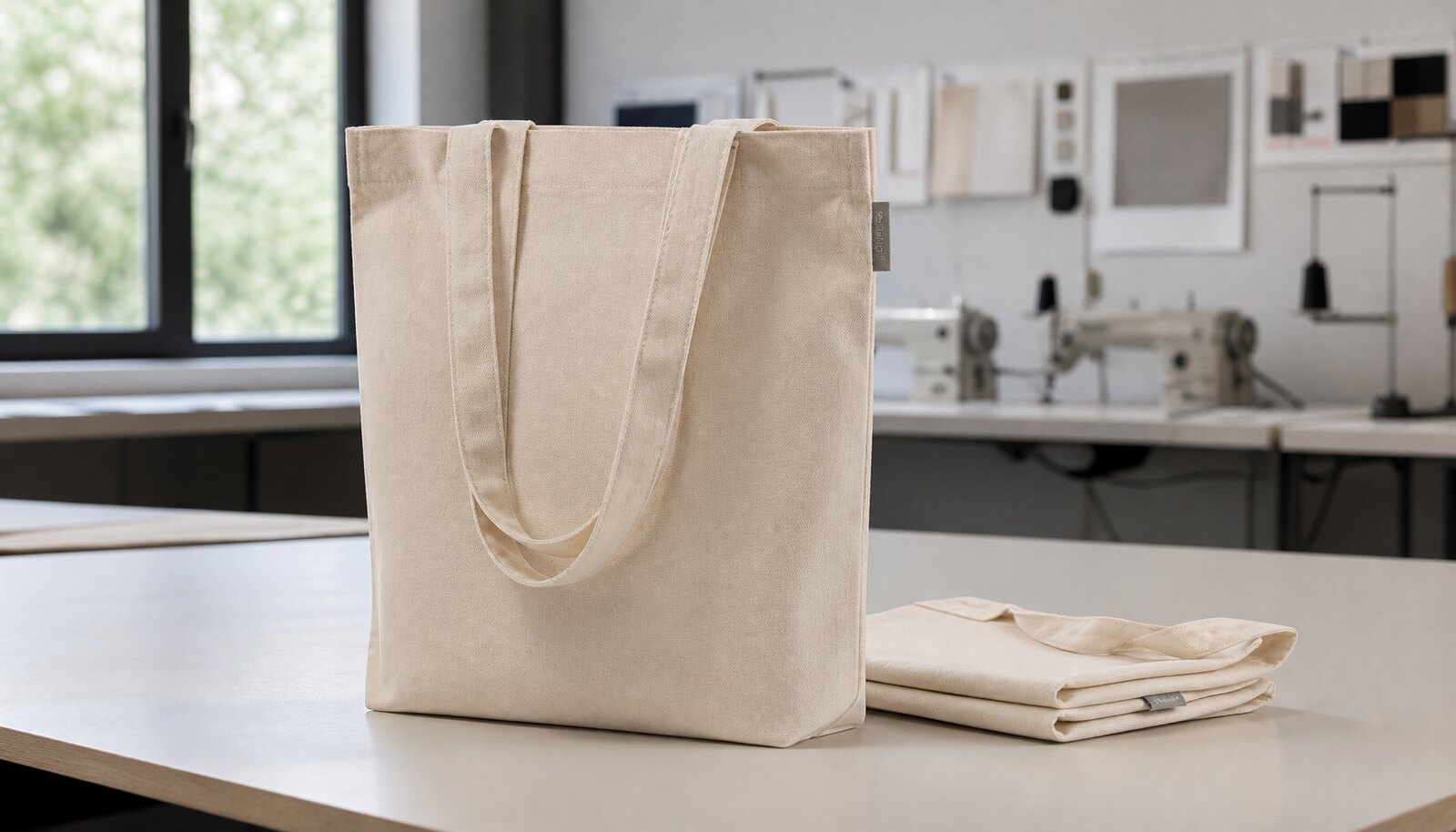
1) Why packaging specs matter more than the tote sketch
For bookstore buyers, the drawing is only the starting point. The real procurement risk usually sits in the packaging specification: how the tote is folded, how many units go into each carton, whether the handles are protected, whether the logo stays flat after packing, and whether the bag arrives ready for retail or only suitable for backroom storage. Two quotes can look identical on paper and still arrive with very different landed cost, damage rate, and shelf appeal.
That is why this guide focuses on canvas book fair totes for bookstores packaging specification guide decisions rather than generic tote buying advice. A tote for an author event, a holiday promotion, or a counter-sale merchandise line may all use the same logo, but the packaging and QC standard should not be the same. Event totes can tolerate simpler packing because they move quickly. Retail totes need cleaner presentation, more consistent folding, and clearer carton labeling so the store team can receive them without repacking.
The most common dispute is not about the art file. It is about the hidden assumptions: whether the factory quoted bulk pack or individual bagging, whether the sample was made from final canvas or a substitute, and whether the seller considered freight cube. Buyers who write a better packaging spec usually get fewer surprises later because the factory has less room to interpret the order.
A useful way to think about the RFQ is this: the bag body, the decoration, the packaging, and the inspection standard are four separate products bundled into one order. If any one of them is left vague, quote comparisons become unreliable. That is why a procurement-grade spec should define not just what the tote looks like, but how it is produced, packed, shipped, and accepted.
- A tote sold at the register needs cleaner pack-out than a tote handed out at a one-day fair.
- If your stores receive stock through a warehouse, carton size and barcode labeling matter as much as print quality.
- A good RFQ should let two suppliers quote the same product on the same assumptions.
2) Start with the use case: event handout, retail add-on, or daily bookstore carry
Canvas tote specs should be tied to the way the bag will actually be used. A tote that only carries a program booklet and a small paperback can be lighter and softer. A tote that will hold hardcovers, notebooks, or bundled purchases needs stronger fabric, better handle reinforcement, and a pack method that does not permanently crease the body panel. If you spec only by price, the failure point simply moves from fabric to handles, or from handles to seams.
For a light book fair handout, 10 oz canvas may be enough if the tote is not expected to carry much weight. For a bookstore retail item or a loyalty gift intended to be reused, 12 oz canvas is a more dependable baseline because it gives better shape retention and a more substantial feel in the hand. If the tote is part of a premium merchandise program, 14 oz can be justified, but the buyer should expect higher material cost, more sewing resistance, and possibly a stiffer fold that affects carton efficiency.
The practical question is not “what is strongest?” but “what is strong enough for the customer journey we are paying for?” A tote used for a single event may only need to survive a car ride home. A tote sold to customers for everyday use must survive repeated load cycles, shelf exposure, and washing or wiping. That difference should show up in the spec, not just in the marketing copy.
When you are deciding between a giveaway program and a retail program, define the maximum expected load. A tote that needs to carry three to five hardcover books should be treated differently from one that holds flyers and a single paperback. Once the load target is clear, the factory can recommend canvas weight, handle width, stitch count, and carton count more honestly.
- 10 oz: lighter and less expensive, suitable for low-load handout programs.
- 12 oz: the common procurement baseline for bookstore resale and repeat use.
- 14 oz: premium feel and stronger body, but higher cost and often less efficient packing.
3) Fabric weight, weave, and finishing: what to lock before you price the order
Do not quote only “canvas.” Ask for weight, weave, composition, and finish. Two suppliers can both claim 12 oz canvas and still deliver different results because one uses a looser weave, another a tighter weave, and a third includes washing or bleaching that changes the final hand feel and shrink behavior. For procurement, those differences matter because they affect appearance, sewing speed, print sharpness, and carton fit.
A bookstore tote benefits from a cloth that sits somewhere between floppy and rigid. If it is too soft, the bag collapses when displayed and may look cheap on a shelf. If it is too stiff, the corners can twist, the fold becomes bulky, and the side seams may not lie flat after packing. A good spec should therefore ask for a swatch approval with approximate gsm or oz, a stated shrinkage allowance, and the finishing method used on the cloth.
If your artwork is placed close to seams or folds, fabric finishing becomes more important. Pre-washed or pre-shrunk canvas may reduce final distortion, but it can also change the cut size and affect how the bag folds into the carton. The buyer should approve the sample after the final finishing stage, not before. Otherwise the approved sample may differ from production by several millimeters or more.
A procurement-ready RFQ should request the following in writing: canvas weight in oz or GSM, whether the cloth is raw, bleached, washed, dyed, or enzyme-treated, the weave description if available, and whether shrinkage has already been built into the cut size. If the supplier cannot provide those basics, the quote is not robust enough for a bulk order.
One practical acceptance rule: if the approved sample feels significantly lighter, more open-weave, or more translucent than the reference swatch, ask for a recheck before mass production starts. On canvas totes, visual density and touch are part of product quality, not just cosmetic preference.
- Request a physical swatch, not just a photo, and attach it to the RFQ version.
- Confirm whether shrinkage allowance is built into cutting dimensions or left for the factory to manage.
- If a tote will be folded tightly, ask the supplier to show the folded dimension using the final fabric finish.
4) Handle, seam, and bottom construction: where load failure usually starts
Handle construction is usually the first real failure point in a bookstore tote, not the fabric panel. Customers lift the bag by the handles, swing it onto a shoulder, and often overpack it. If the handle attachment is weak, even a strong canvas body will not save the product. That is why handle width, attachment method, and reinforcement stitching should be treated as functional requirements rather than style choices.
For most bookstore programs, self-fabric handles with reinforcement stitching can work if the canvas is strong enough and the stitching is dense and even. Cotton webbing handles often feel more premium and can improve grip, especially on heavier loads. The best choice depends on whether the bag is meant to look soft and natural or more structured and durable. If the tote is a retail item, buyers should ask the supplier which handle style has the lowest return risk at the intended load.
The bottom seam and side seams matter almost as much. A tote that carries books should have consistent seam allowance, clean turning, and no exposed raw edge where the structure is supposed to be enclosed. If the tote includes a gusset, confirm the gusset depth because it changes both carrying volume and carton pack. A deeper gusset can improve usability but may also make the bag bulkier when folded.
Buyers should also ask about stitch density and reinforcement at stress points. A practical request is to specify reinforcement at the handle top and handle base, with bar-tacks or equivalent stitches at the exact positions to be approved on the sample. If the supplier uses decorative stitching near the top edge, make sure it does not reduce actual strength.
For bookstore buyers, this is a useful rule: the tote should feel secure at the handle before it feels fashionable in the hand. A premium look is valuable only if it does not compromise load-bearing performance.
- State handle length, width, fold-over allowance, and attachment pattern.
- Require bar-tacks or reinforcement stitches at every load-bearing handle point.
- Confirm whether the bottom seam is double-stitched, enclosed, or bound, especially for heavier books.
5) Print method choices and how they change cost, lead time, and reorder stability
For bookstore totes, print method can be the biggest price swing after fabric choice. Screen printing is usually the most practical option for one- to three-color logos because it is repeatable, relatively durable on canvas, and efficient for reorders. If your art is simple and the same design will be reordered, screen print is often the safest procurement choice because it gives stable results and easier QC.
Heat transfer can work for short runs or complex artwork, but the buyer should not assume it behaves like screen print. Fine lines, gradients, and small text may look sharp at first but can be more vulnerable to edge lift, cracking, or wear depending on film quality and application. Embroidery signals premium value, but it adds cost and can distort the surrounding canvas, especially if the logo area is large or placed near a seam. Buyers should only choose it when the premium positioning is worth the added labor and slower output.
The right question is not which method sounds best. It is which method gives the most predictable outcome for your exact artwork, order size, and reorder plan. A simple bookstore logo on one side panel is a strong fit for screen print. A short-run seasonal design with multiple colors may justify heat transfer. A premium store line with a small logo may justify embroidery if the buyer accepts a different texture and higher unit cost.
In the RFQ, define the print area in inches or centimeters, note whether the print wraps around the seam, and state the number of colors with Pantone targets if color matching matters. If the logo has small text, specify the minimum line thickness or text size that must remain readable. That avoids arguments later about whether blurry detail was acceptable.
When comparing quotes, ask the factory to separate print setup, print unit cost, and any additional registration or color-change fees. A low headline price can become expensive if the supplier charges extra per color or if a second print pass is needed to achieve opacity on natural canvas.
- Screen print is usually best for repeatability and cost on simple logos.
- Heat transfer is useful for short runs but needs stronger durability checks.
- Embroidery should be reserved for premium positioning with acceptance of texture change and possible puckering.
6) Packaging formats: how to protect the bag and your margin at the same time
Packaging is often treated as an afterthought, but for canvas book fair totes it directly affects freight density, labor, shelf presentation, and damage rates. Bulk pack is usually the most cost-efficient for bookstore distribution centers or backroom inventory. Individual polybags are better when the tote is sold on a hook, needs clearer retail presentation, or must stay clean during long transit. The wrong packaging choice can turn a good bag into an expensive receiving problem.
The core packaging question is not whether the tote should be “protected.” It is how much protection is needed relative to the sales channel. A warehouse-bound order can usually tolerate a simpler pack-out. A retail-ready order may need an inner poly, insert card, barcode label, and carton marks. Every added item affects labor and packaging material cost, but sometimes the added expense is still justified because it reduces store handling and improves sell-through.
Carton sizing deserves special attention. If the carton is too tight, the tote can develop fold lines, handle dents, and print rub marks. If it is too loose, the bags shift around and the pack count becomes less stable. Ask the supplier to show the folded dimension and a proposed carton count that preserves the bag shape without wasting cube. For freight, particularly air freight or consolidated LCL, carton optimization can matter as much as the sewn unit price.
Retail packaging should also account for how the bookstore receives stock. If the store team needs barcode-scannable units, specify whether the barcode is on the individual poly, the hang tag, or the carton only. If the warehouse is doing the receiving, carton labels and PO matching may be enough. Buyers should not pay for individual bagging unless the receiving process actually needs it.
In quote comparisons, separate the bag body cost from the packaging cost. A quote that includes retail-ready packing may appear more expensive per unit, but it can still be cheaper overall if it reduces store labor or prevents damaged presentation stock.
- Bulk pack: lowest cost and best for warehouse handling.
- Inner poly plus carton label: a middle ground for mixed handling.
- Individual retail poly: best for shelf presentation, but highest labor and material cost.
7) MOQ, sampling, and quote structure: how to compare suppliers without hidden surprises
MOQ is often misunderstood because it is not always one number. For tote programs, the MOQ may apply separately to the bag body, the print setup, handle material, and packaging format. A supplier may agree to low quantity on the bag itself but require a larger run to amortize the screen setup or custom carton printing. If you do not split these elements in the RFQ, the quote comparison becomes misleading.
A smaller bookstore chain may value lower MOQ and faster replenishment more than the absolute lowest unit cost. A distributor or multi-store buyer may be better off accepting a higher opening quantity in exchange for a lower reorder price. The right answer depends on demand certainty and storage capacity. Extra units are not savings if they sit in inventory past the event season.
Sampling should also be treated carefully. A sales sample is useful for approving style and general appearance, but it is not enough for bulk release. The sample that matters is the pre-production sample made from final fabric, final decoration, and final packing format. If the factory cannot provide that, then the buyer should assume some production risk remains unresolved. In procurement terms, the sample must prove the production method, not just the design.
A useful quote structure separates blank bag price, decoration cost, packaging cost, and freight assumptions. It should also show what changes at 500, 1,000, 3,000, and 5,000 pcs. That lets procurement compare the step-down in unit cost against the extra inventory risk. For bookstore buyers, the best deal is often the one that balances reorder flexibility with stable quality, not the one with the lowest opening quantity.
If a supplier offers free samples, confirm exactly what is included. Sometimes the sample is free only for a basic blank version, while final print, carton mock-up, and special packaging still carry charges. That is normal. What matters is that the buyer knows which version is being approved and which version is being paid for in production.
- Ask whether MOQ is different for blank goods, printed goods, and shelf-ready packing.
- Treat free sample promises carefully and confirm what production elements are excluded.
- Compare quotes at the quantity you can actually reorder, not only the trial quantity.
8) Supplier comparison: choosing between a factory, trading company, or local decorator
A procurement guide should help the buyer choose a sourcing route, not only a spec. For canvas tote bags, the best supplier type depends on speed, control, order size, and the level of packaging discipline required. A direct factory can be the strongest choice when the buyer wants repeatability, stable fabric sourcing, and clear cost breakdowns. A trading company can be helpful when multiple items need coordination or when the buying team needs one point of communication. A local decorator or print shop can win on speed for urgent programs, but may not be the best fit for larger retail orders with strict carton requirements.
The tradeoff is visible in the sample process and in the quote language. A direct manufacturer should be able to tell you the exact fabric spec, sewing method, and packing plan. A trading company may be better at managing communication, but the buyer should still ask for the factory name, production location, and QC accountability. A local decorator can often turn around a simple tote fast, but the buyer should verify whether the bag body is stocked or sourced ad hoc and whether the same material will be available on repeat.
The best sourcing route also depends on order discipline. If the tote will be reordered across seasons, you need a supplier who can preserve the spec, not merely reprint the logo. If the program is one-time event merchandise, a faster supplier may be enough. But even then, the buyer should still insist on a packing and carton spec, because event goods often move through the same receiving channels as retail goods.
When comparing suppliers, ask not only who is cheaper but who is better able to keep the same product stable over three orders. For bookstores, repeatability matters because the tote often becomes part of the brand on the shelf. A factory that can reproduce the same fabric, print placement, and folding pattern is usually more valuable than one that is slightly cheaper but inconsistent.
Use the table below to match sourcing route to the likely procurement problem. It is not a ranking of all suppliers, but a practical decision tool for the buyer who needs the right level of control.
- Direct factory: strongest for repeatability and full spec control.
- Trading company: useful for coordination and mixed-item programs.
- Local decorator: useful for speed, but verify material consistency and carton discipline.
9) QC tolerances and acceptance standards: from broad advice to measurable checks
QC guidance should be written in numbers whenever possible. For canvas book fair totes, buyers should define what is acceptable before production begins, then use the same criteria for sample approval, in-process inspection, and final audit. Without measurable tolerances, a factory can argue that a defect is “normal” while the buyer considers it unacceptable. That dispute usually costs more time than the defect itself.
A practical QC system starts with dimensions. Finished width, height, and gusset should be checked after finishing, not only immediately after sewing if the bag later shrinks or is pressed. A tolerance band of about ±0.25 in or ±0.5 cm on key dimensions is a useful starting point for many tote programs, but the buyer can tighten or relax that based on construction style. The point is to write the tolerance down before production, not to debate it when cartons are ready to ship.
Stitch quality should also be measurable. Ask for even stitch length, no skipped stitches at stress points, and complete bar-tacks on both handles. If the tote is expected to carry books, a loose or incomplete handle reinforcement is not a minor flaw. It is a functional defect. Likewise, any open seam on a load-bearing line should be treated as a reject because it affects use and can lead to returns.
Print quality needs separate criteria. Define the allowed registration shift, the acceptable edge sharpness, and whether faint pinholes or slight texture variation are acceptable on natural canvas. Buyers should not over-reject normal weave variation on raw canvas, but they should reject any print that is visibly off-center, cut by a seam in the wrong place, or altered by folding marks. For a retail tote, the threshold should be tighter than for a giveaway.
Packaging defects should also be specified. A wrong carton count, missing label, or mixed PO in the same carton can cause warehouse delays even if the bag itself is fine. Ask the supplier to inspect carton marks, quantity, destination, and gross weight before release. If the store or DC receives by barcode, confirm barcode readability on the pack unit or carton level. These are low-cost checks that prevent expensive receiving problems.
Here is a simple acceptance rule buyers can use: cosmetic variation on natural canvas may be acceptable if it does not affect shelf appearance or customer use; load-bearing seam failure, major print misplacement, contamination, or incorrect pack-out should be rejected or sorted before shipment. When in doubt, classify the issue by impact on function, presentation, and receiving efficiency rather than by how easy it is to argue about.
- Measure dimensions after finishing and compare them to the approved spec version.
- Reject any handle, seam, or bottom construction issue that affects load-bearing performance.
- Treat wrong carton count, mixed labels, or missing packing inserts as shipment-blocking defects when they disrupt receiving.
10) Lead time, landed cost, and the RFQ bundle that keeps orders comparable
Lead time should be broken into stages so the buyer can see where delays may happen. A good supplier quote should separate sample approval, fabric booking, printing preparation, sewing, packing, and final dispatch. If a supplier only gives a single lead-time number, the buyer does not know whether the risk sits in raw material sourcing, decoration queue, or carton production. That matters when a bookstore event date is fixed.
For landed cost, compare not only the unit price but also the packing format, carton size, gross weight, and any freight consequence of the chosen route. A tote that is cheap at factory gate can become costly if the carton is oversized or the pack-out is inefficient. Similarly, a premium retail pack may look expensive until the buyer accounts for reduced store handling and fewer damaged presentation units. Procurement should evaluate the complete cost to receive and sell, not only the sewing price.
The best RFQ bundle for canvas book fair totes for bookstores packaging specification guide work should include the approved spec sheet, a measured sample, artwork files, packing instructions, carton requirements, inspection rules, and the reorder assumption. It should also say whether the buyer expects blank stock, printed stock, or shelf-ready stock. That way the supplier can price the same thing every time, and the buyer can compare suppliers on a clean basis.
A useful final check is to ask the supplier to restate the order in their own words before confirming the quote. If their summary does not match the buyer’s intended use case, packaging plan, or QC level, the order needs clarification before production begins. That one step can prevent most quote disputes, especially on packaging-heavy tote programs where the bag itself is simple but the commercial requirements are not.
In short, the more the order depends on repeatability, resale presentation, or warehouse handling, the more important it is to lock the spec before price. Buyers who treat packaging as part of the product usually get better delivery performance, fewer surprises at receiving, and cleaner replenishment in the next round.
- Request separate timing for sample, bulk production, packing, and dispatch.
- Compare unit cost with carton size and freight cube, not only with sewing cost.
- Have the supplier restate the spec in writing before you approve the PO.
Specification comparison for buyers
| Sourcing route | Typical order profile | Main tradeoff | Best decision criteria |
|---|---|---|---|
| Direct manufacturer | 1,000+ pcs, stable artwork, repeat reorder plan | Lowest long-run unit cost, but slower spec alignment if the buyer lacks a complete RFQ | Choose when you need fabric control, repeatability, and clear QC terms |
| Trading company | Mixed-item orders, smaller teams, multi-country coordination | Easier communication and consolidation, but margin and factory chain visibility can be weaker | Choose when you need project management and are buying several SKUs at once |
| Local decorator / print shop | Short runs, rush programs, single-color logos, domestic delivery | Fast sample-to-delivery, but limited fabric options and less control over carton optimization | Choose when speed matters more than price or long-term repeat replenishment |
| Retail packaging specialist | Shelf-ready totes, barcode labeling, hang tags, carton pack discipline | Better presentation and pack-out, but the bag body itself may be subcontracted | Choose when the tote must arrive shelf-ready or scan-ready for store receiving |
| Integrated bag factory with in-house printing | Mid-sized programs with print and packing both important | Usually the best balance of cost and control, but MOQs may be more rigid | Choose when you need one accountable source for sewing, decoration, and packing |
| Material | 8-12 oz cotton canvas, 120-220 gsm cotton, recycled cotton, or blended fabric selected by use case and target price | Before price comparison | Different cloth weights, backing, or certification claims make quotes hard to compare |
| Construction | bag size, gusset, handle drop, seam allowance, stitch density, reinforcement patch, and loading expectation | Before sampling | Weak stress points create returns and failed inspections |
| Decoration | screen print, heat transfer, embroidery, woven label, or hangtag matched to fabric texture and brand durability needs | Before artwork approval | The wrong method can crack, bleed, pucker, or fail on the chosen fabric |
Buyer checklist before sampling
- Confirm usable internal size, not only overall outer dimensions.
- State fabric weight in oz or GSM, plus whether the canvas is raw, bleached, washed, or dyed.
- Specify handle length, handle width, attachment method, and reinforcement stitch pattern.
- Define print method, print location, color count, and whether artwork crosses seams or folds.
- Lock the packaging format: bulk pack count, inner poly, insert card, hang tag, barcode label, or retail sleeve.
- Set measurement tolerances, color variance limits, print registration limits, and defect rejection thresholds.
- Request a pre-production sample made with final fabric, final decoration, and final pack method.
- Ask for carton dimensions, gross weight, carton labels, pallet plan, and any moisture-protection requirement.
- Confirm whether MOQ applies separately to fabric color, print setup, and packaging components.
- Get a written lead-time breakdown for fabric booking, sample approval, printing, sewing, packing, and dispatch.
Factory quote questions to send
- What is your unit price at 500, 1,000, 3,000, and 5,000 pcs, and what cost elements change at each tier?
- Does your MOQ apply separately to the bag body, print setup, handle material, and packaging format?
- Can you show the exact canvas weight, weave density, and finishing method you plan to use?
- What is the recommended handle construction for a tote expected to carry 3 to 5 hardcover books?
- Which decoration method gives the best repeatability for my artwork, and what are the tradeoffs on sharpness and durability?
- Can you quote blank goods, printed goods, and retail-ready packing as separate line items?
- What carton count and carton size do you recommend for efficient freight without compressing the bags?
- What inspection standard do you use, and what defects are considered repairable versus rejectable?
- Can you supply a pre-production sample with final packing, and what is the sample charge and lead time?
- Which parts of the lead time depend on fabric booking, printing queue, carton production, or packaging assembly?
Quality-control points to confirm
- Measure finished tote width, height, and gusset at agreed seam-to-seam points after final pressing or finishing.
- Accept size variation only within a written tolerance band, commonly ±0.25 in / ±0.5 cm for key dimensions unless the style is intentionally soft-structured.
- Check fabric weight against the approved swatch or spec sheet; a practical tolerance is within about ±5% of the stated weight unless both sides agree otherwise.
- Inspect handle attachment strength by checking bar-tack completeness, stitch density, and uniform placement on both handles.
- Reject any unit with broken stitches, open seams, exposed raw edges where binding is required, or a handle that twists enough to affect carry comfort.
- Inspect print for centering, color consistency, seam distortion, pinholes, ink cracking, or bleeding at fold lines; reject if the logo is visibly misregistered beyond the agreed limit.
- Check that stains, oil marks, needle holes, broken threads, or dirt spots are not visible on the selling side; if the tote is retail grade, cosmetic contamination is a hard reject.
- Verify fold method, inner poly count, insert cards, hang tags, and barcode labels by carton sample and random unit opening.
- Check carton marks, PO number, quantity, destination label, and gross weight before cargo release.
- Use a clear acceptance rule for defect rates: for example, minor cosmetic flaws may be reworkable, but any functional defect on load-bearing seams should trigger immediate rejection or sorting.