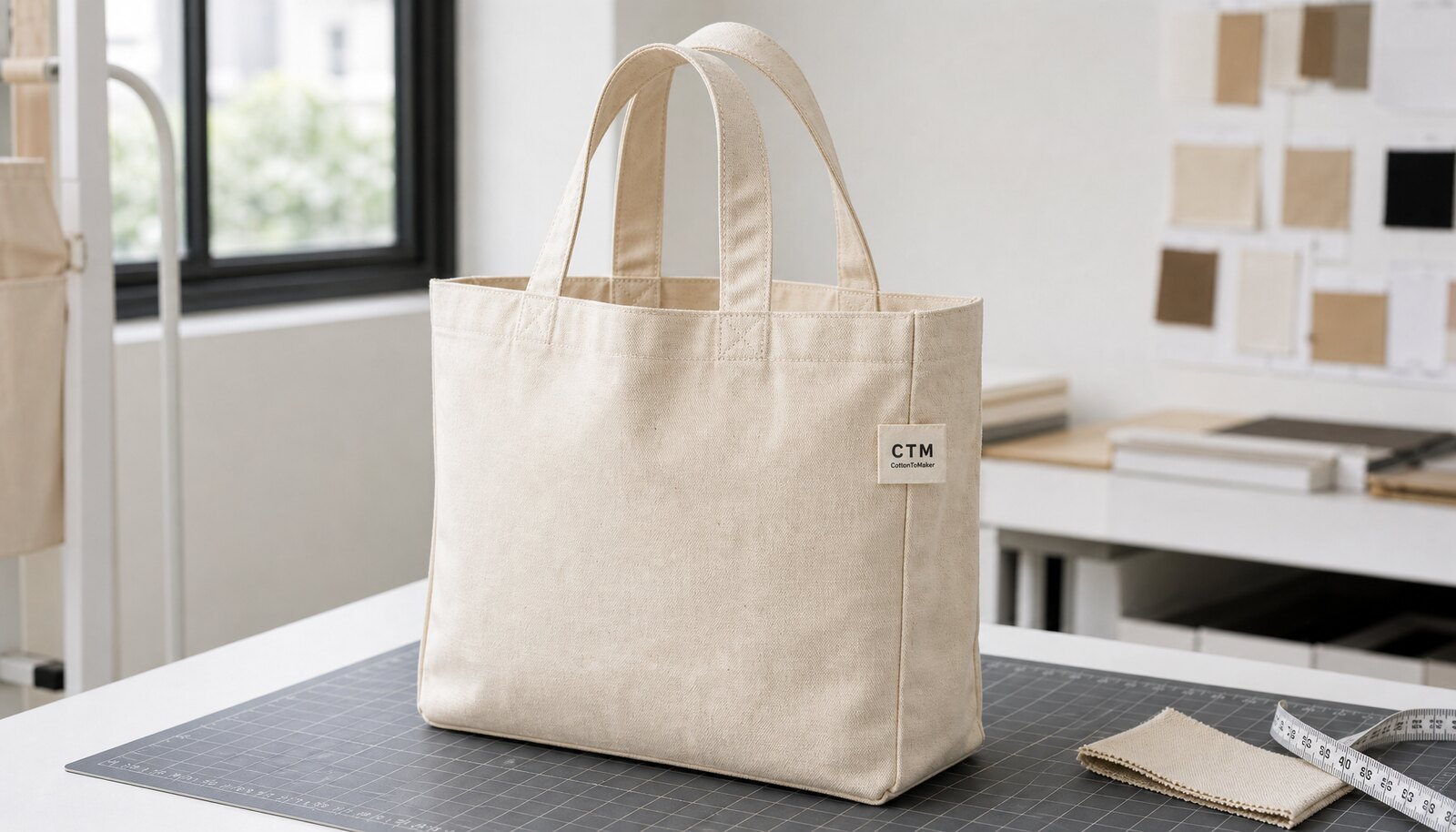
Start With The Event Use Case
A canvas book fair tote for a corporate event is a working container first and a branded object second. It has to hold books, catalogs, notebooks, and often a few extra giveaways without collapsing on the event table or digging into the hand or shoulder. The buying brief needs to start from use: what goes in the bag, how far it travels, and how long the client expects it to remain in circulation after the event. A tote for a one-day conference can be lighter than a tote that will be reused by employees, sponsors, or VIP guests for months.
The most expensive mistake is ordering a generic promo tote and discovering too late that the book stack is too tall, the handle drop is wrong, or the print area is too tight for the logo lockup. For procurement, that is a specification problem, not a design problem. If the bag is carrying thick catalogs or a boxed book set, the gusset, bottom reinforcement, and fabric weight matter more than a small unit-price difference. If the tote will travel through registration, storage, and distribution in bulk, the structure has to survive folding, stacking, and handoff without looking crushed.
Write the use case in plain terms before you request pricing: who receives the tote, what it must carry, whether it needs shoulder carry, and whether the event team will hand it out empty or pre-packed. That single paragraph will do more to improve quote quality than three rounds of vague supplier calls.
- List the actual contents: books, catalogs, notebooks, tech accessories, or mixed kits.
- State whether the tote is for a single event day or for repeated post-event use.
- Define the carry mode: hand carry, shoulder carry, or packed inside another distribution kit.
Lock The Physical Spec Before You Ask For Price
Most corporate book fair buyers can work from a stable baseline: 8 oz / 270 gsm cotton canvas for standard event use, with 10 oz / 340 gsm reserved for heavier books, longer reuse, or a more structured hand feel. That range gives enough body for clear printing and reasonable durability without turning the tote into an expensive premium item. Lighter fabric can feel soft and cheap in use, especially once the bag is loaded; heavier fabric improves structure but adds freight, sewing cost, and carton weight. The right answer is usually the lightest fabric that still holds the intended load without distortion.
Size needs to be tied to the contents, not to a catalog template. A medium vertical tote with a practical gusset usually handles book-fair content better than a shallow fashion tote because the books sit flat and the panel does not bow. Handle length should be driven by how the tote will be worn: too short and the bag is annoying to carry; too long and it swings into the body or crowds the print area. If the tote is expected to survive repeat use, call out handle width, handle drop, top hem or binding method, bottom reinforcement, and the stitch pattern at the handle roots. Those details affect comfort and failure rates more than most buyers expect.
Color choice also changes the buying risk. Natural canvas is common because it prints cleanly and looks appropriate in a book-fair setting, but shade variation across lots can be visible. Bleached canvas gives a cleaner base for brighter inks and a more polished look in photos, yet it may show scuffs faster during distribution. Dyed canvas adds brand impact, but it raises the need for color control and lot approval. Buy the color that fits the event environment and the client expectation, not the one that merely looks best in a sample image.
- Use 8 oz / 270 gsm for standard corporate event programs.
- Move to 10 oz / 340 gsm when the tote carries heavier books or must last beyond the event.
- Specify finished size, gusset depth, handle length, handle width, and reinforcement details in the RFQ.
- Set the acceptable shade range before quoting natural or dyed canvas.
Choose The Print Method For The Artwork, Not The Sales Pitch
For canvas book fair totes, simple artwork usually belongs on screen print. It handles one or two solid colors well, keeps the logo readable from a distance, and scales cleanly across larger runs. That matters in a busy corporate event environment where the tote is seen quickly, often while moving. Screen print also tends to be easier to inspect because the buyer can judge opacity, placement, and registration without guessing how the final finish will age.
Heat transfer can be the right answer when the artwork is more complex, the order is smaller, or the color count makes screen setup inefficient. It is not a default upgrade. Ask how the transfer behaves on folded canvas, what the rub resistance looks like after repeated handling, and whether the edge of the graphic stays clean when the bag is loaded. Embroidery is usually a poor fit for thin canvas book totes because it can pucker the panel and distort the bag shape unless the fabric is heavier and the logo is deliberately simple. Digital print has a place for detailed graphics, but the buyer still has to check coverage on natural canvas and repeatability across lots.
The right question is not which decoration method the supplier prefers. It is which method delivers legibility, durability, and cost control for this exact tote. If the artwork contains fine text, set a minimum text size and line weight before proof approval. If the logo is simple, make the print area large enough to read at event distance and keep the number of colors low. That usually gives better visual impact and fewer production failures.
- Use screen print for simple logos and meaningful volume.
- Use heat transfer only when artwork complexity or small quantity justifies it.
- Avoid embroidery unless the canvas weight and logo size clearly support it.
- Set minimum text size and line weight when the logo includes small copy.
Read MOQ And Quote Structure As Signals, Not Obstacles
MOQ on tote bags is rarely a single fixed number. It changes with size, color, print count, label type, and packing format. A factory may accept one MOQ for a natural tote with a single-color print, then raise the threshold if the body is dyed, the label is woven, or the totes are polybagged individually. That is not just supplier policy; it is a sign of where the real setup labor sits. Cutting, screen making, ink setup, thread changes, and packing labor all affect whether a low-volume order makes sense for the factory.
A useful quote should show the finished size, fabric weight, print method, handle spec, packing format, and Incoterms in the same line item. If those pieces are missing, the buyer is not comparing the same product. The lowest unit price can hide a smaller print area, lighter cloth, lower stitch density, or bulk packing that shifts labor to the buyer's side of the operation. For a corporate event program, it is often smarter to pay slightly more for a stable spec than to chase the cheapest quote and absorb corrections, rework, or a late material substitution.
Ask suppliers to split pricing by cost driver. Request a natural canvas price and a dyed canvas price. Request one-color and two-color versions separately. Ask for the delta between bulk packing and individual polybags. That makes the decision visible and gives procurement a cleaner internal story: what changed, what it costs, and whether the added spend actually improves the tote.
- Ask for MOQ by color and by print version.
- Separate unit price from sample cost, tooling cost, and packing upgrades.
- Compare all quotes on the same destination and Incoterms basis.
- Request split pricing for natural, bleached, and dyed canvas when relevant.
Qualify The Supplier Route Before You Compare Prices
The best supplier route depends on how much control the program needs. A direct factory is usually the right choice when the tote size is custom, the order is repeatable, the packing needs are strict, or the client expects a controlled sample-to-bulk process. That route gives the buyer access to cutting, sewing, and print setup, which matters when the product is simple but the finish needs to be consistent. A trading company can still work if the buyer needs consolidation or multi-category sourcing, but the risk is losing visibility into the actual maker and the real bottleneck.
Domestic stock importers and local decorators solve different problems. A stock importer works when speed matters more than exact construction and the size or color already exists. A local decorator makes sense if the buyer already has blank totes and only needs branding applied quickly. Neither route is ideal if the event spec is tight, the bag shape is custom, or the buyer needs material and stitch control. For a corporate event program with a defined look, the route should match the risk profile of the order, not just the invoice total.
Use the quote process to test supplier competence. Good factories can explain how they reinforce the handle roots, how they control fabric shrinkage, how they manage print registration, and what sample material they use. Weak suppliers stay vague and answer with only a price. That is a warning sign. If a supplier cannot speak clearly about stitch density, shade variation, and packing sequence, they are not ready for a controlled bulk order.
- Direct factory: best for custom size, repeat orders, and tighter process control.
- Trading company: useful for consolidation, but verify the real maker and factory capacity.
- Stock importer or local decorator: useful when speed matters more than exact construction control.
- Prefer suppliers that can explain reinforcement, color control, and sample methods in specific terms.
Approve A Sample That Reflects Bulk Production
A sample only protects the buyer if it mirrors the bulk order. A sales sample made from substitute cloth, substitute thread, or a different print process creates false confidence and usually becomes the source of a dispute later. The right request is a pre-production sample made from actual bulk materials, with the final logo size, final placement, and final label treatment. If the supplier cannot provide that, the order carries more risk and the buyer should price that risk into the schedule.
Sample review should focus on the failures that matter on the event floor. Check whether the tote stands upright, whether the handles hang evenly, whether the print sits square, and whether the bag folds without twisting. Load it with the books or catalogs that will actually be handed out. A tote can look fine empty and still fail when the content pushes against the seams or creates a bulge at the bottom corners. That is why the sample has to be tested as a real event item, not as a tabletop specimen.
Freeze the approved sample with photos, measurements, and a signed spec sheet. Keep that reference in the buying file and send the same record to the factory, freight forwarder, and receiving team if the order is moving through multiple handoffs. For repeat programs, keep the last approved sample from each run. It gives the next buyer a clear baseline when the supplier changes fabric lots, sewing staff, or print setup.
- Approve only a sample made from the same fabric and print method as bulk production.
- Test the tote with real event contents, not an empty bag.
- Freeze the sample with photos, measurements, and a signed spec sheet before production starts.
- Keep the approved sample with the buying file for the next reorder.
Write QC And Packing Rules That A Factory Can Inspect
QC guidance has to be specific enough that a supplier can inspect against it without guessing what the buyer meant. For canvas book fair totes, the most useful categories are size, stitch quality, load performance, print quality, and packing accuracy. Put those rules in the PO or spec sheet, not in a side email. A practical starting point for many procurement teams is AQL 2.5 for major defects and AQL 4.0 for minor defects, but that is a house decision, not a universal standard. Major defects should include seam opening, handle failure, incorrect size, and print misplacement that is obvious at arm's length.
Load testing needs context. If the tote is going to hold a stack of books and catalogs, define the actual event load or a clearly identified surrogate load before production starts. A useful buyer benchmark is to check for no seam failure, no handle pull-out, and no distortion that would affect normal use after the tote is loaded for a controlled period. If your internal team likes a time-based or repeat-carry test, write the method into the spec and keep it internal. Do not present a factory with a vague carry count and then treat it like a universal industry benchmark.
The same logic applies to print placement and rub resistance. If your brand uses a measurement tolerance, set it in the artwork proof or the spec sheet rather than borrowing a generic number from another project. For some buyers, a tight placement window matters because the tote is part of a premium kit; for others, visual centering is enough. If you want a dry rub check, define the cloth, stroke count, and fail point in writing. For packing, call out fold direction, carton count, barcode position, outer markings, and carton weight so the receiving team can move the boxes without opening every case.
- Use AQL 2.5 for major defects and AQL 4.0 for minor defects if that matches your house standard.
- Define major defects to include seam failure, handle failure, wrong size, and obvious print misplacement.
- Write the load test against the actual event contents or a named surrogate load.
- If you want a numeric print-placement tolerance, place it in your spec sheet rather than implying it is a universal norm.
- Lock carton count, fold direction, barcode position, and carton weight before mass production.
Protect The Schedule And Compare Landed Cost
Lead time on canvas totes is usually driven by fabric availability, print setup, and sewing-line capacity. If the canvas needs to be dyed, or if the artwork requires multiple screen changes, the schedule moves quickly. Peak season can also change the answer. Before a corporate event order is placed, ask what already sits in the factory queue, whether the right fabric width is on hand, and what happens if the sample needs one revision. A quote that looks fast on paper can still slip if the raw material is not committed or the print setup has not been planned.
A realistic schedule works backward from the event date with margin. Include time for artwork cleanup, sample approval, production, packing, and transit. For a first order, protect an extra approval cycle when the tote is custom dyed, color matched, or packed as a kit. That is not pessimism; it is cost control. Missing the event date creates a far larger loss than paying for a slightly more careful production plan.
When comparing suppliers, normalize every quote to the same destination and terms. EXW, FOB, and delivered pricing are not interchangeable, and they hide different parts of the supply chain. The real comparison is landed cost per tote, including freight, duty, cartonization, inserts, labels, and any added handling. That view often shows where to simplify. If a woven label adds cost but no real buyer value, cut it. If the tote is larger than the content requires, reduce the size and save fabric, freight, and carton volume. Good procurement uses the quote to improve the spec, not just to choose a winner.
- Build schedule slack around sample approval and raw material purchase.
- Treat peak season and dyeing as real lead-time risks.
- Normalize all quotes to the same destination and Incoterms basis.
- Use landed cost to decide whether a label, insert, or larger size is actually worth the spend.
Use The Quote To Tighten The Final Spec
The best way to source canvas book fair totes for corporate events is to treat the quote as a design tool. Each supplier response should tell you whether the spec is too large, too small, too light, or too expensive in the wrong places. If one supplier flags a handle reinforcement issue and another does not, the more useful answer is usually the more technical one. If a price jumps because the print is too detailed for screen print, the artwork may need to be simplified. If the bag size pushes carton weight past a practical handling limit, the dimensions may need to shrink. That feedback is not noise; it is how a buyer converges on a spec that the factory can produce cleanly and the event team can actually use.
That same approach improves internal approval. When procurement can explain that the chosen tote was selected because the fabric weight supports the load, the print method fits the artwork, the packing format matches the distribution plan, and the landed cost fits the budget, the decision is easier to defend. The result is not just a cheaper tote. It is a lower-risk purchase with fewer surprises at receiving, fewer complaints at the event table, and fewer reorders caused by a spec that was never tightened enough.
- Use supplier feedback to adjust size, fabric weight, or print complexity before PO release.
- Prefer the spec that the factory can produce consistently over the lowest quote that leaves gaps.
- Keep the tote simple enough to inspect quickly and durable enough to survive the event.
Specification comparison for buyers
| Spec decision | Recommended option | When it fits | Buyer risk to check |
|---|---|---|---|
| Supplier route | Direct factory with export experience | 300+ pcs, custom size, repeat ordering, or controlled packing | Confirm the real sewing factory, not a broker quoting stock photos and assumed capacity |
| Fabric weight | 8 oz / 270 gsm cotton canvas | Standard corporate book fairs, catalogs, and moderate reuse | Below this range the tote can feel soft, print less cleanly, and distort under load |
| Heavy-duty version | 10 oz / 340 gsm canvas | Premium event gifts, heavier books, or longer reuse expectations | Freight weight rises; verify handle reinforcement and carton weight limits |
| Panel color | Natural canvas or optically brightened natural | Most book fair programs where the tote is a carrier, not a fashion item | Natural fabric can vary lot to lot; request an acceptable shade range and approval method |
| Print method | 1 to 2 color screen print | Clean logo runs with volume and simple artwork | Fine text, gradients, or tight registration can fail legibility checks |
| Branding route | Printed logo plus sewn side label | When the tote should keep branding after the event and be reused often | Low-grade labels can fray, curl, or shrink if edge finishing is weak |
| Handle construction | Self-fabric handles with X-box and bartack reinforcement | Book fair loads and repeated shoulder carry | Short handles or weak stitch density create comfort complaints and early failure |
| Packing method | Bulk packed with size labels, or polybagged by set | Bulk for internal distribution; polybagged for retail or pre-packed kits | Extra bagging increases cost and volume; confirm carton count and label logic |
| Sample route | Pre-production sample from actual bulk materials | First order, color-critical work, or a new supplier | Approval based on a sales sample can hide fabric, print, and stitch variation |
Buyer checklist before sampling
- Write the finished size, gusset depth, handle length, and target load into the RFQ.
- State the fabric weight in gsm or oz and whether the canvas is natural, bleached, dyed, or recycled content.
- Define the print method, number of print colors, print size, and print placement on the tote.
- Specify whether you need a woven label, sewn side label, care label, hangtag, barcode sticker, or carton mark.
- Set the packing format: bulk pack, individual polybag, insert card, barcode sticker, or pre-packed set.
- Ask for a pre-production sample made with the same fabric, thread, ink, and print method as mass production.
- Request carton count, carton size, gross weight, and stacking limit before you approve the shipping plan.
- Clarify the acceptance standard for stitching, shade variation, print alignment, and measurement tolerance.
- Ask the supplier to quote MOQ by size and color, not just one overall number.
- Compare all bids on the same Incoterms and destination so freight, duty, and handling are visible.
Factory quote questions to send
- Which factory will actually sew this tote, and what is its monthly output for this bag construction?
- What finished size, gusset depth, and handle drop do you recommend for the books and catalogs we plan to pack?
- Can you quote 8 oz and 10 oz canvas separately so we can compare feel, cost, and freight impact?
- What is the MOQ per color, per print version, and per packing format?
- Which print method do you recommend for this artwork, and what detail limit applies to small text or thin lines?
- Will the sample use bulk fabric, bulk thread, and the final print setup, or substitute materials?
- How do you control shade variation for natural or dyed canvas between lots?
- What handle width, stitch pattern, and reinforcement will you use at the handle base and side seam?
- What packing method do you recommend, and how many pieces fit per carton without crushing the tote shape?
- What extra cost applies to woven labels, barcode stickers, inner polybags, insert cards, or carton drop testing?
Quality-control points to confirm
- Use AQL 2.5 for major defects and AQL 4.0 for minor defects if that matches your house standard; define major defects as anything that affects use, safety, fit, or brand visibility.
- Measure finished size on random samples from each lot against the approved spec sheet; set your own tolerance in writing rather than relying on a generic factory rule.
- Inspect handle stitching for symmetry, dense bartacks, clean thread trimming, and no skipped stitches at the stress points.
- For load performance, test the tote with the actual event contents or a clearly defined surrogate load; reject any seam opening, handle pull-out, or distortion that would affect normal use. If you need an internal time-based benchmark, write that into your own spec instead of treating it as an industry standard.
- Check print quality for opacity, edge sharpness, registration, and wash or rub resistance that matches the planned use. If you want a dry rub check, define the cloth, stroke count, and pass-fail threshold in the PO.
- Review print placement against the approved proof and use the same alignment method across all suppliers; if your brand uses numeric placement tolerances, define them in the spec rather than borrowing a generic figure.
- Compare bulk shade against the approved sample under daylight or D65-equivalent lighting, especially for natural canvas and dyed programs.
- Open cartons to verify fold direction, count, barcode position, and carton markings match the approved packing plan.
- Look for needle damage, skipped stitches, oil marks, loose threads, slub holes, and panel contamination that exceed the agreed defect limit.