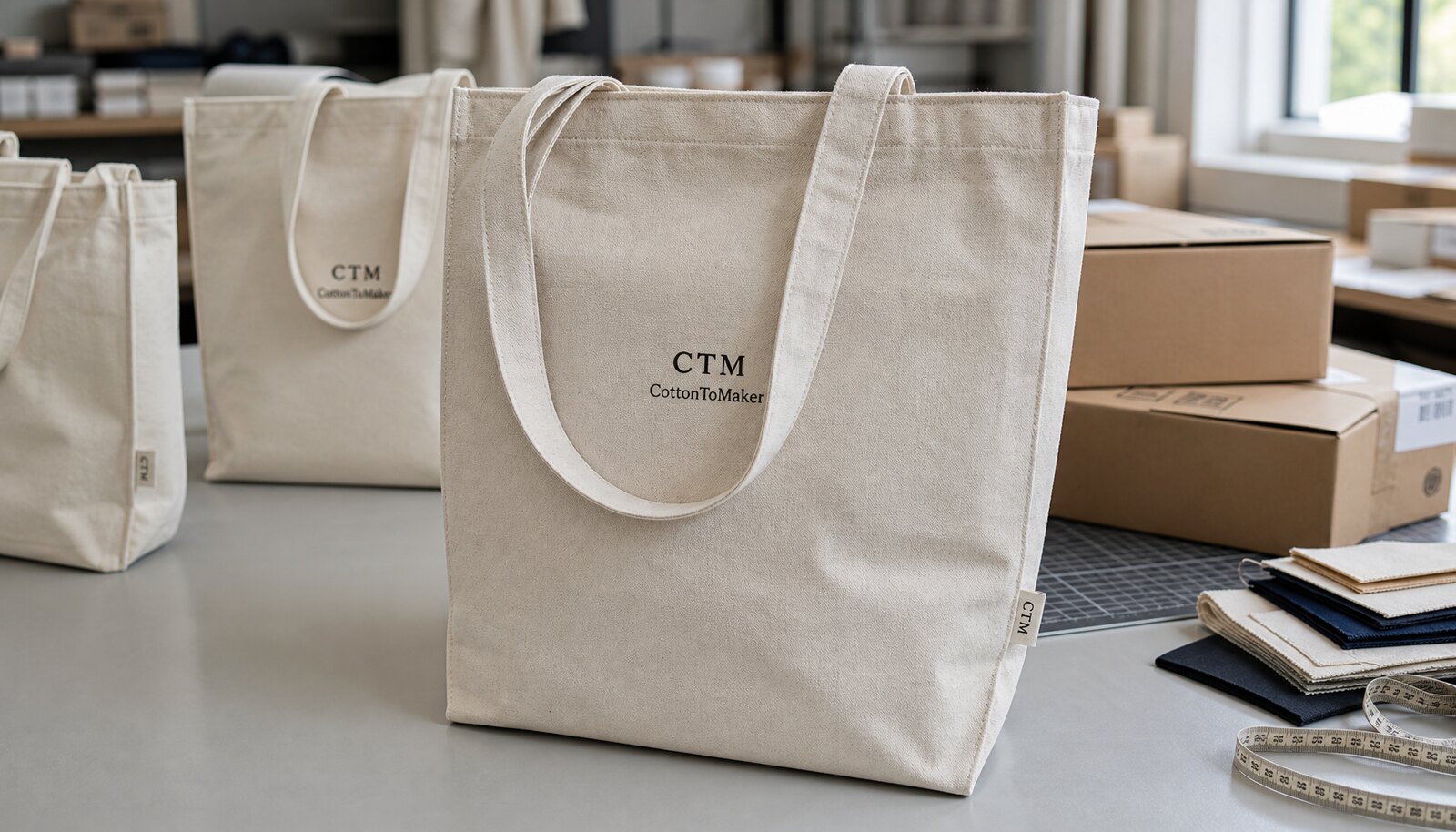
Start With The Carton Problem, Not The Tote
For boutique book fair programs, the failure point is often not the bag itself. Buyers spend time on artwork and fabric, then discover the cartons are too heavy, too large, or packed in a way that slows receiving and damages resale units. If the tote is going to a store, a pop-up, or a distributor warehouse, the shipping carton has to be planned at the same time as the tote spec. The tote, the fold, the carton count, and the freight mode are one system.
The useful way to write the brief is to start from the receiving side. Ask where the cartons will land, who will open them, whether bags need to go straight to shelf or to a backroom, and whether the buyer wants each tote individually polybagged or packed in bulk. That answer determines the carton dimensions, the pack count, and even whether the bag should be flat-folded or lightly stuffed for shape. If you do not define this early, the factory will choose a default pack method that may look fine on paper but creates avoidable labor on arrival.
- Set carton planning before artwork approval so fold size and logo placement do not conflict.
- Treat carton count as a commercial spec, not an afterthought.
- Plan for how receiving staff will open, count, and shelve the product.
Pick The Right Canvas Weight And Structure
For canvas book fair totes for boutiques, the best starting point is usually 10 oz to 12 oz cotton canvas, with 12 oz or roughly 340 gsm being the safer choice when the tote is meant to feel like a retail product. A lighter 8 oz bag may reduce cost, but it can feel soft, collapse under books, and show print distortion more easily after folding. If the tote is mainly a branded giveaway, 10 oz can be acceptable. If the buyer wants a higher perceived value or a bag that can carry hardbacks and catalogues, 12 oz is the more defensible spec.
Structure matters as much as fabric weight. Reinforced handles, bar-tacks, and a stable base seam reduce returns and store complaints more effectively than a cosmetic upgrade. A tote with a weak handle seam may survive sampling but fail once customers fill it with books and promo material. Buyers should also decide whether they want a gusset, because a gusset changes carton count, folding behavior, and shelf presentation. If the tote is intended to be sold, not just handed out, the buyer should view stitching and edge finishing as part of brand perception, not only durability.
- Use 10 oz / about 280 gsm for lighter promotional use and tighter budgets.
- Use 12 oz / about 340 gsm for heavier books, resale programs, or better hand feel.
- Specify handle reinforcement and stress-point stitching before quoting.
Choose A Print Method That Fits Boutique Sell-Through
The print method should match the artwork and the store environment, not just the factory's cheapest setup. For most boutique tote programs, 1 or 2 color screen print is the best value because it gives strong opacity on natural canvas, clear edges, and a predictable unit cost at scale. If the artwork has small type, gradients, or multiple tones, the buyer should expect either more setup complexity or a different decoration route. Embroidery can work for premium branding, but it changes cost, hand feel, and production time. Heat transfer can be useful for short runs, but it needs more scrutiny on durability and surface feel.
The practical issue is not only visual quality. Ink curing, fabric tension during printing, and artwork placement relative to the fold all affect whether the tote looks aligned when it is pulled from the carton. Buyers should ask the factory to show the print on the final fabric color and to confirm registration tolerance. If the logo is placed too low or too close to a seam, the tote may look fine on a flat sample and awkward once folded and packed. A good quote should state the number of colors included, the setup fee, and any surcharge for oversize print areas or multiple print positions.
- Prefer screen print for simple logos, strong coverage, and repeat orders.
- Use embroidery or woven labels only when the branding justifies the added cost and lead time.
- Approve print on the actual production canvas, not a substitute sample cloth.
Translate Shelf Demand Into Carton Math
Carton planning starts with the route, not the carton artwork. If the bags will move from factory to warehouse to store, the carton has to work for handling at every stage. That means a fixed pack count, a carton that can be stacked without sagging, and a gross weight that a warehouse team can move without special handling. For many tote programs, the safer approach is a flat-folded pack with a moderate carton count rather than trying to maximize units per box. A carton that saves a small amount on freight but creates labor delays or damaged corners is not actually cheaper.
The buyer should ask the factory to propose a carton size based on the finished fold dimension, then test whether the carton can be palletized cleanly. Dead air inside the carton adds freight cost; overcompression damages shape and slows counting. In practice, the right answer is often a carton that holds a stable quantity, stays under the buyer's handling limit, and allows clear outer marking. If the tote is sold as merchandise, the outer carton should also protect the surface from crush marks and avoid deep fold creases that customers notice at retail.
- Set a maximum carton weight and do not let the factory exceed it for the sake of unit count.
- Confirm master carton dimensions against pallet size and warehouse rack limits.
- Use carton marks that identify size, color, quantity, and carton number at a glance.
Compare Supplier Routes Before You Compare Unit Price
A direct factory is usually the strongest option when the buyer needs one owner for cutting, printing, sewing, packing, and carton marking. That route gives the best chance of keeping the tote and the carton spec aligned. A trading company may be useful if the buyer needs sourcing support across multiple categories or a smaller order that would not justify a dedicated setup. A local decorator can be useful for rush artwork changes, but local production often raises unit cost and can limit fabric choices or carton control. The right route depends on where the project risk sits: artwork, packing, lead time, or compliance with a retailer's inbound rules.
The point is to compare evidence, not labels. Ask each supplier how they control print registration, who signs off on carton count, whether the production sample is made on the same line as bulk goods, and what part of the work is outsourced. A cheaper quote can be misleading if it excludes carton labels, polybags, or the labor required to fold the tote to the agreed size. When the buyer compares suppliers on the same spec sheet, the cheapest quote is often the least complete, not the best value.
- Favor direct factory sourcing when carton control and print consistency matter.
- Use a trading company only if it adds real coordination value or access to capacity.
- Treat quote completeness as part of supplier quality.
Set MOQ Logic Around One Stable Spec
MOQ should be built around the parts of the order that create setup work: fabric color, canvas weight, handle type, print colors, and carton spec. For a first order, keep the spec narrow. One body fabric, one handle configuration, one print placement, and one master carton format will usually produce a cleaner quote and fewer production mistakes. If the buyer splits the order into many colorways or alternate carton sizes too early, the factory may allocate setup cost across the job in ways that are hard to compare later. That is where quotes become noisy and lead times stretch.
Sampling should follow a disciplined path. A proto sample is useful to test proportions. A pre-production sample should be made on the final canvas, final thread, final ink, and final folding method. For a boutique buyer, the most important sample is not the prettiest one; it is the one that proves the final carton count still works after the tote is folded and packed. If the sample looks good but cannot be packed efficiently, the order is still wrong. Ask for one signed sample set that covers print, handle strength, size, and carton mark approval before bulk starts.
- Keep the first order to one or two SKUs when possible.
- Use a pre-production sample on final materials, not a showroom sample.
- Approve the folded pack size as part of sample sign-off.
Pack For Receiving, Not Just For Protection
Packing spec should be written for the warehouse team that receives the cartons. Flat-folded totes are easier to count and usually reduce carton bulk, but the fold direction matters. If the logo lands on the crease line, the buyer may receive bags that look wrinkled or distorted when they are first opened. For many boutique programs, a simple inner polybag is enough if the product needs protection from dust or moisture; heavy plastic or excessive inserts can make the program feel less premium and raise packing cost without clear benefit. If the tote is to be sold immediately after unboxing, the buyer should also think about how the folded face presents in the carton so the first unit pulled for inspection is representative of the batch.
Carton marks are part of the packing spec, not a clerical detail. Each carton should show product name, size, color, quantity, carton number, gross and net weight if required, and any retailer-specific destination mark. If there are multiple cartons for one SKU, the numbering must be obvious so the buyer can confirm whether any box is missing before the shipment leaves origin. In mixed programs, poor carton marking causes more receiving delay than weak stitching. A factory that handles the labels properly is usually easier to work with at scale than one that only knows how to sew well.
- Define fold direction so the logo does not sit on the main crease.
- Use only the amount of inner packing needed to protect the product and preserve presentation.
- Make carton marks legible and standardized across all boxes.
Use QC Thresholds That Catch Retail Problems Early
Quality control on tote bags should focus on what retailers and end users actually notice: size consistency, handle strength, seam quality, print clarity, and carton accuracy. A buyer can accept a small tolerance on overall dimensions, but handle length, logo position, and stitching around stress points should be tightly controlled. The bag should also be checked after folding, because some defects only appear when the product is packed the way it will ship. A tote with a good flat sample but poor pack behavior is a production issue, not a packaging issue.
A sensible QC plan includes a signed reference sample, an in-line check during sewing and printing, and a final carton audit before shipment. The final audit should not only inspect appearance; it should verify count, carton labeling, and whether the actual packed quantity matches the packing list. For imported retail goods, missed counts and mixed cartons often cost more than visible cosmetic defects. If the buyer has a third-party inspector, the brief should include folding method, carton count, print placement tolerance, seam reinforcement, and carton strength expectations. AQC is not enough if the inspector only opens a few bags and ignores the packed carton.
- Inspect the product in folded, packed, and opened states.
- Measure size, handle length, print placement, and stitch quality against the signed sample.
- Verify carton count and outer marks before the container is sealed.
Build The RFQ So Quotes Are Comparable
A good RFQ gives the factory enough information to quote the same product, not a similar one. Include the tote size, fabric weight or GSM, handle width and length, print method, number of colors, packing method, carton count target, carton dimensions if known, destination country, and whether the order is for resale or promotion. The buyer should also state whether the factory needs to quote EXW, FOB, or another shipping term, because landed cost comparisons get distorted when one supplier includes packing and another does not. If the buyer wants a quick comparison, request the quote in separate lines: tote body, printing, packing, master carton, loading, and any inland service.
The quote should also answer schedule risk. Ask for sample lead time, bulk production lead time after sample approval, and the point at which artwork becomes locked. If the supplier cannot show whether they have the fabric in stock or need to weave or dye it first, the schedule should be treated as an estimate, not a promise. That is especially important for boutiques because launch windows are often fixed around a season, a fair, or a store event. A quote that looks cheap but hides a 4-week delay can be more expensive than a cleaner quote with a realistic timeline.
- Request line-item pricing, not only a single unit price.
- Define the shipping term and destination before comparing suppliers.
- Lock the artwork and folding spec before bulk dates are promised.
Specification comparison for buyers
| Spec decision | Recommended option | When it fits | Buyer risk to check |
|---|---|---|---|
| Supplier route | Direct factory with in-house cutting, printing, packing, and carton marking | Repeat orders, custom carton counts, and buyers who need one owner for spec control | Confirm the factory is not outsourcing print or packing after the sample stage |
| Sampling route | Pre-production sample made on the same canvas, thread, print, and carton spec as bulk | New boutique programs where the carton must arrive shelf-ready | Do not approve a sales sample that uses different fabric weight or different ink curing |
| Print method | 1-2 color screen print for the main logo, with embroidery or woven label only for premium branding accents | Most book fair tote programs with simple artwork and clear logo placement | Check registration tolerance, ink opacity, and hand feel after curing |
| Fabric route | 10 oz to 12 oz cotton canvas, with 12 oz or about 340 gsm for heavier books and retail resale | Boutique buyers who want a sturdier tote that feels closer to merchandise than giveaway stock | Watch for thin open weave fabric that looks heavy on paper but collapses in hand |
| Packing route | Flat-folded totes in a fixed count per master carton, usually with simple inner polybag protection if needed | Wholesale and retail distribution where cartons move through a DC or 3PL | Avoid overstuffed cartons that create crush marks and counting errors |
| Freight route | Sea freight for volume, air freight only for samples, rush replenishment, or small trial lots | Orders where carton dimensions and weight affect landed cost more than unit price alone | Check volumetric weight, pallet stackability, and the risk of oversize cartons |
| MOQ route | One SKU per fabric, print setup, and carton spec for the first order | Pilot programs and new boutique launches with uncertain sell-through | Multi-SKU orders often hide extra setup charges and make carton planning unreliable |
| QC route | Factory inspection with carton count verification before shipment, not only destination receiving | Importers who need to catch count, label, and pack issues before freight leaves origin | A tote can pass print review and still fail because carton marks, counts, or folds are wrong |
Buyer checklist before sampling
- Lock the tote size, gusset, handle length, and fabric GSM before asking for a quote.
- Specify whether the tote is for resale, giveaway, or book fair merchandising, because that changes fabric weight and packing logic.
- State the logo size, number of print colors, print position, and whether the artwork must stay visible after a flat fold.
- Define the master carton target, including max carton weight, acceptable carton dimensions, and whether cartons must palletize cleanly.
- Request one pre-production sample on the final fabric and final print method, not a studio sample on substitute material.
- Ask the factory to confirm whether cutting, printing, sewing, and packing are all done in-house or partially outsourced.
- Require quote lines for tote, printing, packing, carton, and inland loading so hidden costs do not sit inside a vague unit price.
- Include a carton label spec with product name, size, quantity, carton number, and destination mark before bulk production starts.
Factory quote questions to send
- What exact canvas weight, weave type, and finished GSM are you quoting for the body and handles?
- Is the sample made on the same production line, with the same thread, ink, and curing method as bulk goods?
- How many print colors are included, what is the setup charge, and what is the registration tolerance you can hold on bulk production?
- What is your proposed pack count per inner bag and per master carton, and what is the maximum carton weight you recommend?
- Do you apply carton marks, barcodes, and lot codes at the factory, or should the buyer relabel after receipt?
- Which steps are in-house and which steps are outsourced, especially cutting, screen printing, embroidery, and packing?
- What is the normal lead time for sample approval, bulk production, and carton-ready shipment after artwork confirmation?
- Can you break out the quote by tote body, print, handle reinforcement, packing, carton, and loading so we can compare suppliers line by line?
Quality-control points to confirm
- Check body dimensions, handle length, and gusset depth against the approved spec with a practical tolerance that the buyer accepts before production starts.
- Inspect stitch density, seam allowance, handle bar-tack placement, and reinforcement at stress points where books create pull load.
- Confirm print opacity, edge sharpness, and registration on the final fabric color under normal store lighting, not only in factory light.
- Rub-test the print and inside seams so excess ink, loose fibers, or poor curing do not show up in retail handling.
- Verify fold direction, pack count, and carton count by random opening of sealed cartons before shipment.
- Check carton strength, tape closure, outer marks, and label placement so receiving teams can identify the SKU without opening cartons.
- Compare bulk production against the signed sample for color tone, handle width, logo placement, and overall hand feel.
- Record lot code or production reference on cartons and packing list so any complaint can be traced back to the right batch.