Start With the Buying Job, Not the Bag
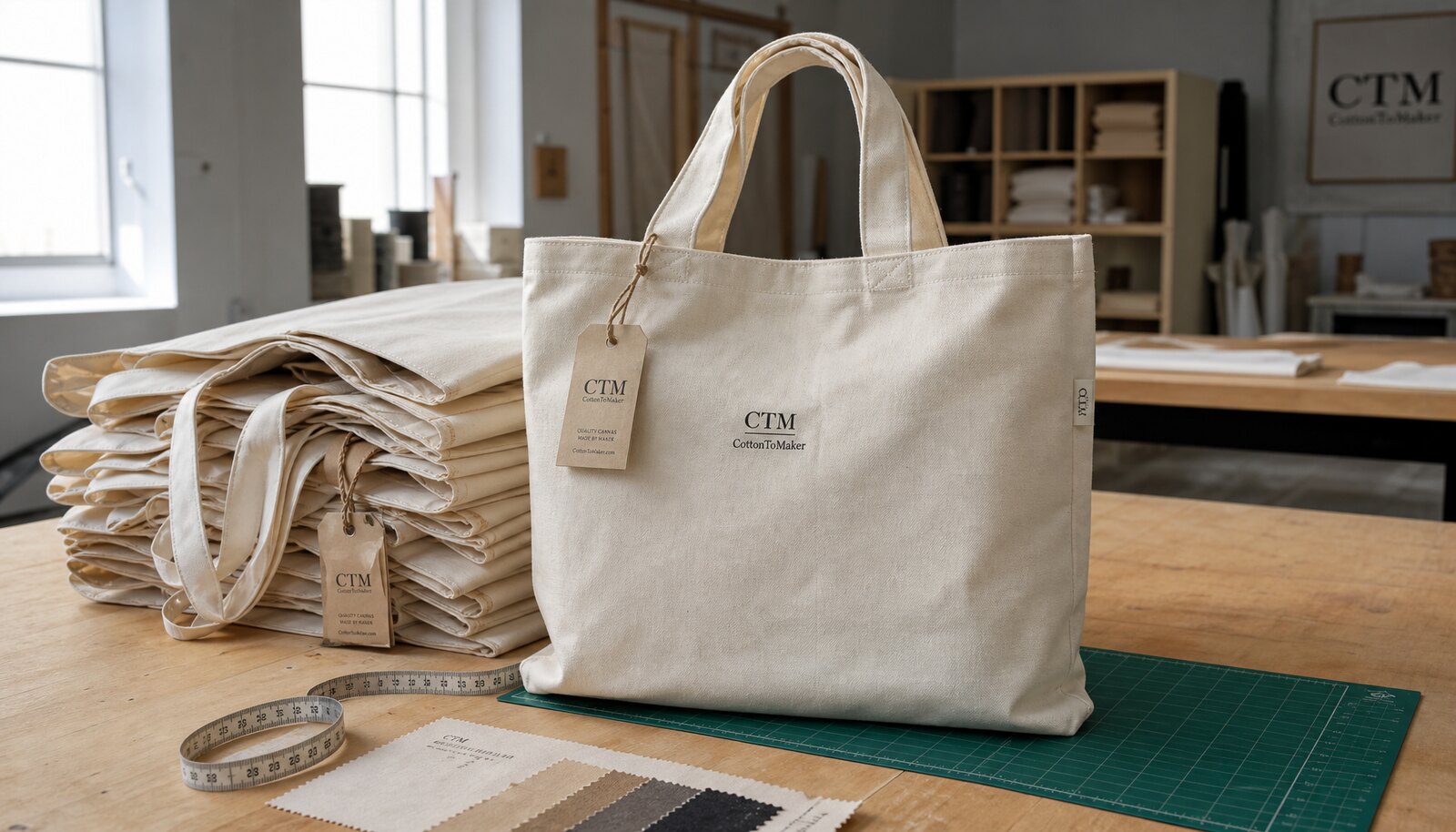
For boutiques, a canvas book fair tote is rarely just a tote. It may be a resale SKU on a retail shelf, a book fair carry bag tied to a seasonal event, a gift-with-purchase, or an in-store packaging item that needs to look good the moment it leaves the counter. That context changes everything a factory should quote. A bag built for a one-day event can tolerate lighter finishing than a bag that has to sell at full margin beside apparel, journals, or home goods.
The most common sourcing mistake is to request a generic canvas tote and then compare prices from factories that are quoting different constructions. One supplier may be pricing a lightweight open-top promotional bag; another may be quoting a more structured 12 oz retail tote with reinforced handles, tighter stitching, and better print registration. Those are not equivalent quotes, even if the photos look similar. Before you ask for numbers, define the buying job in one sentence: what the tote is for, how it will be used, and what the boutique customer expects when they touch it.
For B2B procurement, that one sentence should drive the rest of the brief. If the tote will carry books, magazines, small boxed goods, or event collateral, the buyer must tell the factory the likely load, the desired shelf appearance, and whether the bag should stand upright when filled. If the tote is a retail item, appearance and repeatability matter more than the lowest possible fabric cost. The best quote is the one that matches the commercial use, not the one that simply looks cheapest on an email thread.
- State the end use: resale, giveaway, gift-with-purchase, or packaging.
- Say whether the tote must look premium enough for shelf display.
- Tell the factory the likely load and whether the bag must stand upright.
- Use the same use case when comparing every supplier quote.
Choose a Fabric Spec the Factory Can Actually Hold
Canvas weight drives a large share of the cost and the feel of the bag. For this product category, 10 oz canvas is generally the lightest practical retail option, around 340 GSM depending on weave and finishing. Twelve oz canvas is a common middle ground, often around 400 GSM, and usually feels more appropriate for boutique resale. Fourteen oz or heavier gives more body, better shape retention, and a more substantial retail impression, but it also increases cutting resistance, sewing effort, and freight weight. Ask the factory to quote both ounces and GSM so the fabric cannot be disguised by unit conversion.
Weight alone is not enough. Two bags with the same nominal ounce rating can behave very differently depending on weave construction, yarn thickness, and finishing. Ask whether the factory is quoting plain weave canvas or duck canvas, because duck typically feels denser and more structured. If the fabric is natural and unbleached, expect flecking and tone variation; that may be acceptable for a book fair tote, but it should be acknowledged in the approval sample. If the tote is dyed, ask how the mill controls shade consistency and whether the factory is buying stock fabric or ordering a custom lot.
Finish also matters. A raw, unwashed canvas can shrink or tighten after the first handling cycle, and some bags arrive with a firmer hand than the approved sample. If the tote must be resold at retail, ask about prewashing or anti-shrink treatment, and confirm whether that step changes the size tolerance or print result. A premium-looking boutique tote usually benefits from a stable fabric lot, a balanced body weight, and a handle construction that matches the body weight rather than copying the reinforcement of a lighter promotional bag.
- Use 10 oz only for light-duty programs or tight price targets.
- Use 12 oz when the tote needs a balanced retail feel and reliable print performance.
- Use 14 oz when structure, shelf presence, and carry strength matter more than lowest cost.
- Ask if the fabric is plain weave or duck canvas before you compare quotes.
Specify Dimensions, Gusset, and Handle Construction in Manufacturing Language
A tote quote becomes meaningful only when the factory knows the exact geometry. Give finished width, finished height, gusset depth, handle length, and handle drop. If the bag must fit books or a specific promotional kit, state the minimum internal opening and the flat size. Many buyers think they have specified size when they only wrote “large tote,” but factories need actual measurements from seam to seam, not marketing adjectives.
Handle construction deserves the same level of detail. For a boutique tote, there are major differences between self-fabric handles, cotton webbing handles, folded-edge handles, and straps sewn into the side seam. Self-fabric handles can feel more unified but may stretch if the canvas is too light. Webbing handles can improve strength and make the bag easier to lift, but the visual style changes. If the tote will carry books, ask the factory to state whether the strap attachment is captured in the side seam, set below the top fold, or reinforced with a separate patch.
The buyer should also specify the stitch language. If the factory says “reinforced handle,” that is not enough. Ask for seam allowance, topstitch count, whether the handle base uses box-X stitching, bartacks, or double-row stitching, and how many stitches per inch are targeted on the stress seams. A tote that will hold heavier loads should not rely on vague “strong stitching” wording. Put the construction into the RFQ so the quote is built around the same engineering standard across all vendors.
- Provide finished width, height, and gusset depth, plus the flat size if needed.
- State handle length, handle drop, and handle width.
- Ask how the handle is attached: seam-captured, topstitched, or patch reinforced.
- Require the supplier to name the reinforcement method, not just say “strong stitching.”
Compare Sourcing Routes Before You Compare Unit Price
Not every factory quote represents the same sourcing route, and route differences can distort price comparisons. A direct tote factory with in-house sewing and printing usually gives the cleanest accountability because the cut, sew, decorate, and pack steps sit under one roof. That does not automatically make it cheaper, but it is easier to manage when something goes wrong. A trading company can be useful if the buyer is consolidating multiple packaging items, but the quote should still disclose the actual production site so you can judge capability, not just sales polish.
A sewing factory that outsources decoration can still work, but the buyer needs to know where the handoff occurs. If the bag is sewn in one facility and printed elsewhere, the risk is not only schedule. Color matching, sample interpretation, and responsibility for defects can all get messy when two vendors are involved. A local decorator using imported blanks is another legitimate path, especially for short retail launches, but blank-bag variation can affect shade, weave, handle firmness, and final presentation. That may be acceptable for a quick program and unacceptable for a replenishable boutique SKU.
The right sourcing route depends on the primary risk. If the risk is timing, choose the route with the shortest practical lead time and the simplest handoff. If the risk is consistency, choose the supplier that can lock the fabric and construction spec and repeat it in later orders. If the risk is artwork complexity, choose the vendor that can demonstrate control over the decoration method you actually want. Buyers should decide the route first, then ask for quotes from only those routes that fit the commercial goal.
- Use a direct factory when the spec is fixed and repeatability matters.
- Use a local decorator with blanks when speed matters more than full customization.
- Use a trading company only if the extra coordination is worth the margin.
- Require the real manufacturing site name before accepting any quote.
Build a Quote Template That Exposes Hidden Cost
A useful factory quote should read like a bill of materials plus service scope, not a one-line price. If the supplier only writes “canvas tote bag with logo,” the buyer cannot tell whether fabric, sewing, print setup, labels, packing, or cartons are included. That is where margin surprises appear later. The commercial team should ask for a line-item quote showing the blank bag, decoration, label or patch, packing materials, sample fees, tooling or screen charges, carton cost, and shipping term.
The most common hidden cost is setup. Screen printing may include one screen per color, plus ink mixing and proofing. Heat transfer or DTF may include artwork preparation and press setup. Woven labels and sewn patches may require separate sampling or sewing operations. None of these should be buried inside a vague unit price. If they are hidden, the buyer will have trouble comparing one factory to another because each may be quoting a different bundle of work.
Packing is the other common blind spot. Bulk pack is inexpensive but often unsuitable for retail shelf-ready inventory. Individual polybagging, barcode labels, hangtags, and master carton markings each add labor and material. For boutiques, the quote should show the packing format by SKU, not just one generic sentence. If the quote is meant to support procurement decisions, it should tell the buyer exactly what is being sold: the bag body, the decoration, and the pack-out scope.
- Request separate lines for fabric, sewing, print, label, packing, carton, and sample fees.
- Require the Incoterm on every quote: EXW, FOB, or DDP.
- Ask the supplier to list exclusions explicitly.
- Make setup, plate, and tooling charges visible before you compare suppliers.
MOQ, Sampling, and Artwork Approval Need Their Own Rules
MOQ for canvas book fair totes is rarely one number. A factory may accept a low sewing MOQ but still require a larger minimum for a custom print screen, custom dye lot, or special label version. That matters for boutique buyers, because the commercial risk is usually in the decoration and packing options, not just the bag body. Ask for MOQ by color, by artwork version, and by label type so the production realities are visible before negotiation starts.
Sampling should follow the same structure as the order. A plain sample confirms the body size, fabric hand, seam alignment, and handle geometry. A printed sample confirms artwork placement, ink density, and the interaction between the chosen canvas and the chosen print method. A pre-production sample is the final approval piece before bulk, and it should be made from the actual fabric lot or the closest locked substitute. If the factory says the approved sample is “for reference only,” the buyer should insist on a written spec sheet that converts the sample into measurable requirements.
Artwork approval is a separate control point. The buyer should approve not only the image but also the version number, scale, color references, and print location. Fine text, thin lines, and small logos can disappear on coarse canvas if the art is not adapted to the decoration method. For boutiques, this is especially important because the tote often acts like a brand surface. One wrong scaling decision can make the bag look cheap even when the sewing is fine.
- Get MOQ by color, by print version, and by label version.
- Use a plain sample for construction, a printed sample for decoration, and a pre-production sample for final sign-off.
- Write the artwork version number on the approval record.
- Do not accept “reference only” without a measurable spec sheet.
Print Method Choices Change Cost, Feel, and Retail Appeal
Screen print is usually the most cost-efficient choice for simple logos, one- or two-color artwork, and repeat orders. It tends to work well on natural canvas because it gives strong opacity and a familiar retail look. But screen print is not automatically the right answer for every boutique tote. If the art uses fine lines, small type, or multiple tonal areas, the buyer should test whether the coarse texture of canvas will break the image or force extra setup work. On low-cost quotes, screen count and color separation are often where the hidden cost sits.
Heat transfer and DTF can solve detailed art problems, but they introduce different questions. The buyer should ask about hand feel, edge sharpness, curing, and whether the transfer sits cleanly after folding and handling. For a tote sold in a boutique, a decoration that feels plasticky may be less acceptable than a simpler print with better fabric integration. Embroidery and woven patches can raise perceived value, but they also add labor, thickness, and potential distortion on the bag body. A heavy patch near a seam can change drape or make the tote sit awkwardly on the shelf.
The safest procurement approach is to match the artwork to the method rather than forcing the method to match the artwork after the fact. Ask the factory to tell you what artwork changes they recommend for the chosen method. A good supplier will warn you if a thin font will fill in, if a gradient will band, or if a dense print area needs stronger curing. Those warnings are useful because they prevent a quote from looking good on paper and failing in production.
- Use screen print for simple logos and repeatable pricing.
- Use heat transfer or DTF for detailed artwork or smaller quantities.
- Use woven labels, side labels, or embroidery when retail presentation matters more than the lowest decoration cost.
- Ask the factory what artwork changes they recommend before you approve the print method.
Give the Factory Hard Stitching and Reinforcement Requirements
For canvas totes, sewing quality is not a cosmetic issue; it is a performance issue. The buyer should specify stitch density on the load-bearing seams, handle base reinforcement, seam type, and the acceptable number of skips or loose thread tails. A quote that does not mention construction details may still produce an attractive sample, but you will have no leverage if the bulk run comes back with weaker reinforcement or inconsistent topstitching. For book fair use, handle failure is the most obvious disappointment, so that area needs the most explicit wording.
Good procurement language is concrete. Instead of “strong handles,” ask for a box-X stitch, bartacks, or a clearly described double-row reinforcement at the stress point. Ask whether the main seams are single-needle or double-needle, whether edges are overlocked before topstitching, and what seam allowance is used. Some buyers also specify stitches per inch, often in a visible range such as 6–8 SPI for heavier canvas, but the exact target should reflect the factory’s machine capability and the fabric weight. The key is to write a measurable standard, not an aspirational one.
If the tote needs to carry books, magazine stacks, or small retail boxes, the buyer should ask the factory to confirm how the reinforcement behaves under load. A simple pull test on the handle base is more useful than a generic “durable” claim. Put the load target in the spec sheet, define what failure looks like, and make the production team inspect the same points on every carton sample. The quote becomes much more meaningful when the sewing details are part of the commercial offer rather than afterthoughts in sampling.
- Ask for the seam type, seam allowance, and reinforcement pattern.
- Request a visible stitch target, such as a defined stitches-per-inch range.
- Specify the load-bearing areas that must be reinforced.
- Do not accept “strong” without a named stitch method.
Set QC Targets Before Bulk Production Starts
Quality control for canvas book fair totes should be written as a workflow, not a slogan. The buyer should define the pre-production sample checkpoints, the bulk inspection sampling plan, and the defect categories before production begins. For many commercial buyers, a practical framework is AQL 2.5 for major defects, with the buyer also defining what counts as major versus minor. That threshold is only useful if it is written into the order documents and the supplier agrees to it before cutting starts.
Start with dimensional control. Body width, body height, gusset depth, and handle length should all have a tolerance band. Then move to construction: topstitch straightness, seam finish, lock-off quality, label placement, and the quality of the inside seam. For decoration, inspect print placement, registration, curing, color coverage, and whether the print sits flat without excessive cracking or tackiness. For retail-facing tote bags, the front panel matters, but for book-carrying use, the handle base and bottom seam are the real functional points.
A useful QC plan also includes a pull test or load simulation. The buyer should define the target load in kilograms or pounds and say how many cycles or holds are required before acceptance. This does not need to be laboratory testing in every case, but it should be a repeatable method. Add clear acceptance and rejection language: no open seam, no broken handle stitching, no visible oil marks, no major print misalignment, no carton count variance. When the factory knows these rules before production, the quote becomes easier to evaluate because quality is attached to measurable criteria rather than generic promises.
- Use AQL 2.5 or a written alternative, and define major versus minor defects.
- Measure body size, gusset, and handle length against the approved sample.
- Check handle reinforcement, seam continuity, and print registration on every inspection sample.
- Run a load or pull test on representative pieces before release.
- Reject bags with open seams, broken handle stitching, major misprints, or contamination.
Packing, Labeling, and Cartons Affect Margin More Than Buyers Expect
Packing decisions shape both freight cost and retail readiness. Bulk packing reduces volume and is usually the cheapest path for shipping, but it is not always the right path for boutiques. If the tote is going straight to a store floor, the buyer may need individual polybags, barcode stickers, size stickers, hangtags, or retail-ready folding. Every added step costs labor and material, and every choice affects how neatly the product arrives. This is why packing must be quoted as part of the product, not as an afterthought.
Labeling deserves the same attention. A woven side label sewn into the seam creates a permanent brand mark and usually looks more premium. A paper hangtag is cheaper and easier to change between seasons, but it can fall off or be removed before the bag reaches the shelf. A label sewn inside the seam is harder to see but can avoid visual clutter. The buyer should decide which label format fits the retail story and then ask the factory to price it explicitly. Otherwise the quote can look attractive until the labeling line item appears later.
Carton planning is another overlooked cost center. The carton size affects freight density, and the inner count affects how well the bag holds shape during transit. Ask the factory for the number of units per carton, carton dimensions, carton gross weight, and the shipping marks that will appear on the outer carton. If the tote is sold to boutiques, the buyer should also clarify whether master cartons need SKU separation by color or artwork version so store-level receiving is simpler. A good quote should make the packing logic visible enough for procurement to compare true landed cost.
- State whether the bag should arrive bulk packed or retail ready.
- Define polybag need, barcode placement, inner count, and carton marks.
- Choose the label format before sampling: woven label, side label, or hangtag.
- Ask for carton size and units per carton because freight density changes the true cost.
Specification comparison for buyers
| Spec decision | Recommended option | When it fits | Buyer risk to check |
|---|---|---|---|
| Direct tote factory with in-house sewing and printing | Use one factory that cuts, sews, prints, and packs | Best for repeat boutique programs, lower handoff risk, and one party accountable for the finished bag | Confirm the print room is truly in-house, and ask to see the sewing line, heat-curing area, and final inspection area |
| Sewing factory plus outside print specialist | Split only when the bag factory has weak decoration capability | Useful when the body construction is simple but the artwork needs specialty decoration | Lock color standards, print placement, and approval timing or the two vendors will blame each other |
| Trading company or sourcing agent | Use only when you need multi-item consolidation or local coordination | Fits buyers bundling totes with packaging, tags, and other retail goods | Require the real factory name, not just the reseller’s business card and margin |
| Local decorator using imported blanks | Buy blank totes offshore and add branding domestically | Works for small launches, late artwork changes, or very short retail deadlines | Blank bags can vary by lot in shade, weave, and handle build, which changes the final presentation |
| Nearshore factory | Choose a regional supplier for shorter transit and easier communication | Good for seasonal boutiques, smaller inventory risk, and faster sample loops | Unit cost may be higher, so compare landed cost, not just ex-factory pricing |
| Stock blank program with custom label | Use a standard tote body and add woven label, side label, or hangtag | Useful when you need simple branding and faster replenishment | The blank stock must stay consistent in body size, fabric tone, and reinforcement |
| Small MOQ trial run | Start with a limited run on approved fabric and one decoration method | Best for a new SKU, a book fair promotion test, or a boutique resale pilot | Setup cost per unit rises quickly, so check whether the test batch is still commercially meaningful |
| Replenishment contract with pre-approved specs | Lock fabric, print size, label, and packing before the first order | Best for ongoing boutique programs with seasonal reorder potential | If the spec sheet is vague, later batches can drift on shade, seam finish, or label placement |
Buyer checklist before sampling
- State the commercial purpose clearly: retail resale, book fair giveaway, gift-with-purchase, or in-store packaging.
- Lock fabric weight in both oz and GSM so the factory does not quietly quote a lighter cloth.
- Define the tote size, gusset depth, handle length, and whether the bag must stand upright on a shelf.
- Specify the weave and finish: plain weave or duck canvas, natural or dyed, bleached or unbleached, prewashed or raw.
- Write the handle construction: folded webbing, self-fabric handles, width, length, and whether the handle is set into the seam.
- Ask for reinforcement details: cross-stitch, box-X stitch, bartack, seam allowance, and whether the base seam is double-stitched.
- State the print method, print area, number of colors, and whether the artwork has fine lines, halftones, or solid blocks.
- Name the target quantity by color and by artwork version, not only total units.
- Request plain sample, printed sample, and pre-production sample if the tote is customized.
- Confirm packing format, polybag use, barcode placement, inner count, carton mark format, and whether retail hangtags are included.
Factory quote questions to send
- What exact fabric are you quoting: plain weave or duck canvas, and what is the weight in oz and GSM?
- Is the fabric stock-supported or custom woven, and does the quote include any prewash, singeing, or anti-shrink treatment?
- What are the finished dimensions, gusset depth, and tolerance range for body size and handle length?
- What handle construction is included: self-fabric, webbing, folded edge, or reinforced shoulder-length strap?
- How many stitches per inch do you target on the main seams, and is the base seam double-stitched or overlocked plus topstitched?
- What reinforcement method is used at the handle stress point: box-X stitch, bartack, or multiple-row stitch?
- Which print method are you pricing, how many colors are included, and what is the screen or setup fee per color?
- Are artwork adjustments, plate fees, ink mixing, or curing charges included in the quote?
- What is the MOQ per color, per print version, and per label version?
- What sample stages are available, and which ones are chargeable or refundable against bulk?
Quality-control points to confirm
- Measure finished body width, height, and gusset depth against the approved sample and tolerances on the spec sheet.
- Check handle length, handle symmetry, and handle placement from the top edge on every sample pull and carton inspection.
- Inspect seam construction for skipped stitches, loose thread tails, broken tension, open side seams, and uneven topstitching.
- Verify reinforcement at the handle base with a box-X stitch, bartack, or equivalent approved method.
- Check stitch density on load-bearing seams; many buyers specify a visible 6–8 stitches per inch range depending on fabric weight and machine setup.
- Test print placement against the artwork board, including center alignment, vertical position, and left-right symmetry.
- Inspect print quality for pinholes, ghosting, ink bleed, cracking, incomplete cure, or excessive hand feel on the canvas.
- Confirm fabric shade consistency across cartons and lot codes, especially for natural canvas where flecking and tone variation are common.
- Check for surface contamination: oil marks, needle damage, loose fibers, dirt, discoloration, or handling scuffs.
- Run a pull-test or load simulation on representative samples, with the buyer defining the load target in kilograms or pounds before approval.