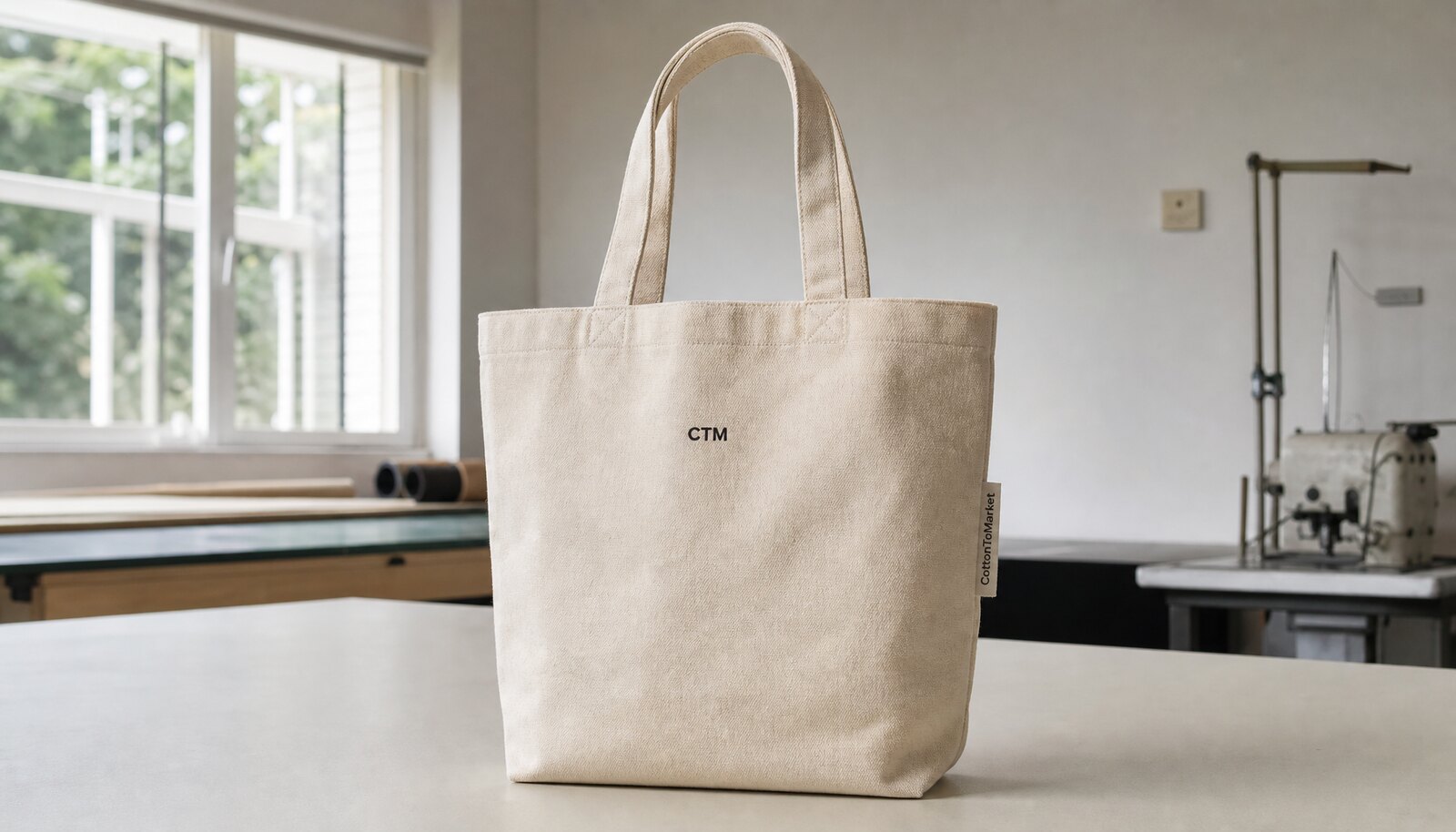
Why canvas bags with logo need a real buying spec
Canvas bags with logo are easy to describe and easy to under-spec. That is why procurement teams often get quotes that look close on paper but produce very different bags on the line. One supplier prices a light 8 oz body with a one-color screen print, another assumes 12 oz canvas, a larger print area, and reinforced handles. The bag name is the same; the build is not. If the RFQ does not pin down fabric weight, handle length, print size, and packing, the lowest quote is usually the least complete quote.
The clean way to buy is to treat the tote as a manufactured product, not a blank promotional item. That means defining the body structure, the logo method, the carton pack, and the inspection target before you request pricing. Buyers who do this can compare supplier offers on the same basis and reduce the usual back-and-forth over sample revisions, print color, or size drift. The goal is not just to get a logo on canvas; it is to get repeatable production that arrives ready to distribute.
- Start with the intended use: retail, corporate gifting, trade show, e-commerce, or resale.
- Match the bag spec to the use case before you decide on print and packing.
- Assume every missing spec will reappear later as a charge, delay, or quality dispute.
Set the body spec first: fabric weight, size, and build
For most buyers, the main spec choice is fabric weight. Lightweight promotional totes often sit around 8 oz or roughly 270 GSM, which works for low-cost event use but feels thin when the bag carries books or groceries. A more balanced retail or brand program usually lands at 10 oz to 12 oz, roughly 340 to 400 GSM. If the bag must carry heavier items or needs a more premium hand feel, some buyers move up to 16 oz or heavier, but that increases material cost, sewing load, and shipping weight. The right weight depends on load, appearance, and margin, not a generic idea of quality.
Size and structure matter just as much as GSM. A narrow tote with short handles can look tidy but fail in real use if the buyer planned to pack catalogues, bottles, or boxed gifts. Decide whether the bag needs a gusset, reinforced top hem, inner pocket, lining, or bottom board. Then define the handle width and drop length, because a handle that feels fine in a sample room can be awkward once the bag is filled. For procurement, the practical move is to ask the factory to quote the exact build, not a similar tote they already make.
- Common buyer starting points: 8 oz for giveaways, 10 oz to 12 oz for retail and premium promo, heavier canvas for load-bearing use.
- Write the finished size in millimeters or inches, not only as small, medium, or large.
- If the logo must sit centered, confirm the print area after seam allowance, not on the cut panel size.
Choose the logo method by artwork and volume
The print method drives both appearance and cost. Screen printing is usually the most efficient option for simple logos, solid colors, and mid-to-high volume programs because the setup spreads across more units. Heat transfer or digital transfer helps when the artwork has fine detail, more colors, or a short run, but the finish can feel less integrated with the canvas. Embroidery works when the buyer wants a premium look on a small mark, yet it is not the best choice for large filled logos on a stiff tote because it adds cost and can distort lightweight fabric. Woven labels and sewn patches are useful for side branding, but they do not replace a front logo unless the brand intentionally wants a subtler look.
The safest selection method is to match the print process to the artwork file and the order size. A one-color wordmark on 10,000 bags should not be quoted like a full-color illustration on 300 bags. A buyer should also decide whether the logo must be color matched tightly or whether a close visual match is enough. On natural canvas, some ink spread and fiber texture are normal, so the supplier should show a sample on the actual bag body, not on a smooth swatch. That is the only way to see how the logo sits on the weave.
- Use screen print for simple, repeatable branding with reasonable volume.
- Use transfer methods when the art is complex, the run is short, or you need more colors.
- Use embroidery or sewn labels when the brand wants a premium texture or a quieter logo placement.
Build the RFQ so quotes can be compared
Most quote gaps come from missing data, not bad intent. A useful RFQ should name the material, the exact size, the handle specification, the logo method, the logo placement, the number of colors, the required packaging, and the shipping term. Add a line for whether the supplier should quote sample cost separately, because some factories roll sample charges into unit cost while others list them as separate line items. If you only ask for a canvas tote with logo, the supplier is forced to fill in the blanks with their own assumptions.
The easiest way to compare offers is to force each supplier to quote the same commercial structure. Ask for the bag unit price, print setup, sample fee, packing charge, carton charge, and any label or barcode fee on separate lines. If one supplier says the order is cheap but excludes cartons and polybags, that is not a comparable quote. You also want the factory to state the MOQ by colorway and by print method, because a low bag MOQ can still hide a high logo setup threshold. Clear quote data is what turns a shopping list into a sourcing decision.
- Include artwork file format, logo size, print colors, and exact print position in the RFQ.
- Ask for the bag price and the decoration price separately when possible.
- Require the factory to state whether the quote is based on ex works, FOB, or another term.
Use MOQ logic instead of guessing at minimums
MOQ is not only a factory policy; it is the point where setup time, fabric consumption, and print screens stop making the order uneconomic. For canvas bags with logo, the minimum can vary by body color, print method, and packing style. A one-color screen print on a standard natural tote may accept a smaller run than a multi-color transfer or a dyed canvas body with custom labeling. Buyers should avoid treating MOQ as a single number unless the supplier confirms that the same MOQ applies to the bag, the print, and the packaging.
A practical MOQ decision is about risk, not just access. If the order is a new design test, a lower MOQ may be worth a higher unit price because it reduces inventory exposure. If the order is a replenishment program with confirmed sell-through, a larger MOQ usually improves pricing and print efficiency. The key is to make the MOQ decision with the sales plan in mind. Many buyers over-order a first run because the factory offered a better price at a higher quantity, then pay for the mistake through markdowns or storage.
- Lower MOQ usually means higher unit cost, more manual handling, or less packing efficiency.
- Custom color bodies and multi-color logo work often push the MOQ up faster than the bag shape does.
- For retail programs, compare MOQ against forecast sell-through, not against the lowest available factory number.
Compare supplier routes before you shortlist
Not every supplier route is the same. A direct factory with in-house sewing and printing gives the buyer one accountable source and usually better control over sample-to-bulk matching. A trading company can be useful if the buyer needs multi-category sourcing or help managing communication, but the real factory still matters more than the intermediary. Stock decorators can be fast, yet they limit control over body weight, handle length, and branding placement. A domestic printer on imported blanks can solve a deadline problem, but the final tote may never exactly match the original source bag. The supplier route should be chosen deliberately based on schedule, control, and repeatability.
The table below is the fastest way to narrow the route that fits the order. The buyer is not choosing the cheapest channel in abstract; the buyer is choosing the route that can actually reproduce the approved sample without hidden handoffs. If your order needs a specific canvas weight, a clean logo position, and retail-ready packing, a single accountable factory is often easier to manage. If your order is a short promotion with loose branding rules, a stock program may be enough. The mistake is mixing those two buying logics and expecting the same result.
- Choose a route that matches the order complexity, not the headline unit price.
- If the supplier outsources print, ask who owns the sample and who pays for rework.
- For repeat programs, prioritize consistency and documentation over one-time speed.
Define quality limits before bulk cutting starts
Quality control on canvas bags with logo is not complicated, but it must be written down. Start with measurable points: finished dimensions, handle length, seam allowance, fabric weight, logo position, and the number of allowed print defects. Then add appearance points like cleanliness, thread trimming, and fold consistency. A buyer who waits until inspection to define these limits usually gets trapped in subjective arguments about what looks acceptable. The factory will consider a loose thread normal if no rule says otherwise.
The most useful acceptance criteria are the ones that can be checked against the approved sample. For example, if the sample shows a centered front logo at a fixed size, the bulk should keep the same visual balance rather than drifting a few centimeters to the left. If the bag is meant to carry weight, reinforce the handle attachment and verify stitch density on both sides. If the print has solid coverage, inspect for pinholes, ink bleed, and fading at the fold lines. The bag should look and perform like the sample, not like a separate interpretation of it.
- Set numeric tolerances for size and handle length where possible.
- Treat print registration and front-face cleanliness as functional quality points, not cosmetic extras.
- Use a pre-shipment sample or golden sample as the reference for bulk inspection.
Control sample approval, not just sample receipt
A sample is useful only if the approval step is disciplined. The buyer should review a prototype or pre-production sample against the agreed spec, then mark down exactly what is approved and what still needs correction. If the logo position, handle drop, stitch density, and packing method are not written onto the approval record, the factory may assume those items are flexible later. That is how small tolerances get lost between the sample room and the production line. The approved sample should be the single reference point for bulk work.
For canvas bags, the sample review should include more than appearance. Check the bag width, height, gusset depth, handle reinforcement, seam finish, print sharpness, color density, and carton pack count. If the order includes retail packing, test one full packed carton for closure, label placement, and unit protection. When possible, keep a signed sample on both sides of the deal so that any dispute can be resolved against the same physical reference. It is much easier to settle a disagreement when both teams are looking at the same bag.
- Use one approval record that combines spec, artwork, sample photos, and packing details.
- Do not release bulk cutting until the pre-production sample matches the approved reference.
- If changes are still open, mark them as mandatory or optional so the factory knows what can move.
Packing, cartonization, and lead time affect the final landed cost
Packing is one of the fastest ways to create hidden cost. A tote that is easy to fold in the factory can take extra labor if every bag must be polybagged, barcode-labeled, and packed in strict retail counts. Carton size also matters because oversized cartons waste freight space while under-sized cartons can crush the bag shape and damage the print. If the buyer ships into distribution centers, carton marks, carton strength, and barcode placement must be resolved before mass packing starts, not after the first pallet is ready. Packaging that is late-spec or vague becomes a rework cost.
Lead time should be read as a chain, not a single number. Artwork approval, sample approval, fabric readiness, printing queue, sewing capacity, packing, and final inspection can each add days. A standard tote program might be manageable in a few weeks after approval, but a custom body, special print, or retail packing requirement can extend that window. The buyer should build schedule risk into the launch plan and avoid promising a retail date until the factory has confirmed material availability and the production slot. In many cases, the cheapest quote becomes expensive when it misses the launch window.
- Ask for carton dimensions and pack count before you approve the shipping plan.
- Make sure the bag shape survives packing without permanent creasing or print damage.
- Treat lead time as dependent on sample approval and material availability, not as a fixed promise.
Specification comparison for buyers
| Spec decision | Recommended option | When it fits | Buyer risk to check |
|---|---|---|---|
| Direct factory with in-house printing | Best when the bag, print, and packing all need to be controlled by one line of accountability | Medium to large programs where you need stable repeat orders and one approver for sample and production | Confirm whether the print is truly in-house or farmed out, because outside print shops add lead time and color drift |
| Direct factory with outsourced decoration | Use only when the bag factory is strong on sewing but weak on decoration | Simple tote construction with a standard logo and flexible lead time | Extra handoffs can create hidden setup charges, slower rework, and weak blame control if artwork or registration slips |
| Trading company or sourcing agent | Useful when the buyer needs supplier comparison, communication support, or multi-category consolidation | Programs with several SKUs, mixed bag types, or limited internal sourcing capacity | Verify who actually makes the bags, who approves samples, and whether the agent is adding margin to every step |
| Stock bag decorator | Good for urgent runs where an existing tote body can carry a basic logo fast | Short deadlines, low complexity artwork, or event reorders | Stock bodies often have fixed GSM, handle length, and branding areas, so do not assume you can change the structure |
| Domestic printer on imported blanks | Works when the logo deadline is tight but the buyer can manage blanks separately | Promo launches, regional distribution, or pilot sales with uncertain demand | The blank bag may not match the factory version later, which creates shade, size, and quality variation across replenishment orders |
| Small MOQ specialist factory | Best for new brand tests, niche retail, or limited-edition campaigns | Pilot orders where the buyer wants to validate sell-through before scaling | Low MOQ often means higher unit cost, weaker packing efficiency, or less room for custom fabric and hardware choices |
| Integrated bag-and-packaging supplier | Strong choice when cartons, inserts, polybags, and barcode labels must all match a retail spec | Retail or e-commerce programs with strict packing and scan requirements | One supplier can simplify control, but only if they can prove carton strength, label accuracy, and consistent pack-out |
| Dual-source model | Use when one supplier handles the main order and another is kept for contingency or regional supply | Large programs, season-critical launches, or buyers with continuity risk | Dual sourcing only works if both suppliers build to the same spec pack and golden sample, otherwise the logos and bag feel drift |
Buyer checklist before sampling
- Lock bag size, fabric weight in GSM or oz, handle length, seam allowance, and any lining or gusset before asking for quotes.
- State the logo method, artwork file type, number of colors, print size, and required print position on the bag.
- Request a quote that separates unit price, print setup, sample fee, packing cost, carton cost, and any inland freight or documentation charge.
- Ask for fabric swatches or a reference sample before production if the order depends on a specific hand feel or color shade.
- Approve a pre-production sample with measurement tolerances, print alignment, and stitching details written on the approval sheet.
- Confirm the carton pack-out, inner bag type, barcode placement, and any retail labeling before mass production starts.
- Define defect limits for broken stitches, uneven print, loose threads, dirt marks, size drift, and shade variation.
- Check whether the supplier owns the sewing line, print process, and final inspection or outsources any of them.
- Get a realistic lead time from sample approval to shipment, then build buffer for artwork revisions and packing revisions.
- Compare landed cost, not just unit price, because print setup, packing upgrades, and freight can change the final number fast.
Factory quote questions to send
- What is the exact fabric construction, width, and finished GSM or ounce weight of the canvas?
- Is the print done in-house, and what method is used for my artwork: screen print, heat transfer, embroidery, woven label, or patch?
- What MOQ applies to the bag body, the logo colorway, and any custom packing requirement separately?
- What is included in the quoted price: bag, print setup, sample, packing, carton, and outer case labeling?
- What measurement tolerance do you hold for bag width, height, gusset, handle length, and print placement?
- Can you share a pre-production sample or photo approval step before bulk cutting starts?
- What is the standard lead time after sample approval, and what items can extend it?
- What carton size, carton strength, and pack quantity per carton do you recommend for export?
- How do you control color variation between sample and bulk for natural canvas and dyed canvas?
- What inspection point is done before shipment, and can you provide defect photos if there is a rejection?
Quality-control points to confirm
- Fabric weight matches the approved spec within a narrow tolerance, especially for 8 oz, 10 oz, 12 oz, or heavier canvas orders.
- Finished bag dimensions stay within the buyer tolerance for body width, height, gusset, and handle length.
- Handle attachment is reinforced with even stitching, no skipped stitches, and no loose thread ends at stress points.
- Print position, size, and color density match the approved sample, with no obvious off-registration or ink bleed.
- Seams are straight and secure, with clean inside finishing and no open seam at the base corners or top hem.
- The bag is free of dirt marks, oil spots, broken needles, fabric holes, and visible repair marks on the front face.
- Folded packing, polybag count, carton count, and barcode placement match the approved packing list.
- If a woven label or side label is used, it is stitched straight, readable, and fixed in the correct location.
- Cartons survive compression and transit handling without crushing the bags or warping the printed area.
- Pre-shipment samples match the bulk lot for color, print clarity, handle feel, and overall workmanship.