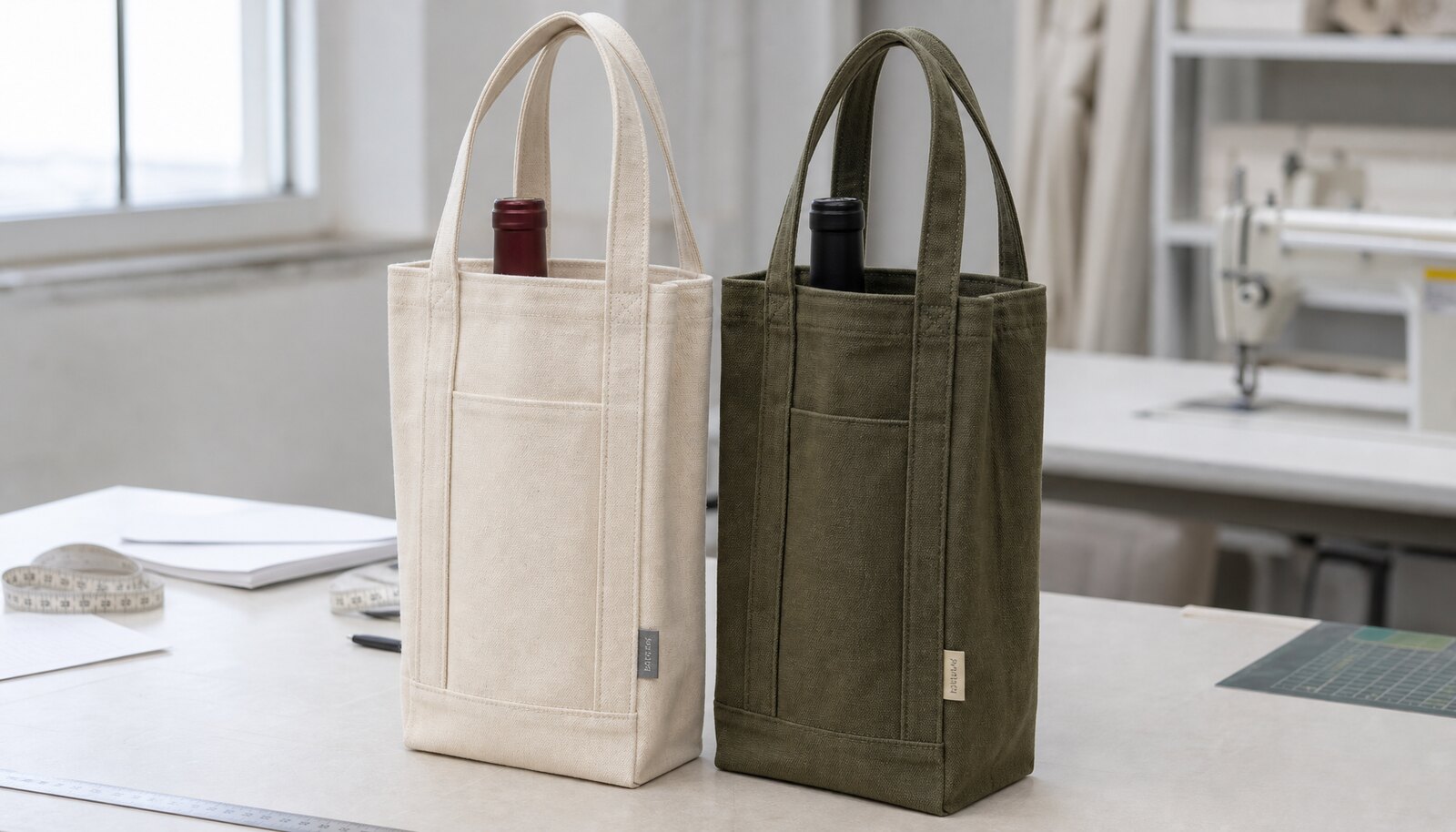
Start With the Bottle, the Shelf, and the Margin
A canvas wine carrier looks like a small accessory, but procurement should treat it as a packaged retail item. It needs to hold a bottle securely, present cleanly in store, and arrive with enough consistency that staff do not have to sort through rejects before display. If those three jobs are not defined before sourcing begins, the factory will optimize for the easiest thing to sew rather than the item that actually sells.
Begin with the bottle, not the bag. Record the exact bottle profile you will sell, including diameter, height, neck shape, and filled weight. A 750 ml Bordeaux bottle, a wider Burgundy bottle, and a heavier-base bottle all drive different width, base, and handle requirements. If the carrier also needs to work with a neck tag, tissue wrap, or gift box, that should be part of the spec from the start.
Then define the retail job. A bag that only needs to move from counter to customer can be simpler and lighter. A bag that sits in a display basket or hangs on a peg needs better shape retention, cleaner finishing, and more consistent panel geometry. The more clearly you define the shelf role, the less you will spend on revisions, freight surprises, and slow-moving stock that looks underbuilt.
- Measure the bottle in millimeters and share the filled weight, not just the product name.
- State whether the carrier is for hand carry, shelf display, or gift wrapping.
- If the item must stand upright, make that a written requirement rather than an implied preference.
Use Fabric Weight as a Shape Decision
For most gift-shop programs, 10 to 12 oz canvas is the practical starting point. In metric terms, that is roughly 340 to 407 GSM. In this range, the carrier usually has enough body to hold shape, enough opacity to avoid a flimsy look, and enough flexibility that it still feels natural in the hand. Lighter cloth can work for promotional runs, but it tends to show the bottle outline and read as temporary. Heavier cloth adds presence, but it also raises material cost, sewing resistance, and freight weight.
Do not stop at fabric weight. Weave density, shrinkage control, finishing, and shade consistency all affect how the final piece looks on shelf. A loosely woven canvas can read as rustic, which may suit some brands, but it can also look uneven or less premium if the customer expects a cleaner retail finish. If the fabric is dyed, ask how the mill controls lot variation and what the factory will do on reorder if the next roll is slightly different in tone.
The right fabric is the one that supports the commercial role. A store-focused program usually wants a consistent medium-weight canvas that can be reordered without visual drift. A seasonal or tourism item can tolerate a softer hand if the design is simple and the price point is tight. A premium gift item should prioritize consistency and appearance over a small saving in cloth.
- Use 10-12 oz as the comparison point unless you have a reason to go lighter or heavier.
- Ask for the actual GSM, weave type, and finishing method, not just a broad fabric description.
- Check shade and texture on multiple swatches so you can see lot variation before you commit.
Compare Construction Before You Compare Unit Price
The build details separate a retail-ready carrier from a bag that only looks good in a mockup. Handle attachment, top-edge finish, seam allowance, and base shape all affect how the product behaves when a shopper lifts a full bottle. If the handle is attached poorly, the top edge can twist or collapse, and the bag starts to look like a disposable item instead of a gift accessory.
A simple open-top sleeve is often enough for single-bottle retail, but the base still needs a decision. A flat or lightly gusseted base helps the carrier sit straight in display trays and reduces the chance that the bottle leans awkwardly. If the style includes a divider, insert, or multi-bottle format, internal spacing should be tested with the actual bottle shape rather than an abstract size assumption.
Handle comfort is another detail buyers often under-spec. A short handle may be fine for counter handoff, but if customers will carry the bottle through a store, across a parking lot, or to an event, the handle should be reinforced enough to stay comfortable under load. Ask the factory how they secure the handle ends, how many reinforcement points they use, and whether the top edge is stabilized to prevent puckering.
- Ask for a drawing that shows seam placement, base width, and handle attachment points.
- Confirm whether the bag is meant to stand straight on its own or only function as a carry item.
- Test the sample with the bottle shape you actually intend to sell, not a similar one.
Match Decoration to Artwork, Volume, and Reorder Pattern
Decoration should be chosen for production control, not only visual taste. A simple one-color screen print is usually the most straightforward option when the logo is bold and the order is repeatable. It is easier to quote, easier to inspect, and easier to reorder than a method that depends on complex placement or multiple passes. For a basic gift-shop brand mark, that is usually the best balance of cost and reliability.
When the artwork is small or the branding needs a quieter look, a woven label or stitched side label can be a better fit than a large print. Labels reduce the risk of ink cracking or rub-off, and they can work well when the carrier is sold in multiple colors but the brand mark stays constant. Embroidery can feel premium, but it can also distort lighter canvas and is not always the best choice for fine text or detailed art.
The supplier should also be able to explain the practical output of the decoration method. Multi-color art, embroidery, and very small type increase the chance of setup waste, rejected units, or rework. That is why it helps to ask for decoration yield, not just decoration price. A method with slightly higher setup cost can still be cheaper if it produces fewer rejects and reorders cleanly.
- Use screen print for simple logos and higher repeatability.
- Use woven labels when the brand wants a cleaner, quieter look.
- Ask for rub resistance, placement control, and expected yield before approving the decoration method.
Read Supplier Type and MOQ as Commercial Signals
Not every supplier is pricing the same thing. A factory-direct quote usually gives you the best chance to control fabric, stitching, and packing, but it also exposes you to the factory's actual setup costs and material constraints. A stock blank supplier can move faster and often supports lower quantities, but you are buying their existing fabric and construction, not your own spec. A trading company can help coordinate mixed items or freight, but you need to know whether they are controlling the factory or simply relaying the request.
MOQ is usually driven by the parts of the order that create setup work, not by the sewing line alone. Custom fabric color, new screens, woven labels, and carton artwork can all push the minimum higher. That is why the useful question is not just, "What is your MOQ?" It is, "What is the MOQ for this exact fabric, decoration method, and packing configuration?" That wording forces the supplier to show you where the real cost sits.
If a vendor quotes a very low MOQ, check what is actually stock and what is custom. A low number may be valid for a blank body with a hangtag, but not for custom dyed canvas with a new logo and custom carton. When the numbers look unusually easy, it usually means the quoted item is not the item you will actually receive.
- Ask for MOQ by fabric color, print color, and label type.
- Confirm whether mixed colors can be combined under one lot or need separate runs.
- Ask whether the quoted item is stock blank, stock body plus decoration, or fully custom production.
Treat the Quote as a Landed-Cost Worksheet
The useful quote is the one that tells you how the final cost is built. If the supplier only gives a single unit price, you cannot tell whether the difference comes from fabric weight, decoration method, pack count, or carton size. Ask for the body cost, decoration cost, sample fee, packing cost, and carton cost separately so you can compare suppliers without guessing.
Landed cost is where many buyer mistakes show up. Freight is influenced by carton dimensions as much as by gross weight, especially when the carrier is bulky relative to its value. A slightly larger carton can raise cube, increase shipping cost, and reduce pallet efficiency. If you import through a broker, duties and customs charges should also be included in the comparison. Those costs vary by destination and classification, so have your broker confirm the code and estimate instead of assuming the first number is final.
The quote should also show the commercial terms that affect risk. Ask whether the price is ex-works, FOB, or another Incoterm, and whether it includes inland trucking to port, export documents, or only factory gate pricing. A low factory price can become a weak deal if screens, labels, carton artwork, or overage are added later. Compare the whole path to warehouse receipt, not only the sewing invoice.
- Ask for separate line items so you can compare like with like.
- Check carton dimensions because cube can matter as much as weight.
- Confirm who pays for samples, freight, customs paperwork, and any rework caused by a spec miss.
Approve a Physical Sample, Then Stress-Test It
A flat proof is not enough for a canvas wine carrier. You need a physical sample in the final fabric, final decoration method, and final pack style. Otherwise you are approving artwork on a screen, not a retail object that will be handled, carried, and displayed. The sample should be judged with the actual bottle shape in the carrier, because a perfect-looking empty bag can still fail once it is loaded.
Treat sample approval like a small pilot run. Check how the bottle sits, whether the handles stay comfortable, whether the top edge distorts, and whether the logo placement still looks centered when the bag is full. If the sample is better than the quoted spec, ask why. Sometimes the sample is made with a better fabric roll, cleaner stitching, or extra attention that will not be repeated in bulk unless you lock it into the order.
Sample terms matter too. Ask whether the sample fee is deductible from the bulk order, whether courier costs are credited, and whether the supplier will retain a reference sample for future reorders. If you are ordering a seasonal item, keep one approved sample with the purchase order file. That gives both sides a clear standard if there is a dispute on a later run.
- Test with a full bottle, not an empty one.
- Check the sample after loading because the fabric and print can shift under weight.
- Ask the supplier to mark the approved sample as the production reference.
Pack for Shelf Appearance and Freight Efficiency
Packing is part of the product, not an afterthought. Canvas can wrinkle, pick up dust, and absorb odor if it is packed poorly or stored in a damp environment. If the carrier is meant to be sold as a gift item, the inner pack should keep the piece clean and folded consistently. If it is sold into a warehouse system, the pack should also protect count accuracy and keep the cartons easy to receive.
For export cartons, ask for the full packing plan before production starts. That means the inner pack method, number of pieces per inner bag, master carton count, carton dimensions, and gross weight. A carton that is too large wastes cube and can let the product shift around. A carton that is too tight can compress seams, crease the body, and make the stock harder to retail after arrival. If you need barcode labels or retail tags, define where those are attached so the factory does not improvise.
There is a tradeoff between protection and presentation. A clear polybag helps keep dust off, but it can add plastic and reduce the premium feel. Tissue, belly bands, or paper wraps may suit some shops better. The right answer depends on how the store merchandises the item and how much abuse the carton will see in transit and receiving.
- Lock the inner pack count and master carton count before mass production.
- Ask for carton dimensions early so you can check freight cube and warehouse fit.
- Make sure the outer label matches the SKU, color, and quantity on the purchase order.
Build the Timeline Around the Slowest Step
Lead time is often less about sewing and more about the parts that stop the line. Fabric sourcing, custom dyeing, screen setup, label approval, carton printing, and final packing can all affect the delivery date. If the supplier gives only a single turnaround number without identifying the slowest step, they are probably quoting the easy case, not the realistic one.
For a simple custom carrier, the sample stage often takes about a week or slightly more, and bulk can take several weeks after approval, but that is only a planning window. A custom fabric color, complex logo, or seasonal congestion can extend the schedule quickly. If your gift shop relies on holidays, wedding season, tourism peaks, or trade events, build buffer into the plan and ask the supplier what can slip first.
The useful question is not, "How long does production take?" It is, "What needs to happen before production can start, what can be done in parallel, and what will stop shipment if it is late?" That forces the supplier to show the real critical path. It also helps you decide whether a stock blank with custom labeling is worth the compromise when the calendar is tight.
- Ask which step is the longest: fabric, decoration, packaging, or final packing.
- Leave buffer for artwork revisions and sample changes.
- Confirm whether carton printing or barcode approval can delay the finished shipment.
Lock Down QC With Real Acceptance Criteria
A useful QC plan defines what failure looks like before the goods are made. Start by separating critical, major, and minor defects, then decide what your team will do if the shipment misses the target. For this product, the obvious critical defects are broken seams, failed handles, severe odor, wrong size, and any condition that makes the carrier unsafe or unsellable. Those should be zero tolerance unless you have a clear rework agreement.
The testing needs to be practical. Check the fabric weight on incoming rolls, inspect the stitch line, and load the carrier with the actual bottle or a matched weight. Then check the bag under real handling conditions. A good buyer standard is to look at the product flat, full, and after repeated lifts. For print, ask for a rub test that shows no visible transfer under normal handling. For odor, define what is unacceptable before shipment so nobody can argue later that the smell is "normal canvas."
AQL is useful only if both sides know what it covers. Many procurement teams use a standard AQL plan for major and minor defects, but the exact number should be part of the purchase order or inspection instruction. The main point is to avoid vague approval language. If a lot fails, the next step should be spelled out: quarantine, photo report, supplier response deadline, rework, or replacement. QC without escalation is just documentation.
- Use zero tolerance for broken handles, open seams, wrong size, or severe odor.
- Require a functional load test with the actual bottle or an equivalent weight.
- Set a clear escalation path if the lot fails inspection so the shipment does not stall without a decision.
Specification comparison for buyers
| Decision | Good default for gift-shop programs | Supplier-side decision data | What to verify in the quote or sample |
|---|---|---|---|
| Fabric weight | 10-12 oz canvas, roughly 340-407 GSM | Usually the best balance of structure, shelf presence, and freight weight for a single-bottle retail item | Ask for actual GSM, weave density, shrinkage after finishing, and an agreed tolerance band of about +/- 5% on incoming fabric |
| Fabric finish | Tight plain weave, washed or stabilized before cutting if shrinkage is a risk | Pre-washing can improve dimensional stability but may slightly change hand feel and cost; untreated fabric is cheaper but can move after production | Check shade consistency by lot, odor, lint level, and whether the approved swatch reflects the real production finish |
| Handle build | Cotton webbing with bartacks or box-X reinforcement | A wider webbing handle usually improves comfort and reduces stress concentration; reinforcement adds sewing time but lowers failure risk | Confirm handle width, handle drop, bartack length, and proof-load target, such as a 2x filled-bottle load for 60 seconds |
| Decoration method | 1-color screen print or woven side label | Screen print usually gives the cleanest cost-to-yield ratio for simple logos; woven labels are better for repeatability and low rub-off risk | Ask for print registration tolerance, cure method, rub test expectations, and what the yield looks like if artwork has fine lines or small text |
| MOQ example | Stock blank plus label: often 300-500 pcs; one-color print: often 500-1,000 pcs; custom dyed fabric: often 1,000-3,000 pcs | MOQ rises with custom fabric, new screens, new labels, and carton artwork; low MOQ is usually only realistic when at least part of the item is stock | Make the supplier state whether MOQ is per color, per print color, per label type, or per full SKU |
| Carton pack | 12-24 pcs per master carton, depending on fold and bag size | Smaller flat-fold packs improve cube efficiency, but over-compression can crease the carrier and hurt shelf appearance | Verify carton dimensions, gross weight, inner pack count, pallet count, and whether the pack method keeps the goods retail-ready |
| Decoration yield | One-color print or woven label keeps yield high and scrap low | Multi-color art, embroidery, or complex placement lowers yield because setup errors and rework increase | Ask for the expected decoration yield, setup waste, and whether rejected prints are charged back to the buyer |
| Lead time | Stock blank: 1-2 weeks; simple custom print: 3-5 weeks; custom dye plus custom pack: 5-8 weeks as a planning window | The slowest step is usually fabric, decoration setup, or packaging approval rather than sewing itself | Get the critical path in writing, including what can delay the shipment and whether sampling, screens, or carton artwork are on that path |
| QC method | AQL inspection plus function tests and carton checks | Photo approval alone misses handling failures, odor, print rub-off, and count errors | Require agreed defect categories, load-test criteria, size tolerances, and who pays if the lot needs rework |
Buyer checklist before sampling
- Define the exact bottle profile: 750 ml Bordeaux, wider Burgundy, or another shape, and record diameter, height, neck position, and filled weight.
- State the use case up front: shelf display, checkout handoff, gift wrap, or carry-around use. The use case determines how much structure and reinforcement you need.
- Set the fabric target in oz or GSM and require every supplier to quote against the same fabric spec, finish, and shrinkage expectation.
- Choose one decoration route that matches the artwork and reorder pattern instead of letting each supplier switch between print, embroidery, label, or patchwork.
- Specify handle material, handle width, handle drop, and reinforcement method so comfort and strength are not left to assumption.
- Ask for a physical pre-production sample in the final fabric, final decoration method, and final packing style, not a flat proof only.
- Request separate pricing for body, decoration, label, sample, packing, and carton so the quote can be compared on a like-for-like basis.
- Confirm whether the sample fee and courier cost are deductible from the bulk order and whether the approved sample will be retained as the production reference.
- Lock the pack count, carton size, and gross weight before approval so you can check freight cube, warehouse fit, and pallet efficiency.
- Require written QC criteria for size tolerance, stitch quality, print placement, odor, rub resistance, and carton count accuracy.
Factory quote questions to send
- What exact fabric weight, weave, and finish will you use, and can you put that on the quote?
- Is the MOQ per color, per print color, per label type, or per full SKU?
- Can you separate the quote into body, decoration, packing, carton, and any insert or hangtag cost?
- What is the sample fee, and is it deductible if we approve the bulk order?
- What handle construction do you recommend for a filled 750 ml bottle, and what reinforcement will you use at the attachment points?
- Can you provide a physical sample with the final print method instead of a digital proof only?
- What carton size, pack count, and gross weight are you planning for the bulk shipment?
- What dimensional tolerance will you hold on finished size, handle drop, and print placement?
- What is the production lead time after sample sign-off and deposit, and what specific step could extend it?
- What changes if we switch from screen print to woven label, embroidery, or a hangtag?
Quality-control points to confirm
- Set a defect plan before production starts. Critical defects should be zero tolerance: broken handles, open seams, wrong size, severe odor, or any condition that makes the carrier unsafe or unsellable.
- Use a practical size tolerance. For soft goods like canvas carriers, a buyer-controlled target of +/- 5 mm on body dimensions and +/- 10 mm on handle length is a reasonable starting point unless the design is unusually tight.
- Verify fabric weight on incoming rolls, not only on the supplier specification sheet. A common buyer rule is to reject rolls that miss the approved GSM target by more than about 5% unless the order is formally re-approved.
- Inspect handle attachment points for clean bartacks or box-X reinforcement, no skipped stitches, no loose thread tails, and no top-edge distortion after loading.
- Test the carrier with the actual bottle or a matched weight. A useful acceptance check is a 2x filled-bottle load held for 60 seconds without seam opening, handle slip, or visible structural failure.
- If the item includes print, inspect placement after the bag is filled, not only when flat. A centered flat print can drift once the fabric is under load.
- Run a dry rub test on printed areas. If ink transfers visibly to a white cloth after repeated moderate rubbing, treat it as a cure or process issue.
- Check odor at receiving. Musty, solvent-like, or mildew smell should be rejected before the cartons enter retail inventory, because odor problems are difficult to fix later.
- Open enough cartons to verify count accuracy, carton labeling, dryness, corner condition, and whether the packing method matches the approved sample.
- Require an escalation path in writing: quarantine, photo report, supplier response deadline, rework, replacement, or credit if the shipment misses spec.