Start with the job the portfolio must do
When coffee roasters source wholesale canvas zipper portfolios, fabric weight is not just a style preference. It affects structure, print behavior, zipper movement, sewing speed, carton weight, sample approval, and repeat-order consistency. A short request such as “heavy canvas zipper portfolio with logo” leaves too much room for interpretation. One supplier may quote an unlined 10 oz natural cotton sleeve. Another may include 12 oz dyed canvas, lining, and a better zipper. A third may build in foam padding. Those prices may sit in the same spreadsheet, but they are not pricing the same product.
Roasters use zipper portfolios in several business settings. A wholesale team may need them for cafe onboarding documents, cupping sheets, brew guides, price lists, origin cards, ordering forms, or small sample cards. A sales rep may carry one between account visits. A marketing team may sell a cleaner version as merch or pack it into a gift set. The right canvas weight depends on that job. Heavier is not automatically better, especially if the portfolio must lie flat, zip smoothly, and keep printed artwork clean.
Begin the RFQ with function, not fabric shorthand. Is this a flat document sleeve, an organizer folio, a tablet-adjacent carrier, a sales kit, a retail item, or a gift-pack insert? Once that answer is clear, GSM, lining, foam, zipper gauge, decoration, pocket layout, and packing can be specified in a way suppliers can quote fairly.
- Write the use case first: document sleeve, organizer, sales kit, tablet carrier, merch item, or gift pack.
- Compare quotes only after normalizing GSM, lining, foam, zipper, decoration, sample terms, and packing.
- Use finished GSM in the RFQ and PO because ounce descriptions vary by mill and supplier.
- Ask the factory to retain an approved fabric cutting and signed pre-production sample for repeat-order comparison.
Practical GSM ranges for canvas zipper portfolios
Most B2B canvas portfolios sit in the 280-430 GSM range. Lighter than that, the product may feel too soft for a brand-sensitive folio unless the design is deliberately simple. Heavier than that, the shell can look rugged but create seam bulk, zipper waviness, and higher shipping weight. The best starting point depends on size, interior build, artwork, and how the finished item will be handled after delivery.
Canvas around 280-300 GSM, often called roughly 10 oz, works for basic document sleeves, event packs, and light sales inserts. It is usually easier to cut, sew, fold, and carton efficiently. The tradeoff is structure. On A4 or US letter sizes, this weight can feel limp unless the pattern is tight, the zipper opening is supported, or a lining is added.
Canvas around 340-370 GSM, often called roughly 12 oz, is a strong first sample range for many coffee roaster programs. It gives a more substantial hand feel without making sewing and zipper installation unusually difficult. It can support a simple front print, woven label, organizer pocket, and No. 5 nylon coil zipper in a balanced way. For buyers trying to avoid both flimsy giveaways and overbuilt products, this is often the most useful baseline.
Canvas around 400-430 GSM, often called roughly 14 oz, belongs in premium or rugged programs. It can make sense for retail merch, subscription add-ons, account welcome packs, or field-use portfolios expected to carry mixed contents repeatedly. Still, the sample has to prove the concept. Heavy canvas may slow sewing, push needles off line at corners, increase carton gross weight, and create visible fold marks if packing is too tight.
- 280-300 GSM: suitable for basic paper carry, promotional use, and cost-sensitive orders.
- 340-370 GSM: balanced default for branded wholesale coffee roaster portfolios.
- 400-430 GSM: premium hand feel with higher sewing, packing, and freight risk.
- For every range, confirm whether GSM is measured before or after dyeing, washing, coating, or pre-shrinking.
Match fabric weight to roaster workflows
A fabric weight guide becomes more useful when it is tied to real roaster workflows. A cafe onboarding portfolio may hold wholesale terms, brew recipes, ordering instructions, invoices, and account notes. It needs to feel professional when opened in front of a buyer, but it may not need foam. A trade show portfolio may be distributed in larger quantities and carried for only a few days, so cost, flat packing, and logo visibility may matter more than long-term rigidity.
For sales team use, function usually beats a single premium touch. Account managers may open and close the zipper repeatedly, insert new price sheets, swap sample cards, and place the portfolio on cafe counters. A medium-weight canvas with lining and a reliable zipper can perform better than a very heavy unlined shell. For tablet-adjacent use, padding and usable internal dimensions matter more than simply moving to a heavier canvas.
The most practical test is simple: load the sample with the real contents. Paper size, insert thickness, tablet width, sample-card corners, and accessory shape all change how the portfolio behaves. An empty sample can look flat and attractive, then bow once a brochure stack goes inside. A zipper can glide smoothly while empty and strain at the corner when loaded. Procurement approval should include this loaded review before bulk cutting.
- Flat document sleeve: 280-340 GSM may be enough if the opening and seam finish are clean.
- Wholesale account kit: 340-370 GSM or medium canvas with lining is usually more appropriate.
- Retail merch or gift pack: 340-430 GSM, lining, and protected packing help preserve presentation.
- Tablet-adjacent organizer: prioritize foam, lining, usable internal dimensions, and zipper path.
Canvas finish, dyeing, shrinkage, and shade control
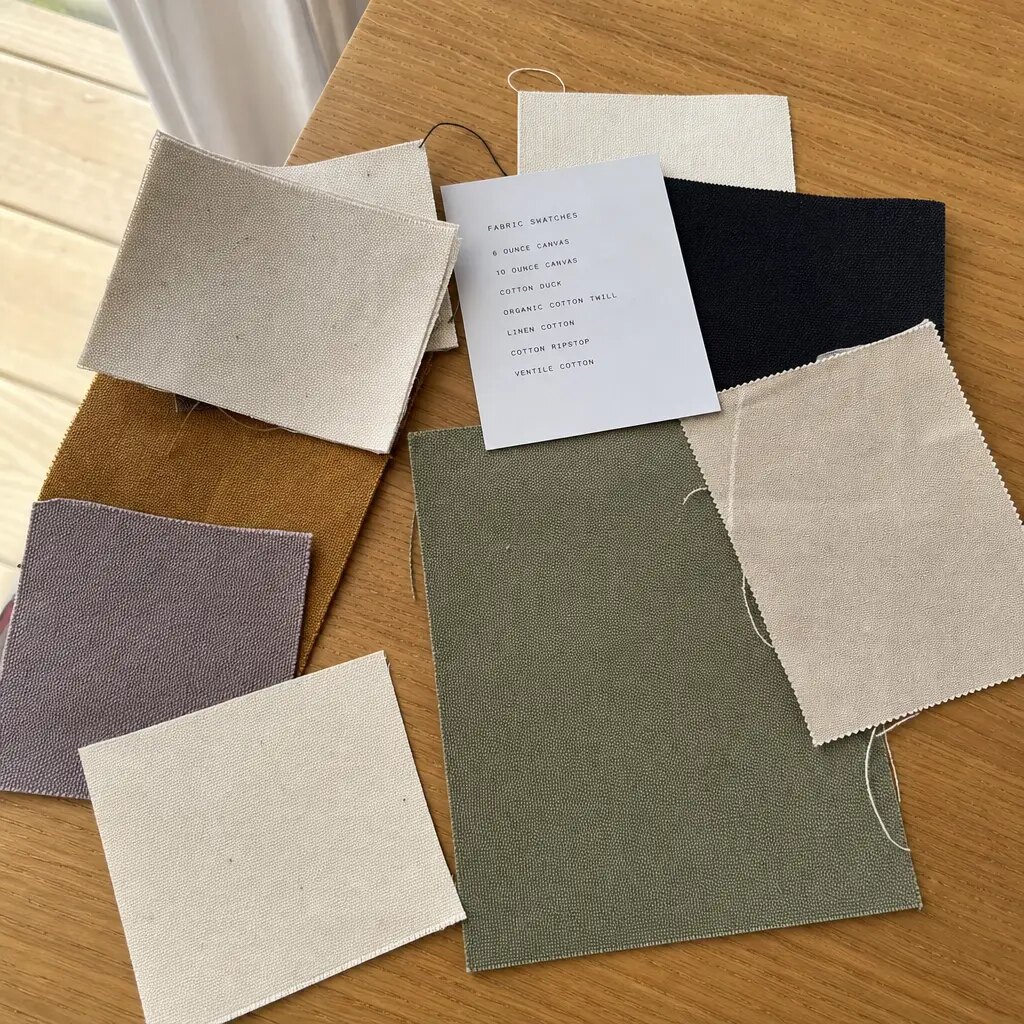
Two fabrics with the same GSM can behave differently after dyeing, washing, coating, or finishing. Natural cotton canvas often has a dry, slightly irregular surface that suits coffee brands with earthy or craft positioning. Bleached canvas gives a cleaner base for some print colors but can change hand feel. Dyed canvas looks more polished, yet shade consistency, rub resistance, and surface behavior need closer control. Washed or enzyme-treated canvas feels softer and more casual, but it can reduce crisp structure in a portfolio format.
The RFQ should state the fabric condition plainly: greige, natural, bleached, stock dyed, custom dyed, washed, enzyme treated, pre-shrunk, coated, or water repellent. That choice affects price, MOQ, lead time, color approval, and QC. Custom shades such as black, charcoal, olive, brown, or muted green may require lab dips and minimum dye lots. For a modest order, the dye lot can become the real MOQ even when the sewing factory is willing to make fewer finished units.
Shrinkage also deserves a line in the sourcing file. The portfolio may not be sold as washable, but fabric can still move during finishing, pressing, steaming, or post-wash treatment. If a washed vintage effect is required, approve the washed finished size, not just the cut size. If the product is not intended for consumer washing, avoid care claims that imply wash performance unless testing supports them.
Dark dyed canvas should be checked for dry rub and, where relevant, wet rub. Portfolios may touch white documents, kraft coffee bags, light apparel, retail shelves, or printed inserts. Also compare the shell fabric, zipper tape, thread, lining, label, and patch color together. A component mismatch that looks small on a swatch card can become obvious on the finished portfolio.
- Ask for lab dip lead time, dye-lot MOQ, shade tolerance, and excess fabric liability for custom colors.
- Check dry rub on black, charcoal, brown, olive, and other saturated shades.
- Confirm whether the fabric is pre-shrunk if size stability is important.
- Keep one approved bulk fabric cutting for shade and hand-feel comparison.
Construction often matters more than shell weight
Shell GSM is only one part of structure. Lining can make a canvas zipper portfolio feel more finished, hide seam allowance, protect paper from raw edges, and make contents easier to slide in and out. Common lining options include 210D polyester, 230T polyester, cotton lining, or lighter canvas. Polyester is smooth and economical. Cotton feels more natural, but it can add shrinkage and thickness variables. Specify lining material, color, weight, and whether it is loose, fully bagged, bound, or caught into the main seam.
Foam interlining changes the product. With 2-3 mm foam, a portfolio becomes more structured and can offer light protection for tablets or mixed sales kits. Foam also changes production behavior. It adds thickness at seam stacks, affects corner shaping, can distort flat print areas if handled poorly, and may create compression marks in packing. A pre-production sample should use the final foam thickness and final packing method. A substitute sample will not prove bulk performance.
Internal organization adds value, but each feature adds operations and risk. Pen loops, card slots, mesh pockets, dividers, sample-card sleeves, elastic bands, gussets, and tablet pockets all need clear dimensions. If pockets are sewn to light canvas, the panel can ripple or sag. If they are sewn through heavy canvas, the seam stack can become stiff and difficult to stitch cleanly. Map the actual contents before approving pocket dimensions: cupping sheets, brew cards, order forms, sample cards, brochures, and small accessories.
Targeted reinforcement can be smarter than increasing shell weight everywhere. Reinforced zipper ends, better binding, corner bartacks, extra seam allowance, or a support layer behind a pocket may solve the problem without making the whole portfolio bulky. Use this approach when the concern is local stress at zipper ends, corners, or pockets rather than overall hand feel.
- Specify every layer: shell fabric, lining, foam, board, binding, reinforcement, and pocket material.
- Approve pocket sizes against real insert dimensions, not generic office assumptions.
- Use foam for protection and shape, but confirm zipper smoothness and corner bulk.
- Use targeted reinforcement when the risk is localized at zipper ends, pockets, or corners.
Zipper specification for business portfolios
The zipper is a working component, not an afterthought. For most canvas zipper portfolios in A4, US letter, or tablet-adjacent sizes, a No. 5 nylon coil zipper is a practical default. It is flexible, smooth, and easier to sew around portfolio edges than many heavier decorative options. No. 3 zippers may work for small lightweight sleeves, but they can feel underpowered on larger formats. Metal zippers can look premium, though they add weight, may scratch contents, and may not move as smoothly around curves unless the pattern is designed for them.
The quote should identify zipper type, gauge, tape width, slider grade, puller style, tape color, finish, stop type, open length, and whether the zipper is stock or custom sourced. A branded puller can improve the retail feel, but it often brings a separate MOQ and lead time. Treat a custom puller as its own trim project with sample approval, plating or color standard, pull strength review, and unused inventory policy.
Review the zipper path on the real construction. Heavy canvas, foam, tight corners, and thick binding can create tape wave or slider drag. A zipper that works in a flat unlined prototype may not behave the same way in a padded lined sample. If the portfolio is intended to hold a defined insert set, test the zipper after those contents are loaded. This small check catches many avoidable complaints.
- Use No. 5 nylon coil as the default starting point for most medium and large portfolios.
- State zipper gauge, tape width, slider, puller, stop type, color, and open length in the RFQ.
- Test zipper function empty and loaded with intended documents or devices.
- Treat custom pullers as separate trim items with MOQ, lead time, and approval standards.
Decoration on canvas: print, label, embroidery, or patch
Coffee roaster branding often uses bold wordmarks, origin graphics, roast icons, vintage marks, and muted color palettes. On canvas, screen printing is usually the most efficient decoration for repeat wholesale programs with one or two colors. It can produce a matte, integrated look. Its limits are fine lines, small text, large solids, and coarse weave. On natural canvas, texture may show through the ink. That can be acceptable if approved on the strike-off, but it should never be discovered for the first time during bulk inspection.
Heat transfer, DTF, or similar transfer methods can work well for multicolor graphics, seasonal launches, art-heavy designs, and lower-volume SKU testing. The advantage is artwork flexibility. The risk is hand feel and durability. A transfer may look too smooth against natural canvas, and edges may lift if heat, pressure, curing, or placement is not controlled. Review scratch resistance, edge lift, flexibility, and appearance after packing.
Embroidery, woven labels, leather patches, and PU patches create a different brand impression. Embroidery can look premium but may pucker lighter canvas, especially with dense filled logos. Woven labels are consistent and useful across repeat product families. Patches can support a heritage look, but they add stitch holes, material compliance questions, and another component to approve. These options work best when branding is stable and the buyer wants repeatable identity rather than seasonal graphics.
Decoration should be approved on final fabric. A digital mockup cannot show ink absorption, weave interruption, thread pull, transfer edge behavior, or patch stiffness. If the order includes natural and dyed bodies, each body color needs a decoration review because contrast, opacity, and edge sharpness can change. The approved strike-off should become part of the inspection standard.
- Screen print is best for bold marks, limited colors, and repeat order efficiency.
- Transfer methods suit multicolor artwork and small campaign runs but need edge-lift and scratch checks.
- Embroidery and patches can look premium but require pucker, placement, and material review.
- Approve decoration on final GSM, final color, and final finish.
MOQ, lead time, and quote normalization
MOQ is rarely controlled by sewing capacity alone. It is shaped by fabric sourcing, dyeing, zipper availability, decoration setup, custom trims, packing materials, and SKU count. Natural canvas often supports lower starting quantities because it is easier to source as stock fabric. Stock dyed colors may also be accessible depending on the supplier. Custom dyed canvas can shift the MOQ to the mill minimum, which may be higher than the sewing factory’s finished-goods minimum.
Artwork can split a healthy total order into small production lots. A buyer may request one total quantity across four roaster logos, three body colors, two print positions, and two packing formats. Operationally, that becomes multiple cutting, printing, approval, packing, and carton-marking batches. Unit price can rise even when the total quantity looks strong. Define whether MOQ applies by shell color, artwork, zipper color, lining color, label, packing style, or total order.
Trim sourcing creates hidden commitments. Custom zipper pulls, woven labels, branded lining, metal badges, patches, printed insert cards, and retail belly bands may each have separate minimums. For repeat evergreen programs, excess trims may be acceptable. For event-specific or seasonal artwork, unused trims can become dead stock. Ask who owns excess material and whether the supplier can hold it for reorder.
To compare quotes, force every supplier into the same base specification. Ask each one to price the same finished size, GSM range, fabric finish, lining, foam if any, zipper gauge, print area, label, packing method, sample terms, and estimated carton weight. Then request optional adders for items such as custom pullers, cotton lining, foam, patches, or retail insert cards. This makes cost decisions visible instead of buried inside inconsistent assumptions.
- Ask for MOQ by shell color, artwork, zipper color, lining color, label, and packing method.
- Separate base unit price from optional adders for foam, lining, custom pullers, patches, and retail packing.
- Request lab dip, strike-off, sample, and revision costs before approving artwork.
- Collect carton dimensions and gross weight during quote review, not after production.
Pre-production sample approval
A true pre-production sample should prove production readiness. It needs final fabric, final GSM, final finish, final zipper, final lining or foam, final decoration, final label, and final packing. A stock sample can help you judge general workmanship, but it cannot approve the real order if it uses substitute materials. Approving a substitute sample leaves open questions about hand feel, print quality, zipper function, structure, and shade.
Sample review should be visual and functional. Measure finished size, internal usable dimensions, zipper opening, pocket placement, print location, and label placement. Open and close the zipper several times. Load the portfolio with the intended contents. Place it flat, hold it by the edge, and check whether it twists, bows, puckers, or strains at the corners. Look inside carefully. Many complaints appear only when the portfolio is opened.
Document approval with measurable notes. Record fabric GSM, color standard, lining color, zipper details, print colors, print placement, stitch density, seam allowance, finished dimensions, pocket dimensions, packing method, and approved exceptions. Photos help, but physical reference samples are better for repeat orders. For ongoing programs, ask the factory to retain one signed pre-production sample and one fabric cutting while the buyer keeps matching references.
- Do not approve bulk production from a sample using substitute fabric, zipper, lining, or print method.
- Load the sample with actual roaster documents, cards, tablet, or inserts before approval.
- Measure print placement from fixed reference points, not by eye.
- Keep signed samples and fabric cuttings for repeat-order comparison.
QC plan and acceptance tolerances
Most canvas zipper portfolio problems are consistency issues, not dramatic failures. A production lot feels lighter than the approved sample. A dark body color rubs onto paper. Print placement drifts. Some zippers catch at the corner. Lining twists inside the bag. These issues are easier to prevent when the purchase order defines acceptance criteria before production starts.
Fabric QC should include GSM verification, shade comparison, surface defect review, odor check, and colorfastness checks where relevant. A common commercial GSM tolerance is plus or minus 5 percent unless the PO states otherwise. Finished size tolerance should also be written down. For many sewn portfolios, plus or minus 0.5 cm may be practical on smaller unpadded items, while plus or minus 1.0 cm may be more realistic for larger or padded constructions. The tolerance should fit the design.
Zipper QC should include full-cycle testing. The slider should move smoothly from end to end, stops should hold, the puller should stay attached, and the tape should not pucker beyond the approved sample. If the product is designed around a defined insert set, inspectors should test some units loaded. Print QC should compare color, coverage, registration, placement, pinholes, scumming, cracking, edge lift, and contamination against the approved strike-off.
Sewing QC should focus on corners, topstitch consistency, stitch density, skipped stitches, seam allowance, lining capture, foam position, loose threads, and cleanliness. Heavy canvas can cause needle deflection near corners. Lining can pull out if seam allowance is too narrow. Foam can shift or crease if it is not secured and packed correctly. Packing QC should verify unit count, color ratio, SKU label, barcode if used, carton marks, inner packing, gross weight, and carton condition.
- Write GSM, finished size, print placement, zipper, stitch, and packing tolerances into the PO.
- Use the approved strike-off and signed sample as the inspection standard.
- Classify defects before inspection: critical, major, and minor, with examples for this product.
- Include loaded zipper testing when the portfolio has defined contents or tablet-adjacent use.
Specification comparison for buyers
| Spec decision | Recommended option | When it fits | Buyer risk to check |
|---|---|---|---|
| 10 oz canvas, about 280-300 GSM | Cost-conscious base for simple promotional or document portfolios | Event handouts, cafe account paperwork, cupping sheets, price lists, brochures, lightweight sales inserts, and short-term wholesale onboarding kits | Can feel soft on A4 or US letter sizes; request finished GSM, finished size tolerance, and whether lining or reinforcement is included |
| 12 oz canvas, about 340-370 GSM | Most practical first sample range for branded roaster programs | Wholesale account kits, retail merch, reusable sales folders, roastery training materials, and field team document carry | Mill-to-mill ounce conversion varies; specify GSM tolerance, fabric finish, and retained fabric standard before bulk cutting |
| 14 oz canvas, about 400-430 GSM | Premium shell when structure and rugged hand feel are important | Retail gift sets, subscription add-ons, higher-value account welcome packs, and portfolios expected to carry mixed contents repeatedly | More seam bulk, needle deflection, zipper waviness, slower sewing, heavier cartons, and visible fold marks if pattern and packing are not adjusted |
| Single-layer canvas body | Lean construction for flat zipper sleeves | Flat paper carry, low-SKU promotional orders, trade show document packs, and simple logo programs | Interior raw edge quality, print strike-through, zipper tape impression, and corner collapse should be checked on the sample |
| Canvas with 210D, 230T, or cotton lining | Cleaner interior and better loading experience | Document pockets, card slots, pen loops, organizer layouts, retail-ready interiors, or programs where the bag will be opened in front of customers | Lining shade mismatch, twisting, loose seam capture, wrinkling, and lower tear resistance on very light linings |
| Canvas plus 2-3 mm foam interlining | Semi-structured build for protection and shape | Tablet sleeves, sales rep kits, premium roaster welcome packs, training folders, and multi-item inserts | Foam changes corner radius and zipper behavior; approve final foam thickness, final panel size, and final packing compression |
| Nylon coil zipper, usually No. 5 for most portfolios | Best default for smooth function and flexible sewing | A4, US letter, tablet-adjacent, and organizer portfolios where smooth opening matters more than a heavy decorative look | Check gauge, tape width, slider quality, puller style, end stops, color match, and full-cycle zipper function after loading |
| Screen print on natural or dyed canvas | Efficient decoration for simple one- or two-color roaster branding | Bold logos, wholesale account marks, event artwork, origin icons, and repeat programs with stable branding | Fine lines and small text can fill in or break on coarse canvas; approve a strike-off on final fabric and define acceptable pinholes |
| Heat transfer or DTF on dyed canvas | Useful for multicolor or lower-volume artwork | Seasonal merch, retail tests, art-heavy graphics, limited drops, or multiple roaster SKUs where screen setup is inefficient | Transfer hand feel, edge lift, scratch resistance, and cracking near folds must be tested |
Buyer checklist before sampling
- Define the actual use case before asking for price: flat document sleeve, organizer folio, tablet-adjacent carrier, sales kit, retail merch item, or gift-pack insert.
- State the finished size, orientation, zipper opening side, and usable internal dimensions. Include A4, US letter, tablet model, cupping form, sample card, or brochure dimensions where relevant.
- Specify fabric by finished GSM range and canvas finish, not only ounce shorthand. Example: natural cotton canvas, 340-370 GSM finished, unwashed, no coating.
- Clarify whether fabric weight is measured before or after dyeing, washing, enzyme treatment, water-repellent treatment, or pre-shrinking.
- Decide how structure is achieved: heavier shell, lining, foam, board, binding, corner reinforcement, pocket layout, or a combination.
- List each internal component separately: document sleeve, divider, pen loop, card slot, mesh pocket, elastic band, sample-card sleeve, gusset, or tablet pocket.
- Specify zipper details: type, gauge, tape width, tape color, slider finish, puller style, end stops, open length, and stock versus custom sourcing.
- Match decoration to artwork and substrate: screen print for bold marks, transfer for multicolor graphics, woven label for repeat branding, embroidery only after pucker review.
- Request a print strike-off on final fabric color and final GSM, especially for dark dyed canvas, natural slub canvas, fine lettering, and large solid ink areas.
- Require a pre-production sample made with final fabric, final zipper, final lining or foam, final decoration, final labels, and final packing format.
Factory quote questions to send
- What is the actual finished GSM range of the quoted canvas, and is the fabric greige, natural, bleached, stock dyed, custom dyed, washed, enzyme treated, pre-shrunk, coated, or water repellent?
- Is the quoted construction single-layer canvas, lined, foam padded, board reinforced, bound, turned-edge, or another structure? Please list each layer and approximate thickness.
- What fabric tolerance will apply in bulk production? Can you retain an approved fabric cutting and one signed pre-production sample for repeat-order comparison?
- What finished size tolerance, print placement tolerance, zipper alignment tolerance, seam allowance, and stitch density are included in the quote?
- What zipper is included: nylon coil, metal, or molded plastic; No. 3, No. 5, or another gauge; tape width; slider type; puller style; stop type; and tape color?
- Is the zipper from stock or custom ordered? If custom, what are the trim MOQ, lead time, overage policy, and liability for unused pullers or tape?
- What decoration method is included, how many colors are priced, what print area is assumed, and are setup, screens, strike-off, curing, or film costs included?
- Does the sample charge include material sourcing, print strike-off, lab dip if needed, pre-production sample, and one revision after buyer comments?
- What is the MOQ by shell color, lining color, zipper color, artwork, label, puller, and packing style? Can mixed colors share a total order quantity?
- For custom dyed fabric, what is the mill minimum, lab dip lead time, bulk shade tolerance, colorfastness target, and excess fabric responsibility?
Quality-control points to confirm
- Finished fabric GSM should be checked against the approved range. A common commercial tolerance is plus or minus 5 percent unless the purchase order states a tighter or wider tolerance.
- Finished size tolerance should be written on the PO. For many sewn portfolios, plus or minus 0.5 cm is practical for smaller sizes and plus or minus 1.0 cm may be more realistic for larger or padded constructions.
- Zipper function should be tested through full open-close cycles, both empty and loaded with intended contents where applicable. Reject rough drag, catching corners, broken stops, slider pull-off, tape puckering, and uneven zipper wave beyond the approved sample.
- Print placement should be measured from fixed reference points such as top edge, side seam, zipper tape edge, or panel centerline. Visual judgment alone is not enough for bulk inspection.
- Screen print QC should compare opacity, edge sharpness, registration, curing, pinholes, ghosting, scumming, contamination, and cracking against the approved strike-off.
- Transfer print QC should include edge-lift, scratch, flexibility, and heat mark checks, especially where the panel bends during packing or use.
- Lining should be fully caught in seams with no loose raw edges, twisting, exposed seam allowance, trapped threads, or excessive wrinkling when the zipper is opened.
- Foam or interlining should stay flat with no hard crease, lump, delamination, migration, or packing compression mark that changes the exterior shape.
- Topstitching should be straight and consistent, with controlled stitch density, no skipped stitches, no broken thread, and no needle damage near heavy corner stacks.
- Visible surfaces should be free from oil marks, stains, odor, shade panel mismatch, loose threads, raw thread ends, fabric holes, and unacceptable slubs beyond the approved canvas standard.