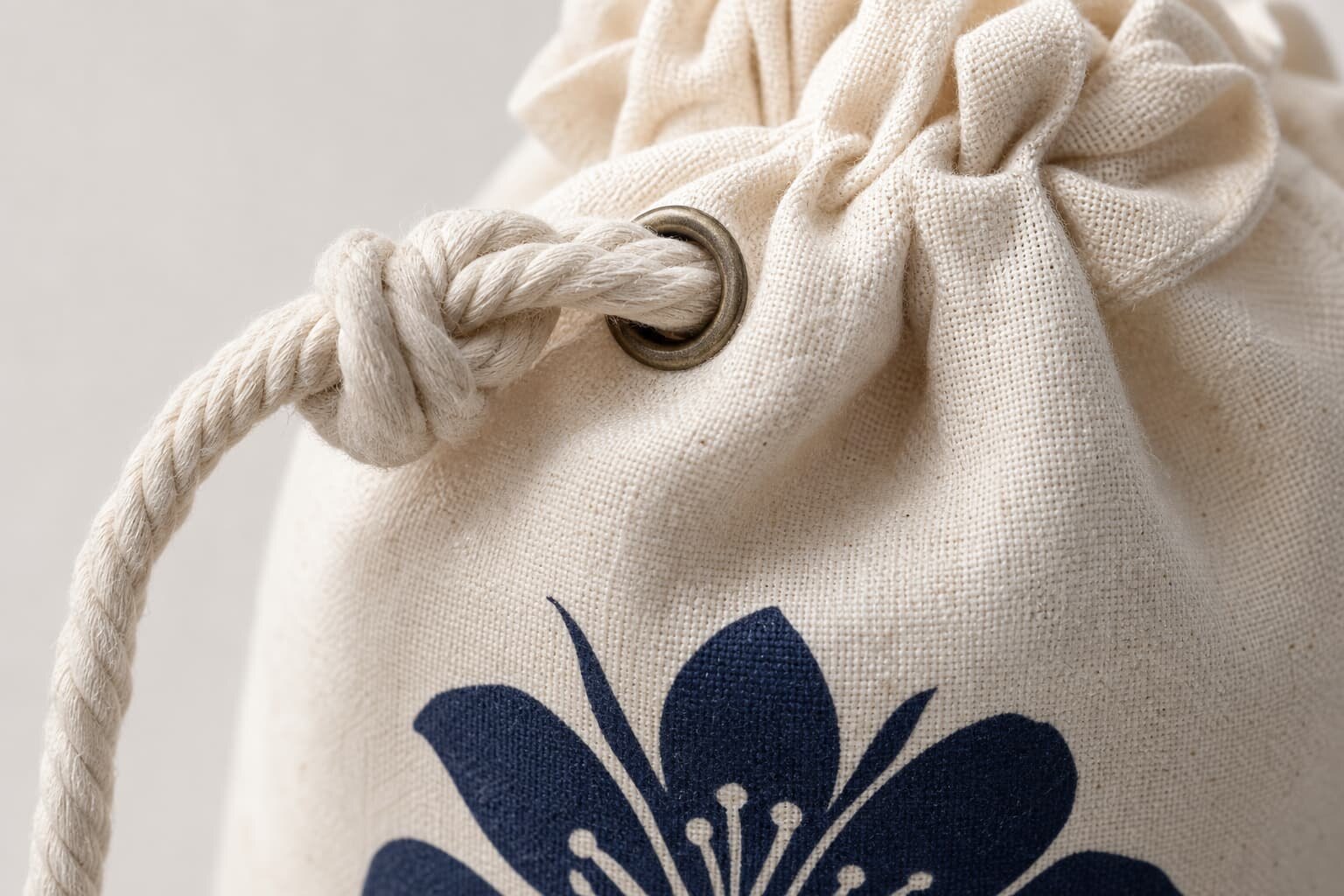
Why logo placement variance matters on a drawstring pouch
A drawstring pouch can look simple, but logo placement is one of the easiest things to get wrong in bulk. Buyers often approve a clean sample and then receive cartons where the logo sits too low, drifts left, or changes position from piece to piece because the factory used a loose visual target instead of a measured reference. On a small pouch, even a 5-10 mm shift can make the brand look unbalanced, especially when the logo is close to the hem, seam, or cord channel.
That is why a logo placement variance tracker is not a paperwork exercise. It is a control tool that helps procurement teams compare supplier quotes, set expectations in the PO, and resolve disputes with evidence. The real goal is not perfection; it is repeatability. If the logo stays within an agreed tolerance and still looks centered on the finished pouch, the order passes. If the factory cannot define its measuring method, the buyer is exposed before production even starts.
- Small pouches magnify small placement errors.
- Visual center and measured center are not always the same after sewing and pressing.
- A tracker helps buyers separate acceptable variation from avoidable defect.
- The cost of rework is usually higher than the cost of defining placement properly at quotation stage.
Start with the pouch structure, not the artwork file
Logo placement must be built around the finished pouch structure. The usable print area changes with fabric weight, seam allowance, top hem depth, drawstring channel height, and whether the pouch is flat, gusseted, or lined. A 140 GSM cotton pouch with a narrow hem behaves differently from a 200 GSM canvas pouch with a firmer body. If the factory measures from the cut panel before sewing, the logo can move after the hem is formed and the side seams are closed.
For RFQs, buyers should ask suppliers to define the finished measurement basis. The best practice is to reference the finished pouch front after sewing, then specify exactly where the logo should sit relative to the top hem, bottom edge, and side seams. If the pouch size changes across the order, each size needs its own placement line. Do not assume the same artwork position works across 10 x 15 cm, 12 x 18 cm, and 15 x 20 cm bags without rebalancing the layout.
- Confirm GSM and fabric construction because they affect drape and visual centering.
- Specify whether measurements are taken on the sewn pouch, not the cut panel.
- Create separate placement specs for each pouch size and closure style.
- Account for seam bulk, cord exit points, and any gusset depth.
Build a placement spec the factory can actually measure
A useful placement spec is simple enough for the production team to measure at speed and strict enough to stop ambiguity. The spec should identify the logo origin point, the final logo dimensions, the reference edges, and the tolerance. For example, instead of writing "center logo," define "logo centerline 35 mm below top hem fold and centered between left and right side seams, tolerance +/- 5 mm vertically and +/- 4 mm horizontally." That language gives the factory one way to measure and gives the buyer a clean basis for inspection.
The spec should also say when the measurement is taken. Some methods, especially embroidery and heat transfer, can shift after stitching, pressing, or cooling. If the pouch is packed flat, the pressure from carton compression can change how the front panel sits. For that reason, the measurement rule should say whether acceptance is checked on the finished pouch after final press, after a 24-hour rest, or both. Buyers who skip this detail often end up comparing a pre-press sample to a post-pack bulk unit and calling it a defect when it is really a process difference.
- Name the measurement origin and the final acceptance stage.
- Use millimeters, not vague language like near center or around midline.
- Set separate tolerances for vertical and horizontal placement.
- State whether the logo is judged on a laid-flat pouch or a filled pouch.
Choose the right print method for placement control
The print method changes both the cost and the risk profile. Screen print is usually the most stable for simple one- or two-color logos because the print area is fixed and the artwork is easy to repeat. Heat transfer can handle more detail and lower MOQs, but the transfer sheet can be positioned slightly off if the operator is rushing or if the pouch fabric is too textured. Embroidery and woven labels have their own risks: stitch pull, badge skew, and visible tilt if the panel is not taut.
For buyers, the practical question is not which method looks best on a sales sample. It is which method gives the lowest placement variance for the target volume and target margin. On cotton pouches in the 140-200 GSM range, a simple screen print is often the easiest to control. If the brand wants a premium feel, a sewn patch or woven label may be better than a large direct print, because the label can be positioned on a smaller, easier-to-control zone. The quote should show whether the placement tolerance changes by method, because it often does.
- Screen print usually gives the most repeatable front placement on plain cotton.
- Heat transfer can support short runs but needs strict jig control.
- Embroidery may distort lightweight fabric if the backing is not matched well.
- Sewn labels can reduce layout risk when the print area is small.
Use a variance tracker to compare sample, pilot, and bulk
A good variance tracker records the same points on every stage: approved sample, pre-production sample, first bulk pieces, middle-of-run checks, and packed-carton samples. The tracker should capture the logo offset from the top hem, the left-right centerline, and any tilt. If the logo is a small chest mark, a 3 mm shift may matter. If it is a large front panel graphic, the same shift might be acceptable if the logo still sits square inside the usable print field. The point is to measure against the same baseline every time.
This is also where procurement teams can spot supplier behavior. Some factories send one beautifully centered sample and then quietly allow looser placement in bulk because the operator set the jig by eye. Others over-correct the first pieces and then drift as production speed increases. A variance tracker shows whether the process is stable or whether the factory needs a tooling correction, a better template, or a stricter in-line approval step. It is much cheaper to stop a drift on piece 80 than to sort 8,000 units at carton-out stage.
- Track sample, pre-production, first-run, mid-run, and packed-carton measurements.
- Record both numeric deviation and visual impression.
- Use the same ruler points and the same person if possible.
- Escalate if drift grows across the run instead of staying random.
What to ask for in the quote so placement risk is priced correctly
Many quote problems start because the buyer asks for a logo print price without defining the placement controls. Then the supplier prices the job as a generic decoration, not as a controlled production process. Buyers should ask the factory to separate base pouch cost, print setup cost, extra color charges, embroidery digitizing or plate cost, and any second-location branding fee. If the logo must sit in a fixed position with a tight tolerance, that can affect setup time, inspection time, and scrap risk, so it belongs in the quote logic.
MOQ should also be tied to the placement method. A short-run heat transfer pouch might have a lower MOI for the blank bag but a higher unit cost for positioning and labor. A screen-printed pouch might need a higher MOQ to justify screen setup, but the repeatability is better. For buyers comparing offers, the cheapest quote is not the best quote if it excludes measurement photos, sample approval, or a second inspection pass. Ask suppliers to quote the same basis so you can compare apples to apples.
- Request a line-item quote for base pouch, print setup, decoration, and packing.
- Ask whether first sample and revised sample are both included.
- Confirm MOQ by pouch size, fabric color, and decoration method.
- Check whether the supplier assumes random placement tolerance or measured placement tolerance.
A realistic product comparison for branded drawstring pouches
Acceptance criteria buyers should write into the PO
An acceptance rule should be specific enough that both sides can inspect it without a debate. The PO can state that the logo must remain within the approved artwork size, the approved placement window, and the approved color standard on the reference sample. If the pouch is a cotton drawstring bag for retail packaging, the buyer should also decide whether a tiny shift is acceptable if the visual balance remains correct. That is especially important when the logo sits above a seam or near the drawstring channel, because stitching and pressing can move the final appearance without violating the measured spec.
The rule should also cover what happens when the factory finds a deviation. Is the lot held, sorted, reworked, or conditionally accepted with a concession? Buyers who do high-volume programs should define a correction path in advance. That avoids last-minute pressure on the warehouse team and gives the supplier a clear trigger for containment. If the factory knows the exact cutoff, it is more likely to control the process instead of hoping a loose inspection will pass.
- Write the acceptance window in mm and keep it tied to the approved sample.
- Define whether visual balance can override a small measured offset.
- State the action for hold, sort, rework, or concession.
- Include photo evidence requirements for any disputed lot.
Packing and lead time details that affect placement quality
Packing can create placement defects that were not present at inspection. If a pouch is folded too tightly, the logo may crease or shift visually when unpacked. If cartons are overfilled, the front panel can compress and make the print look lower or tilted. Buyers should ask how the factory packs the pouches, whether they are inserted flat or nested, and whether a tissue sheet or board is used for premium retail orders. Packing style matters even more for embroidered or patched logos, which can catch and distort if cartons are pressed too hard.
Lead time also affects quality. A factory that rushes the print line may reduce cure time, skip a second check, or use a looser operator jig. Buyers should ask whether the quoted lead time includes pre-production sample approval, screen or plate making, print setup, production, and final carton inspection. If artwork changes after sample approval, a realistic supplier should update both lead time and risk. Tight placement tolerances with an aggressive schedule often cost more than the blank bag itself, so the RFQ should make that tradeoff visible before the PO is issued.
- Ask how the pouch is folded and whether logos face the same direction in every carton.
- Check whether overpacking could deform the front panel.
- Confirm if the quoted lead time includes sample approval and print setup.
- Build in time for a corrected sample if placement is not stable on the first attempt.
How to inspect without slowing the whole order
Inspection should be fast enough to use on arrival and strict enough to catch drift before shipment is released. Start with a simple method: inspect the first, middle, and last carton; measure the logo from the same reference points; and compare the result against the approved sample. If the pouch is a cotton or canvas drawstring bag, check the front panel while the pouch is laid flat and again after it is lightly opened, because a bag that looks centered on the table may shift once the drawcord is tightened. This is especially important for logos near the top third of the bag.
When a lot fails, the report should say why. Was the logo too low, too far left, crooked, or inconsistent across cartons? Did the defect come from the print stage, the sewing stage, or the packing stage? That distinction matters because the fix is different. Print drift may require a jig reset; seam skew may require a sewing correction; packing compression may require a carton change. Buyers who record the cause can negotiate better corrective action on the next order instead of repeating the same problem.
- Check first, middle, and last cartons rather than only the top carton.
- Inspect the pouch both flat and lightly opened.
- Record whether the defect came from printing, sewing, or packing.
- Use the same measuring rule every time to keep the data comparable.
Specification comparison for buyers
| Spec decision | Recommended option | When it fits | Buyer risk to check |
|---|---|---|---|
| Logo placement reference | Use a fixed distance from top hem and side seam | Best when the same pouch size repeats across SKUs | Confirm the factory measures from the same seam edge on every size |
| Print method | Screen print for simple logos; heat transfer or digital print for multi-color art | Screen print suits stable artwork and larger runs; transfer fits short runs or complex details | Check hand feel, wash resistance, and whether the logo shifts after pressing |
| Placement tolerance | Set separate vertical and horizontal tolerances | Useful on front-center logos, corner marks, and side labels | Do not accept a single vague note like center aligned without mm limits |
| Fabric weight | 140-200 GSM cotton for most branded pouches; heavier for premium retail packs | Fits pouch packaging, gift sets, and reusable brand presentation | Heavier fabric can change drape, which changes visual centering |
| Sampling path | Pre-production sample plus photo signoff with measurement callouts | Best for first orders, new suppliers, and artwork with critical positioning | Avoid approving only a flat artwork proof with no sewn sample check |
| Packing method | Packed flat with print facing same direction; avoid over-compression | Helps preserve shape and keeps inspection straightforward | Compressed packing can distort the pouch and make placement look off |
Buyer checklist before sampling
- Define the logo reference points on the pouch drawing: top hem, side seam, bottom edge, and drawstring exit point.
- State the logo size, print method, and acceptable placement tolerance in millimeters before asking for price.
- Approve a sewn or printed pre-production sample with ruler photos, not just a digital mockup.
- Ask the factory to measure placement on at least three pieces from the first bulk carton.
- Confirm whether the logo position is measured before or after final pressing and packing.
- Check how fabric shrinkage, seam pull, and cord tension may move the logo after production.
Factory quote questions to send
- What exact point do you use as the logo origin: top hem fold, seam line, pouch centerline, or the lowest point of the logo?
- Can you state the placement tolerance in mm for both vertical and horizontal position?
- Is the quoted price based on screen print, heat transfer, embroidery, woven label, or sewn patch?
- How many colors are included in the quote, and what is the surcharge for extra print colors or a second logo location?
- Will you send a pre-production sample with measurement photos before bulk cutting and printing?
- What is the MOQ by size, fabric color, and print method if the logo position must remain consistent across variants?
- How does your packing method protect logo alignment during carton compression and transport?
- What lead time applies if the artwork needs a new screen, plate, or embroidery file?
Quality-control points to confirm
- Measure logo position on the first piece off the line and compare it with the approved sample using the same reference points.
- Check at least three cartons from different parts of the lot to see whether placement drifts during the run.
- Verify that front and back logos are centered to the same internal axis if both sides are branded.
- Inspect after light pressing or steaming if the pouch will be folded flat in retail packing.
- Reject units where the logo is within tolerance but visually skewed because the pouch body is twisted or seam alignment is inconsistent.
- Document any placement change caused by fabric stretch, print shrinkage, or embroidery pull so the next order can be corrected.