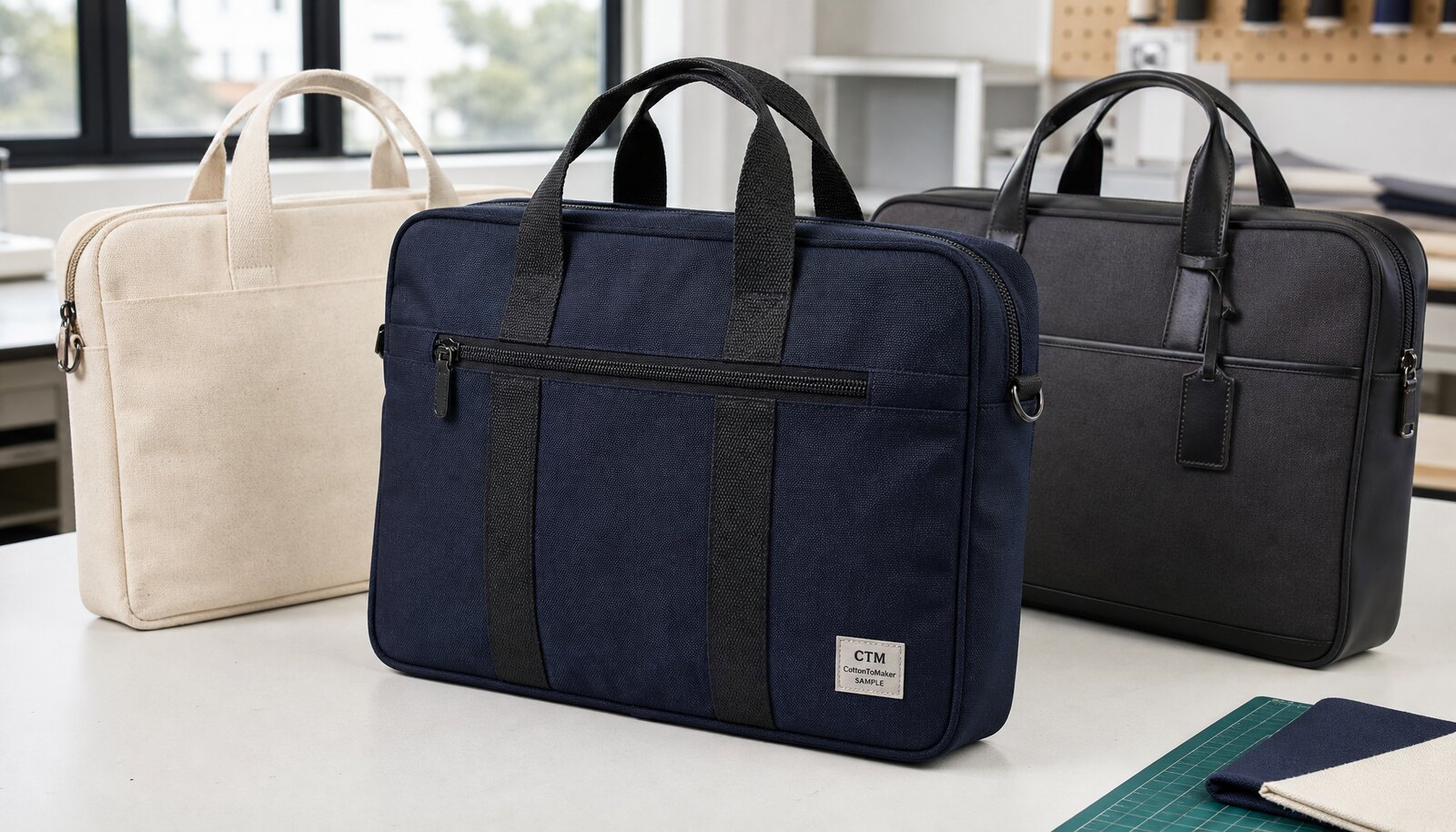
What buyers mean by business document bags for retail
For retail buyers, business document bags are not just file carriers. They are shelf-ready or e-commerce-ready soft goods that need to look clean, hold shape, and survive repeated opening, closing, and handling in stores, offices, and distribution channels. The buying problem is usually not the bag itself; it is choosing a construction that looks premium enough for retail while staying within a workable landed cost.
In practice, the product sits between a promotional document pouch and a small utility bag. The right spec depends on how it will be sold: as a standalone retail SKU, as a bundled organizer, or as part of a corporate merchandise program. The wrong spec usually shows up in three places: zipper failure, weak structure, or a logo application that looks cheap under store lighting.
- Retail use case drives spec: office carry, conference merchandise, travel organizer, or stationery accessory.
- A good retail bag must balance appearance, durability, and carton efficiency.
- The quote should be judged by construction consistency, not just unit price.
Start with size, structure, and fabric weight
Most sourcing mistakes begin with an unclear product profile. Buyers often say they need a business document bag, but the final retail size can vary widely: slim A4 carry, padded laptop-adjacent document tote, or gusseted organizer for papers and devices. Set the finished dimensions, gusset depth, and usable opening width before you request quotes. If the bag is too shallow, it may look tidy but fail in daily use. If the gusset is too deep, the product starts to feel bulky and loses retail appeal.
Fabric weight matters as much as size. For polyester, 300D is a common entry point for low-cost retail, while 600D usually gives better body and a more stable hand feel. For canvas, 12 oz to 16 oz is a practical range depending on the target shelf price and the amount of structure you want. If you are quoting a premium line, ask the factory whether they will add light foam, interfacing, or a board insert. Do not assume a heavier fabric automatically solves the problem; if the panel size and seam construction are weak, the bag can still warp or collapse.
- Specify finished size, not only paper size compatibility.
- Use 300D–600D polyester for value retail; 12–16 oz canvas for a more natural premium look.
- Ask whether the construction includes foam, interfacing, or a stiffening insert.
Choose a print method that matches fabric and order size
The logo method is one of the biggest cost and appearance drivers. Screen printing usually works well for simple logos, bold type, and higher quantities. It keeps unit cost controlled, but the artwork must be suitable for a flat panel and a stable fabric. Heat transfer can suit small runs or more detailed logos, but buyers should watch for cracking, gloss mismatch, and lower abrasion resistance if the bag is handled heavily. Embroidery gives a stronger retail impression on canvas or thicker fabric, but it adds cost and can distort lighter materials if the stitch count is too high.
For retail document bags, the best method is the one that survives shelf handling and end-use abrasion. A large full-color logo may look good in a quote, but if the bag is folded, stacked, or compressed in carton, some print methods show stress marks quickly. Ask for a sample made from the same body fabric and the same decoration method, not a substitute on different cloth. If the quote uses a special finish like metallic ink, puff print, or debossed patching, build time for extra approval because those methods often need more than one sample round.
- Screen print: best for simple logos and larger volumes.
- Heat transfer: useful for small runs or more detailed graphics, but test wear resistance.
- Embroidery: stronger retail feel, but only if the fabric can support the stitch density.
How MOQ logic changes your unit price
MOQ is not just a factory rule; it is how the factory spreads setup costs across the run. For business document bags, the MOQ can change based on fabric color, zipper color, logo method, trim availability, and whether the factory is cutting from stock material or buying fresh rolls. A low-MOQ quote may look attractive, but the factory may compensate with simpler packing, fewer color options, or a higher decoration charge. A larger order can lower the per-unit sewing cost, but only if the spec stays stable and the trims are standard.
When comparing quotes, separate the cost of the base bag from the cost of the decoration and the packaging. A supplier that quotes a lower unit price may have removed a carton insert, switched to a thinner zipper, or reduced reinforcement at the handles. That is not always visible in the first quote sheet. Good buyers ask for price breaks at realistic quantity levels: for example 500, 1,000, 3,000, and 5,000 pieces. That shows where labor efficiency starts to improve and whether the factory is pricing the run honestly.
- MOQ can change with fabric color, print method, zipper spec, and packaging format.
- Quote price breaks at multiple volume levels, not just one quantity.
- Watch for hidden savings through thinner zippers, lighter fabric, or weaker packing.
Supplier routes: stock base, full custom, or trading quote
There are three common sourcing routes for retail business document bags. The first is a stock base with custom decoration, which is useful when you need speed and lower upfront risk. The second is full custom production, which gives you better control over fabric, lining, zipper color, labels, and retail packaging. The third is a trading or sourcing agent route, where one party manages the quote but the actual factory may be elsewhere. Each route can work, but they do not deliver the same level of control or transparency.
For retail programs, the safest route depends on how critical the bag is to your brand. If the product is a test SKU or a seasonal add-on, a stock base may be enough. If the bag will carry your retail brand name and sit on shelf next to competitors, full custom is usually worth the extra coordination. Trading routes can be useful for broader sourcing, but buyers should still demand direct evidence of the production factory, sample room output, and packing standard. Otherwise, the quote may not reflect the real line that will produce the order.
- Stock base route: faster, less flexible, good for tests.
- Full custom route: more control, better brand alignment, stronger repeatability.
- Trading route: useful for access, but requires extra proof of factory capability.
Comparison of sourcing routes for retail document bags
When you are comparing suppliers, the real question is not who gave the lowest quote. The real question is which sourcing route best fits your risk, timeline, and retail standard. A lower-priced quote can still cost more if it arrives with inconsistent stitching, weak logos, or non-retail packing that forces rework at your warehouse. The table below shows the tradeoff buyers should use when reviewing options.
Use this comparison with actual sample sets and not just catalogue photos. A sample made from the right fabric but packed loosely will not tell you much about shelf readiness. A neat sample photo without zipper cycle testing also leaves a gap. Compare the route that controls your biggest risk, not just the route that looks easiest on paper.
What the factory quote should include, line by line
A serious quote for business document bags should read like a build sheet. At minimum, it should show fabric composition and weight, lining choice, zipper type, handle spec, logo method, packing format, MOQ, sample lead time, and bulk lead time. If the quote says only 'custom bag with logo', it is incomplete. A vague quote is difficult to compare and easy for the supplier to revise later with add-on charges.
Request the quote in a structure that lets you compare factories side by side. You want to know what is included, what is optional, and what will trigger a price change. For example, if the factory quotes an insert card, barcode sticker, and individual polybag, make sure those are included in the unit price and not listed as tentative. If the supplier is quoting with or without VAT, with or without export carton marks, or with different zipper grades, the comparison is not clean.
- Fabric spec: composition, weight/GSM, color method, and finish.
- Trim spec: zipper type, puller style, thread, webbing width, labels.
- Commercial spec: MOQ, sample cost, bulk lead time, packing, and payment terms.
Sample approval: what should be in the first sample
The first sample should prove the build, not just the look. A good approval sample for retail document bags needs the correct fabric weight, the actual zipper type, the final logo method, the right handle width, and the intended internal finish. If the sample is made with generic substitutes, it may win approval visually and still fail in production. That is how many buyers end up with a bulk run that feels different from the approved piece.
Use the sample to test the bag in the way it will be sold. Load it with paperwork, a slim notebook, or the accessory set it will carry in retail. Check zipper alignment, handle stress points, panel shape, print placement, and how the bag sits after being filled and emptied several times. If the bag is meant for a premium shelf, photograph the sample under store-like lighting because some fabrics and prints change appearance under strong white light. Approve only after the sample matches the intended retail presentation and the factory confirms the same materials will be used in mass production.
- Sample must match fabric, zipper, logo, and construction method.
- Test the bag loaded and unloaded, not only flat on a table.
- Do not approve a sample if the factory says bulk will use a different trim set.
Packing and carton strategy for retail channels
Packing is part of the product, especially when you sell through retail chains or e-commerce. A document bag with a clean front print can still arrive damaged if it is folded too tightly, crushed in carton, or packed with zipper heads rubbing against the face panel. Ask how the factory will protect the print surface, whether the bag will be lightly stuffed or folded flat, and whether a polybag is needed for each piece. If a barcode sticker or hangtag is required at the warehouse, include that in the quote from the start.
Carton efficiency matters because these bags are often light but bulky. The factory should give carton dimensions, net and gross weight, and units per carton. That information affects ocean freight, warehouse receiving, and retail distribution planning. If the bag is shipped flat for cost reasons, make sure the folding method does not create permanent creases in the front panel or deform a printed logo. Retail buyers often save on unit price but lose margin later through repacking labor or freight inefficiency.
- Confirm whether each bag gets an individual polybag, insert card, or barcode label.
- Request carton dimensions and gross weight before final approval.
- Protect print surfaces from zipper abrasion and folding marks.
Lead time, schedule risk, and landed cost comparison
Lead time for business document bags is usually driven by three things: material availability, decoration setup, and packing complexity. A simple stock-base order with a one-color logo can move faster than a fully custom bag with custom zipper tape, woven labels, and retail insert cards. The most common schedule risk is not sewing capacity; it is waiting on artwork approval, trim sourcing, or sample revisions. If your launch date is fixed, build buffer time for the first sample and final pre-production sign-off.
Landed cost should be compared with the whole path in mind. A slightly higher factory unit price can still be cheaper if it reduces rework, avoids repacking, and lowers carton volume. Compare at least these cost components: product unit price, sample charge, artwork/setup, packaging charge, inland freight to port or warehouse, and import duty or customs handling where relevant. This is especially important when comparing a stock-base route with a full custom route. The lower quote may not include the packaging or trim quality you need for retail acceptance.
- Lead time risk often sits in artwork and trim sourcing, not only sewing capacity.
- Compare landed cost, not factory price only.
- Reserve buffer time for sample approval and pre-shipment inspection.
Specification comparison for buyers
| Spec decision | Recommended option | When it fits | Buyer risk to check |
|---|---|---|---|
| Main fabric | 300D–600D polyester or 12–16 oz canvas | Retail programs needing a clean look, stable cost, and repeatable bulk production | Too-light fabric can wrinkle and telegraph packing marks; too-heavy fabric raises freight and unit cost |
| Lining | 210D polyester lining with light foam or none | When the bag needs structure without becoming bulky | Unlined bags may feel cheap; full lining can hide stitching defects and increase labor |
| Closure style | Top zipper with metal or nylon coil zipper | Document bags sold for office, travel, conference, or business use | Cheap zipper tape or slider failures create high return rates; confirm smooth pull after repeated cycles |
| Print method | Screen print for bold logos, heat transfer or embroidery for small retail runs | When logo clarity matters more than full-surface decoration | Some methods crack, bleed, or look weak on textured fabric; match artwork to fabric surface |
| MOQ route | Low-MOQ stock base with decoration vs full custom production | Brands testing a new retail SKU or seasonal line | Stock base may limit color and trim control; full custom may require higher minimums and longer lead time |
| Handle style | Webbing handles with reinforced bar-tack | Retail bags that carry catalogs, tablets, or sample documents | Short reinforcement stitches can fail under load; verify stitch length and thread quality |
| Structure | Flat document style or slim gusseted profile | Flat styles for slim paperwork; gusseted styles for thicker files and accessories | A gusset that is too deep can make the bag look like a briefcase and affect shelf appeal |
| Packing method | Bulk polybag with barcode label or insert card pack-out | Retail distribution, e-commerce prep, or mixed channel supply | Loose packing can damage print and zipper heads; retail-ready packing must match channel requirements |
| Supplier route | Factory direct with sample-room approval and pre-shipment QC photos | When you need control over spec, cost, and repeat orders | Trading routes can hide the actual factory standard; always confirm who makes the bag and who inspects it |
Buyer checklist before sampling
- Define the retail use case first: document bag for office carry, conference giveaway, travel organizer, or premium retail SKU.
- Lock the size in finished dimensions and internal capacity, not just a generic bag name.
- State target fabric weight or GSM, lining requirement, zipper grade, handle width, and reinforcement points.
- Choose one logo application method that matches fabric and order size.
- Confirm packing format, barcode label position, and carton count before quotation.
- Request a pre-production sample or photo sample with all trims, prints, and label placements matched to the PO.
Factory quote questions to send
- What exact fabric weight or GSM will you use for the body, and is that before or after finishing?
- Which zipper brand or zipper spec will you quote, and is it nylon coil, metal, or resin?
- What is the MOQ for one colorway with one logo method, and how does the price change at 500, 1,000, and 3,000 pieces?
- What sample lead time do you need, and will the sample use the same fabric, zipper, and print method as bulk?
- How will the bags be packed for retail: individual polybag, insert card, hangtag, barcode sticker, or master carton only?
- What are the carton dimensions and estimated carton weight, and how many units fit per export carton?
- Which inspections do you run before shipment, and can you share photos of stitching, zipper pull tests, and logo placement?
- What parts of the quote are excluded, such as artwork setup, plates, labels, cartons, or special packaging?
Quality-control points to confirm
- Fabric weight tolerance: keep the body fabric within a practical range of the quoted GSM and reject visibly thinner substitute lots.
- Zipper test: run repeated open-close cycles on random samples; sliders must not catch, split, or expose poor stitching at the zipper ends.
- Stitching standard: no skipped stitches, loose thread tails, broken bartacks, or seam puckering at handle anchors and zipper corners.
- Logo placement: artwork must sit within an agreed tolerance window and remain centered relative to the front panel and zipper line.
- Handle load point: webbing reinforcement should cover the full stress area, not stop short of the seam edge.
- Packing integrity: polybags, inserts, and cartons must protect print surfaces from scuffing during transit and warehouse handling.