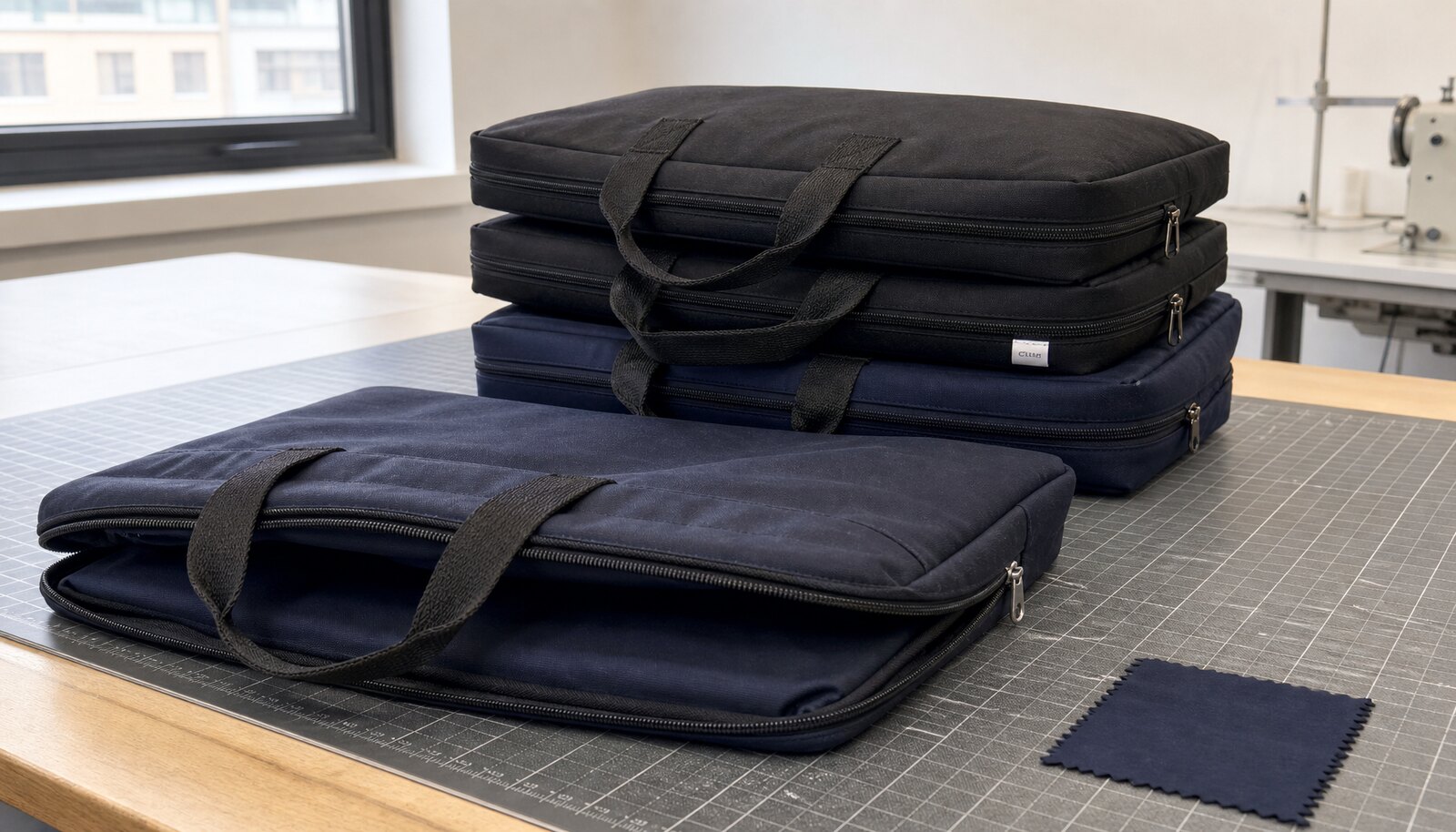
Why business document bags for events need tighter specs than they look
Business document bags for events are often treated like a simple giveaway, but they behave more like a light-use work bag. Buyers are usually packing flat brochures, contracts, samples, notebooks, tablets, and a few small accessories. That means the bag must hold its shape, close cleanly, survive transit, and still look presentable after repeated handling on an event floor.
The common mistake is quoting from a loose description such as “zippered document bag, black, printed logo.” That description is too broad to compare suppliers. One factory may quote a 300D polyester shell with a basic coil zipper, while another includes thicker lining, better pullers, and reinforced handles. Those are not equivalent products, and they will not land at the same cost or failure rate.
- Define the actual contents first: A4 files, a brochure set, tablet, pen, phone, or samples.
- Set the appearance standard: utilitarian staff bag, conference handout bag, or premium executive kit.
- Decide whether the bag is one-time event use or intended for repeat carry after the show.
Start with the use case: conference handout, meeting kit, or executive carry bag
The right spec depends on how the bag will be used. A handout bag for a one-day conference can use lighter material, a basic zipper, and minimal structure. A business meeting or boardroom kit usually needs a cleaner finish, stronger handles, and better logo presentation. If the bag is meant to carry a tablet or portfolio, you need more dimensional control and probably some padding or an internal divider.
Buyers should state the event environment in the RFQ. Will the bag be handed out at registration, carried outdoors between venues, or loaded into a welcome kit? That changes everything from fabric choice to packing density. A supplier can only quote accurately if they know the bag’s working life, not just its color.
- One-day event: prioritize cost, print clarity, and fast packing.
- Repeat-use event bag: prioritize handle strength, zipper durability, and seam reinforcement.
- Executive kit: prioritize surface quality, lining, and clean finishing inside and out.
Fabric choice and weight: where quotes usually diverge
For business document bags for events, most buyers end up comparing 300D, 420D, or 600D polyester, or a canvas option around 10oz to 12oz. The right answer depends on how structured the bag needs to be and how premium it must look. Polyester is usually better for cost control, shape retention, and easier print consistency. Canvas gives a more tactile feel, but it can increase sewing time, bulk, and freight volume.
If the bag is flat and lightweight, 300D polyester is often enough. For a product that must hold up in a busy event environment, 420D or 600D gives a better balance of body and price. Canvas is a stronger brand statement, but do not specify it unless you want a heavier, more textured item and are comfortable with a higher unit price and potentially lower carton efficiency.
- 300D polyester: best for low-cost distribution and large event quantities.
- 420D polyester: a practical middle ground for better body and reduced wrinkling.
- 600D polyester or canvas: better for premium positioning and frequent reuse.
Zipper, lining, and handle details that change both price and complaints
The zipper is the most visible functional component on a document bag, and it is also one of the easiest places for a supplier to cut cost. A nylon coil zipper in size #5 is usually enough for standard document bags, while #8 or a better-grade coil makes sense for larger formats or heavier loads. The puller should be easy to grip, and the zipper tape should be color-matched if the buyer wants a cleaner finished look.
Handles deserve equal attention. Self-fabric handles may work on budget models, but they must be reinforced with bar-tack stitching or a proper seam structure. If the bag will be carried daily during an event week, webbing handles are more reliable and reduce stretch. Inner lining is optional on low-cost bags, but it improves the hand feel, hides thread ends, and reduces the chance of print show-through.
- Choose zipper size based on opening width and loading frequency, not just visual preference.
- Specify handle stitch pattern and reinforcement zone in the tech pack.
- Use lining when the buyer wants a cleaner inside finish or better perceived value.
Print method selection: what works on polyester, canvas, and mixed builds
For most business document bags for events, screen printing remains the most cost-effective option when the logo is simple and uses one to three solid colors. It gives a clean result on flat panels and works well on polyester if the surface is smooth enough. If the design includes gradients, a full-color image, or small fine text, heat transfer may be more practical, but buyers should expect a different feel on the fabric and should approve it on a sample, not a screen mockup.
Embroidery can elevate the look, but it is not always the right answer. It works best on thicker materials and smaller logos. On thin panels, embroidery can tunnel the fabric, distort the panel shape, or add unnecessary cost. Buyers should also be careful with logo placement: a large front print may interfere with the zipper line or expose uneven seams if the supplier does not align the print mark to the actual sewing pattern.
- Screen print: best for flat logos, clean color blocks, and volume orders.
- Heat transfer: useful for complex art or smaller runs, but requires surface approval.
- Embroidery: suitable for premium bags with thicker fabrics and small logo areas.
How to compare supplier quotes without getting misled by the unit price
A good supplier quote should separate the base bag, decoration, packaging, and freight assumptions. When suppliers bundle everything into one line, it becomes impossible to tell whether the lower price reflects a better manufacturing route or simply weaker materials. The best comparison is to ask for blank price, printed price, and any added cost for lining, pockets, padding, or non-standard zipper colors.
A clear quote also reveals MOQ logic. Some factories quote a low quantity but apply a steep setup charge, while others require a larger MOQ but give a much more stable unit price. For event buyers, this matters because the real cost is not only the bag itself; it is the cost of creating a usable production run, packing it efficiently, and getting it to the event on time.
- Compare like for like: same fabric, same print method, same packaging, same carton count.
- Separate setup fees from unit price to understand the real first-order cost.
- Request a blank sample price and a decorated sample price if the artwork affects process time.
MOQ logic: why a smaller order can still cost more
MOQ is usually driven by fabric color availability, print setup, zipper sourcing, and sewing line efficiency. If you use a standard stock color with one simple logo, the factory can usually keep MOQ lower. If you want a custom fabric shade, special lining, or branded zipper puller, the MOQ may rise because the factory has to reserve materials and interrupt standard production flow.
For procurement teams, the real question is whether the MOQ matches the event plan and re-order strategy. A smaller first order may look easier to approve, but the unit cost can be higher and the production process less efficient. A larger order can lower unit cost, but only if the bags can be stored and used later without becoming obsolete. The buyer should balance event quantity, safety stock, and repeat-run potential before negotiating MOQ.
- Lower MOQ usually works best with stock materials and standard decoration.
- Higher MOQ may be justified if the bag will be reused for multiple events or channels.
- Avoid custom zipper colors unless the brand value is worth the added sourcing risk.
Sample approval: what must be tested before bulk production starts
A sample should be treated as a production control tool, not just a visual reference. The buyer needs to verify size, zipper movement, handle comfort, logo position, color match, and the overall finish of the bag. If the sample already feels flimsy or the zipper catches on the first few cycles, do not assume bulk production will improve it. In most factories, the bulk run will replicate the sample, not fix it.
The best sample approval process includes a first sample for construction and a pre-production sample or reference sample for final sign-off. During approval, measure the opening width, body depth, and handle length, then compare against your buyer spec sheet. If the bag includes inside pockets, padding, or a lining, open and inspect every sewn area because hidden defects usually start there.
- Measure all critical dimensions and record the allowed tolerance in the approval note.
- Cycle the zipper repeatedly and inspect the end stop, tape alignment, and puller grip.
- Evaluate print placement on the actual sewn bag, not on a flat artwork proof.
Packing and carton strategy for event distribution
Packing can change the economics of the order more than many buyers expect. Flat-packed bags save freight and usually reduce carton count, but they also need careful stacking so the print does not rub. If the bags are premium or have a structured body, the factory may need tissue, inner sleeves, or separator sheets to protect the finish. Those materials add cost and volume, so they should be quoted explicitly.
For event distribution, buyers should think about how the bags will be handed out at site. If teams need to issue them from cartons, packing must be simple and fast. If the bags are shipped to multiple venues, carton labels, quantity per carton, and batch identification matter more than decorative packing. Overpacking with individual polybags is often unnecessary unless the product is sensitive to dust, scuffing, or print transfer.
- Specify carton quantity, gross weight target, and whether the bags should be flat folded or lightly stuffed.
- Use inner protection only where needed; do not pay for retail-style packing if the bags are for event distribution.
- Request carton marks that match your receiving and venue allocation plan.
Lead time risk: where event orders usually go off schedule
Lead time should be viewed as a chain: sample confirmation, material reservation, print setup, cutting, sewing, finishing, packing, and inspection. Any delay in artwork approval or fabric confirmation can push the entire schedule. A supplier who promises a short delivery window without defining when the sample is approved is not giving a usable schedule. For event programs, the best protection is to lock the technical details early and leave a shipping buffer before the event date.
The highest-risk changes are usually fabric color, zipper substitution, logo revision, and carton specification changes after production starts. Buyers should freeze the order once the sample is approved and keep a written approval trail. If the event is fixed, ask the factory to confirm the calendar based on the real start date, not a vague “after confirmation” promise.
- Plan sample time separately from bulk production time.
- Reserve shipping and clearance buffer before the event date.
- Treat late artwork changes as schedule risk, not a minor admin update.
Specification comparison for buyers
| Spec decision | Recommended option | When it fits | Buyer risk to check |
|---|---|---|---|
| Outer fabric | 300D–600D polyester or 12oz canvas with tight weave | Conference kits, board meetings, trade shows, and repeat-use event bags | Too-light fabric shows wrinkles and weakens handles; too-heavy fabric increases cost and bulk in packing |
| Main closure | Nylon coil zipper #5 or #8 with smooth puller | When documents, brochures, tablets, or samples must stay contained during travel | Cheap zippers snag, split at the ends, or create complaints after distribution |
| Padding level | No padding for flat handouts; 2–3 mm foam or lining for premium kits | Events where the bag carries a tablet, binder, or fragile media pack | Padding changes size, sew time, and carton efficiency; it also affects quote comparisons |
| Print method | Screen print for 1–3 solid colors; heat transfer or embroidery only for small logos | Corporate events with bold logos, short color counts, or repeat runs | Overly detailed art can blur on coarse fabric; embroidery can distort on thin panels |
| Handle construction | Self-fabric handles with bar-tack reinforcement or webbing handles | For higher carry weight and frequent reuse | Weak handle anchoring causes the most visible field failure in event bags |
| MOQ route | Standard color/fabric run with logo customization | Buyers needing price control and a workable launch quantity | Custom dye, special lining, and unique zipper colors can push MOQ above the event requirement |
| Packing format | Flat packed, bulk cartons with inner polybag separation only if needed | Large event programs and distributor orders where carton density matters | Overpacking raises freight; underpacking increases scuffing and logo abrasion |
| Supplier route | Direct factory with in-house sewing and print, or integrated trading factory with verified QC control | When you need spec control, sample speed, and quote transparency | Middlemen can hide fabric origin, print subcontracting, and extra internal margins |
| Lead time | Sample approval first, then 25–40 days production after deposit and confirmed art | When the event date is fixed and there is some schedule buffer | Late artwork approval, zipper substitutions, and carton changes are the most common delay causes |
Buyer checklist before sampling
- Confirm final bag size, gusset, handle drop, and usable loading weight.
- Specify fabric type, GSM/oz weight, color tolerance, and shrinkage expectations.
- Send vector artwork and define logo size, print position, and Pantone references.
- Ask for sample photos plus one physical pre-production sample before bulk approval.
- Agree carton packing, barcode or hangtag needs, and shipment marks before production.
- Record inspection checkpoints for stitching, print adhesion, stains, and quantity count.
Factory quote questions to send
- What exact fabric is included in your quote, and what is the GSM or denier of the outer layer, lining, and any padding?
- Which zipper size and brand-equivalent are you using, and is the puller finished to match the bag color or logo standard?
- Does your MOQ change if we keep the same fabric but change the print method, handle type, or zipper color?
- Can you quote separately for blank bags, printed bags, and bags with inner pockets so we can compare true cost drivers?
- What carton size, packing quantity per carton, and carton gross weight do you recommend for this bag size?
- How many days do you need for sample development, pre-production approval, and bulk lead time after artwork sign-off?
- Which steps are done in-house at your factory and which steps are outsourced?
- What defects do you consider rejectable at final inspection, especially zipper failure, handle stitch gaps, and logo misplacement?
Quality-control points to confirm
- Confirm fabric lot, denier or GSM, and color consistency against the approved sample.
- Check zipper smoothness on multiple units from different cartons, not just the first finished piece.
- Measure handle seam reinforcement and bar-tack length on each side.
- Verify logo placement tolerance and color consistency under daylight or neutral inspection light.
- Inspect stitching at corners, zipper ends, and pocket edges for skipped stitches or puckering.
- Open and close the bag with a realistic load to ensure shape stability and seam safety.
- Review packing compression so the bag does not arrive creased, crushed, or with print abrasion.