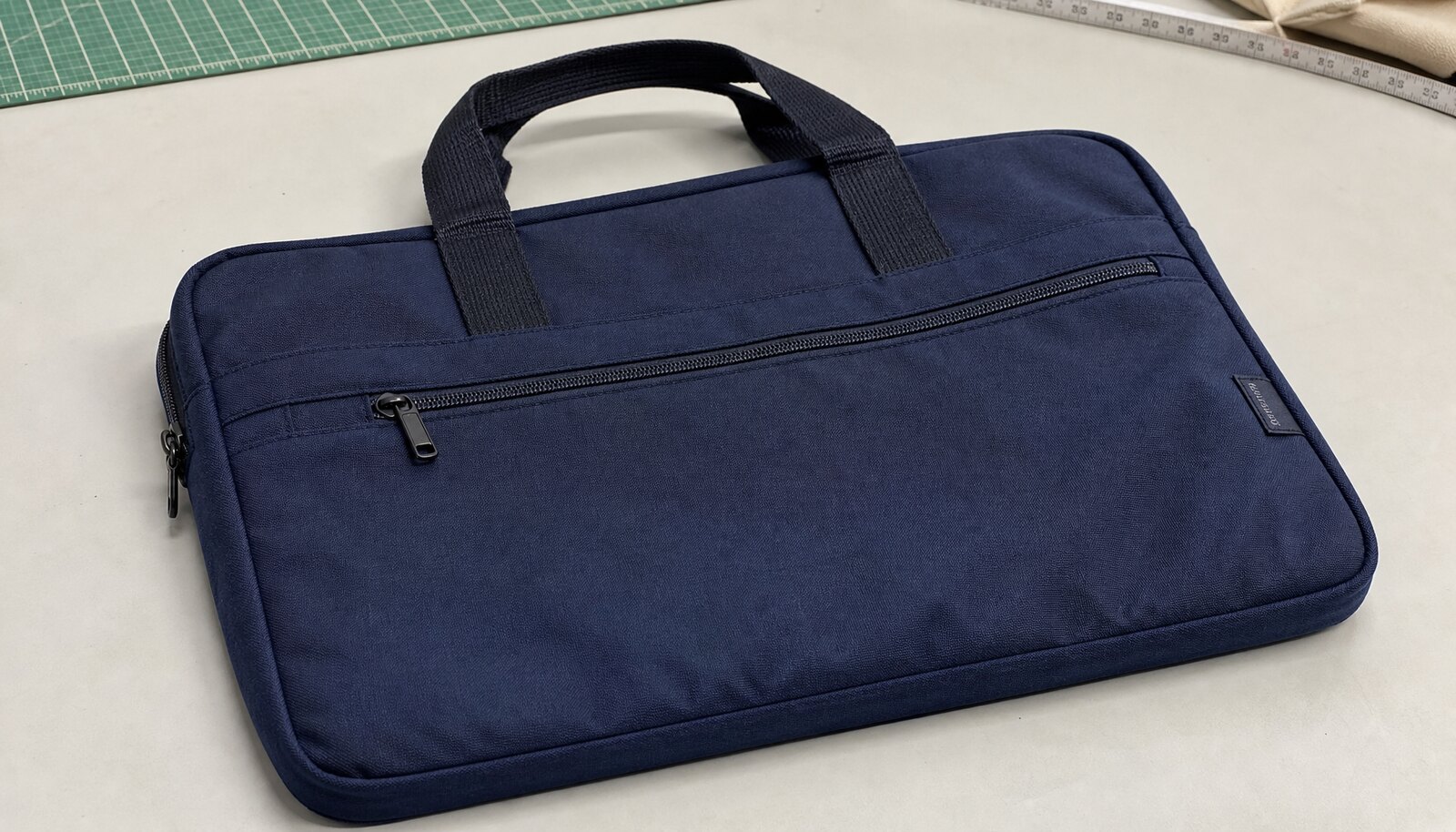
Why ecommerce buyers need a different document bag spec
Business document bags for ecommerce are not the same as office giveaway pouches or a conference handout bag. In ecommerce, the bag has to survive pick-and-pack handling, hold its shape when packed flat, and still look clean when the customer opens the parcel. That changes the buying logic. The question is not only whether the bag can hold papers; it is whether it can be mass packed, shipped, stored, and reordered without variation that turns into complaints.
The spec has to balance three things at once: presentation, protection, and freight efficiency. A bag that looks premium in a sample room can become expensive once it is packed into cartons, because every extra millimeter of height increases cubic volume and every rigid insert increases transport cost. On the other hand, an ultra-light pouch can save freight but arrive looking flimsy. For ecommerce programs, a controlled mid-structure bag with a clear build sheet is usually safer than a loosely described pouch.
The best starting point is the intended load. A4 sheets, letter-size contracts, folded brochures, and thin sales kits create different stress points. A bag made for A4 paperwork needs internal width and zipper path clearance so the papers slide in without curling. If the bag is used as an ecommerce insert or a resale product, buyers should define whether the bag must close with contents inside, whether the front panel must remain flat for branding, and whether the handle is for occasional carry or daily use. Those answers influence size, fabric body, and reinforcement far more than the logo does.
- Define the content first: papers only, papers plus brochure set, or papers plus a slim notebook.
- Decide whether the product is for function, presentation, or resale, because each use case changes the construction.
- Do not approve a bag based on empty appearance alone; test it with the real document stack.
Finished-size rules that prevent fit problems
Finished size is one of the most important procurement controls, but it is often left too vague. Buyers sometimes say A4 size when they actually need enough usable internal clearance for A4 plus a sleeve, tabs, or a small notebook. That difference matters. If the zipper runs too close to the top edge or the side seams are too tight, the bag can technically measure A4 on paper and still fail in real use.
A procurement spec should list finished external dimensions and, where relevant, the minimum internal clearance. If the bag includes a gusset, define where that gusset sits and whether it expands evenly. If the bag is flat, define the usable opening width so documents do not catch on the zipper tape or seam allowance. A supplier can usually work to a measured sample, but a loose verbal dimension is how fit disputes start.
Treat tolerance in practical terms rather than abstract language. State the exact finished target and the allowed range on critical dimensions, then define the fit test. For example: the approved sample should accept a full A4 sheet set, close smoothly, and not visibly curl the top corners. If the bag is meant to hold a sales deck or product sheet pack, test the exact stack thickness. A bag that fits ten pages with ease may fail with twenty pages, and that difference affects customer experience in ecommerce returns and complaints.
- State external dimensions and internal clearance if the bag must hold a specific document stack.
- Use a physical fit test with the real paperwork, not only a ruler check.
- Treat zipper closure around the intended load as part of the size spec, not as an afterthought.
Fabric choices, backing, and what the quoted GSM actually tells you
For most business document bags for ecommerce, 600D polyester is still the safest default because it gives enough body for a tidy front panel, it prints well, and it handles repeated packing without feeling overly soft. If the brand wants a lighter or more sustainability-led option, 300D to 450D recycled polyester can work, but it usually needs more careful construction control. Buyers should not let the quote stop at polyester. Ask for denier, weave density, backing or coating, and any recycled content percentage if that claim matters to the program.
GSM by itself is not enough. Two fabrics with similar weight can behave differently because of weave tightness, yarn quality, coating, and whether the material has lamination or foam backing. A fabric can feel fine in hand and still collapse in a carton if the weave is too open or the backing too weak. The procurement buyer should ask for a cut swatch, a finished sample, and the same material in the final color if shade control is important. If the supplier only offers a vague photo, there is not enough evidence to compare quote quality.
A useful rule when comparing price options: the more structure the buyer wants, the more the quote should show what is supporting that structure. Light foam, PE board, extra lining, or a double-layer front panel can improve appearance, but those additions change sewing complexity, thickness, and packing volume. In landed-cost terms, a slightly more expensive fabric may still be the better choice if it packs flatter and reduces carton count. That is why the buyer should compare total shipped cost, not just ex-factory unit price.
- Ask for denier, weave, backing, and coating, not only fabric name.
- Request a physical swatch and final-color sample if shade matters across reorders.
- Compare freight volume as part of the fabric decision, especially for ecommerce fulfillment.
Construction details that change cost, durability, and reorder stability
Most quote gaps for zipper business bags come from construction, not just the base fabric. A flat pouch with a top zipper is straightforward, but the price increases quickly once the design adds a front pocket, reinforced piping, a semi-rigid insert, a hidden handle, or a lined interior. Each extra panel means more cutting, more sewing steps, more points where variation can appear, and more chances for the bag to shift during production. For procurement, the first step is to freeze the construction drawing before asking for the price.
The zipper itself deserves a specific callout. A nylon coil zipper in size 5 or 8 is usually the most reliable choice for document bags because it runs smoothly, tolerates repeated opening and closing, and is easier to source consistently than very cheap alternatives. The puller should be easy to grip but not bulky enough to snag in pack-out. If the bag is for ecommerce use, the factory should tell you the exact zipper grade or source, because zipper quality differences are a common cause of friction in the final customer experience.
Handle reinforcement is another area where buyers often under-specify. A handle that feels fine in a sample can still fail if the bar-tack count is too light, the stitch density is uneven, or the handle anchor area sits too close to the seam edge. If the bag is meant for carry use, ask for the handle width, stitch pattern, anchor length, and reinforcement method in writing. If the bag is mainly a document sleeve with an occasional carry function, it may be better to keep the handle simple and save cost elsewhere rather than add a decorative but weak construction detail.
- Freeze the construction drawing before price comparison.
- Specify zipper size and type, not just zipper closure.
- Ask for handle anchor details, including reinforcement method and stitch pattern.
Branding methods and what works for logos, fine lines, and repeat orders
Logo decoration should be chosen according to artwork complexity and reorder behavior, not just by habit. For a simple one- or two-color logo, silkscreen printing is usually the most cost-efficient method and gives good repeatability on polyester. If the artwork has gradients, small text, or detailed linework, heat transfer or digital transfer can produce a cleaner result. Woven labels or sewn side labels work when the buyer wants a more discreet brand mark or when the front panel should remain visually simple.
The biggest mistake is approving decoration from a screen mockup alone. On fabric, ink spread, line thickness, and placement shift are real production variables. The buyer should request a strike-off or decorated sample at final size, not only a digital proof. The sample should show exactly how far the logo sits from the seam, where it lands relative to the zipper, and whether any fine elements fill in on the fabric texture. If the product will be photographed for ecommerce listings, a slight shift in logo position or a weak print edge can matter more than the buyer expects.
For reorders, the decoration method affects consistency. Silkscreen is attractive because it is repeatable and relatively low cost when the artwork stays simple. Transfer methods can be better for complex graphics, but the supplier should explain durability, whether a heat press is used consistently, and what visual differences may appear if artwork or panel shape changes later. Buyers who expect regular reorders should ask the factory to retain the approved print reference and to mark the decoration method on the specification sheet so it does not change silently on the next order.
- Approve a final-size decorated sample, not just a digital file.
- Use silkscreen for simple logos and transfer methods for detail-heavy art.
- Record decoration method on the spec sheet so repeat orders do not drift.
MOQ logic, customization traps, and repeat-order implications
MOQ is usually driven by three things: material sourcing, decoration setup, and packing labor. Standard fabric and standard zipper colors give the factory more purchasing flexibility and therefore keep MOQ lower. Custom fabric colors, custom zipper tape, special pullers, or bespoke cartons often raise MOQ because each change creates a separate sourcing or setup step. Buyers sometimes ask for many custom details at once and then wonder why the order becomes expensive or slow; in reality, they are paying for fragmented setup.
The easiest way to keep MOQ manageable is to separate brand identity from structural changes. In many cases, a stock-color body, standard zipper, and one logo placement are enough for a launch order. If the buyer wants a better-looking product, the first upgrade should usually be decoration or a small label, not a custom material change. That keeps the order closer to a standard factory route and makes the first reorder easier. Reorders matter because a good ecommerce program is not only about the first shipment; it is about repeating the same item without re-qualifying everything from scratch.
When reviewing supplier quotes, buyers should ask which choices actually change MOQ. Some suppliers treat color changes as a minor issue and others treat them as a full re-tooling event. The right question is not only What is your MOQ? but What element is driving the MOQ? That answer tells the buyer where to save complexity. It also helps later when the product is restocked: if the first run uses stock zipper tape and a standard body fabric, the reorder path is usually faster and less risky than a one-off custom color build.
- Keep the first order close to stock materials whenever possible.
- Ask which specific change drives MOQ: fabric, zipper, puller, label, or packaging.
- Plan for reorder stability before approving a highly customized launch spec.
Supplier routes: direct factory, trading company, or one-stop bag maker
Not every sourcing route is equally suitable for zipper business bags. A trading company can be helpful when the buyer needs multiple product categories and wants one communication point, but the risk is that the actual manufacturing process may be less transparent. A direct factory can offer better control over sewing quality and packing decisions, especially if the buyer wants the bag to be built, printed, and packed under one roof. The most efficient route for a focused bag program is often a one-stop bag factory with cutting, printing, sewing, and packing in the same facility or under clear in-house control.
The key procurement issue is accountability. If printing is outsourced and sewing is in-house, or if packing is done by a separate team, defects can become harder to trace. A crooked logo might be blamed on the printer, a weak handle on the sewer, and crushed panels on the packer. Buyers should ask the supplier to show the process flow and state who owns each QC checkpoint. A supplier that can explain process ownership clearly usually handles production coordination better than one that only answers with a price.
For ecommerce buyers, the supplier route should match the order risk. A repeat order with no spec change can often go through a direct factory smoothly. A new design with exact fit requirements, special packing, or difficult artwork should not be awarded purely on unit price. In those cases, the buyer should prioritize sample discipline, process ownership, and willingness to quote multiple routes. The supplier who can price a standard spec and an upgraded spec side by side is usually easier to manage than the supplier who gives a single number with no breakdown.
- Direct factory: usually better for quality control and repeat stability.
- Trading company: useful when consolidating several product categories into one shipment.
- One-stop bag maker: best when you want clear responsibility for cutting, printing, sewing, and packing.
Supplier comparison table: what to compare beyond unit price
The comparison table above is most useful when procurement teams separate route risk from product spec. A low-price quote is not always a low-risk quote, and a low-risk quote is not always the cheapest on paper. For business document bags for ecommerce, the buyer should compare route, setup complexity, and the likely impact on reorder stability. That is often where the true cost difference sits.
A common mistake is comparing a launch-development quote against a repeat-order quote. A launch quote often includes extra sample work, more detailed artwork handling, and additional communication time. A repeat-order quote may look cheaper because the route is already stable. If you do not separate those cases, the unit price may mislead you. Use the table to decide which route is right for the current stage of the program, then ask for the missing detail before issuing the PO.
- Compare quotes only after freezing the same spec version.
- Ask for sample type, carton data, and QC limits on the same sheet as price.
- Treat landed cost and reorder stability as part of supplier selection, not just order placement.
QC limits that catch real production failures before shipment
QC should focus on the failures that damage buyer confidence or create returns. The product does not need luxury-level perfection, but it does need to open and close properly, hold documents flat enough to look intentional, and carry without the handle or seams looking flimsy. The highest-risk zones are the zipper ends, handle anchors, seam corners, and print placement. These are the points where a small production error becomes visible immediately to the ecommerce customer.
A good quality standard should translate visible concerns into measurable checks. Size should be checked against the signed sample, not against a rough estimate. Zipper function should be checked by repeated opening and closing, including final closure under a realistic document load. Stitching should be checked for loose threads, skipped stitches, and weak bar-tacks. Print placement should be checked for centering and edge bleed. Color variation should be judged against the approved sample and, if possible, under daylight-like inspection. This is more useful than broad language like good quality or agreed tolerance, which leaves too much room for interpretation.
Packing quality is also part of QC for ecommerce bags. A product can pass sewing inspection and still arrive in bad shape if the carton is over-compressed. Buyers should inspect open cartons for crushed corners, zipper waves, panel creases, dirt, and moisture. If the front panel is supposed to look crisp on arrival, the packaging method must protect that visual standard. It is better to define a few visible defect limits clearly than to rely on a generic factory standard that may not match ecommerce expectations.
- Use size, zipper function, stitch quality, and packing condition as primary QC gates.
- Test samples with the real document load and repeat-open the zipper 20–30 cycles.
- Reject obvious handle weakness, print drift, or crushed pack-out before bulk ships.
Sample approval workflow that protects the bulk order
A solid sample process should include at least two checkpoints: a blank construction sample and a decorated approval sample. The blank sample shows whether the pattern, seam placement, zipper alignment, handle position, and panel fit are correct. The decorated sample then confirms logo placement, print edge quality, and final appearance after the full sewing process. If the supplier only sends one finished sample, it becomes difficult to tell whether any defect came from the material, the sewing, or the decoration step.
The buyer should review the blank sample with actual contents inside the bag. Put in the A4 pages, letter stack, brochure set, or sales kit that the product is meant to hold. Close the zipper and check whether the opening is too tight, whether the contents catch on the seam allowance, and whether the front panel warps when filled. If the bag looks good only when overstuffed, the bulk order may disappoint once it is used in normal volume. This is especially important for ecommerce, where customers see the bag in shipping condition rather than on a display shelf.
Approval criteria should be written before sign-off. That means deciding what counts as acceptable seam alignment, what level of print shift is still passable, and whether minor packing wrinkles are acceptable. If the buyer wants to avoid later disputes, the sample approval record should include photos of the approved sample, notes on the fit test, and the version number of the spec sheet. Reordering is much easier when the approved reference is documented cleanly from the start.
- Review one blank sample and one decorated sample before bulk approval.
- Test the sample with real contents, not an empty bag.
- Save photos and version numbers with the approval record for future reorders.
Specification comparison for buyers
| Procurement decision | Recommended spec / route | Buyer fit | Cost, MOQ, lead-time, and risk tradeoff |
|---|---|---|---|
| Fabric route | 600D polyester as the default; 300D–450D recycled polyester for a lighter or recycled-content program | Best for ecommerce fulfillment where body, print clarity, and reorder stability matter | Cost: low to medium. MOQ: usually lower with stock colors. Lead time: standard. Risk: thin or open weaves can wrinkle in cartons; ask for denier, coating, backing, and a cut swatch |
| Construction route | Flat pouch with top zipper and bar-tacked handle anchors; add gusset only if the document stack truly needs it | Best for launch orders, inserts, and simple resale packs where flat packing matters | Cost: lowest. MOQ: lowest. Lead time: fastest. Risk: limited structure and a more basic shelf look unless panel flatness is controlled |
| Presentation route | Semi-structured front panel with light foam or PE board only where appearance is critical | Best for client kits, retail-style ecommerce, and samples that must arrive crisp | Cost: medium. MOQ: medium. Lead time: moderate. Risk: over-rigid inserts can crease or crack if allowances are wrong |
| Decoration route | Silkscreen for 1–2 spot colors; heat transfer for detailed artwork; woven or sewn label for discreet branding | Best when the brand needs repeatable decoration without overcomplicating the build | Cost: low to medium depending on method. MOQ: low for print; higher for custom labels. Risk: fine lines can fill in on coarse fabric, so approve a decorated strike-off at final size |
| Closure route | Nylon coil zipper size 5 or 8 with tested end stops and smooth puller action | Best for document protection and repeated warehouse handling | Cost: low. MOQ: low. Lead time: standard. Risk: low-grade zipper tape causes snagging and returns; ask for cycle test evidence and the exact zipper spec |
| Handle route | Webbing handle with bar-tack reinforcement or a hidden handle under binding | Best when carry convenience is needed without making the bag bulky | Cost: low to medium. MOQ: low. Lead time: standard. Risk: weak stitch density around handle anchors is a common failure point; request pull-test evidence |
| Packing route | Flat pack with tissue and desiccant; add carton dividers only if shape retention matters | Best for cross-border ecommerce and parcel fulfillment | Cost: low pack cost, but freight can be material. MOQ: low. Lead time: standard. Risk: compression may leave zipper waves or crushed front panels; define max stack height and carton pressure |
| Supplier route | One-stop bag factory with in-house cutting, printing, sewing, and packing | Best when you want tighter defect ownership and fewer handoffs | Cost: often better total value than split sourcing. MOQ: flexible depending on material. Lead time: usually faster than multi-vendor coordination. Risk: outsourced steps can blur accountability unless process ownership is written down |
| Quote route | Request two priced options: standard spec and upgraded spec on the same RFQ | Best for procurement teams comparing margin, quality, and landed cost before launch or reorder | Cost: depends on structure. MOQ: easier to compare. Lead time: easier to forecast. Risk: mixed assumptions disappear into unit price unless the spec is frozen and line-item quoted |
Buyer checklist before sampling
- Define the use case before quoting: document carry, ecommerce parcel insert, sales kit, conference handout, or retail resale pack.
- State the exact document format the bag must hold: A4, letter, or legal. Include whether the bag must close with contents inside and whether corners must remain uncurled.
- Lock finished size, zipper placement, handle length, and any front pocket dimensions on a drawing or measured sample.
- Specify fabric by denier/GSM, weave, backing or coating, and whether recycled yarn is acceptable. Do not leave thickness to supplier judgment.
- Choose a zipper grade and puller style, and ask the supplier to identify the actual zipper source or equivalent spec.
- Approve artwork file, print placement, print size, and acceptable color variance before sample sign-off.
- Ask for a blank construction sample first, then a decorated sample, so sewing defects and print defects can be separated.
- Define packing method, piece-per-carton target, carton dimensions, and whether flat-pack compression is allowed.
- Set QC limits for zipper cycles, stitch defects, handle pull strength, logo centering, and shade variation between lots.
- Compare quotes using the same version-controlled spec sheet and ask suppliers to break out material, decoration, packing, and carton costs separately.
Factory quote questions to send
- What exact fabric denier/GSM, weave, coating, and backing are included in the quoted price? Please send a cut swatch or a finished sample photo with the same material.
- Is the logo printed in-house or outsourced, and what is the price difference between silkscreen, heat transfer, digital transfer, and woven label branding?
- What MOQ applies to this exact spec, and which changes increase MOQ the most: fabric color, zipper color, puller style, handle construction, or packaging?
- Can you quote both a standard version and an upgraded version on the same sheet so we can compare unit price, freight volume, and margin impact?
- What sample stage is included in the quote: blank construction sample, decorated pre-production sample, or both? What is the lead time for each stage?
- What zipper brand or zipper grade are you quoting, and what cycle testing has been done on it?
- What carton size, inner pack count, and gross weight do you recommend to avoid panel creasing during transit?
- Can you share your QC acceptance standard for size, stitching, print registration, zipper operation, and handle strength?
- Which defects are treated as critical, major, and minor during final inspection? Please list your defect limits.
- What is the estimated bulk lead time after sample approval, and which steps usually add delay: artwork approval, fabric sourcing, zipper sourcing, or packing changes?
Quality-control points to confirm
- Finished size tolerance: define finished length, height, and gusset against the approved sample, and verify the bag still fits the intended document format without forcing the zipper or curling corners.
- Fabric consistency: verify batch GSM or denier, weave density, coating, and hand feel against the signed sample; reject obvious shade differences between fabric lots.
- Zipper function: open and close each sample at least 20–30 cycles by hand, checking for snagging, tooth misalignment, end-stop failure, and rough puller action.
- Stitch quality: inspect seam straightness, thread trimming, backtack consistency, and bar-tack density at handle anchors and zipper ends; a weak handle area should fail the sample.
- Print registration: check logo placement from seam to edge and from top to bottom, and reject obvious off-center prints, ghosting, pinholes, or line fill-in.
- Color variation: set a shade reference for the bag body, zipper tape, lining if any, and printed artwork; separate-lot materials should not create visible mismatch.
- Panel flatness: inspect for warping, waves, or collapsed front panels that make the product look distorted on arrival or on camera.
- Packing condition: open cartons and check for crushed corners, zipper waves, creases from over-compression, moisture signs, and dirty inner packaging.
- Carton integrity: confirm carton dimensions, stack strength, and pack count match the shipping plan; a quote without carton data is incomplete for procurement.
- Sample approval rule: approve bulk only after the blank sample and decorated sample both match the agreed spec and real documents fit correctly inside the bag.