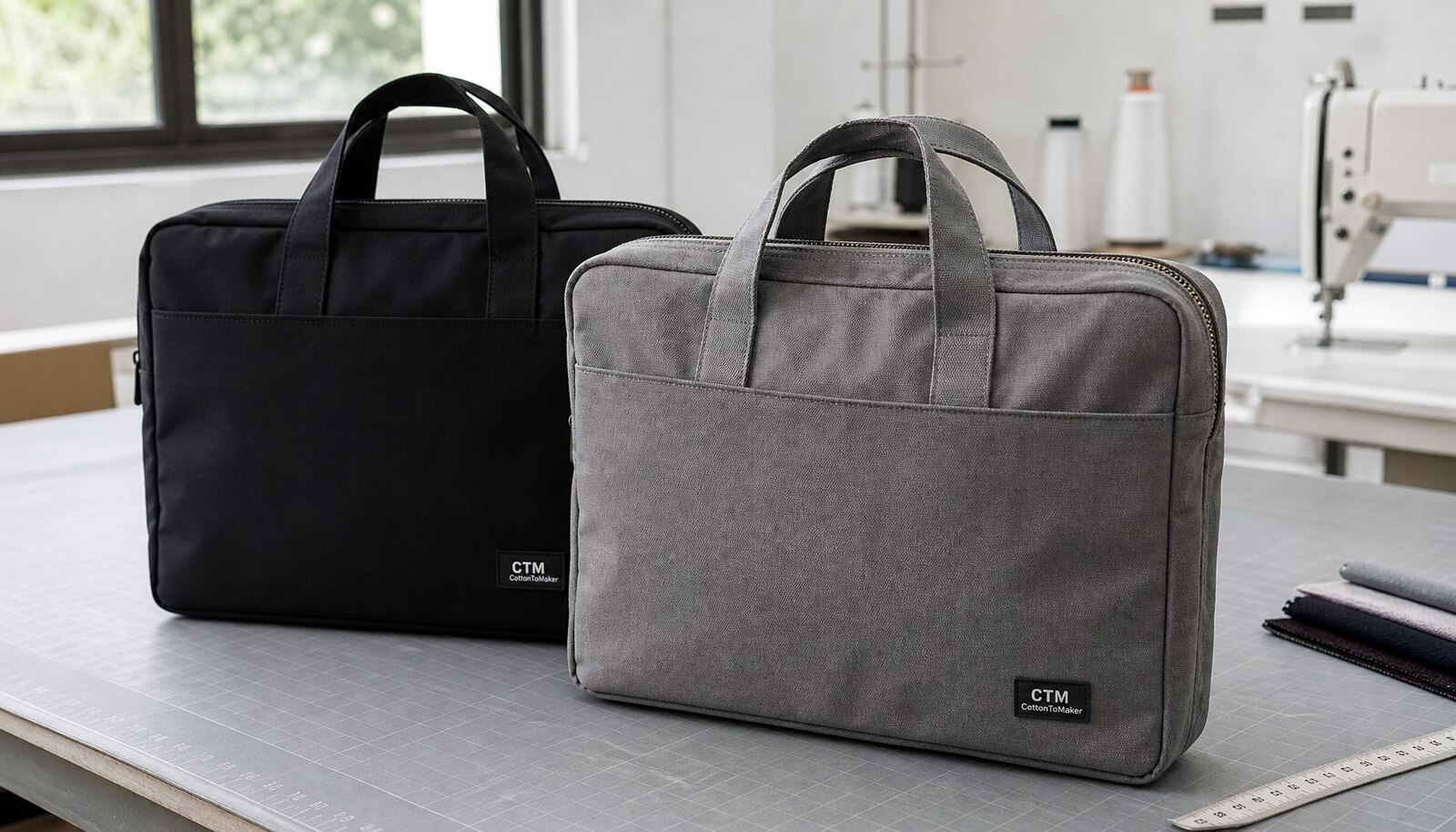
What buying problem these bags solve
Business document bags for corporate gifts sit between a basic conference folder and a full travel bag. Procurement teams usually choose them when the gift has to carry A4 paperwork, contracts, notebooks, tablets, or event kits, but still look polished enough for a client-facing handover. The buying problem is not simply price. It is getting a bag that looks premium, holds its shape, takes logo branding cleanly, and arrives with predictable repeat quality across one or several batches.
The mistake I see most often is treating these like generic promo bags. A document bag that will be carried into meetings needs stronger construction than a giveaway tote, but it does not need expensive features that inflate cost without improving usefulness. The best RFQs define the real load, expected use, and brand position first, then match fabric, zipper, handle, and packing to that use.
- Best use cases: client gifts, conference kits, employee onboarding, distributor incentives, investor events, and premium mailer programs.
- Typical carry contents: A4 documents, 13-inch tablets, slim notebooks, brochures, charging cables, and lightweight stationery.
- Avoid over-specifying: heavy lining, metal fittings, or complex multi-pocket layouts unless the contents truly require them.
Choose the right construction before you compare quotes
For corporate gifts, the core decision is whether the bag should feel structured or soft. Polyester document bags are usually more cost-efficient and easier to produce in consistent color. Canvas versions feel more tactile and premium, but they can wrinkle, absorb more dye variation, and cost more if you want tight print registration. If the bag is intended for a conference kit or mailing program, 300D–600D polyester is often enough. If it is a gift that should stay in use after the event, 12oz–16oz canvas or a heavier blended material may be a better match.
Size logic matters more than most buyers expect. A bag made only for A4 papers often looks too small once the recipient adds a tablet, charger, and notebook. A practical corporate-gift size usually allows a usable interior width, a light gusset, and a top zipper that opens far enough for fast access. Ask the factory for internal dimensions, not only external size, because seam allowance and padding can reduce usable space.
- Common size direction: around A4 plus comfort margin, or tablet-friendly formats with a gusset.
- Fabric options: 300D for light promo use, 600D for stronger body and better shape, 12oz–16oz canvas for a more giftable hand feel.
- If the bag must stand upright, request reinforcement at the base and lower side panels.
Material and print choices that change quote quality
When buyers compare quotes, they often see the same bag description but very different unit prices. The main reason is fabric weight, print method, and finishing complexity. A 300D polyester bag with one-color screen print is a very different production job from a 16oz canvas bag with embroidered logo and contrast lining. If the RFQ does not name the exact fabric weight or GSM, factories will fill the gap with their own interpretation, and the quote comparison becomes unreliable.
For logos, screen printing is the most economical if the artwork is simple and placed on a flat area. Heat transfer works for smaller runs or more detailed logos, but it can look less textile-like and may show aging differently depending on use. Woven labels, embroidery, embossed patches, and sewn brand patches are useful when the gift should feel more premium and less like a disposable promo item. Keep in mind that every added color, patch, or embellishment increases both labor and reject risk.
- Screen print: best for bold logos, large area branding, and repeat programs.
- Heat transfer: useful for complex artwork or smaller orders, but test wash and abrasion resistance if the bag will be reused often.
- Woven label or sewn patch: better for premium perception and lower visual risk than dense embroidery on thin fabric.
- If the logo uses thin lines or tiny text, approve a print-ready artwork version with line thickness adjusted for the method.
How factories usually build the price
A quote for business document bags for corporate gifts is usually built from five blocks: fabric, accessories, sewing labor, branding, and packing. Fabric cost is driven by weight, weave density, coating, and whether the supplier must match an exact color. Accessories include zipper tape and slider, webbing handles, lining, piping, and any metal parts. Sewing labor rises quickly once the bag includes a gusset, internal pocket, reinforced handles, or multiple stitch lines for a cleaner finish.
Branding can be a small line item or a major one. A single-color print on a front panel is easy to price. A multi-color logo, oversized artwork, or patch application takes more time and often needs an extra setup charge. Packing is another hidden cost: if you want every bag polybagged with insert card and barcode sticker, the unit price will move more than many buyers expect. In comparison, bulk packing can save money but may not suit retail or gift-box programs.
- Fabric price shifts with GSM, weave density, color matching, and any coating or lamination.
- Labor increases with gussets, reinforcement, pockets, piping, and precision logo placement.
- Packing cost depends on whether the shipment is bulk packed or retail-ready.
Use supplier options wisely: direct factory, trading company, or stock base bag
For this product category, the sourcing route affects both price and control. A direct factory is usually the best choice when the design is custom, the logo is important, and you need stable repeat production. A trading company can help if you need small-volume sourcing across mixed products, but you should expect a wider price spread and more risk of spec drift. Stock base bag sourcing can be useful for urgent timelines, yet it usually limits fabric color, zipper style, and exact branding placement.
The right route depends on how much product control you need versus how fast you need the shipment. If you are buying for a brand launch or distributor program and plan to reorder, the extra time spent validating a real factory is usually worth it. If the order is a one-time internal event and the product only needs standard branding, a stock-base route can make sense as long as the print area and packing are clearly confirmed.
- Direct factory: best for repeat orders, better QC control, and custom details.
- Trading company: useful for consolidated buying, but confirm who actually owns production responsibility.
- Stock base bag: fast, but usually less flexible on color, size, and logo location.
Supplier comparison table buyers can actually use
Below is a practical sourcing comparison for business document bags for corporate gifts. Use it to decide whether the quote is aligned with your buying route, not just the lowest unit price. The same bag can land very differently depending on whether the supplier is making from scratch, modifying stock, or acting as a coordinator.
If two suppliers quote similar prices but one is using a stock body while the other is sewing a custom pattern, the comparison is not equal. Ask each supplier to state the route clearly in the quote so you can compare like for like.
- Write decisions in measurable language, not only descriptive wording.
- Ask for sample photos plus one physical approval sample for important orders.
- Keep quotation, sample approval, and inspection notes tied to the same spec version.
Sample approval: what to lock before bulk order
Sample approval is where many document bag orders are won or lost. A neat-looking photo sample can still fail in bulk if the factory has not locked the right zipper, handle reinforcement, or print position. Before releasing mass production, the buyer should approve the physical sample or a pre-production sample that reflects the real bulk materials, not a random equivalent fabric.
The most useful sample checks are practical. Open and close the zipper repeatedly. Put in the actual contents you expect the user to carry. Measure the usable width after the bag is filled. Look at the logo from arm’s length, because that is the viewing distance most recipients will have. If the product is a corporate gift, the sample should feel stable and tidy, not flimsy or over-engineered.
- Approve one signed reference sample and keep it against production inspection.
- Check logo size, placement, tone, and edge sharpness under normal indoor light.
- Confirm handle drop and comfort when the bag is carried with actual weight inside.
- If the product includes lining or pocketing, test whether the pocket distorts the front panel.
QC thresholds that prevent expensive rework
For document bags, quality issues tend to show up in three places: stitching, branding, and packing. Stitching defects are visible when the handle is loaded or when the zipper end is tugged. Branding defects usually appear as misalignment, blurry print edges, or color mismatch. Packing defects are less obvious but can damage the order at the carton stage if labels, quantities, or folding direction are inconsistent.
Define acceptance criteria before production starts. A general statement like 'good quality' does not help a factory line supervisor. A better instruction is: logo centered within an agreed tolerance, zipper running smoothly without snagging, handle ends reinforced with bar-tack, and no obvious oil marks, dirt, or broken stitches. If you have a premium gift program, include a stricter appearance standard for the front panel, because that is what the recipient sees first.
- Randomly inspect multiple cartons, not just the first box off the line.
- Check that zipper tape, thread color, and fabric shade are consistent across the whole shipment.
- Confirm carton marks, shipping labels, and packing list counts before final release.
Packing and lead time: where delays usually start
Packing can slow a document bag program more than sewing does. If the buyer wants individual polybags, insert cards, hangtags, barcode stickers, and then master carton packing by assortment, the factory needs extra labor and final-count control. For corporate gifts, bulk packing often makes more sense unless the bags are going directly to retail shelf or presentation kits. If you need presentation-ready packing, decide it early because packaging material approval can hold up production just as much as the bag sample itself.
Lead time should be split by stage. A realistic order flow is artwork confirmation, sample approval, fabric and accessory booking, bulk production, line inspection, final packing, and shipment booking. The biggest schedule risk is not sewing time alone; it is waiting for a logo approval or a packing detail change after materials have already been cut. If the order is tied to an event date, keep buffer time for corrections and freight delays.
- Typical production timing depends on fabric availability, print complexity, and packaging requirements.
- Lead time shortens when the supplier already has the fabric and zipper spec in stock.
- Late artwork changes can force reprint, extra material loss, and shipment slip.
Landed-cost comparison for procurement teams
A good RFQ should help you compare landed cost, not just ex-factory price. For business document bags for corporate gifts, the landed result depends on unit price, packing method, carton efficiency, shipment mode, and how many units fit into a carton without crushing the shape. A slightly higher factory price can still win if the carton pack-out is better and the bag arrives with lower damage risk.
When you compare quotations, put each supplier into the same frame: bag spec, print method, packing route, sampling cost, and delivery term. Then compare the total cost to your warehouse, not the line price alone. In many corporate gift programs, the biggest hidden difference is packaging and freight volume. A bag with more structure may cost a little more to produce but still be cheaper per usable gift if it looks better and reduces complaints.
- Compare unit price together with carton size and gross weight.
- Check whether packing inflates shipping volume disproportionately.
- Treat sample fees and artwork setup as part of the program cost, not as an afterthought.
Specification comparison for buyers
| Spec decision | Recommended option | When it fits | Buyer risk to check |
|---|---|---|---|
| Supplier route | Direct factory with sample room and in-house sewing | When you need custom logo control, repeat orders, and stable QC | Verify the factory is not only trading; inspect photos of stitching, zipper attachment, and packaging lines |
| Material | 300D–600D polyester or 12oz–16oz canvas | When the bag must hold documents, folders, tablets, and give a structured corporate-gift feel | Too light a fabric can collapse; too heavy can raise cost and slow sewing |
| Body construction | Single-compartment with gusset and padded or reinforced base | When the bag carries paperwork, catalogs, or event kits rather than loose travel items | Check gusset width and base reinforcement or the bag may barrel, twist, or print poorly |
| Closure type | Top zipper with smooth nylon coil zipper | When contents must stay secure during travel, conferences, and courier handling | Low-grade zippers snag; puller size, tape color, and slider quality should be stated in the RFQ |
| Logo method | Screen print for large flat logos; woven label or emboss patch for premium feel | When branding is simple and repeatable across gift programs | Overly detailed logos may blur in print; confirm artwork line thickness and Pantone tolerance |
| Handle spec | 25–38 mm webbing handles with bar-tack reinforcement | When buyers want daily-use durability and a cleaner carry profile | Weak handle stitching is a common failure; ask for pull-test evidence or stitch count details |
| MOQ strategy | 500–1,000 pcs per style/color for custom-made production; lower only if using stock base bags | When the program is a launch, conference, or seasonal gift order | Very low MOQ often increases unit cost, limits print options, and weakens material choice |
| Packing route | Bulk pack 25–50 pcs per carton with individual polybag only if required | When warehouse efficiency and lower carton cost matter more than retail shelf presentation | Retail-style polybags can add cost, plastic waste, and packing labor; confirm carton loading quantity |
| Supplier source | Single-source factory for body, print, and packing coordination | When schedule risk matters and you need one owner for artwork, sewing, and export packing | Multi-supplier routing can create color mismatch, delayed handoff, and harder claim handling |
Buyer checklist before sampling
- Confirm bag size, target contents, and usable internal width before asking for a quote; document sleeves and laptops need different gusset logic.
- State fabric choice by denier or GSM, not just 'polyester' or 'canvas'.
- Specify logo method, artwork size, color count, and Pantone targets if color matching matters.
- Set zipper grade, handle width, and reinforcement points in the RFQ to avoid guesswork.
- Ask for sample photo set, pre-production sample, and carton packing photos before mass production.
- Define acceptable tolerance for size, print position, and stitching appearance on the approved sample.
- Request lead time split by sample stage, raw material booking, production, inspection, and shipment.
- Confirm whether packing includes individual polybag, hangtag, insert card, desiccant, or export carton markings.
Factory quote questions to send
- What fabric GSM or denier will you use, and can you show the exact spec on a previous similar order?
- Is the zipper nylon coil, resin, or metal, and what slider type will be used?
- How many logo colors are included in the quoted print process, and what is the surcharge for extra colors or oversized print?
- What is your MOQ per color and per logo version, and what happens to price if I reduce the quantity?
- Can you share the carton pack-out quantity, carton size, and gross weight estimate for shipping planning?
- What sample stages are included before bulk production, and which stage is chargeable or refundable?
- What QC points do you inspect on the line and before shipment for stitching, zipper function, and print alignment?
- What is the production lead time after artwork approval, and how much buffer should I allow for material sourcing?
Quality-control points to confirm
- Fabric weight or denier matches the approved sample; no thin spots, staining, or uneven weave visible under normal light.
- Zipper runs smoothly end-to-end at least several cycles on random pieces; puller and slider are consistent in color and finish.
- Logo placement stays within agreed tolerance; no major shift, blur, cracking, or color bleeding on print or patch work.
- Handle stitching uses even bar-tacks and no loose thread bundles; seam ends are trimmed and secure.
- Bag dimensions fall within an agreed tolerance, especially opening width, gusset depth, and handle drop.
- Inside seams are clean enough for a corporate gift product; no broken stitches, skipped stitches, or exposed raw edges that affect appearance.
- Carton packing matches the packing list; unit count, carton label, and outer carton strength are correct for export handling.
- Approved sample and production bulk show consistent shade across the same PO; if color variance is expected, define the tolerance before order release.