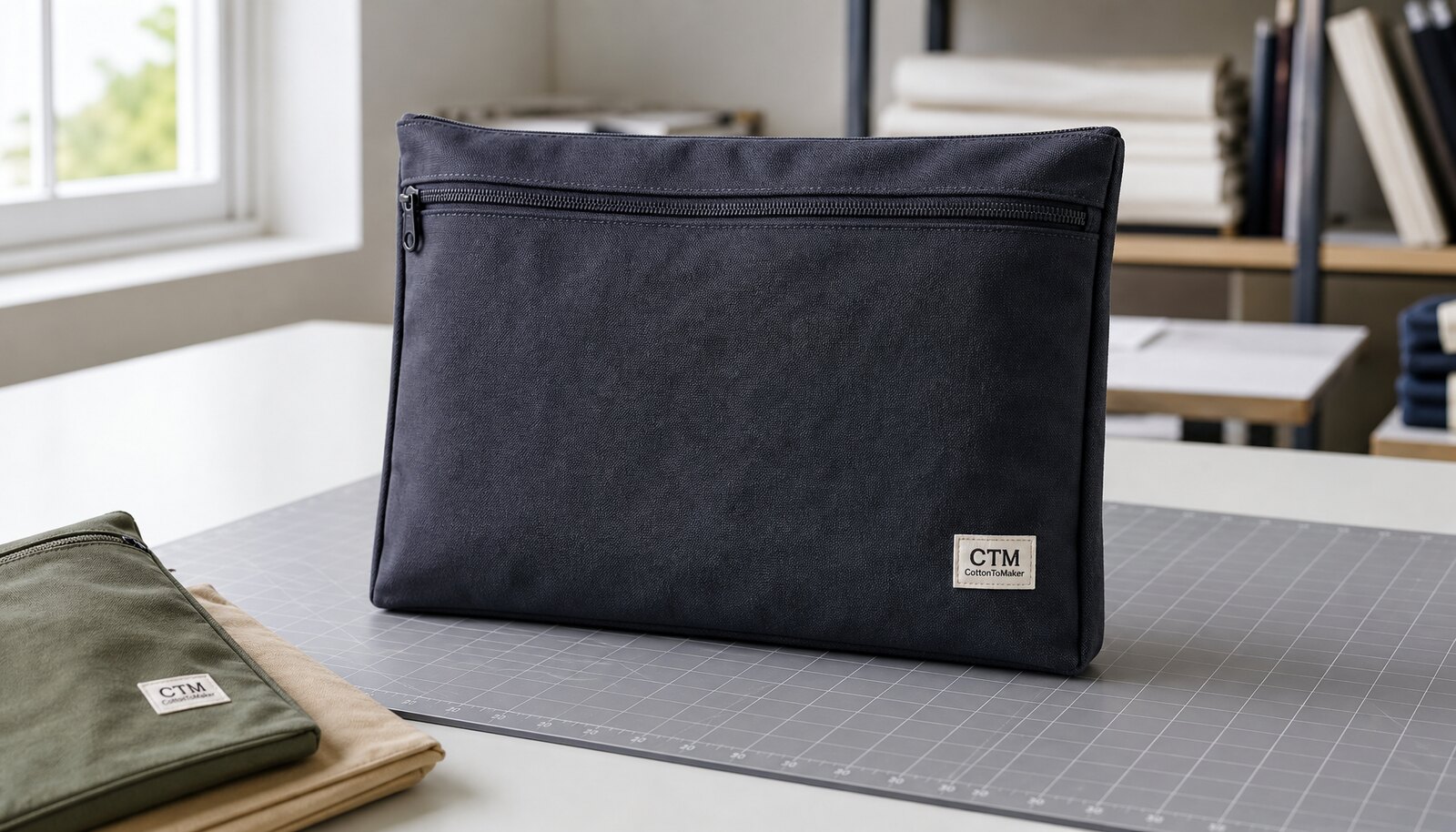
What business document bags need to do
Business document bags sit in a narrow but important space between a simple tote and a laptop bag. Buyers usually need them for proposal packs, conference handouts, contracts, tablets, samples, or sales kits. That means the bag has to look professional, hold its shape, and survive repeated opening and closing without the zipper or handles becoming the weak point. If the bag is too thin, it wrinkles and feels cheap. If it is overbuilt, you pay for structure the end user does not need.
The first buying mistake is treating every document bag like the same product. A paper-only conference bag can use lighter fabric and a simpler build. A bag that must carry a tablet, charger, and folder stack needs more structure, a stronger zipper, and reinforced handles. Decide the load and daily use first, then spec the bag around that. That sequence gives you better quotes and avoids comparing suppliers on the wrong basis.
- Paper-only use: lighter body, simple pocket layout, low-cost branding
- Tablet carry: padding, lining, stronger zipper, and reinforced handles
- Retail or resale use: cleaner stitching, tighter packing, and more consistent print finish
Material choices that change the quote
For most business document bags, 300D to 600D polyester is the practical starting point. It is stable, easy to print on, and usually strong enough for conferences, sales calls, and distributor programs. If the buyer wants a more premium hand feel, cotton canvas in the 12 to 16 oz range gives a heavier impression, but it can add weight, shrink risk, and higher sewing cost. Nylon is useful when flexibility and abrasion resistance matter more than a natural look. Recycled PET works when the brand has a sustainability brief, but the quote should still be based on the same functional spec, not the story alone.
The material decision should include more than the face fabric. Ask for lining type, foam or board insert if needed, coating, and zipper tape construction. A 210D lining is common on padded business bags; a lighter lining can save cost, but it can also make the inside feel flimsy and expose seams. If the bag needs water resistance, define the coating clearly and ask how it affects odor, folding, and print adhesion. Buyers often compare shell fabric only and miss the hidden cost of lining, backing, and reinforcement.
- 300D to 600D polyester: balanced cost, stable print surface, common factory setup
- 12 to 16 oz canvas: stronger visual premium, but heavier and more variable
- 210D lining or light foam: useful when the bag carries tablets or dense paperwork
Compare sourcing routes before comparing unit price
A direct factory is usually the best route when you need a custom size, a specific print position, or repeat orders with stable packaging. The factory can control fabric booking, sewing sequence, and inspection logic more tightly than an intermediary. The tradeoff is that your RFQ has to be complete. If the specification is vague, the first quote may look low but will later expand with missing items such as setup, cartons, or sample fees. For buyers managing branded business document bags across regions, direct factory sourcing usually gives the clearest control over repeatability.
A trading company or sourcing agent can help when your internal team needs speed, when the order is small, or when you are combining multiple product categories in one shipment. The downside is that the buyer often sees less of the actual production plan. Stock programs and hybrid routes can work as a bridge, especially if you need logo add-on on existing shells, but they narrow your options on size, color, and construction. The right comparison is not only unit price. It is quote completeness, defect risk, and how much change control you keep after sample approval.
- Direct factory: best for repeatable custom builds and stronger process control
- Trading company: useful for multi-category buys and smaller teams
- Stock shell plus logo: fastest path, but limited on shape and material choices
How to write a useful RFQ
A good RFQ for business document bags should read like a production brief, not a marketing note. Start with the finished size, zipper style, handle dimensions, target load, and whether the bag must fit a folder, tablet, or A4 documents. Then define the body fabric, lining, print method, and number of logo positions. Include artwork in vector format and say whether the logo must be centered, offset, or repeated. If you need pockets, pen loops, ID windows, or shoulder straps, name them before the quote stage, because each one changes labor and material cost.
The quote should also be built around production data, not just product description. Ask the supplier to quote by quantity break, color break, and logo version. State whether you need a sealed sample before bulk, what overrun tolerance is acceptable, and whether the bag must ship in individual polybags or retail-ready packaging. The more specific the RFQ, the easier it is to compare factories on equal terms. Otherwise one supplier may quote a bare shell while another includes a full retail pack and inspection, and the numbers will not be comparable.
- Give finished dimensions, not only flat dimensions
- Specify print area in centimeters or millimeters
- State packing format and carton target up front
- List sample approval steps and target shipment window
Cost drivers that actually move the quote
The biggest cost drivers in business document bags are usually fabric grade, structure, print complexity, and packing labor. A heavier fabric or padded body uses more material and more sewing time. A one-color screen print is usually straightforward, while multi-color artwork, tonal shading, or a large coverage area adds setup and scrap risk. Zippers, sliders, pullers, internal pockets, and reinforced handles also move the price because they add both material and assembly steps. If you want a reliable quote, separate the functional must-haves from the nice-to-have features before you request pricing.
MOQ logic matters just as much as the unit price. Factories often price around fabric availability, print setup, and sewing line efficiency. If you ask for several colors, several logo versions, and a small quantity per SKU, the factory may need to buy extra fabric and interrupt the line for changeovers. That can make a cheap-looking design expensive in production. If your brand needs variety, one practical approach is to keep the shell identical and vary only the label, print position, or insert card. That keeps the order manageable without reducing brand control.
- Heavier fabric and padded builds increase both material and labor
- Multiple logo colors or print locations raise setup and defect risk
- Many SKUs with low volume each usually cost more than one larger run
Sample approval and QC thresholds
The sample stage should prove that the bag is buildable, not just photogenic. Review the sample for zipper alignment, seam finish, handle reinforcement, pocket placement, and whether the bag stands or folds the way your market expects. Measure width, height, and gusset depth against your drawing. If the bag will carry tablets or heavy paperwork, test it with the actual load rather than an estimated weight. The sample should also show the final logo size and position, because small artwork errors become obvious once the bag is in use.
QC thresholds need to be specific enough that a factory inspector and your receiving team would judge the same bag the same way. Set size tolerances, print placement tolerance, and acceptable needle damage levels. Ask the supplier to submit a pre-production sample if the first sample was a hand-made prototype and the bulk will use machine production. For business document bags, the zipper and handle areas deserve special attention because those parts fail first when buyers reuse the product as a daily carry item.
- Measure the finished bag on three random samples from each size or color
- Test zipper action on a full bag, not just on an empty shell
- Load-test the handle area with the expected real use weight
- Sign off only after the print, stitching, and packing format all match the approved sample
Packing and labeling that prevent warehouse mistakes
Packing is not a minor detail on a B2B bag program. It affects how the buyer receives, counts, stores, and redistributes the order. For retail-ready or distributor orders, individual polybags help protect the fabric and keep each SKU clean. A barcode sticker on the bag or polybag can reduce receiving errors, especially when the same body is used across multiple logo versions. If the bag includes inserts, paper cards, or hangtags, lock those details early because they influence assembly time and carton weight.
Carton planning should match the way your warehouse operates. Ask for carton dimensions, gross weight, and carton count by SKU so you can estimate cubic volume and import handling costs. If the bags are packed loosely, they may arrive with corner scuffs or make count verification harder. If they are overpacked, the fabric can crease permanently. The right packing spec is usually simple, but it has to be explicit: bag count per polybag, polybag count per carton, carton mark format, and whether mixed SKUs are allowed or forbidden.
- Use a consistent barcode or SKU label if the order splits by color or logo
- Define inner pack and master carton count before production starts
- Keep carton marks readable and aligned with your receiving system
Lead time and schedule risk
Lead time for business document bags is usually driven by three things: sample approval, fabric or trim booking, and sewing line capacity. A clean quote should separate sample timing from bulk timing. If the supplier says the production schedule is short, ask whether materials are already in stock or whether they still need to source zippers, lining, or custom labels. The fastest schedule is not always the safest one. If the factory is promising speed without a clear approval plan, the risk usually shows up later as print variation, missed packing details, or rushed inspection.
A realistic plan leaves room for artwork confirmation, pre-production sample approval, bulk sewing, and final inspection before shipment. If the product has multiple print colors or several SKUs, build in more time for line changeovers and packing checks. For seasonal programs, the most common error is starting the order too late and then accepting a weaker spec to protect the calendar. That creates a product that ships on time but underperforms in the market. A better approach is to lock the spec early, freeze the artwork, and protect the last two weeks for QC and loading.
- Separate sample timing from bulk timing in the supplier schedule
- Confirm whether trims and zippers are in stock or made to order
- Protect time for final inspection before the vessel or truck cutoff
Landed-cost comparison for real buyers
The landed cost of business document bags is often decided by small items that never show up in the headline quote. Setup charges, sample fees, cartons, labels, packing labor, inspection, and freight volume can all shift the final number. A supplier that quotes a lower unit price but excludes packing or assumes a lighter fabric may end up more expensive once you compare the full shipment. The safest comparison is to ask each supplier to quote the same finished spec, the same packing format, and the same shipping basis so the spread is real, not cosmetic.
Importers and brand buyers should also look at failure cost, not only purchase cost. A bag that arrives with weak zippers or poor stitching can create chargebacks, rework, or replacement shipments that quickly erase any initial savings. If the product is used in corporate gifting or retail resale, consistency matters more than chasing the lowest first quote. A slightly higher factory price can be the cheaper option if it reduces claim handling, warehouse sorting, and post-delivery complaints. In business document bags, quote accuracy and production discipline usually matter more than headline discounting.
- Compare quotes on the same materials, packing, and shipment basis
- Include setup, labeling, cartons, and inspection in the cost view
- Measure the risk of rework and replacements, not just the purchase price
Specification comparison for buyers
| Spec decision | Recommended option | When it fits | Buyer risk to check |
|---|---|---|---|
| Best sourcing route | Direct factory with sample approval before bulk | Custom size, repeat orders, and tight control over materials and packing | Quotes may exclude setup, testing, or carton work if RFQ is not specific |
| Body material | 300D to 600D polyester for most corporate document bags | Trade shows, meetings, conferences, and general office carry | Low denier fabric can feel thin; ask for fabric GSM or denier plus coating details |
| Premium route | Canvas or 12 to 16 oz cotton canvas with lining | Brand-driven programs that need a heavier hand feel | Canvas can add weight and cost; confirm shrinkage, color variation, and stitching strength |
| Water resistance | Polyester with PU or PVC backing and zipper cover | Outdoor sales teams, deliveries, and travel use | Backing can affect flexibility and odor; request a smell and flex check on samples |
| Closure system | #5 nylon coil zipper for standard sizes, #8 for larger formats | Most document bags that carry papers, folders, or tablets | Weak zipper tape or poor zipper stops create early failures during use |
| Branding method | Screen print for simple logos, woven label or embroidery for premium feel | When the logo is one or two colors or when the buyer wants a durable identity mark | Complex artwork, gradients, or fine text may blur or shift on textured fabric |
| MOQ strategy | Single shell with multiple logo versions or colors only when fabric is stock-supported | Programs that need several regional versions or account-specific branding | Too many variants can inflate MOQ per SKU and create dead stock |
| Packing route | Individual polybag with barcode sticker, then carton pack by SKU | Retail-ready or distributor shipments that need clean receipt and count control | Loose packing increases scuffs, count disputes, and warehouse receiving delays |
Buyer checklist before sampling
- Confirm the end use: paper-only carry, tablet carry, conference kit, or multi-pocket sales bag.
- Lock the finished size, gusset depth, and load target before asking for quotes.
- Specify fabric type, fabric weight or denier, lining, and any water-resistant coating.
- State zipper size, puller style, handle length, webbing width, and any shoulder strap requirement.
- Provide artwork in vector format and list logo size, placement, and print colors.
- Ask for sample stage, sample cost, and whether the bulk order follows sealed sample approval.
- Define packing: individual polybag, insert card, barcode label, inner carton, and master carton marks.
- Set the acceptable overrun and underrun range, target lead time, and shipment terms.
Factory quote questions to send
- What fabric, lining, zipper size, and handle webbing are included in the quoted price?
- Is the quote based on a custom pattern or an existing factory pattern, and what tooling or sample fees apply?
- What is the MOQ per color and per logo version, and can the factory combine colors in one production run?
- Which print method is included, and what are the setup charges for extra colors or extra placements?
- What are the exact packing terms, including polybag style, barcode label, carton count, and carton dimensions?
- What is the approved size tolerance, and how does the factory measure finished size and handle length?
- What is the sample approval process before bulk production starts?
- What lead time applies to sample, pre-production approval, bulk sewing, and shipping readiness?
Quality-control points to confirm
- Finished dimensions stay within the agreed tolerance for width, height, and gusset depth.
- Zipper runs smoothly, aligns at the top stop, and does not separate under normal use.
- Handle stitching uses reinforced bartacks or box-x reinforcement at every load point.
- Print placement stays within the approved location and the logo color matches the signed sample reasonably well.
- Fabric surface is clean, with no oil stains, needle damage, loose threads, or obvious shade variation within the order.
- Seams do not pucker or twist at corners, gussets, or zipper ends.
- Packing count, barcode labels, and carton marks match the packing list and purchase order.
- Drop test and load handling show no tearing at straps, zipper seams, or bottom corners during sample review.