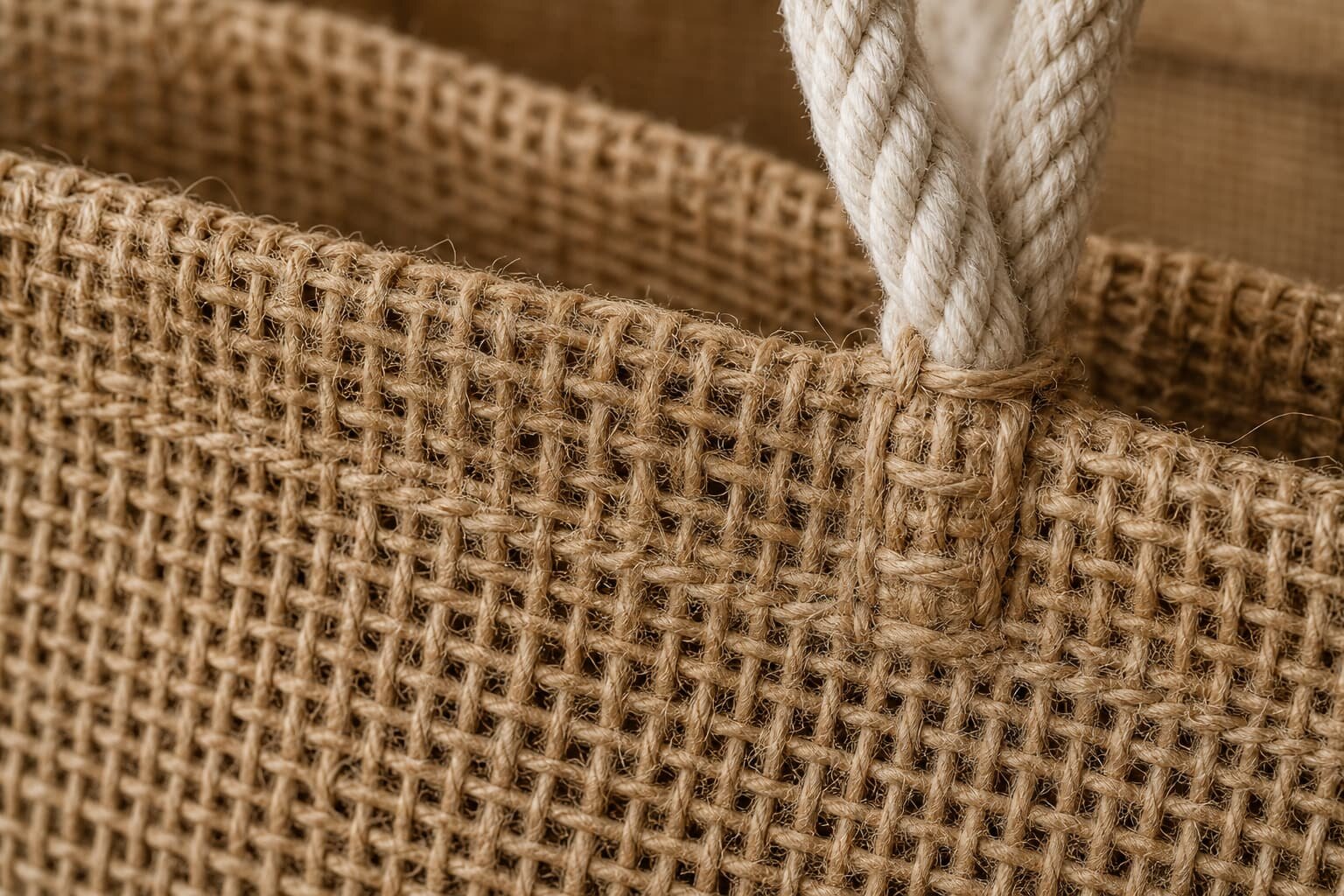
Why burlap changes the logo color discussion
A burlap tote bag is usually made from natural jute yarn, and that base color is not neutral. It has brown, tan, grey, and sometimes olive fiber tones in the same fabric surface. When a buyer asks a factory to match a logo color on burlap, the factory is not printing onto white coated paper. The logo sits on a rough, absorbent, uneven weave, so the final color depends on fabric shade, ink opacity, print pressure, ink layer thickness, and curing.
This is why many color disputes start from a weak RFQ. The buyer sends a vector logo and a Pantone number, the supplier replies with a digital mockup, and both sides assume the brand color is controlled. In bulk production, the logo may look darker, duller, greener, or less crisp than expected. A good sourcing process treats color matching as a production specification, not only an artwork instruction.
- Natural burlap is not a stable color background like white cotton canvas.
- Jute weave gaps can make thin strokes and small text look broken.
- Light logo colors need extra opacity planning before quotation.
- The approved physical sample should become the color standard for inspection.
Start the RFQ with the bag base, not only the logo
Before discussing Pantone accuracy, confirm which burlap tote bag you are buying. A 220 GSM loose jute promotional tote and a 340 GSM laminated jute shopping bag will print differently. Lower weight jute can have a more open weave, which reduces print edge sharpness. Higher GSM can give better body and print support, but it may also increase cost, carton volume, and minimum production quantity.
For most import programs, ask the supplier to quote the fabric weight in GSM, not only describe it as burlap or jute. Also confirm whether the fabric is laminated. Lamination can improve structure and reduce fraying, but it changes the handfeel and may affect how the bag folds and how ink behaves near seams. If the factory quotes a lower GSM than your approved sample, the logo may no longer look the same even when the ink formula is unchanged.
- Typical lightweight promotional jute: around 220-260 GSM, suitable for low-load giveaways.
- Common reusable retail tote jute: around 280-320 GSM, better for repeated handling.
- Heavy structured jute: around 330-380 GSM, useful for grocery, wine, or premium retail bags.
- Always state whether GSM refers to fabric only or fabric plus lamination.
- Ask for fabric swatches from the actual available production lot when timing allows.
Set a realistic color target on natural jute
Pantone references are still useful, but buyers should understand what they control. Pantone Solid Coated gives the factory a clear ink target, yet the same ink printed on natural burlap will not visually equal the chip. The brown base absorbs and darkens the color. A corporate orange can look rusty, a light green can look muddy, and a white logo can look grey if the ink layer is too thin.
A practical RFQ should separate the brand target from the production acceptance target. The brand target can be the official Pantone number. The production acceptance target should be a signed physical strike-off or pre-production sample printed on the actual burlap. For strict retail or franchise orders, ask the factory to submit more than one print option, such as single print, double print, and white underbase, so the brand team can choose the best commercial balance before bulk.
- Use Pantone as the starting reference, not the only approval standard.
- For light colors, ask if a white underbase or double pass is needed.
- For dark logos such as black, navy, forest green, or burgundy, check edge sharpness and ink cracking.
- For metallic colors, confirm whether the effect is achievable on coarse jute or better handled by a patch or label.
- For multi-color logos, approve registration tolerance because burlap weave can shift under the screen.
Choose the logo method by artwork risk
Screen printing is the usual first option for burlap tote bags because it is cost-effective for bold spot-color logos. It works well for large company names, simple icons, event branding, and retail slogans. The limitation is detail. Small letters, thin outlines, halftones, and tight color registration are harder to control on jute than on smooth cotton canvas.
If the logo has gradients, small compliance text, fine brand marks, or a strict color tolerance, a sewn patch, woven label, or heat transfer may be safer. A cotton patch sewn onto the burlap gives a smoother print surface and can carry cleaner artwork, but it adds sewing labor and changes the look of the bag. A woven side label gives strong brand consistency for small logos, but it will not create the same front-panel impact as a large print.
- Use screen print for one to three solid colors and large artwork.
- Use a printed cotton patch when the logo needs cleaner edges than burlap can provide.
- Use a woven label for small repeat branding or retail identity programs.
- Use embroidery only after confirming thread density and distortion on the jute panel.
- Avoid approving complex gradients directly on coarse burlap unless the factory proves it with a strike-off.
Build MOQ logic into the color matching plan
MOQ is not only about the bag quantity. It is affected by fabric availability, dyeing, lamination, handle material, logo process, color count, and production line setup. A natural burlap tote with one screen print color may have a lower MOQ than a dyed jute tote with four logo colors and a sewn patch. If the buyer changes the logo color after sample approval, the factory may need new ink mixing, new strike-offs, or a separate production setup.
For distributors handling several customer artworks, ask whether the factory can combine the same bag body and split logo prints. This can reduce bag-body MOQ pressure, but each artwork or color change may still carry setup charges and production constraints. If you need mixed logo colors in one order, define each variant clearly in the RFQ so the quote does not hide extra screen charges or packing complexity.
- Bag body MOQ may differ from logo MOQ.
- Each print color can require a separate screen and setup.
- Each artwork version should have its own approved sample or strike-off.
- Dyed jute fabric normally needs higher MOQ and longer preparation than natural jute.
- Mixed carton packing by logo version should be requested before quotation, not after production.
Use samples to prevent bulk shade disputes
A digital proof is useful for layout only. It cannot approve logo color on burlap. The practical sequence is artwork confirmation, fabric swatch approval, print strike-off, and then a full pre-production sample. For simple repeat orders, a print strike-off on actual fabric may be enough if the bag construction is already approved. For a new retail program, the full sample should show the final fabric, handles, seams, print position, logo color, label, and packing method.
When reviewing the sample, do not look only at the center of the logo. Check the ink coverage over thick and thin yarns, the edges of letters, the visibility of small text, and whether the logo sits straight after the bag is sewn. Burlap panels can stretch or skew, so a logo that is straight on cut fabric may look slightly off after side seams and gussets are formed.
- Approve the sample under consistent light, not mixed office lighting.
- Keep one signed approval sample with the buyer and one with the factory.
- Photograph the approved sample next to the Pantone reference and fabric swatch for internal records.
- Write the approved print method and ink details into the PO or production file.
- Do not authorize bulk production from a mockup if logo color is important to the brand.
Define practical acceptance criteria for inspection
Color inspection on burlap needs a fair standard. If the buyer says the logo must match Pantone exactly, the factory may agree in writing but fail in production because the base material makes exact visual matching unrealistic. A better standard is: bulk production must match the approved physical sample within an agreed commercial tolerance, viewed under specified light and distance.
For import inspection, define what is critical, major, and minor. A completely wrong logo color, missing underbase, upside-down print, or wrong artwork version should be critical or major depending on the order. Slight shade variation caused by natural burlap may be minor if it stays within the approved sample tolerance. This protects the buyer without setting an impossible standard that creates avoidable arguments at shipment time.
- Critical: wrong logo, wrong color family, wrong artwork, missing logo, or unsafe ink issue.
- Major: obvious shade deviation, poor registration, large print position error, heavy ink cracking, or unreadable brand name.
- Minor: small jute fiber variation showing through ink within approved tolerance.
- Measure print position from fixed bag points such as top edge and side seam.
- Inspect packed goods for ink transfer marks, not only loose samples from the line.
Packing choices that protect the printed logo
Burlap tote bags are often folded or compressed to reduce freight cost. That is normal, but printed logos need enough drying and curing time before packing. If bags are packed too soon, especially with dark ink or a large print area, the logo can stick to another bag or leave transfer marks. Humidity during sea freight can make this worse.
Ask the factory how the bags will be folded, how many pieces go into each inner polybag or bundle, and whether tissue or interleaving is needed. For low-cost promotions, full interleaving may not be economical. For retail-ready printed totes, it can be worth specifying a controlled fold that avoids hard creases across the logo. Carton size, carton weight, and carton moisture resistance should also be reviewed because over-compressed cartons can damage both bag shape and logo appearance.
- Avoid folding directly through a thick logo when the artwork allows another fold line.
- Use sufficient curing time before bulk packing.
- Check if printed faces touch each other inside the bundle.
- Confirm carton quantity and gross weight so cartons are not over-compressed.
- For humid routes, discuss desiccants, carton quality, and container loading conditions.
Quote data buyers should request line by line
A clear quote should let you compare factories on the same basis. If one supplier includes 300 GSM laminated jute, two-color screen print, print strike-off, and export carton packing while another quotes 260 GSM unlaminated jute with one-color print and no sample charge, the lower price is not a true saving. Ask each factory to separate the bag specification, logo process, sample cost, setup cost, packing, lead time, and shipping data.
For logo color matching, the most important quote detail is what the factory assumes. Does the price include an underbase? Does it include one strike-off or only a digital proof? Does it include Pantone ink mixing? Is the quoted lead time counted from PO, deposit, artwork approval, or sample approval? These details affect both cost and delivery reliability.
- Bag size, gusset, handle length, handle material, fabric GSM, and lamination status.
- Logo method, logo size, logo position, color count, and Pantone references.
- Screen charge, setup charge, sample charge, and any re-sampling charge.
- Included sample steps and expected sample lead time.
- Bulk production lead time after final sample approval.
- Carton packing method, carton dimensions, gross weight, and estimated CBM.
Common mistakes that increase cost or delay shipment
The most common mistake is approving artwork on screen and expecting the same color on burlap. The second is changing the fabric after approving the logo. Even a small difference in jute shade can change how the print looks. A third mistake is choosing the lowest quote without checking whether the supplier included the same print method and sample process.
Buyers can prevent most issues by freezing the specification before sampling, approving a physical standard, and writing the approval basis into the purchase order. If the order is for a retailer or corporate brand with strict visual identity rules, build extra time into the schedule for strike-off correction. Rushing color approval usually costs more than planning one additional sample round.
- Do not compare quotes unless fabric GSM and logo method are the same.
- Do not approve bulk production from a digital mockup for brand-sensitive orders.
- Do not assume white or yellow ink will look clean on natural jute without testing.
- Do not change bag size or fabric after the print strike-off without checking logo appearance again.
- Do not leave packing decisions until after printing is complete.
Specification comparison for buyers
| Spec decision | Recommended option | When it fits | Buyer risk to check |
|---|---|---|---|
| Natural burlap fabric weight | 260-320 GSM laminated or unlaminated jute depending on structure | Use 260-280 GSM for light retail giveaways and 300-320 GSM for grocery, wine, or reusable shopping programs | Open weave and color variation can shift the perceived logo shade, especially on light ink colors |
| Logo color reference | Pantone Solid Coated plus digital artwork in vector format | Best for screen print, heat transfer, woven label, and embroidery color communication | Pantone on paper will not look identical on brown burlap; require a physical strike-off approval |
| Print method for solid logos | Screen printing with enough ink coverage and a clear underbase when needed | Good for one to three spot colors, bold brand marks, event logos, and retail packaging programs | Fine lines may break on coarse jute; ink absorption can make colors darker and less sharp |
| Print method for detailed or gradient logos | Heat transfer label or printed cotton patch sewn onto the bag | Useful when artwork has small text, gradients, photos, or strict brand color requirements | Transfer edges, patch fabric color, and sewing tolerance must be approved as part of the sample |
| White or light color logo on natural burlap | Use opaque ink, double print, or white underbase depending on artwork | Needed for white, cream, yellow, light blue, and light green logos that must stay visible | Without enough opacity, the jute base makes the logo look dirty, grey, or uneven |
| Sample approval standard | Approve fabric swatch, print strike-off, and full pre-production sample before bulk | Recommended for branded retail orders, distributor repeat programs, and strict corporate identity projects | Approving only a digital mockup leaves no objective standard for color dispute during inspection |
| Packing for printed burlap totes | Flat pack or controlled fold with tissue/interleaving for dark or heavy ink areas | Useful for large logos, multiple print panels, or bags shipped in humid conditions | Fresh ink, pressure, and moisture can cause blocking, transfer marks, or scuffing inside cartons |
Buyer checklist before sampling
- Confirm the exact burlap base: natural jute, dyed jute, laminated jute, cotton-jute blend, or burlap-look fabric.
- State the fabric weight in GSM and whether the quoted weight is before or after lamination.
- Provide vector artwork, Pantone references, print size, print position, and whether the logo must match coated or uncoated brand standards.
- Ask the factory to advise if an underbase, double print, thicker ink, transfer, woven label, or sewn patch is more stable for the logo.
- Approve a physical print strike-off on the actual bulk fabric, not only a paper proof or digital rendering.
- Set an acceptable visual tolerance for shade difference because natural burlap has fiber color variation.
- Check logo legibility after folding, handle attachment, side gusset shaping, and carton compression.
- Require bulk production to use the same fabric lot, ink formula, and print process approved in the pre-production sample.
- Define inspection method: viewing distance, light source, reference sample, and acceptance criteria for color, registration, and ink coverage.
- Confirm packing method and drying time before carton packing, especially for dark ink or large coverage prints.
Factory quote questions to send
- What is the exact burlap or jute fabric specification, including GSM, weave, lamination status, and expected color variation?
- Which logo method are you quoting: screen print, heat transfer, embroidery, woven label, cotton patch, leather patch, or another process?
- Can you match our Pantone color directly on natural burlap, or do you recommend an underbase or alternative logo method?
- What is the minimum order quantity for this bag size, fabric GSM, logo color count, and print method?
- What sample steps are included in the quote: artwork proof, fabric swatch, print strike-off, pre-production sample, or salesman sample?
- What are the setup charges, screen charges, sample charges, logo mold charges, or color change fees?
- How many days are required for sampling, bulk material preparation, printing, sewing, inspection, and packing?
- Will bulk production use the same fabric lot and ink formula as the approved sample, and how will this be controlled?
- What packing method do you recommend to avoid logo scuffing, ink transfer, odor, or moisture problems during sea freight?
- What inspection standard will you accept for logo color, print position, ink coverage, stitching, handle strength, and carton condition?
Quality-control points to confirm
- Compare bulk print shade against the approved physical strike-off under consistent daylight or D65 lighting.
- Check whether the logo remains readable across the natural dark and light fiber variation of the burlap surface.
- Measure print position from the top edge, side seam, and bottom fold because burlap bags can distort during sewing.
- Inspect for ink bleeding, pinholes, weak coverage, cracked ink, rough edges, and missing strokes in small text.
- Rub the printed area lightly with dry and damp white cloth where applicable to check transfer risk.
- Confirm that printed panels are fully cured before folding and packing into export cartons.
- Check that carton compression has not caused ink set-off onto the back of another bag.
- Verify that production cartons are marked with style, color, quantity, PO number, and approved sample reference.