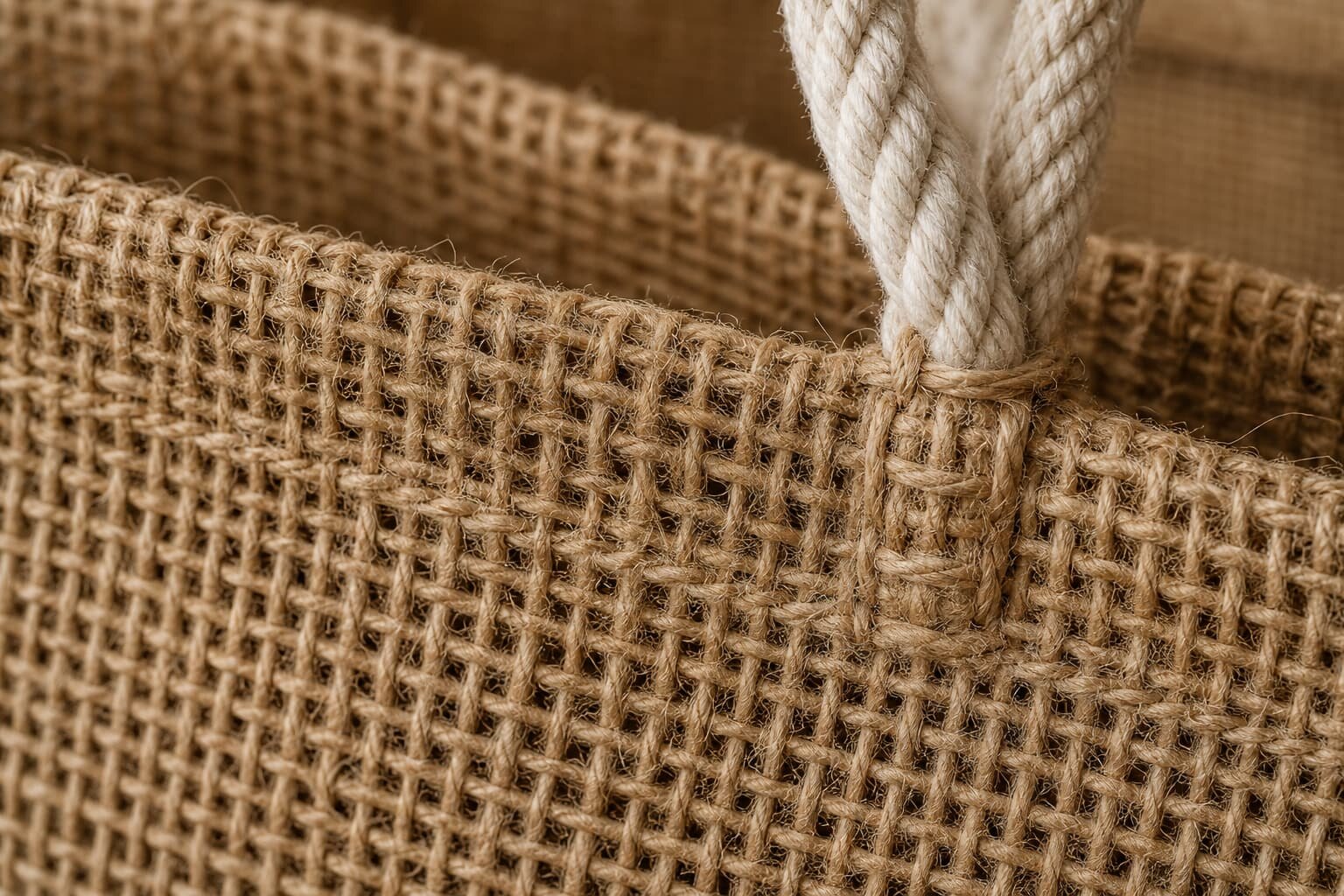
Why the print proof matters more on burlap than on cotton canvas
A burlap tote bag custom logo print proof is not just a branding approval step. Burlap is rough, uneven, and more open than cotton canvas. The ink sits across raised fibers and small gaps instead of a smooth woven surface. A logo that looks sharp in a PDF can become broken, fuzzy, or too heavy once it is printed on natural jute or burlap.
For procurement teams, the proof prevents three common disputes: the logo edge is not clean, the print color does not match the brand guide, or the production bag feels cheaper than the sample photo. The best way to avoid these issues is to approve a physical proof that uses the correct fabric weight, print method, logo size, and curing process before bulk cutting and printing begin.
- Do not approve bulk production from a digital mockup only.
- Ask the factory to print the logo at the final size on the actual burlap surface.
- Review the proof together with fabric GSM, handle construction, and packing method.
- Keep the approved sample as the inspection standard for color, placement, and workmanship.
Start the proof with the right burlap fabric specification
Print quality starts with the base fabric. Many RFQs say only burlap tote bag or jute shopping bag, but those words can cover very different materials. Natural burlap may have an open weave and hairy surface. Laminated jute is stiffer and usually prints more consistently. Jute-cotton blends can feel softer and may support finer artwork, but they change the price and appearance.
For branded retail or gift packaging, a practical range is often 260-320 GSM for laminated or lined jute and burlap bags. Lighter fabric can work for low-cost promotional use, but it may collapse more easily and show more print distortion. Heavier material improves structure, yet it also affects carton weight, freight cost, and sewing difficulty. Your RFQ should ask for GSM, tolerance, lamination, lining, and weave type together.
- Use 220-260 GSM only when low weight and low cost are more important than crisp structure.
- Use 260-320 GSM for most retail, event, and reusable shopper programs.
- Use 320 GSM and above when the bag needs a firmer body, heavier loading, or premium feel.
- Ask whether GSM is tested before lamination, after lamination, or as total finished material.
Choose a logo method that matches the artwork, not only the target price
Screen printing is the normal choice for custom logo burlap tote bags because it can deposit enough ink to cover a rough surface. It works best for solid artwork, bold letters, simple icons, and one to three colors. The factory should advise a safe minimum line thickness before making the screen. If your logo has tiny legal text, fine serifs, gradients, or distressed details, screen printing on burlap may need artwork adjustment.
Heat transfer, digital print, woven labels, cotton patches, and sewn PU patches can also be used, but each solves a different problem. A patch can make a detailed logo look cleaner than direct printing. A woven side label can add brand identification without fighting the burlap texture. Digital print may not have the same hand feel or cost logic at bulk quantities. The proof should confirm both the look and the durability of the chosen method.
- Use direct screen print for bold logos, large slogans, and promotional volume.
- Use a cotton or canvas patch when the logo has small details or multiple colors.
- Use a woven label when subtle branding is enough or when print space is limited.
- Use embroidery cautiously because dense stitching can pucker open-weave burlap.
- Avoid approving gradients unless the supplier has already proven the method on similar burlap.
Build artwork rules into the RFQ before sample making
A supplier cannot make a reliable proof if the artwork data is incomplete. Send vector artwork in AI, EPS, or editable PDF format. Include Pantone references, final logo width and height, and print position measured from stable bag edges. Do not say centered logo only; bags are sewn products and visual centering can shift when the side gusset expands or the bag is folded flat.
For burlap, artwork simplification is often a buying decision, not a factory mistake. Thin reversed-out letters may close up. Small gaps between letters may disappear. Hairy yarns can interrupt a thin stroke. If the supplier recommends increasing line weight or reducing small text, ask for a revised proof layout instead of forcing unsuitable artwork into production.
- State print size as width x height in millimeters.
- State placement from top edge, bottom edge, side seam, or handle stitch line.
- Mark whether the print is on one side, both sides, side gusset, or pocket.
- Convert fonts to outlines before sending artwork.
- Provide Pantone Solid Coated or Uncoated reference and accept that burlap may visually dull the color.
What a useful burlap tote print proof should include
A useful proof is a production test, not a pretty photo. It should use the selected burlap fabric, the agreed fabric weight, the actual ink system, and the final print dimensions. If the bulk order will use laminated jute, the proof should not be printed on unlaminated sample cloth. If the bulk order will be packed flat, the proof should be reviewed after folding as well.
Ask the factory to label the sample with date, material, GSM, print method, Pantone target, logo size, and any deviations. This avoids confusion when several revisions are made. For large distributors or retail buyers, keep one approved proof in your office and ask the factory to keep a signed counter sample on the production line. Final inspection should compare against that physical standard, not against a phone photo.
- Confirm base fabric color and natural fiber variation before judging print color.
- Check whether the ink fully covers raised yarns without becoming too thick.
- Review logo edges at normal viewing distance and close distance.
- Fold the bag as it will be packed and check whether the printed area cracks or transfers.
- Photograph the approved proof with a ruler and approval label for internal records.
Set acceptance criteria before the factory starts bulk printing
Buyers often approve a sample but do not define acceptable tolerance. Burlap is a natural material, so exact uniformity is unrealistic. However, the factory can control the main points: logo position, print completeness, curing, sewing alignment, and packing. Put the tolerance in writing before production, especially if the goods will be inspected by a third party.
For example, you may accept small fiber interruptions inside a solid print area if they are not visible at normal retail viewing distance. You may reject heavy ink smears, missing letters, wrong logo size, under-cured ink, obvious slant, or placement outside the agreed tolerance. Clear criteria help both sides avoid arguing over subjective appearance after cartons are finished.
- Logo placement tolerance: commonly plus or minus 5-8 mm depending on bag size and sewing method.
- Logo size tolerance: define allowed variation in millimeters, not as a vague percentage.
- Color tolerance: compare to approved sample under consistent light, allowing natural burlap influence.
- Print defects: reject smearing, severe pinholes, misregistration, ink transfer, and unreadable small text.
- Sewing defects: reject broken bartacks, open seams, twisted handles, and sharp loose threads near the logo.
Understand how MOQ changes when the proof changes
MOQ is not only a sales number. It is connected to fabric sourcing, dyeing, lamination, printing setup, cutting efficiency, and accessory purchasing. A factory may offer a lower MOQ for natural burlap in an existing width but require a higher MOQ for dyed burlap, custom lining, custom webbing, woven labels, or exact Pantone print ink.
When comparing quotes, do not judge MOQ without checking what it includes. One supplier may quote a low MOQ using stock fabric and approximate print color. Another may quote a higher MOQ because they include custom fabric color, screen setup, pre-production proof, reinforced handles, and export-grade packing. For a brand program, the second quote may be safer even if the headline MOQ is higher.
- Ask MOQ by bag size, not only by total order quantity.
- Ask whether multiple logo colors can be combined under one MOQ.
- Ask whether different bag colors count as separate MOQs.
- Ask if sample and screen fees are refundable after bulk order confirmation.
- Ask whether reorder MOQ is lower once screens, labels, or patterns already exist.
Read supplier quotes by cost driver, not only by unit price
A clean quote for custom burlap tote bags should show the important cost drivers. Fabric GSM, bag dimensions, gusset, handle material, lining, lamination, print colors, label type, packing, carton quantity, and sample fees all affect cost. If these details are missing, the quote may look competitive because it is incomplete.
Ask every supplier to quote from the same spec sheet. If one quote includes a 300 GSM laminated jute body and another uses 240 GSM open burlap, the prices are not comparable. If one quote includes a physical print proof and another includes only digital artwork confirmation, the risk is different. A proper quote lets procurement see where cost is being saved and whether that saving creates a production problem.
- Material cost: fabric weight, fabric width, lamination, lining, and color treatment.
- Labor cost: cutting, sewing, handle reinforcement, patch sewing, trimming, and inspection.
- Printing cost: screen setup, number of colors, ink type, registration difficulty, and curing time.
- Packing cost: inner bag, paper divider, carton strength, carton mark, barcode label, and pallet request.
- Development cost: artwork adjustment, sample fee, courier fee, and pre-production sample revision.
Check packing and lead time before approving the proof
Packing is part of the proof decision because burlap can crease, shed fibers, absorb odor, and hold moisture. Fresh ink can also transfer if bags are stacked too soon or pressed tightly in cartons. For retail buyers, poor packing can turn an acceptable bag into a complaint at warehouse receiving. Ask the factory how long printed bags cure before packing and whether printed faces are separated.
Lead time should be broken into artwork confirmation, material purchasing, sample proof, revision time, bulk production, final inspection, and packing. A normal project can lose many days at the artwork and proof stage if approvals are slow or the RFQ is unclear. If you need a fixed launch date, approve the proof only after confirming the production calendar and the latest date for artwork freeze.
- Confirm whether bags are packed flat, folded, bundled, or individually polybagged.
- Use paper sheets or careful stacking when large printed areas may touch each other.
- Ask for carton dimensions and gross weight to estimate freight and warehouse handling.
- Avoid over-compressed cartons if the bag has lamination, structured gusset, or patch branding.
- Add moisture protection when shipping by sea or storing in humid conditions.
Use a sourcing workflow that prevents last-minute artwork disputes
The safest workflow is simple: technical RFQ first, supplier feasibility review second, physical proof third, written approval fourth, bulk production fifth. Problems happen when buyers approve price before the supplier has reviewed the real artwork, or when factories start bulk production from a screenshot because the delivery schedule is tight.
For procurement teams handling many SKUs, create a one-page proof approval sheet for each burlap tote bag. Include product code, bag dimensions, fabric GSM, logo file name, logo size, placement measurement, print method, Pantone target, sample date, revision number, and approval signature. This document is more useful than a long email chain when the order reaches production and final inspection.
- Freeze artwork before screen making unless the supplier confirms the change is minor.
- Number every proof revision so old files do not return to production by mistake.
- Ask for first bulk print photos only as a checkpoint, not as a replacement for approved sample.
- Require the factory to stop and report if bulk fabric differs from the approved proof material.
- Use the same approval sample for sales, procurement, QC, and warehouse reference.
Specification comparison for buyers
| Spec decision | Recommended option | When it fits | Buyer risk to check |
|---|---|---|---|
| Burlap fabric weight | 260-320 GSM laminated or lined jute/burlap | Retail gift bags, wine shop totes, brand event bags needing better shape retention | Very open weave can cause ink bleed, weak corners, and inconsistent logo edges |
| Logo print method | Screen print with thicker ink deposit | One to three solid colors, medium to large logos, normal promotional quantities | Fine text under 2 mm, thin outlines, and gradients may fill in on rough burlap |
| Premium logo finish | Cotton patch, woven label, or leather-look PU patch sewn onto the bag | Small detailed logos, boutique retail packaging, higher perceived value | Patch color, stitch color, and placement tolerance must be approved separately |
| Sample proof type | Pre-production sample using bulk fabric and real print method | Orders where logo color, handle length, bag structure, or retail presentation matters | Digital mockups do not prove ink coverage, texture, shrinkage, or sewing alignment |
| Packing method | Flat pack in inner polybag or bundled carton pack with paper divider if needed | Export cartons for distributors and retail buyers who need clean arrival | Over-compression can crease laminated burlap and transfer ink between bags |
| MOQ planning | Confirm MOQ by bag size, fabric color, print color count, and accessory changes | Buyers comparing multiple supplier quotes for the same branded tote | A low MOQ may use available fabric only and may not include exact PMS matching |
Buyer checklist before sampling
- Confirm whether the bag is natural burlap, dyed burlap, jute-cotton blend, or laminated jute before approving artwork.
- State target fabric weight in GSM and ask whether the supplier tolerance is plus or minus 5 percent or another range.
- Send vector artwork in AI, EPS, or PDF format and include the exact print size in millimeters, not only a percentage of bag width.
- Specify logo placement from top edge, side seam, bottom seam, and handle stitching so the factory can measure during production.
- Ask for a real print proof on the selected burlap fabric, not only a flat digital mockup on a clean background.
- Check whether the logo has thin strokes, small letters, gradients, metallic effects, or reversed-out details that may not print cleanly.
- Approve thread color, handle material, handle drop length, side gusset, lamination, lining, and closure together with the print proof.
- Define acceptable color tolerance using Pantone reference plus physical sample comparison under normal daylight or D65 light.
- Confirm carton quantity, carton size, gross weight, inner packing, and whether printed sides need paper protection.
- Keep one signed approval sample at the factory and one buyer-retained sample for final inspection comparison.
Factory quote questions to send
- Which burlap or jute fabric weight are you quoting, and is the GSM measured before or after lamination?
- Is the quoted fabric open-weave burlap, tighter jute, jute-cotton blend, or cotton-lined jute?
- Which print method will be used for the logo, and what is the minimum safe line thickness on this fabric?
- Does the quotation include a physical print proof sample using bulk-equivalent fabric and the actual logo size?
- What is the MOQ for this bag size and fabric color, and does the MOQ change if we add a second print color or woven label?
- How many days are needed for artwork setup, sample proof, sample revision, bulk production, and export packing?
- What artwork format, Pantone codes, print position measurements, and approval documents do you need before production starts?
- What print color tolerance and placement tolerance do you normally accept for burlap tote bags?
- How will bags be packed to avoid ink transfer, creasing, moisture, and deformation during ocean or air shipment?
- Which quote items are included and excluded, such as sample fee, screen fee, carton labels, barcodes, inner bags, inspection support, and freight?
Quality-control points to confirm
- Compare bulk fabric GSM, weave openness, color tone, lamination feel, and odor against the approved sample before cutting.
- Measure logo position on the first production pieces from fixed bag edges, not by visual centering only.
- Check print coverage on raised burlap fibers, especially around curves, small text, and reversed-out logo areas.
- Perform dry rub and light scratch checks after ink curing to confirm the logo is not powdery or under-cured.
- Inspect handle bartacks, side seam strength, bottom corners, gusset shape, and loose fibers after the print process.
- Verify carton packing direction, bag count, carton marks, barcode labels, and moisture protection before final sealing.