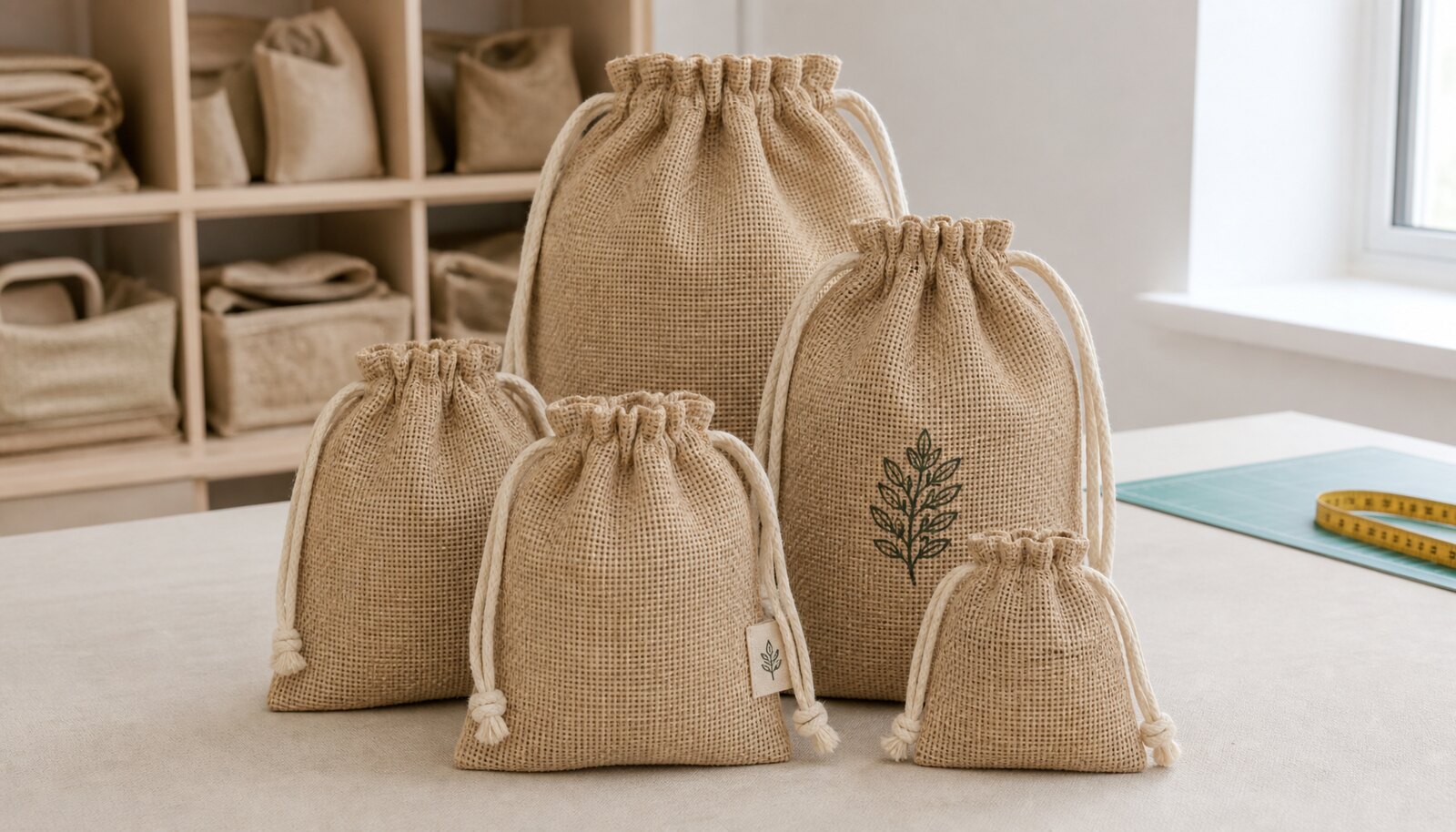
Why burlap gift bags for events need a real buyer spec
Burlap gift bags for events are easy to describe and surprisingly easy to misbuy. A supplier can quote the same-looking bag in several ways: different jute weight, looser or tighter weave, different seam construction, different cord quality, and very different decoration processes. On paper, the bags may look interchangeable. In a live event, they are not.
That is why procurement teams should write the requirement around the event use case. The right question is not, "What size burlap bag do you have?" It is, "What bag will hold this item set, present cleanly, survive handling, and arrive at a cost that still works after freight, packing, and rejects?" For this category, the buying risk is usually hidden in construction details, not in the headline product name.
The best sourcing brief starts with the contents and the distribution model. A bag for wedding favors, conference kits, retail handouts, hotel welcome packs, or candle sets can all be called burlap gift bags for events, but each one needs a different structure and quality threshold. If the spec is vague, the quote will be vague, and the buyer ends up comparing numbers that are not built the same way.
- Define the event contents before you define the bag size.
- Treat decoration, packing, and shipping as part of the product spec.
- Ask suppliers to quote the same build, not just the same outer dimensions.
Choose the right jute weight, weave, and finish
For most event programs, a burlap or jute fabric in the 240-280 GSM range is the practical starting point. That range usually balances hand-feel, structure, and cost. If the fabric drops much lower, the bag can look thin, fold too easily, and show uneven print behavior. If it climbs much higher, the bag becomes firmer and more premium, but the cost rises and some closure styles become harder to sew cleanly.
Weave density matters as much as nominal GSM. Two suppliers can both claim "250 GSM" while one uses a visibly looser weave and another uses a tighter, cleaner cloth. The tighter option usually prints better, sheds less, and reads as more premium. The looser option may be acceptable for rustic giveaways, but it becomes risky when the artwork has small text, thin lines, or a lot of negative space.
For high-visibility events or retail resale, ask for a hemmed top edge and a cleanly finished cut edge elsewhere. That reduces fraying, improves presentation, and gives the factory a more stable surface for cord channels or labels. If the supplier offers dyed jute or a specialty finish, ask how the color is fixed, whether the fabric sheds, and whether the finish changes the print result.
- 240-260 GSM: good for lightweight favors, small handouts, and lower-cost event programs.
- 260-280 GSM: a strong default for premium event kits, retail-style gifting, and moderate item weight.
- 300 GSM and above: useful when structure, shelf presence, or durability matters more than minimum cost.
Size, structure, and closure should follow the contents
A common mistake is approving a bag from the outside dimensions alone. On a burlap bag, seams, hems, and gussets reduce usable space. A bag that looks large enough in a catalog can still be too tight once a boxed item, candle, or jar is inserted. For procurement, the right metric is usable internal space with the actual item inside, not just a nominal width and height on a quote sheet.
The construction should match the load. If the bag is meant to sit upright on a table or at a place setting, a side gusset and a firmer bottom are worth the added cost. If it is only carrying loose favors, a lighter build may be fine. For premium gifting, buyers often want the bag to hold its shape when partially filled, because that is what guests see first.
Closure choice also matters. A drawstring cord is practical for repeated opening and a secure close. A ribbon tie can look better for weddings, hospitality, and curated gift sets, but it may not be the best option for frequent handling. If the bag will be opened and closed more than once, ask the supplier to explain how the cord channel is reinforced and how the tie end is finished.
- Set size by usable internal volume, not just outer dimensions.
- Use a gusseted body when the bag must stand up or hold boxed items.
- Match the closure style to how often the recipient will open the bag.
Compare sourcing routes before you compare unit prices
The lowest quote is not always the best sourcing route. A direct factory can usually control sewing, decoration, and packing more tightly, which matters when the event date is fixed and the artwork must repeat cleanly. A trading company or distributor can help if the buyer wants mixed products in one shipment, but then the buyer needs to know who actually owns the sample approval and who is responsible if the decoration quality slips.
For burlap gift bags for events, direct factory sourcing tends to work best when the bag shape and artwork are already fixed and the buyer wants a reliable repeat build. The factory can quote the real process, not an estimated resale margin. If the program is small, time-sensitive, or assembled with multiple unrelated items, a reseller route may be faster, but the quote should be read as a managed bundle rather than a pure manufacturing price.
The commercial question is not whether a supplier is a factory or a trader in the abstract. It is whether the buyer can see the actual process owner, the sample path, the QC gate, and the packing line. If those details are missing, the risk gets pushed downstream into delays, misprints, and rework.
- Direct factory: best for repeatability, QC visibility, and controlled decoration.
- Trading or distributor route: useful for convenience, but confirm who owns the sample and the final inspection.
- Local stock source: fastest to ship, but usually limited on customization and less efficient on landed cost.
What a useful quote should show
A quote for burlap gift bags should be precise enough that two suppliers can be compared on the same build. At a minimum, it should identify fabric weight, weave finish, bag dimensions, gusset depth, closure type, decoration method, artwork color count, and packing configuration. If any of those are missing, the supplier has room to swap in a cheaper version while keeping the same headline price.
The quote also needs to separate one-time setup from recurring cost. Screen setup, woven label setup, embroidery digitizing, cutting dies, and sample charges all affect the economics of the order. For small event runs, the setup line can matter more than the bag price itself. For larger programs, the recurring unit cost and packing efficiency usually dominate.
Procurement teams should also ask whether the price covers the sample, the strike-off, the carton labels, and the inner pack. If those items are not listed, they often reappear later as extras. The cleanest quote is the one that leaves as few assumptions as possible.
- Ask for unit price, setup cost, sample cost, and carton cost separately.
- Confirm whether the price is for one-side print, two-side print, or label-only branding.
- Require the supplier to state if inner packing and barcodes are included or quoted separately.
Decoration methods that work on rough burlap
Burlap is not a smooth substrate. The texture pulls ink into the weave, interrupts tiny details, and makes thin text less readable. That is why simple screen printing is usually the safest method for event bags. Bold logos, short taglines, and one or two spot colors tend to reproduce well. The more detail you try to force onto burlap, the more likely the result will look soft or uneven.
For buyers who want a more premium appearance, a woven label or sewn-on side label can be a better fit than trying to overprint the cloth. A label gives the brand a cleaner edge and often survives handling better than a fine print. Embroidery can also work, but it adds cost and can pucker the fabric if the design is dense or the thread count is too high for the weave.
The right method depends on the event use case. A conference handout may only need a bold logo and date. A boutique retail bag may need a cleaner brand presentation with better tactile finish. A wedding favor may prioritize a subtle look and a softer closure. The more premium the presentation, the more important it is to compare the decoration method, not just the artwork file.
- Screen print: best for simple logos and clean spot colors.
- Woven label: strong for premium branding and repeated seasonal use.
- Embroidery: use selectively, because dense stitching can distort burlap.
MOQ, artwork, and size changes can split the order
MOQ for burlap gift bags for events is usually driven by the combination of bag size, color, and decoration setup. A single bag body with one artwork version is the easiest order to price. As soon as the buyer adds a second size, a second print color, a second label design, or a different cord color, the supplier may need a separate material lot or setup run.
This is where many buyers get surprised. The supplier may advertise a low MOQ for a blank stock bag, but the moment a logo is added, the practical MOQ rises because the factory has to recover print setup, waste allowance, and labor changeover. A clean RFQ should state the exact quantity per size and per artwork version so there is no room for after-the-fact re-pricing.
For seasonal event programs, it is often smarter to standardize the bag body and vary only the insert card, hangtag, or outer label if the brand needs personalization. That can preserve the core MOQ while still giving the event a custom look. If the program truly needs multiple SKUs, ask the supplier to show where the price steps change, not just the headline minimum.
- Single size and single artwork usually give the best cost base.
- Multiple event names or dates can require separate print setups.
- Different bag colors or labels may trigger separate lots and higher waste.
Sampling and approval should test real use, not just appearance
The approval sample is where the buyer should try to break the order before production does. For burlap bags, a good sample review checks the fabric feel, stitch straightness, closure behavior, print clarity, and how the bag behaves when filled with the real item. An empty sample can look fine and still fail once the event product is inserted.
A better sample review includes the actual use case. Put in the jar, candle, brochure stack, or favor set that the event will use. Check whether the top closes cleanly, whether the bag stands upright, and whether the logo is still readable after the bag is handled and set down. If the program is retail-facing, also check whether the bag sheds lint, has an odor, or shows packaging marks.
If possible, ask for a strike-off or pre-production sample before mass sewing starts. That is especially useful when the logo is small, the label is centered precisely, or the cord color has to coordinate with the event palette. Sampling costs less than rework, and the fastest way to compress the schedule is to avoid a first production run that needs correction.
- Test the bag loaded with the actual contents, not with air.
- Check seam stress, print placement, and cord function after repeated opening and closing.
- Ask for a strike-off or pre-production sample when artwork or placement is critical.
QC checkpoints that reduce rejects
Procurement quality control for burlap gift bags should be specific enough to be executable. A sensible tolerance target is typically set on finished dimensions, with tighter tolerances for small bags and slightly looser ones for larger sizes. The buyer should define how the bag is measured, where the seams sit, and whether the gusset is included in the stated width. That avoids arguments when a bag looks "close enough" but does not actually fit the approved contents.
The inspection should cover both construction and presentation. On the construction side, look at stitch density, seam integrity, cord channel reinforcement, and any handle attachment points. On the presentation side, review ink coverage, alignment, fiber shedding, odor, and carton cleanliness. If the product is going to an event, small cosmetic issues matter more than they would on a utility sack.
For decoration-heavy orders, ask the supplier what test method they use for rub resistance, color transfer, or print durability. You do not need every bag to be laboratory-tested to a global standard, but the two sides should agree on a concrete method before production starts. That is better than relying on general wording like "good quality" or "no problem."
- Set a clear dimension tolerance and define the measurement method in the PO.
- Check stitch density, seam strength, and cord-channel reinforcement together.
- Agree on a rub, color transfer, or handling test for printed or dyed bags.
Packing and labeling should match the downstream workflow
Packing is not a clerical detail. It changes cleanliness, damage rate, receiving labor, and how easily the bags can be distributed at the destination. Burlap can shed fibers and pick up dust in transit, so some buyers prefer inner packs or individual polybags, especially when the bags will sit on shelves or be included in premium gift sets. Other buyers want bulk packing because the bags are going straight to a one-day event and there is no need to pay for extra packaging.
The right packing choice depends on who touches the product next. If the bags are going to warehouse shelves, retail stores, or high-end gift assemblies, then clearer labels, cleaner inner packs, and consistent carton counts are worth the cost. If the bags are going straight from a pallet to a giveaway desk, then the buyer may prefer the simplest carton format possible. Either way, the packing spec should be written before the quote is finalized.
The carton label should match the SKU structure used in the buyer's system. That means size, bag color, print version, and pack count should all be visible. If there are multiple event dates or artwork versions, the carton marks should distinguish them clearly so the receiving team does not have to open boxes to identify the contents.
- Use bulk packing for direct event handouts when presentation is secondary.
- Use inner packs or polybags when dust control or retail appearance matters.
- Make carton labels match the buyer's SKU and artwork naming system.
Specification comparison for buyers
| Decision point | Practical recommendation | When it fits | Buyer risk to check |
|---|---|---|---|
| Fabric weight / GSM | 240-280 GSM jute for most event bags | Standard favors, retail handouts, and premium promo kits | Too light can look open-weave and wrinkle easily; too heavy can reduce flexibility and raise cost |
| Weave density and finish | Ask for a tighter weave with hemmed top edge | When print clarity and presentation matter | Loose weave can blur small text, shed fibers, and look inconsistent across panels |
| Bag construction | Sewn side gusset with reinforced seams | When the bag needs to stand upright and hold jars, candles, or boxed items | Weak gussets distort capacity and create failures at the corners |
| Closure style | Drawstring cord for loose fills; tie ribbon for presentation-heavy favors | For wedding favors, conference gifts, and small retail packs | Cord channels need reinforcement or the fabric can tear after repeated opening |
| Decoration method | 1-2 color screen print for most logos; woven label for premium branding | When the artwork is simple and repeat orders are likely | Fine details, gradients, and thin type do not reproduce well on burlap |
| Supplier route | Direct factory with in-house sewing and decoration | For repeat programs, tighter QC, and lower landed cost variability | A trading layer can hide process owners and slow sample approval |
| Packing method | Bulk pack for events; inner pack or polybag for retail and gifting | When appearance, dust control, or store handling matters | Loose packing increases abrasion, count errors, and dirty units |
| MOQ logic | Base the MOQ on size plus decoration setup, not on blank stock pricing | When artwork and bag size are fixed for one event season | Separate colors, labels, or sizes can split MOQ and inflate setup cost |
| Lead time plan | Count sample approval first, then production after deposit | For standard builds with confirmed artwork | Art revisions, strike-offs, and accessory sourcing can add weeks |
Buyer checklist before sampling
- Confirm usable inner dimensions, gusset depth, and seam allowance against the actual event item, not just the outer bag size.
- Specify fabric weight, weave density, finish, and acceptable odor level in the RFQ, and ask the supplier to name the measurement method.
- Provide vector artwork, PMS/CMYK references, print placement drawing, and a clear approval limit for logo size and position.
- State whether the bag must stand upright, carry a defined load, or simply hold lightweight favors, because structure changes the build.
- Define closure style, cord length, and reinforcement requirement before sampling starts.
- Ask for sample photos of the exact fabric and decoration method being quoted, not a generic catalog image.
- Set carton pack count, inner pack, barcode label, and carton mark requirements by SKU.
- Request the approval sample, production sample, and pre-shipment inspection points in writing.
- Clarify if the bags need retail-ready presentation, dust protection, or gift-box compatibility.
- Build the timeline from final artwork approval backward to the event date, with buffer for correction rounds.
Factory quote questions to send
- What exact GSM, weave density, and fabric finish are you quoting, and can you show a close-up sample photo of the cloth?
- Is the price based on blank bags, screen print, woven label, embroidery, or another decoration method, and how many colors are included?
- What are the MOQ and setup charges by size, artwork, and colorway, and at what volume does the unit price step down?
- Do you sew the bags and apply the decoration in-house, or is any step outsourced to another vendor?
- What size tolerance do you hold on finished bags, and how do you measure usable internal space after seams and gussets?
- What stitch specification do you use at the side seams, top hem, and cord channel, and can you state the thread type?
- What load or pull test do you use for handles, seams, or cord channels, and what is the pass-fail criterion?
- What is included in the packing price: bulk carton only, inner packs, polybags, barcode labels, or carton marks?
- What are the sample timeline, strike-off timeline, and mass production lead time after approval and deposit?
- What is your pre-shipment QC process, and can you share the inspection checkpoint list or AQL standard you use?
Quality-control points to confirm
- Finished dimensions within agreed tolerance, with special attention to usable width and gusset depth after stitching.
- Fabric matches the approved swatch for weight, weave density, color, and hand-feel, with no obvious weak slubs or open panels.
- Print registration, logo size, and placement stay within the approved artwork window, with no blur, pinholing, or ink bleed on the rough weave.
- Stitch density remains consistent at side seams, top hem, cord channels, and handle anchors, with no skipped stitches or loose ends.
- Cord pull or seam pull test passes the agreed load target for the intended use case, not a generic test with no reference to content weight.
- If dyed or printed, the bag passes the agreed rub test or color transfer check for the intended handling environment.
- Odor, lint, stain, and fiber shedding stay within the presentation standard for event handout or retail use.
- Carton count, SKU label, size label, and artwork version are accurate and consistent across cases.
- Inner pack configuration matches the packing list, with no mixed lots, incorrect quantities, or damaged units.
- Pre-shipment photos or inspection records confirm the final finish before goods leave the factory.