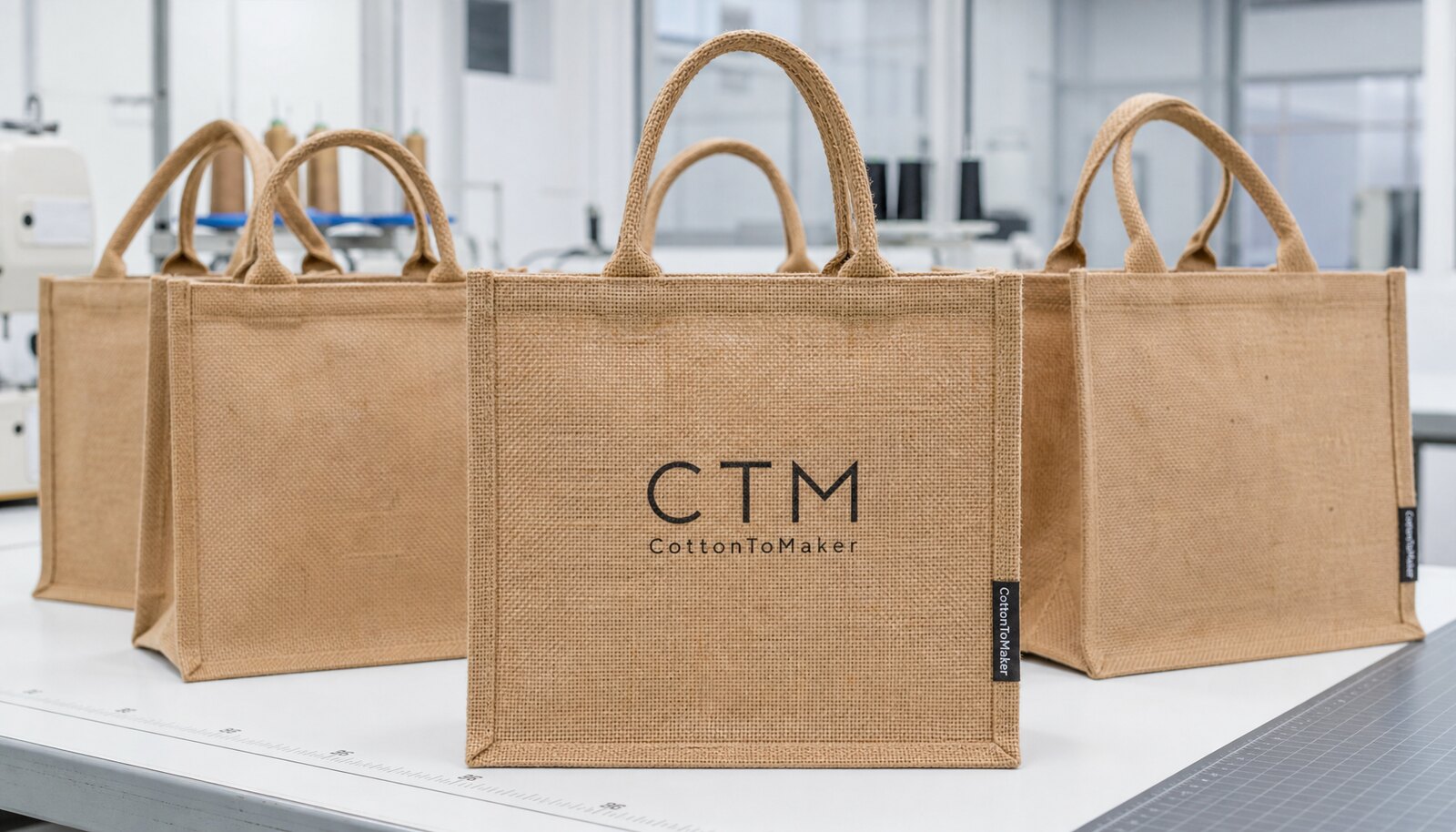
Why burlap bags with logo need a different buying approach
Burlap bags with logo are often treated like a simple promotional item, but the buying risk is closer to a small retail product than a disposable giveaway. The fabric is coarse, the weave is open, and the print surface is not uniform. That means the same artwork can look clean on one supplier's bag and weak or blurry on another supplier's bag even if the dimensions are identical.
For procurement teams, the real issue is not finding a vendor who can quote a bag. It is defining what the bag must do in your channel. A trade show giveaway only needs light carry capacity and decent print visibility. A retail shelf item needs better structure, cleaner seams, and carton packing that arrives ready for distribution. If those use cases are mixed up in the RFQ, the quotes will look comparable but the received goods will not.
- Promotional use usually tolerates lighter GSM and simpler construction.
- Retail and ecommerce use often need tighter size control and better print durability.
- Gift packaging programs need visual consistency more than high weight capacity.
Start with the use case, not the decoration
The first buying decision is whether the bag must carry weight, hold its shape, or simply present a logo well. A 250–300 GSM burlap bag can work for lightweight gifts, brochures, and event inserts. If the bag will hold bottles, boxed products, or be displayed on shelves, move closer to 320–400 GSM and specify stronger seams. A thicker bag costs more, but the savings from fewer damage claims and fewer customer complaints usually outweigh the extra unit cost.
Logo requirements also change the structure of the order. If you want one-color branding, the factory can usually keep setup simple. If you need multiple logo versions, variable names, or front-and-back branding, the print process becomes more sensitive to alignment and setup time. The safest RFQ describes both the functional use and the visual expectation.
- Light duty: 250–300 GSM, basic flat bag, single-color print.
- Medium duty: 300–350 GSM, reinforced handles, cleaner seam allowance.
- Display or retail duty: 350–400 GSM, optional lamination or lining, tighter size tolerance.
Fabric weight, weave, and finish drive more of the quote than most buyers expect
Jute and burlap pricing is not just about the bag size. Fabric weight, weave tightness, yarn quality, and finishing all influence how the bag prints and how it feels in hand. A loose weave can reduce cost, but it often makes logos look patchy because ink sinks unevenly into the fibers. A tighter weave gives a cleaner print and a more premium look, but it also increases raw material cost and may require better sewing control to avoid puckering.
If the bag is meant for retail, ask for the GSM or ounce weight in the RFQ and tie it to a physical sample. Do not accept “heavy burlap” as a specification. Require a real sample from the actual fabric lot or a close approved equivalent. If the supplier offers a laminated or lined burlap version, compare it against the unlined version by weight, stiffness, and packing efficiency before you decide.
- 250–300 GSM: lower cost, lighter hand feel, faster to pack flat.
- 320–350 GSM: better shape retention, more stable print surface.
- 350–400 GSM: premium appearance, better standing structure, higher freight weight.
Logo application choices: print, patch, stitch, or woven label
For burlap bags with logo, screen print is usually the most efficient method when the artwork is simple and the quantity is meaningful. It gives a strong visual at low setup cost, but the mesh texture of burlap can leave slight breaks in fine details. If your logo has thin lines, small text, or a gradient, a patch or stitched application may produce a cleaner result than forcing a delicate print onto rough fiber.
Heat transfer is sometimes offered for low-volume orders, but buyers should treat it carefully. Burlap surfaces are irregular, so transfers can sit unevenly, especially across folds and seam intersections. For repeated retail use, a woven label or stitched patch usually outlasts a transfer. The best choice depends on whether your brand values a rugged handmade look or a cleaner retail finish.
- Screen print: best for bold logos, 1–2 colors, and bulk orders.
- Patch or embroidery-style stitching: better for premium perception and texture.
- Heat transfer: use only when the order is short-run and the artwork is not too detailed.
- Woven label: good for side branding when the front panel must stay clean.
How supplier quotes should be structured
A useful quote breaks the bag into cost blocks. The buyer should see the fabric cost, sewing cost, print setup or plate fee, label or patch cost, packing cost, and carton loading cost. When suppliers hide everything inside one unit price, it becomes hard to understand where they made the bag cheaper. That is how some quotes look attractive until the samples arrive with thinner fabric, smaller handles, or reduced print coverage.
For comparison work, ask each supplier to price the same dimensions, the same GSM, the same logo method, and the same pack count. If one supplier prices a bag with 300 GSM and another prices 240 GSM, those quotes are not comparable. Also watch for tool charges, color change fees, and any cost for custom hangtags or barcode stickers if retail packing is required.
- Require unit price plus setup fee plus packing fee, not only one blended number.
- Clarify whether the print plate fee is one-time or repeated on reorders.
- Ask for carton quantity, carton dimensions, and gross weight for each quote line.
- Separate blank bag pricing from printed bag pricing if you may run future SKUs.
Supplier options and sourcing routes: what actually changes the outcome
The source route matters because burlap bags are simple enough to be quoted by many sellers, but not all sellers control the same production steps. A direct factory with its own cutting, sewing, and printing lines usually provides better consistency and faster sample feedback. Traders and consolidators can be useful when you need mixed product baskets or smaller volumes, but they may not control fabric lots or print curing as tightly.
If your brand needs repeatable quality, prioritize suppliers that can show in-house production evidence: sample room photos, machine list, stitching references, and a recent production sample from the same construction method. For an initial low-volume test, a sourcing agent or trader may be acceptable if they can still commit to the same measurable spec. The key is to avoid buying on relationship language alone.
- Direct factory: better for repeat orders and stable QC.
- Trader/consolidator: useful for mixed orders, but verify actual production control.
- Local stock supplier: fastest lead time, but limited customization and weaker brand fit.
Sample approval should test structure, not only artwork
A photo of the logo is not enough to approve burlap bags with logo. The pre-production sample must show the actual fabric lot, the actual print process, the final stitch pattern, and the final packing method. A good sample also proves that the bag size is correct after sewing, because burlap can shift during cutting and seam closure. If the sample is flat and neat but the bulk production is warped, it usually means the factory changed material lots or rushed the sewing line.
Use the sample to test folding, print rub resistance, and hand feel. Fold the bag in the same way it will be packed, then inspect whether the print cracks at the crease. Fill it with the intended product weight if you know the load. Check the handle drop against your shelf or carry use. These are small tests, but they reveal most of the failure points before bulk production starts.
- Approve one blank sample and one printed sample if the logo contrast matters.
- Measure width, height, gusset, and handle drop on the actual sample.
- Record photo angles of the approved sample for factory reference.
- Keep the signed sample in the PO file for dispute handling.
QC thresholds buyers should write into the PO
A strong PO for burlap bags with logo includes measurable quality thresholds. Size tolerance should be written in millimeters or inches, not words like “close enough.” Print alignment should reference seams or center points. Stitching should be judged by straightness, skip rate, and thread tails, because those defects are common on coarse fabrics. If the bag includes a side label, the label position should also be fixed from the edge, not estimated by eye.
You should also define what is a defect versus normal burlap variation. Natural fiber bags will not look uniform like coated polyester. Slight shade variation, occasional fiber knots, and weave irregularity are normal if they do not affect use or logo visibility. But uneven print density, open seams, oil stains, musty odor, and mixed carton counts are not acceptable on a retail or brand order.
- Size tolerance: define exact maximum deviation for width, height, and gusset.
- Print registration: define centerline or distance from edge.
- Stitch quality: no skipped stitches on load-bearing seams.
- Odor and cleanliness: bags must be dry, clean, and free of storage smell.
Packing and carton design can protect the print or ruin it
Burlap bags are usually packed flat, but the fold direction matters. If the logo sits where the fold line lands, the print may crack or leave a permanent crease that affects shelf appeal. For retail or ecommerce, a simple inner polybag can reduce dust and abrasion, though it adds cost and plastic content. Many buyers skip this step and then wonder why the print arrives rubbed or the fabric picks up moisture during transit.
Carton size should support the bag dimensions without excessive compression. Overpacked cartons squeeze the weave and distort the outline, while underpacked cartons waste freight cube and increase carton crush risk. Ask the factory to give you the exact carton count, gross weight, and carton marks before shipment. That data helps both warehouse receiving and freight booking.
- Use a fold plan that keeps the logo away from the sharpest crease.
- Choose inner poly only if dust control or retail presentation matters.
- Confirm carton count consistency and carton label format before shipment.
- Do not let the factory compress cartons just to reduce cubic volume without approval.
Lead time, MOQs, and schedule risk
Lead time for burlap bags with logo usually depends on three gates: fabric booking, sample approval, and print readiness. A standard order may take around 20–35 days after sample approval, but the actual schedule can expand if artwork changes after plate making or if the supplier needs to source a special fabric lot. New molds are not usually the issue here; the schedule risk is more often in print setup, drying, and sewing queue congestion.
MOQ should be read as a combination of size, color, and print setup. A supplier may offer a low overall MOQ but still require a minimum per artwork version or per fabric color. That matters when a brand wants multiple SKUs for a seasonal program. If your launch plan needs several versions, it may be cheaper to consolidate artwork into fewer print variants than to split the order into many tiny runs.
- Standard production: often 20–35 days after final sample sign-off.
- New artwork or custom label: add setup time for plates and label proofing.
- Multiple colors or sizes: expect MOQ pressure by SKU, not just by order total.
- Rush orders: often increase risk of print curing issues and packing errors.
Specification comparison for buyers
| Spec decision | Recommended option | When it fits | Buyer risk to check |
|---|---|---|---|
| Bag fabric weight | 250–300 GSM burlap/jute for light retail and promo use; 320–400 GSM for better structure | Use 250–300 GSM when you need lower cost and flexible bags; use 320–400 GSM when the bag must stand upright or carry heavier items | Thin fabric can look uneven after printing and may show warp/weft gaps; heavier fabric changes cost, hand feel, and stitch difficulty |
| Logo application | Screen print for simple 1–2 color logos; heat transfer only for short runs; woven/stitched patch for premium presentation | Screen print fits most bulk orders with clean artwork; patch or stitching fits brands that want a more durable, tactile look | Fine lines can break on rough burlap; heat transfer may crack or lift if the bag flexes often; patch placement can drift if not measured from seam references |
| Supplier route | Direct factory with jute/burlap line and in-house printing | Best for repeat orders, controlled quality, and better quote transparency | Some traders quote low but outsource printing and sewing; that can hide margin layers and weaken QC control |
| MOQ structure | Base MOQ by fabric color and print setup, not by logo alone | Useful when you need one SKU in several print colors or sizes | Low MOQ sometimes means shared stock fabric or mixed production batches that increase shade variation |
| Sample stage | Pre-production sample with actual fabric lot, print plate, thread, label, and packing spec | Needed when the bag is customer-facing or has strict retail presentation | Approving only a photo sample can miss print density, seam tension, and size tolerance problems |
| Packing method | Flat-packed with controlled fold, inner poly if needed, then carton with count label | Best for ecommerce, distributors, and retail DC receiving | Loose packing can crease prints; over-compressed cartons can distort jute shape and slow store-ready unpacking |
| Lead time route | 20–35 days for standard specs after sample approval; add time for new plates or custom labels | Best for planned seasonal programs and reorder business | Rush schedules often skip drying time for print and increase smudge or odor risk |
| Cost comparison | Quote should separate fabric, sewing, print, label, packing, and inland carton loading | Useful when comparing suppliers on a true apples-to-apples basis | All-in quotes can hide whether the supplier cut fabric weight, skipped lining, or downgraded thread |
| Quality standard | Define size tolerance, stitch density, print opacity, odor, and carton count accuracy before order | Best when the bags are sold into retail or used in brand promotions | Without written acceptance criteria, suppliers may treat cosmetic flaws as acceptable and ship mixed quality |
Buyer checklist before sampling
- Final artwork in vector format with spot colors or Pantone references, plus approved placement measurements from seam to logo edge
- Target fabric weight in GSM and whether the bag must stand upright, carry bottles, or only hold lightweight giveaways
- Bag dimensions, handle length, handle width, seam construction, gusset depth, and whether an inner lining or lamination is needed
- Print method preference and the maximum number of colors the artwork should use on burlap texture
- Packing spec: flat pack, fold direction, polybag requirement, carton count, carton mark format, and master carton size limit
- Required sample types: blank sample, printed strike-off, pre-production sample, and shipment reference sample
- Acceptable tolerance for size, print registration, stitch quality, smell, and visible fiber variation
- Target ship date, port or delivery point, and whether the supplier must support split shipments or phased delivery
Factory quote questions to send
- What GSM or ounce weight are you quoting, and is that fabric weight measured before or after printing and finishing?
- Is the logo printed in-house, outsourced, or applied as a patch, and what setup fee or plate fee applies?
- What exact MOQ applies by size, color, and print version, and can mixed artwork share the same production run?
- What is included in the unit price: fabric, stitching, print, side label, inner packing, carton packing, and export carton marks?
- Can you provide a measured pre-production sample based on the actual fabric lot and final artwork before bulk production?
- What are your accepted tolerances for bag size, handle length, print alignment, and carton count?
- How long is the lead time after sample approval, and how many days are needed for plate making, fabric booking, and print curing?
- What carton size and quantity per carton will you use, and can you confirm gross weight for freight planning?
Quality-control points to confirm
- Fabric GSM must match the approved range; confirm there is no visible thinning, weak weave, or uneven slub that affects print clarity
- Logo placement should stay within a defined tolerance from the top edge and side seam; print must be centered or positioned per artwork sheet
- Print opacity must cover the base fabric evenly without heavy pinholes, smearing, or cracking at fold lines
- Stitching should be straight and secure at handles, side seams, and bottom seam; loose threads and skipped stitches should be limited
- Handle length and drop length must match the approved sample so the bag hangs correctly for retail display or shoulder use
- Smell and moisture should be acceptable on arrival; jute/burlap must be dry, clean, and not musty from storage
- Cartons must be count-accurate, labeled clearly, and packed so the printed surface does not rub against raw edges or staples
- Reference sample from the approved production sample should be kept for final inspection and dispute resolution