Start with what durable means for this order
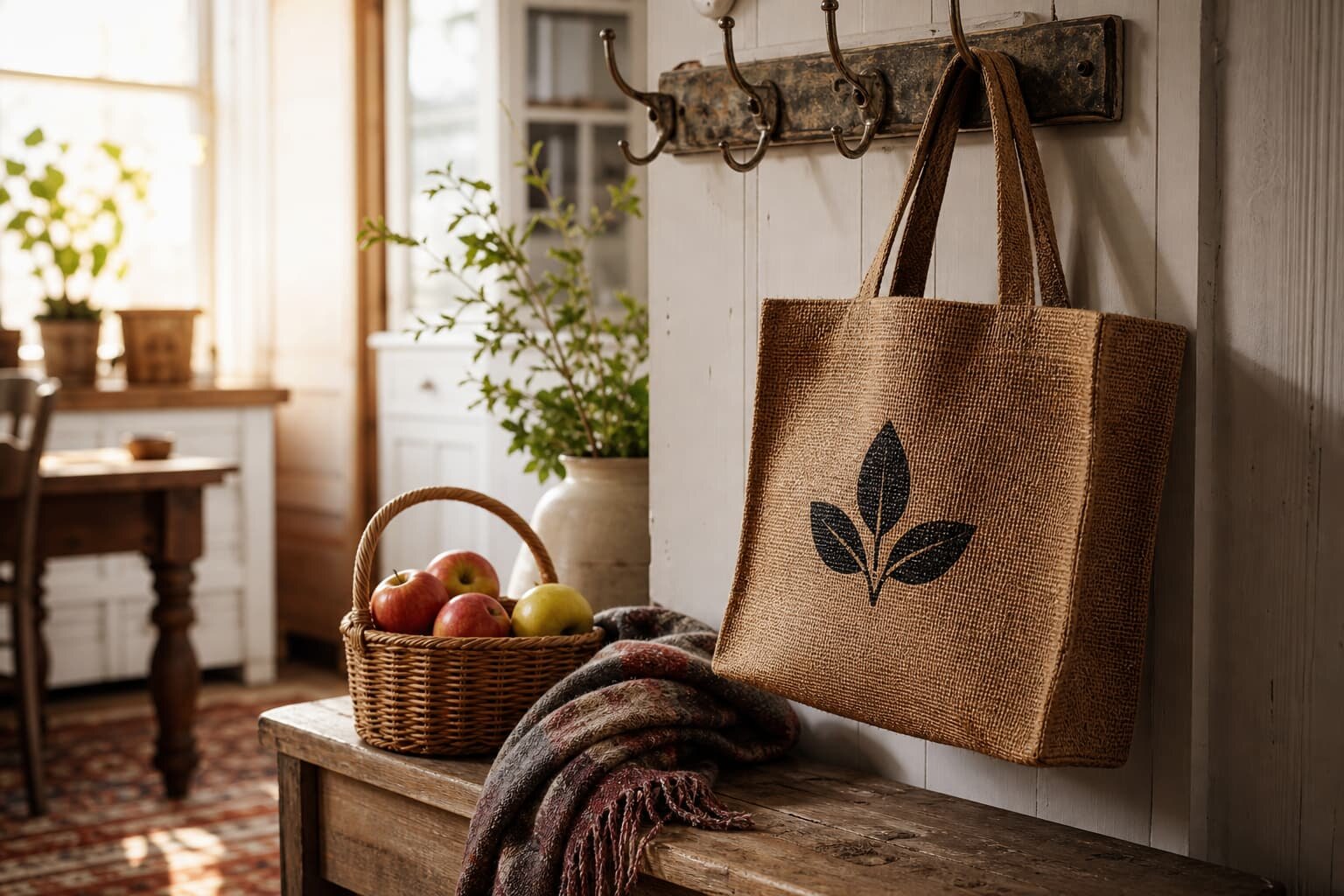
A durable logo on a burlap bag does not mean the print will look like ink on coated paper. Burlap is textured, absorbent, uneven, and naturally slubbed. For wholesale buying, durability means the logo remains legible, bonded, and commercially acceptable through factory handling, packing, export movement, warehouse storage, retail presentation, and normal customer use. A sample can look good on the approval table but fail later if the ink is under-cured, the bags are folded through the logo, or printed faces rub together under carton pressure.
The first sourcing decision is not print method. It is the commercial standard the order must meet. A seasonal gift bag, reusable grocery tote, event giveaway, retail merchandise bag, and premium bottle carrier all face different handling and branding expectations. If the logo is central to the selling value, the buyer should pay more attention to fabric stability, sample quantity, and packing controls. If the logo is secondary, a simpler print or hangtag may be a better commercial choice than forcing detailed artwork onto a coarse surface.
- Define durability as adhesion, rub resistance, fold performance, legibility, color acceptability, and appearance after unpacking.
- State the intended channel: retail sale, promotional giveaway, gift packaging, grocery reuse, hospitality, wine, food, or export resale.
- Decide whether natural burlap texture is part of the desired look or a risk to brand consistency.
- Ask suppliers to protect the logo outcome, not only to quote the lowest bag price.
Specify the burlap before discussing logo detail
Fabric construction drives print performance. Two suppliers may both describe a bag as natural burlap, yet one may use a loose open weave with heavy fiber shedding while another uses a tighter jute construction, lamination, lining, or backed print zone. Those differences affect ink deposit, edge definition, rub resistance, color appearance, and how much texture shows through the logo. A quote that does not identify the fabric is not ready for meaningful price comparison.
Fabric weight can be useful, but it should not become a false shortcut. Heavier burlap is often more stable than very light open-weave material, but weave tightness, yarn quality, lamination, backing, panel tension, and finishing matter as much as the nominal GSM or oz range. If a supplier recommends a range for better printing, ask whether it is based on its own production data, a previous approved order, or a new strike-off. The safest specification is a combination of measurable details and a physical swatch or sealed sample.
- Request the supplier's GSM or oz range, but validate it with close-up photos, swatches, or a sample bag.
- Confirm whether the print face is unlaminated burlap, laminated jute, cotton-lined burlap, or a backed panel.
- Check weave openness and loose fibers because both can cause broken edges, pinholes, and weak rub performance.
- Use the approved fabric swatch as the reference for bulk inspection, not only the written fabric name.
Match the logo method to the artwork risk
Direct screen printing remains a practical option for many wholesale burlap bags. It is cost-effective at volume and can perform well for bold one-color or two-color logos when the factory controls ink deposit, squeegee pressure, cure time, and panel support. The risk is assuming that a screen print setup used on cotton canvas will behave the same way on burlap. A rough weave can interrupt small text, expose gaps in solid fills, or create a dusty look if the ink sits only on raised fibers.
Other branding methods are not upgrades in every situation; they simply move the risk. Heat transfers can reproduce more detail, but they must bond to a coarse surface and survive folds. Woven labels keep small logos crisp, but sewing placement becomes the key QC point. Printed patches provide a cleaner print face while preserving a rustic bag body. Embroidery can be durable, but dense stitching can distort loose burlap. Badges can look premium, but badge material, tooling, and attachment must be specified. The buyer's job is to select the method with the most controllable risk for the actual artwork.
- Choose direct screen print for bold marks, moderate logo size, simple colors, and volume efficiency.
- Choose labels or patches for fine type, small icons, cleaner edges, or tighter brand geometry.
- Treat transfers as sample-dependent on burlap rather than automatically stronger or more precise.
- Include attachment tolerances when the logo is sewn, riveted, patched, labeled, or badged.
Convert brand artwork into burlap-ready artwork
Many print durability problems begin with artwork that was designed for smooth media. Fine serifs, hairline rules, distressed textures, small reverse text, close multi-color registration, and thin outlines can break down on burlap. Instead of using a generic line-width rule, ask the supplier to state the minimum positive stroke, reverse detail, letter height, and registration tolerance it can validate on the selected fabric and process. Those limits should come from its production experience, a strike-off, or the actual sample for the order.
A burlap-ready artwork file may use heavier strokes, fewer distressed details, slightly larger text, simpler traps, and more open spacing. That is not a brand failure; it is surface-specific adaptation. For retail-facing orders, the buyer should approve the artwork at actual size and at normal viewing distance, not only zoomed in on a screen. The key question is whether the logo remains readable and commercially consistent after real handling, not whether every digital detail reproduces perfectly across a rough natural weave.
- Provide vector artwork with logo size, colors, print position, smallest text, and any non-negotiable brand elements.
- Ask which details the supplier recommends simplifying before sample production.
- Avoid tight multi-color registration unless the factory proves it on the actual bag fabric.
- Review the sample both close up and at normal shelf or user viewing distance.
Use sampling to expose variation, not hide it
A pre-production sample should prove the production process. It should use the same burlap construction, logo method, ink or component system, print size, print location, sewing sequence, cure or drying method, and intended fold direction planned for bulk. If the sample uses a hand-selected cleaner fabric, slower sample-room print settings, different backing, or a different folding method, it may not predict mass production performance.
For low-risk orders, one approved pre-production sample may be enough. For large dark logos, detailed artwork, two-sided printing, retailer-facing packaging, or premium orders, three to five printed pieces or strike-offs are more useful. They reveal normal variation across slubs, weave gaps, panel tension, and print coverage. Keep one sample sealed as the approval reference and use another for handling checks. Photograph the approved logo, edge detail, fabric texture, fold line, inside construction, and packing method so the inspection team has an objective standard.
- Approve actual-material samples rather than digital mockups, paper proofs, or off-fabric print tests.
- Request multiple printed pieces when logo appearance is commercially important or technically risky.
- Reject sample substitutions that change fabric, backing, ink, curing, sewing order, or packing fold.
- Attach approved sample photos and written tolerances to the purchase order.
Set acceptance tolerances that inspectors can use
Burlap needs clear acceptance rules because natural variation is unavoidable. Instructions such as print must be perfect or logo must be sharp are not useful in a factory or inspection report. Define what can vary and what cannot: logo placement, logo size, shade, registration, edge softness, minor slub-related pinholes, weave show-through, and panel skew. Then identify major defects such as peeling, powdering, wet transfer, heavy offset, severe smudging, wrong color, unreadable text, or missing print areas.
Placement tolerance should be tied to the actual construction. A flat, unsewn panel printed before assembly may hold tighter positioning than a finished gusseted bag printed after sewing. Handmade or semi-handmade burlap bags may also vary more than rigid packaging. Rather than inserting a generic number, ask the supplier for its achievable tolerance after sampling and decide whether that tolerance meets the brand requirement. If it does not, change the print location, method, or bag construction before bulk production.
- Measure placement from fixed reference points such as panel centerline, bottom seam, side seam, or handle stitch line.
- Separate acceptable burlap texture from unacceptable durability failures in the inspection checklist.
- Define major defects before production: peeling, flaking, wet transfer, blocking, illegibility, wrong size, or wrong location.
- Inspect early, middle, and late production pieces because ink deposit and curing discipline can drift.
Compare quotes by hidden process assumptions
A low quote for printed burlap bags can hide a different construction, smaller logo, lighter fabric, simpler packing, shorter cure time, or excluded setup cost. To compare suppliers fairly, the RFQ should lock the bag size, gusset, handle, fabric construction, print method, logo size, number of colors, print location, sample requirement, acceptance tolerance, and packing method. If a quote says custom logo included without naming the method and assumptions, it is incomplete for B2B procurement.
Separate one-time charges from unit price. Screen charges, color setup, transfer setup, label tooling, badge tooling, embroidery digitizing, patch cutting, sample making, carton marking, and export packing may be included by one supplier and excluded by another. MOQ can also mean different things: bag sewing MOQ, fabric booking MOQ, print setup MOQ, per-color MOQ, label MOQ, or badge component MOQ. Ask suppliers to quote quantity tiers against the same specification so cost changes are visible without changing the product.
- Compare 1,000, 3,000, and 5,000 pieces on the same bag, same logo, and same packing specification.
- Break out setup, sample, tooling, component, packing, and repeat-order charges.
- Confirm whether repeat orders can reuse screens, labels, artwork settings, or fabric references.
- Treat missing fabric, curing, or packing details as claim risk, not minor wording.
Control curing, folding, and export packing
A logo can pass visual inspection and still be damaged by packing. Burlap bags are commonly folded, bundled, compressed, and held in cartons for long periods. If printed faces touch before full cure, dark logos can offset onto other panels. If the fold line crosses a large solid logo, the ink or transfer may crack or whiten. If bundles are packed too tightly, raised fibers can abrade the logo during vibration and handling.
Packing details belong in the print durability specification. Ask how long printed bags rest before folding, whether humidity affects cure or drying time, how many pieces are bundled together, whether printed faces touch, whether separators are used, and what carton gross weight is planned. For large solid logos or high-contrast prints, separator tissue, altered fold direction, bundle orientation, or carton liners may be worth the small added cost. The buyer should approve packing on the sample, not discover it when export cartons arrive.
- Confirm cure, drying, pressing, or resting time before folding and cartoning.
- Avoid a hard fold through the logo unless the approved sample proves it survives that fold.
- Specify separator use, bundle quantity, printed-face orientation, carton liner, and carton gross weight.
- Open carton-packed samples after dwell time to check offset, blocking, odor, scuffing, and crease damage.
Build QC around simple repeatable tests
Effective quality control for logo burlap bags does not require complicated language. It requires repeatable checks performed at the right time. Start by verifying bulk fabric against the approved sample before printing. Then check logo position, logo size, color, edge clarity, solid fill, registration, slub show-through, contamination, and panel distortion. If labels, patches, embroidery, or badges are used, inspect attachment strength, alignment, thread color, edge finishing, and whether the component sits flat.
Durability checks should be simple and documented. A dry rub with a clean white cloth should not create heavy color transfer or obvious loss of definition. A light damp rub may be relevant for humid handling, food retail, grocery use, or outdoor event distribution. Tape adhesion should be used only after the supplier's stated cure or rest time; otherwise the result may be unfair or misleading. Fold checks, face-to-face stack checks, and carton dwell checks are especially useful because they reflect the way bags are packed and shipped.
- Pull inspection samples from different cartons and production stages, not only from the top of one stack.
- Record the rub cloth, tape type, cure time, fold direction, and pass or fail photos.
- Hold shipment when the same failure appears across multiple cartons or production periods.
- Do not reject normal minor slub texture if it was approved in the sealed sample and does not affect legibility.
Use a sourcing workflow that reduces revisions
The strongest workflow is to solve print durability before final price pressure. Send the supplier the use case, destination market, target quantity, logo file, logo importance, shelf expectation, and any retailer or brand packaging rules. Ask the supplier to recommend the safest fabric and logo method, then explain what may fail and how to reduce that risk. A supplier who identifies limits early is often more useful than one who immediately confirms every request.
After the method is selected, issue a sample brief with fabric, logo size, placement, color, method, cure expectation, tolerance target, and packing plan. Test and approve the sample, then attach the approved photos, tolerance notes, and packing requirements to the purchase order. Before bulk production, reconfirm material booking, print setup, sewing sequence, inspection timing, cure time, packing method, carton details, and shipment date. This keeps sales, production, inspection, and procurement aligned on the same definition of a durable burlap bag logo.
- Start with use case and artwork risk, then choose construction, then negotiate price.
- Ask what the supplier would change if the first sample fails rub, fold, or legibility checks.
- Freeze approved fabric, logo file, tolerance notes, and packing rules before bulk production.
- Reconfirm cure time and packing plan before goods are folded, bundled, and sealed in cartons.
Specification comparison for buyers
| Logo application method | Best-fit use | Durability risk to validate | Detail capability | Quote notes for buyers |
|---|---|---|---|---|
| Direct screen print, 1-2 colors | Bulk retail totes, grocery bags, event bags, gift packaging with bold logos | Ink adhesion, rub resistance, cure time, weave show-through, scuffing during carton storage | Good for solid marks, block text, simple icons, and medium-size logos; weak for hairlines and tiny reverse text | Ask for screen charges, ink system, cure/rest time, logo size, print location, and whether the quoted price assumes one side or two sides |
| Direct screen print, 3+ colors | Simplified multi-color branding where the logo can tolerate slight registration movement | Color registration on flexible panels, extra handling between colors, longer drying or curing schedule | Moderate; works best when colors do not require tight traps or fine alignment | Each color may add screen cost, setup time, inspection risk, and sample iterations |
| Heat transfer or digital transfer | Detailed graphics, gradients, small-batch branding, or logos that cannot be simplified for direct print | Bonding to raised burlap fibers, edge lifting, cracking on folds, film feel, blocking in cartons | Better detail than direct print when the transfer bonds properly, but not automatically more durable | Request actual-material testing; confirm transfer type, press settings, wash or non-wash claims, and packing restrictions |
| Woven label sewn onto bag | Premium small logos, fine text, brand marks needing repeatable geometry | Label sewing alignment, label fraying, stitch strength, color variation between label batches | Very good within woven label limits; better than direct burlap for small lettering | Confirm label MOQ, label size, edge fold, sewing position, thread color, and whether label production is included in lead time |
| Printed cotton or canvas patch sewn onto burlap | Brands wanting a cleaner print area while keeping a rustic burlap body | Patch print durability, patch edge curling, sewing distortion, color match against bag body | Good for cleaner edges, small text, QR-adjacent graphics, and more controlled color | Break out patch printing, cutting, sewing, and any extra backing or edge finishing charges |
| Embroidery direct on burlap | Small simple marks, monograms, premium rustic branding | Fabric distortion, thread snagging, loose-weave instability, dense-fill stiffness | Good for simple shapes; poor for tiny type, large filled logos, and fine outlines | Ask for digitizing fee, stitch count assumption, backing use, thread color, and sample proof on the same burlap |
| Leather, kraft, cork, or PU badge | Premium packaging, wine, gifting, boutique retail, limited detail logos | Badge material stability, stitch or rivet strength, color transfer, tooling accuracy | Good for debossed, embossed, printed, or simple branded marks; limited for detailed graphics | Confirm badge MOQ, tooling, material thickness, attachment method, color approval, and replacement policy for damaged badges |
| Unprinted bag plus printed hangtag | Low-risk branding, seasonal campaigns, information-heavy copy, short-term promotions | Tag attachment strength, tag scuffing, tag loss during handling | Excellent for small text and legal copy; less permanent than bag-body branding | Useful when print durability risk on burlap is not worth the added cost or lead time |
Buyer checklist before sampling
- Lock the physical bag specification first: width, height, gusset, handle material, handle length, handle reinforcement, lining or lamination, seam position, and whether the logo sits on a flat panel, near a fold, or over a construction seam.
- Describe the print face in measurable or sample-based terms: natural unlaminated burlap, laminated jute, cotton-lined burlap, backed print area, supplier GSM or oz range, weave reference, and approved swatch number if available.
- Send production artwork, not only a visual mockup: vector file, logo dimensions in millimeters, print position from fixed reference points, color references, number of colors, smallest text height, and any details that may be simplified.
- Require the supplier to state its validated artwork limits for the selected fabric and process, including minimum positive stroke, minimum reverse detail, registration expectation, and whether those limits come from past production or a new strike-off.
- Ask for the recommended logo method with the reason: direct screen print, transfer, woven label, patch, embroidery, badge, or hangtag, including the tradeoff between durability, detail, cost, hand feel, MOQ, and lead time.
- Approve a production-representative sample using the same fabric construction, print process, logo size, sewing sequence, cure or drying method, and intended packing fold direction planned for bulk production.
- For large, dark, detailed, or retailer-facing logos, request three to five printed samples or strike-offs so the team can judge normal burlap variation rather than one selected best piece.
- Set written acceptance rules for placement, logo size, shade, edge clarity, registration, slub-related pinholes, weave show-through, flaking, peeling, wet transfer, blocking, and illegible copy.
- Define handling checks before bulk approval: dry rub, light damp rub if relevant, fold-and-unfold, tape adhesion only after stated cure time, face-to-face stack check, and unpacking check after carton dwell when timing allows.
- Confirm packing rules for printed faces: cure time before folding, pieces per bundle, separator use, fold direction, carton liner, carton dimensions, carton gross weight, compression level, and whether printed panels touch each other.
Factory quote questions to send
- What exact burlap or jute construction are you quoting, including GSM or oz range, weave tightness, lamination, lining, backing, and approved swatch reference?
- Which logo application method do you recommend for this artwork on this bag, and what durability or detail problem does that method solve?
- What minimum positive stroke, reverse detail, smallest readable letter height, and registration tolerance can you validate on this actual fabric and process?
- Will the logo be applied before sewing, after sewing, or on a separate component, and how does that affect placement accuracy, panel tension, handle interference, and inspection?
- What ink, transfer, thread, label, patch, or badge system is used, and what drying, curing, pressing, resting, or conditioning time is required before folding and packing?
- Can you provide a 1:1 strike-off or three to five pre-production samples on the actual material so we can review normal variation, not only a selected best sample?
- What are your standard and achievable tolerances for print position, logo size, color shade, edge sharpness, registration, slub show-through, and fold-line performance?
- Which charges are included or separate: sample fee, screen charge, color setup, transfer setup, label tooling, patch cutting, embroidery digitizing, badge tooling, carton marking, and export packing?
- Does the MOQ apply to bag sewing, fabric booking, print setup, each color, each print location, label production, badge tooling, or patch component?
- How will printed bags be packed after curing: flat or folded, pieces per bundle, printed faces together or separated, separator type, carton size, carton gross weight, and maximum stacking pressure?
Quality-control points to confirm
- Check bulk burlap against the approved swatch or sample before printing; changes in weave openness, lamination, fiber shedding, shade, or stiffness can change logo durability even when the printing process is unchanged.
- Measure logo position from fixed reference points such as panel centerline, top edge, bottom seam, side seam, or handle stitch line; avoid judging centering only by eye on a flexible burlap panel.
- Inspect early, middle, and late production pieces for logo size, color, edge clarity, solid-fill coverage, slub-related pinholes, registration, smudging, contamination, and visible panel distortion.
- Run dry rub and relevant light damp rub checks with a clean white cloth on pieces from different cartons; reject obvious transfer, powdering, peeling, or major loss of logo legibility.
- Use tape adhesion checks only after the supplier's stated cure or rest time; record tape type, pressure, dwell time, and removal angle so results are repeatable.
- Fold and unfold the printed panel along the intended packing crease to identify cracking, whitening, delamination, or ink breakage in large solid areas.
- Open packed bundles after a dwell period and check for blocking, offset marks, sticking, odor, abrasion, and scuffing caused by face-to-face pressure.
- Review seams, handles, gussets, labels, patches, or badges near the logo because sewing distortion or poor attachment can make an otherwise acceptable logo look off-square or unstable.
- Check carton density, bundle pressure, separator placement, and carton liner use for large dark logos; over-compression can damage prints during export transit.
- Compare all findings with written tolerances and the sealed approved sample under neutral light, and photograph failures before approving shipment or negotiating corrective action.