1. Start with the buying job, not a one-line product name
Canvas zipper portfolios can serve very different roles for coffee roasters. One order may be a low-cost event folder for sample menus and product cards. Another may be a wholesale onboarding kit carried by sales reps into café meetings. A third may be a distributor training folder that holds roast profiles, brew guides, cupping forms, and account documents for repeated use. The construction should follow the job.
Before requesting bulk pricing, define the use case, expected service life, and who will handle the item. A portfolio that sits on a trade show table can be lighter and simpler. A sales portfolio that travels between cafés needs a smoother zipper, cleaner interior, stronger seams, and enough internal clearance to close when filled. This prevents suppliers from guessing and keeps quotes comparable.
The sourcing goal is not the lowest visible unit price. It is the lowest practical landed cost for the required function. A cheap quote can become expensive if the zipper catches, the document sleeve is too narrow, the print rubs, or carton packing increases freight. A useful bulk pricing plan separates the base item, optional features, setup fees, packing, carton data, and lead time.
- Define the commercial role first: event giveaway, onboarding kit, sales portfolio, distributor folder, or premium gift.
- Give every supplier the same construction, artwork, packing, and quantity tiers.
- Compare landed cost per usable unit, not only ex-factory price.
- Approve the sample filled with real or equivalent roaster materials.
2. Convert roaster contents into measurable specs
The best RFQ begins with contents. Coffee roasters may need room for wholesale price lists, roast profile sheets, café opening checklists, cupping forms, invoices, brewing guides, business cards, a pen, a notebook, or a tablet. Paper size is only one part of the requirement. Stack thickness and accessory placement often determine whether the zipper closes smoothly.
Avoid broad terms such as “A4 portfolio,” “letter folder,” or “tablet sleeve” unless they are backed by measurements. Usable internal space is smaller than outside size because zipper tape, seam allowance, lining, binding, foam, and pocket construction all consume space. As planning guidance, these elements may reduce usable width by 15-30 mm on many soft portfolios, depending on design.
Write the closed finished size, open size if it lays flat, internal sleeve width and height, maximum loaded thickness, pocket dimensions, and any clearance requirement. If the item must hold 20 letter sheets, an 8 mm notebook, two business cards, and a pen, say so. If a tablet is involved, provide the exact model dimensions and whether padding is for structure or protection.
- Build a dummy kit before sampling and measure the loaded thickness.
- Specify internal usable dimensions separately from outside dimensions.
- Confirm pen-loop diameter, business-card pocket size, and document sleeve clearance.
- If contents vary by sales team, design for the heaviest normal kit rather than the lightest.
3. Choose canvas by weight, finish, and brand appearance
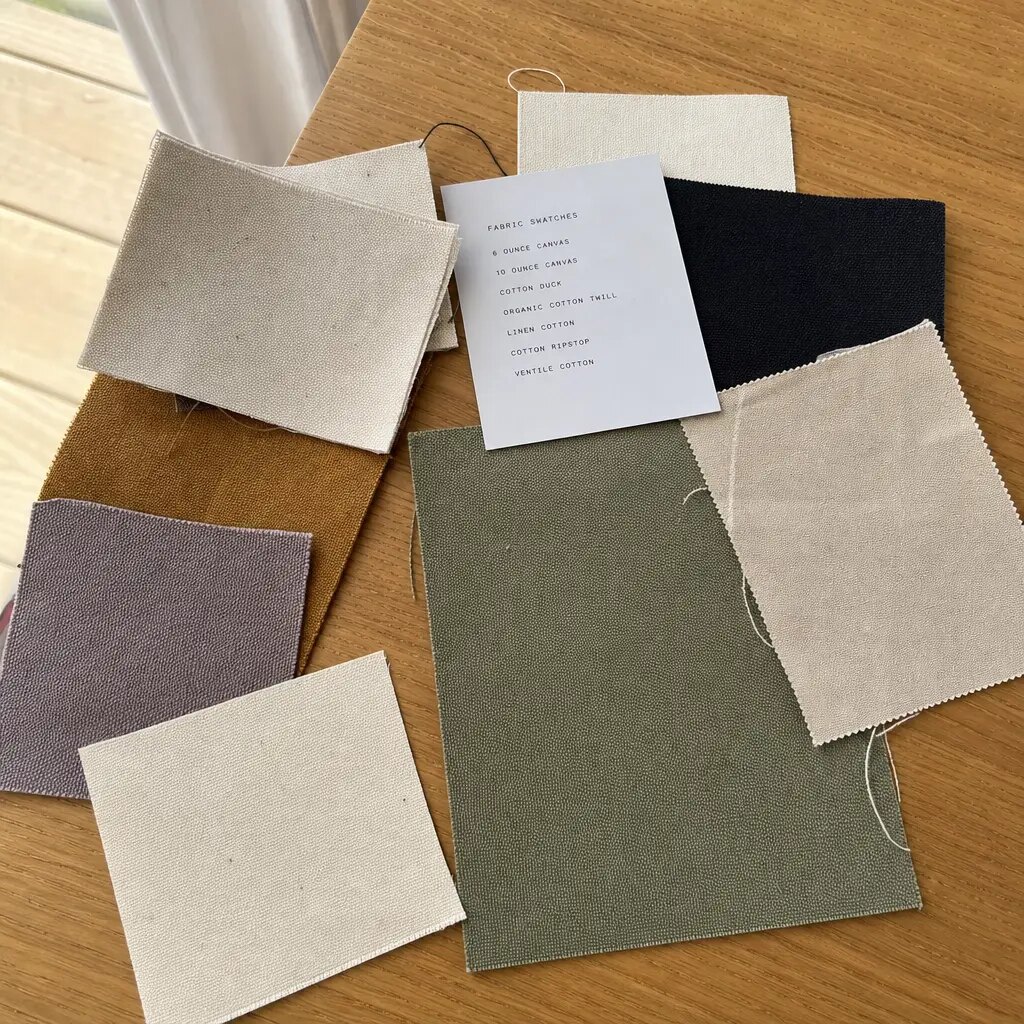
Canvas descriptions can be inconsistent unless the buyer defines them. Suppliers may quote 10 oz, 12 oz, 14 oz, or 16 oz canvas, but actual GSM varies by mill, weave, dyeing, washing, coating, and measurement method. For repeated professional use, 14 oz canvas is often a practical starting point, commonly around 450-500 GSM depending on source and finish. Economy programs may use 10-12 oz canvas, often around 340-410 GSM. Heavier 15-16 oz canvas can feel premium but increases seam bulk, corner thickness, carton volume, and sewing difficulty.
Use both oz and GSM in the RFQ and approve a range rather than a single number. Ask whether GSM is measured before dyeing, after finishing, or from finished bulk panels. Keep an approved swatch with the signed sample so production fabric can be checked against a physical standard.
Color also needs a standard. Natural cotton canvas may show seed specks, slubs, and shade variation, which can suit a craft coffee brand if the range is approved. Dyed black, navy, or olive canvas can show lint, scuffs, chalk marks, or dye-lot differences. Custom colors may require lab dips and separate fabric MOQs.
- Specify cotton or blended canvas, nominal oz, target GSM range, and finish.
- Approve natural canvas with a swatch or shade band, not only photos.
- Test dark canvas for lint, scuffing, and logo contrast.
- Ask whether custom color has a separate MOQ or longer lead time.
4. Specify zipper, stitching, binding, and structure
The zipper is the most important functional trim. For most soft canvas portfolios, a No. 5 nylon coil zipper is a practical default because it is flexible and usually runs well around corners. Metal zippers can look premium but must be tested for rough travel, weight, corner catch, and tooth consistency. A top-only zipper may suit a simple document sleeve, while a three-side zipper gives better access and presentation when the portfolio opens flat.
The RFQ should state zipper size, type, tape color, route, corner radius, slider finish, puller shape, end stop, and reinforcement. Reinforced zipper ends, clean backtacking, and controlled tape tension reduce early failures. Loaded open-close testing matters more than testing an empty sample because most zipper problems appear when the portfolio is filled.
Stitching and interior finish should match use. Bound internal seams and lining give a cleaner account-facing presentation and reduce fraying. Foam or nonwoven reinforcement can improve body and handfeel, but it changes thickness, zipper strain, carton quantity, and freight. Add padding only when it improves the user experience enough to justify the cost and space.
- Use No. 5 nylon coil as the baseline unless the design requires another zipper.
- Test the zipper through the full route while loaded.
- Specify stitch density and reinforcement at stress points.
- Use bound seams if the inside will be visible in sales meetings.
- Confirm lining or foam does not reduce usable document space below spec.
5. Match logo method to canvas and quantity
Coffee roaster logos range from simple wordmarks to detailed vintage badges. Screen printing is usually the most practical choice for one- or two-color logos on flat canvas panels. It is visible, scalable for bulk orders, and cost-efficient when artwork is not overly fine. On dark canvas, light ink may need an underbase for opacity. On textured canvas, small type and thin lines should be reviewed carefully.
Woven labels are useful for a quieter premium look and can be placed on the front panel, side seam, or interior. They may carry separate artwork lead time, MOQ, and color limits. Embroidery can work for small marks but may pucker canvas or create stiffness. Heat transfers can reproduce detail but should be tested for edge lifting and abrasion. PU or leather patches can look premium but add tooling, stitching, and material-compliance questions.
Place branding where it will stay clean and visible. Avoid large prints over hard bend points, zipper curves, or high-abrasion edges. Approve branding on the actual production canvas color, not on a smooth substitute fabric.
- Use screen print for bold one- or two-color front logos.
- Use woven labels for subtle distributor or premium gifting programs.
- Test embroidery for puckering and backing visibility.
- Test heat transfers for adhesion, rub, and pressure marks.
- List screen charges, label tooling, patch tooling, and custom puller tooling separately.
6. Build a real bulk pricing plan
A useful bulk pricing plan shows how cost changes with order size and specification choices. Ask for the identical construction at 300, 500, 1000, and 3000 pieces. These are planning tiers, not universal MOQs. The point is to reveal where fabric purchasing, print setup, cutting efficiency, sewing line balance, and packing labor begin to improve.
Each tier should include base unit price, MOQ by fabric color and logo, setup fees, sample cost, optional adders, packing method, carton data, estimated CBM, and lead time. Keep first-order costs and repeat-order costs separate. Tooling, artwork setup, and development samples may make the first order look higher, while repeat orders may be cleaner if the specification stays unchanged.
Break out optional features. Lining, foam, extra pockets, gussets, woven labels, custom zipper pullers, hangtags, barcode labels, inner cartons, and individual polybags should be priced as adders. This lets procurement choose a good/better/best construction without forcing suppliers to hide assumptions in one all-in number.
Also clarify split rules. A factory may accept 1000 total units but require 500 per body color or artwork. Stock natural canvas may allow lower quantities than custom dyed canvas. Trim suppliers may have their own MOQ for woven labels, metal badges, or custom pullers. Confirm this before approving multiple roaster sub-brands, distributor versions, or colorways.
- Request tier pricing at 300, 500, 1000, and 3000 pieces on the same spec.
- Show setup fees outside the unit price and ask whether they repeat.
- Ask for MOQ by body color, artwork, trim, and packing style.
- Compare first-order cost and repeat-order cost separately.
- Use carton CBM and gross weight in the landed-cost comparison.
7. Use a quote format suppliers can actually price
Reference photos are helpful, but they are not enough. A factory-ready RFQ should include closed size, internal usable dimensions, loaded thickness, fabric type and weight, body color standard, zipper type and route, interior layout, branding method, logo size and placement, quantity tiers, packing method, and requested delivery window.
The most valuable line is often the contents line. “Must hold 20 US letter sheets, one 8 mm notebook, two business cards, and one pen” gives the factory a practical target. If a tablet is included, provide the model dimensions. If the training pack is thick or laminated, specify stack thickness or send a dummy insert file. This helps the supplier recommend gusset depth, body size, pocket changes, or a different zipper route before sampling.
Packing and labeling should be included in the first RFQ. Warehouse teams may require barcode stickers, SKU separation, color-ratio packing, carton labels, master carton marks, or pallet instructions. These affect labor, carton count, and receiving accuracy. Late packing changes often cause cost revisions and production delays.
- Ask suppliers to list inclusions, exclusions, assumptions, MOQ, tier pricing, lead time, and quote validity.
- Require carton dimensions, gross weight, units per carton, and estimated CBM.
- Provide vector artwork and logo placement measured from fixed edges.
- Identify which features are required and which are optional adders.
- Use one RFQ version for all suppliers so pricing can be audited.
8. Approve samples in the same condition they will be used
Do not approve an empty portfolio only from photos. Empty samples often look clean and flat, while filled samples reveal zipper strain, panel ripple, tight sleeves, blocked pen loops, logo distortion, and corner stress. Test the sample with the same documents and accessories your sales or training team will use.
Sampling usually has two stages. A development sample confirms size, layout, usability, and visual direction; it may use substitute fabric or trims. A pre-production sample should use approved bulk fabric, zipper, lining, foam, trims, logo process, and packing. The PP sample becomes the inspection master for bulk production.
Record measurements consistently. Lay the portfolio flat without stretching. Measure outside width and height, internal sleeve width and height, pocket depth, logo position, zipper opening length, and finished thickness. Open and close the zipper repeatedly while loaded. Insert and remove cards, pen, documents, notebook, or tablet. If the shipment will be compressed in cartons, run a short packing pressure check and inspect for print transfer, zipper wave, and permanent creasing.
- Test filled samples, not empty samples only.
- Approve internal usable dimensions after seam allowance and zipper tape.
- Keep the signed PP sample, fabric swatch, zipper sample, logo standard, and packing approval.
- Document any approved tolerance changes before mass production starts.
9. Set QC checks before production, not after defects appear
Quality control language should be specific. “Good quality” is not enough for zipper business bags. The inspection plan should cover fabric, color, size, zipper function, stitching, binding, pockets, branding, odor, packing, and carton labels. The approved PP sample should be the working standard.
Fabric inspection should check GSM range, shade match, stains, oil marks, odor, weaving faults, dye streaks, excessive slubs beyond the approved standard, and contamination. Natural canvas needs an agreed shade and slub range. Dark canvas should be checked for lint, scuffs, chalk marks, and dye-lot inconsistency.
Zipper function deserves its own step. Random units should be opened and closed through the full travel, including corners, both empty and loaded to the approved insert thickness. Inspect slider looseness, missing stops, tape twist, skipped stitches near zipper tape, snagging at binding, and sharp puller edges. A non-working zipper should normally be treated as a major defect because it prevents normal use.
Stitching and binding need inside and outside review. Skipped stitches, broken seams, exposed raw edges where binding is required, unusable pockets, incorrect logo, and wrong fabric should be treated as major defects at minimum. Branding checks should cover print color, clarity, position, registration, curing, adhesion, and rub performance.
- Measure internal usable size as well as outside size.
- Check zipper operation loaded and empty.
- Inspect hidden interior binding, lining, card pockets, and pen loops.
- Verify logo placement against approved tolerance.
- Confirm carton marks, barcode labels, SKU separation, and color ratios before release.
10. Control packing, freight, and landed cost
Packing can change delivered cost and product condition. A flat unpadded portfolio may pack efficiently. A padded, lined, individually protected portfolio may reduce units per carton and increase CBM. If two quotes use different packing assumptions, their unit prices are not directly comparable.
Choose packing by channel. Bulk packing with tissue separators may be enough if portfolios go to the roaster’s warehouse for later kit assembly. Individual polybags can protect dark fabric, fresh screen print, or items handled by multiple warehouses, but they add cost and waste. Premium gifting may require a paper sleeve, hangtag, or presentation wrap. Quote each packing method separately if the channel is not final.
Every supplier should provide units per carton, carton dimensions, gross weight, and estimated CBM. Confirm whether units are packed flat, lightly folded, or compressed. Over-compression can create panel creases, zipper waves, print transfer, and corner distortion. A landed-cost worksheet should include unit price, setup allocation, packing, inspection, inland transport, freight, duty, warehouse receiving, and expected usable quantity after defects.
- Request carton data with every pricing tier.
- Compare bulk packing, tissue separation, and individual polybag options.
- Avoid compression that deforms zipper corners or canvas panels.
- Use landed cost per usable unit as the final procurement comparison.
Specification comparison for buyers
| Pricing plan item | Typical planning structure | What to ask suppliers to show | Buyer risk to check |
|---|---|---|---|
| Base tier pricing | Quote the same approved spec at 300, 500, 1000, and 3000 pieces | Unit price by tier, MOQ by color/logo, lead time by tier, quote validity | A low 300-piece price may exclude lining, binding, print setup, or realistic packing |
| Setup fees | Keep tooling and setup separate from unit price | Screen charges, artwork setup, label tooling, custom puller mold, sample fee, repeat-order setup | Buried setup fees make first order and repeat order economics hard to compare |
| Feature adders | Price optional upgrades line by line | Lining, foam, divider, card pocket, pen loop, gusset, woven label, custom zipper puller, hangtag | One supplier may include features that another prices as extras; normalize before selecting |
| Packing assumptions | Quote both bulk and individual protection if undecided | Units per carton, carton size, gross weight, CBM, polybag or tissue, barcode labels, inner cartons | Packing changes freight, warehouse handling, print protection, and landed cost |
| Freight planning | Use estimated CBM and gross weight to model landed cost | Carton dimensions, loading method, port or door terms, estimated dispatch date | Heavier fabric and padding may erase a lower ex-factory price through higher freight |
| Cost allocation | Calculate first-order and repeat-order cost separately | Unit price plus amortized setup fees, sample charges, inspection, freight, duties, and receiving cost | A first order with tooling may look expensive; repeat orders may be much more efficient |
| Split-order rules | Confirm whether mixed colors or artworks count toward MOQ | MOQ per fabric color, MOQ per logo, trim MOQ, surcharge for split packing | Marketing colorways can create hidden MOQ pressure and higher unit cost |
| Landed-cost worksheet | Compare suppliers on delivered usable unit cost | EXW/FOB unit price, setup allocation, inland/freight, duty, inspection, packaging, defect allowance | Choosing by ex-factory price alone can misstate the true procurement decision |
Buyer checklist before sampling
- Define the business use: trade show giveaway, wholesale account onboarding kit, sales representative portfolio, distributor training folder, or premium account gift.
- List the real contents the portfolio must hold: roast profiles, wholesale price sheets, cupping forms, café checklist, product cards, business cards, notebook, pen, tablet, or inserts.
- Specify closed finished size, open size if relevant, internal usable sleeve dimensions, and maximum loaded thickness.
- State fabric in both oz and GSM, such as 14 oz / about 450-500 GSM, and define the approved tolerance as planning guidance, not a universal rule.
- Confirm whether GSM is measured before finishing, after dyeing, or from finished bulk fabric panels.
- Define body color approval: stock natural canvas swatch, dyed color lab dip, shade band, or custom Pantone target.
- Specify zipper type, size, tape color, route, corner radius, puller finish, and end reinforcement.
- Clarify whether lining, foam, divider panel, document sleeve, card pocket, pen loop, gusset, and bound seams are included.
- Lock the logo method early: screen print, woven label, embroidery, heat transfer, PU patch, leather patch, or custom puller.
- Request tiered pricing with base unit cost, setup fees, optional adders, sample cost, carton data, and packing method shown separately.
Factory quote questions to send
- What is the exact canvas specification: fiber content, weave if known, nominal oz, measured GSM range, finish, and whether it is natural, bleached, dyed, washed, or coated?
- What fabric weight tolerance is included, and will GSM be checked from bulk fabric before cutting or from finished panels?
- What color approval process is included: stock swatch, lab dip, strike-off, bulk swatch, or shade band approval for natural canvas?
- Is the zipper No. 3, No. 5, or another size; nylon coil, resin tooth, or metal tooth; and what tape color, slider grade, and puller finish are included?
- Does the zipper quote include reinforced ends, backstitching at starts and stops, corner radius control, and a loaded open-close function check?
- What stitch density is planned for main seams, zipper attachment, binding, and pocket assembly, and what thread type is used?
- Does the quoted construction include lining, foam, nonwoven reinforcement, edge binding, inside sleeve, pen loop, card pocket, divider, or gusset?
- What are the finished size tolerances for outside width and height, internal sleeve width and height, logo placement, pocket placement, and zipper length?
- How many logo colors are included, and are screen charges, artwork setup, films, label tooling, custom puller tooling, sampling, or repeat setup fees separate?
- For screen print, what ink type is planned for canvas, is an underbase required on dark fabric, and what curing or rub check is performed?
Quality-control points to confirm
- Fabric GSM should match the buyer-approved range within the agreed tolerance, rather than relying only on a nominal oz label.
- Bulk color must match the approved swatch, lab dip, or shade band under the agreed light source; natural canvas variation should be defined in advance.
- Canvas should be checked for stains, oil marks, strong odor, weaving faults, dye streaks, excessive slubs beyond the approved standard, chalk marks, and visible contamination.
- Finished size should be measured on closed portfolios laid flat without stretching; internal usable dimensions should be measured separately.
- Common soft-goods planning tolerances may include plus or minus 5 mm for overall size and plus or minus 3-5 mm for logo placement, but the buyer should approve tolerances by design.
- Zipper should open and close smoothly through full travel with no snagging, tape twist, slider looseness, missing stops, sharp burrs, or corner binding.
- Loaded zipper testing should be performed on random units using the approved insert thickness or an agreed document stack equivalent.
- Zipper pullers should match the approved finish and shape, with no plating inconsistency, loose pull tabs, sharp edges, or weak attachment.
- Stitching should be consistent with no skipped stitches, broken stitches, loose thread chains, seam puckering, needle cuts, or open seams.
- Binding and internal seam finishing should be checked inside the portfolio because interior defects are common on zipper business bags.