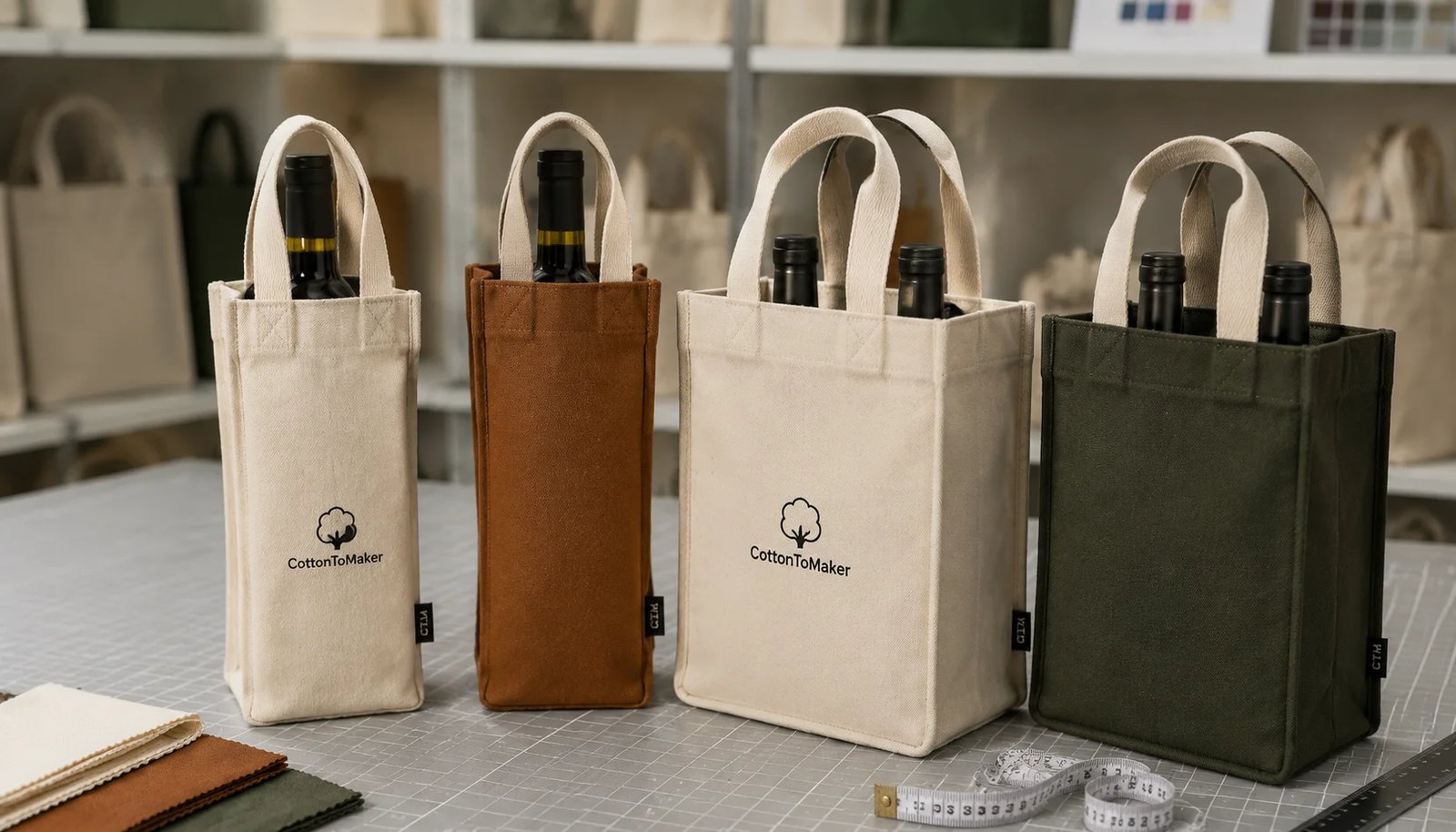
Why skincare brands use canvas wine carriers differently from beverage buyers
The buying problem is usually not the bag itself. It is whether the bag can carry a skincare bottle set safely, look premium enough for retail gifting, and still land at an acceptable unit cost. That makes a skincare wine carrier different from a standard bottle gift bag used by wineries. The bottle may be shorter and wider, it may sit inside a rigid carton, and the visual standard is often closer to beauty packaging than grocery packaging.
For procurement teams, the main mistake is sending a generic tote bag RFQ to multiple factories and expecting comparable prices back. A canvas wine carrier has several cost-sensitive details that suppliers may interpret differently: bottle count, divider style, base reinforcement, actual fabric weight, and handle construction. If these are not fixed in the RFQ, the cheapest quote often hides a lighter fabric, weaker handle attachment, or lower print standard.
- Typical skincare uses: holiday gift sets, influencer kits, launch bundles, spa retail packaging, and limited-edition purchase-with-purchase programs
- Most common failure point: bag dimensions based on bottle volume only, not actual bottle height plus closure, neck shape, or outer carton dimensions
- Most common quote gap: one supplier prices stock natural canvas with screen print, another prices custom dyed fabric with transfer print
Build the right bag specification before you compare bulk prices
Start from the pack-out method. Is the carrier holding one glass bottle directly, two bottles with a divider, or a skincare bottle plus insert box? This single decision changes the finished width, gusset depth, seam load, and whether a divider or reinforced bottom is necessary. A bag that looks oversized for one bottle may still be correct if retail staff need room to insert tissue, a neck card, or a carton sleeve without slowing store operations.
Fabric should be written in a way that stops ambiguity. Buyers should specify both ounce weight and GSM. For many skincare gift programs, 12 oz canvas at roughly 340 GSM is the clean middle ground. It gives enough structure for shelf presentation without pushing the bag into unnecessary freight cost. If bottles are heavy, tall, or shipped in pairs, move up to 14 or 16 oz. Below that range, the bag may still look acceptable when empty but distort visibly once loaded.
- Single bottle guide: 12 oz canvas around 340 GSM, 25 mm cotton webbing handle, one-color screen print
- Two-bottle guide: 14 to 16 oz canvas, fixed divider, reinforced bottom seam, 30 mm cotton webbing handle
- Useful RFQ dimensions: finished width x gusset x height, handle width, handle drop, divider width, and bottom seam allowance
- State tolerance expectation, for example finished size plus or minus 0.5 cm for key dimensions
Cost drivers that move the unit price more than most buyers expect
Quantity matters, but not as much as construction and material route. A natural canvas body using stock fabric can price significantly better than a custom-dyed body at the same volume because the factory avoids dye MOQ, lab dip approvals, and color risk. For lower-volume skincare activations, stock natural or black canvas often gives the best balance of speed and cost. If the program is annual and tied to a strict brand palette, custom-dyed fabric starts to make sense.
Printing is the next major driver. Simple one-color screen print stays cost-efficient across most bulk programs. Add a second color, large flood area, metallic effect, or print on both sides and cost rises through setup, ink consumption, and slower handling. Small details can also move price more than expected: sewn side labels, swing tags, internal dividers, snap closures, individual polybags, and lower carton piece counts. These are legitimate adds, but they should be visible in the quote.
- Main cost drivers: fabric GSM, dyed versus natural body, print colors, print coverage, divider construction, webbing handle quality, packing format
- Hidden cost adders: small MOQ surcharge, custom carton labels, barcode stickers, insert cards, and sample courier charges
- Freight-sensitive issue: moving from 12 oz to 16 oz canvas may add value visually, but may not improve user experience enough to justify higher landed cost
How MOQ logic changes the best sourcing route
Not every skincare brand needs a fully custom bag from the first run. If the objective is to test a gift-with-purchase offer or launch a seasonal set in one market, using a stock natural canvas body with custom print is usually the practical route. Factories can often source stock fabric faster, development is simpler, and the MOQ can stay lower because the mill minimums do not drive the program.
A full custom route becomes more economical when the brand has stable annual demand, multi-region replenishment, or retailer-specific colorways. In that case, custom-dyed fabric and locked trims may reduce variation across repeat orders. Buyers should not compare a stock-body quote and a full-custom quote as if they are the same product. One is a lower-risk launch solution. The other is a scaled program build.
- Best for launch testing: stock natural canvas, one-color print, standard webbing, flat packing
- Best for repeat annual program: custom-dyed canvas, approved pantone target, fixed divider, branded labels, confirmed carton standard
- Request price ladders by quantity break to see where custom dyeing starts to make commercial sense
Sampling steps that prevent expensive approval mistakes
A digital artwork approval is useful for logo size and rough placement, but it does not solve fit or structure. For a wine-style carrier adapted to skincare, the pre-production sample should be made in the quoted fabric weight with the actual handle construction and print method. If the brand is using two bottles, the sample must include the real divider design. Buyers often approve a neat-looking sample that was made without the actual bulk construction details, then find later that the final bag behaves differently under load.
The best sample review includes a live fit test using the real product or a weighted dummy matching bottle dimensions and closure height. Stand the bag loaded for several hours, lift it by one handle repeatedly, and insert it into the planned shipping carton or store display setup. This confirms whether the bag mouth opens enough for packing, whether the base distorts, and whether logo placement still looks centered when filled.
- Approve in sequence: artwork layout, blank fit sample if dimensions are uncertain, then full pre-production sample
- Sample pass criteria: bottle enters easily, no excessive side pull, divider stays fixed, handle drop feels comfortable, print remains visually centered when loaded
- Do not approve based on empty-bag photos only for glass bottle programs
Print and branding choices for premium appearance without avoidable cost
Most skincare brands do not need complex decoration on a canvas wine carrier. A clean one-color or two-color screen print often aligns better with beauty packaging than a heavy, overfilled graphic. It keeps the surface soft, lowers defect risk, and is easier to reproduce consistently in repeat runs. A sewn side label with a small CTM-style sample mark or the brand logo can also elevate the presentation without adding large front-panel ink coverage.
Heat transfer can work when artwork has gradients or many colors, but buyers should understand the tradeoff. Transfer areas can feel stiffer and may show wear on fold lines. Foil or puff effects can look premium in presentation photos yet create rub issues during flat packing and transit. For most bulk gift programs, the strongest cost-to-result combination remains simple screen print on stable canvas with a clearly defined print position from the bottom seam and side seam.
- Practical standard: one-color screen print, centered on front panel, with approved size in cm
- For side labels: define folded or flat label size, seam insertion position, and weave or print type
- Request visual standards for print registration, edge sharpness, and acceptable pinhole level
Packing decisions that affect landed cost and warehouse handling
Packing is where many buyers lose control of landed cost. If the bags are imported flat and assembled later by a co-packer or distribution center, flat carton packing usually wins. It reduces cubic volume and keeps freight efficient. However, if the retail channel requires direct store-ready presentation, buyers may need tighter bundling by color and style, barcode labels on inner packs, or a lower carton count so stores can handle stock more easily.
Individual polybags should not be added automatically. They protect from dust and rubbing, but they add material cost, labor, and disposal issues. For many skincare retail programs, a clean master-carton pack with inner bundles is enough, provided the canvas is fully dry after printing and the cartons are lined or packed in a way that prevents transit marks. If a market requires polybags, state thickness and vent-hole requirements rather than letting factories choose ad hoc.
- Useful carton controls: target pieces per carton, maximum gross weight, carton dimensions, and outer shipping marks
- Bundle by exact SKU if stores or co-packers will not sort mixed cartons
- For printed natural canvas, ensure bags are fully cured and cooled before packing to reduce offset or odor issues
QC thresholds that matter more than cosmetic perfection
For a canvas wine carrier, the quality standard should prioritize fit, strength, and print consistency over unrealistic fabric perfection. Natural canvas will show some slub and weave variation; that is not necessarily a defect unless the buyer has specified a cleaner, combed, or tightly woven appearance. What does matter is whether the finished bag holds the intended bottle securely, keeps the logo visually acceptable, and survives normal handling through import, warehousing, and retail use.
Buyers should set acceptance criteria for the actual use case. That includes dimensional tolerance, handle attachment quality, seam security, divider placement, and carton assortment accuracy. Print registration matters, but a slightly softer edge on natural canvas is often commercially acceptable if the artwork remains clear at shelf distance. By contrast, a skewed handle drop or weak bartack can create immediate functional failure even if the print looks perfect.
- Critical QC items: bottle fit, seam strength, handle symmetry, divider fixation, print placement, and carton count accuracy
- Commercial tolerance examples: minor natural slub acceptable; skipped stitches, open seams, and severe shade mismatch not acceptable
- Use a loaded sample during final inspection if the bag carries glass bottles
Lead time planning and the schedule risks buyers can actually reduce
Lead time for canvas wine carriers usually breaks into material preparation, sampling, production, and booking. The biggest delays often come before sewing starts: artwork revisions, slow sample approval, custom dye approvals, and trim substitutions. When procurement teams push for a ship date without freezing these inputs, the factory either quotes a vague timeline or rushes later stages where mistakes become more likely.
The easiest schedule protection is separating what must be custom from what can stay standard. If the market launch date is fixed, use stock fabric where possible and lock print artwork early. If custom color is non-negotiable, approve lab dips quickly and avoid changing logo position after the first PPS. Also align the packing list requirements early; last-minute barcode or carton mark changes can hold goods after production is complete.
- Typical risk points: custom fabric dyeing, divider redesign after fit test, artwork updates after screen preparation, and delayed PPS approval
- Good planning habit: issue one approved spec sheet version to all quoting suppliers before price comparison
- Separate sample calendar from bulk production calendar so development slippage is visible early
How to compare quotes on a landed-cost basis instead of a unit-price basis
A lower ex-factory unit price is not always the better buy. Heavier fabric, lower carton counts, and unnecessary polybagging can all raise freight cost. Likewise, a cheap bag that fails fit testing may force repacking, replacement, or markdown costs downstream. Procurement teams should compare quotes in a simple landed-cost worksheet that includes unit price, sample charges, print setup, packing assumptions, carton count, carton cube, and any likely extras such as barcode labels or testing.
This is particularly important for skincare promotions where order quantities may not be large enough to dilute development cost. A supplier offering a slightly higher unit price on stock fabric with fast approval and efficient packing may outperform a lower-priced custom fabric offer once freight, delay risk, and internal handling are included. The article keyword is about bulk pricing, but the practical buying decision is total delivered value under the real program timeline.
- Include in comparison: ex-works or FOB basis, sample fees, tooling or screen fees, print setup, pack format, and estimated freight cube
- Request carton dimensions from each supplier before selecting the winner
- Treat delay risk as a real cost if the bags support a launch, holiday, or retailer booking window
Specification comparison for buyers
| Spec decision | Recommended option | When it fits | Buyer risk to check |
|---|---|---|---|
| Fabric weight for single bottle skincare gift bag | 12 oz canvas, about 340 GSM | Best balance for premium hand feel, enough body to stand better during packing, suitable for most serum, oil, and fragrance bottle gift programs | Below 280 GSM can collapse too easily and print may show through; above 400 GSM raises freight and sewing cost without much retail benefit |
| Fabric weight for two-bottle or heavy glass set | 14 to 16 oz canvas, about 400 to 540 GSM | Useful when the bag carries two tall glass bottles, a bottle plus carton, or retail buyers want a more structured presentation | Handle attachment and bottom seam strength matter more than fabric alone; heavy fabric with weak bartacks still fails in transit |
| Natural canvas versus dyed canvas | Natural canvas for lowest MOQ and easier replenishment; dyed canvas for brand color match | Natural works for quick promotional runs and simple black print; dyed works for holiday gifting and stronger shelf impact | Dyed lots need color tolerance approval and can delay bulk if lab dips are not signed off early |
| Print method for logo and artwork | 1 to 2 color screen print for most orders; heat transfer only for small multicolor graphics | Screen print is more durable and cost-efficient on 1,000 plus units; transfer suits short runs or detailed artwork | Large solid ink areas can crack on folds if ink film is too heavy; request rub test and curing standard |
| Bottle divider construction | Self-fabric padded divider stitched into bottom seam for two-bottle bags | Useful for skincare gift sets with glass bottles that must not knock together in retail shipment | Loose divider panels shift during use; require divider fixation point and bottle fit test with actual pack-out components |
| Handle material | Cotton webbing handle, 25 to 30 mm width, cross stitched or bartacked | Standard choice for premium gift carry bags and better grip than self-fabric narrow handles | Thin webbing saves cents but cuts into hand and may look cheap next to premium skincare packaging |
| MOQ route | Use stock natural canvas body with custom print for lower MOQ; full custom dyed body for annual programs | Stock-body route suits launches, market tests, and regional promotions; full custom suits repeat volume with fixed artwork | Mixed assumptions create bad quote comparisons; buyers must separate development cost from repeat-order cost |
| Packing plan | Flat packed by master carton with bundle count by size and color, optional inner poly only if market requires | Most efficient for import freight and DC handling, especially if stores or co-packers assemble gift sets later | Overpacking increases landed cost; underpacking causes dust marks, crushed handles, and mixed SKU carton errors |
| Sampling route | Digital artwork mock approval, then pre-production sample in chosen fabric and print | Fastest way to lock logo size, bottle fit, seam placement, and retail appearance before bulk | Skipping physical PPS often leads to bottle height mismatch, divider failure, and handle drop not matching the retail carton |
Buyer checklist before sampling
- State bottle type, bottle height, bottle diameter, and whether bottles are packed bare, boxed, or sleeved inside the bag
- Specify whether the bag is for one bottle, two bottles, or a bottle plus skincare accessory set
- Define fabric clearly in oz and GSM, for example 12 oz canvas about 340 GSM, instead of only saying heavy canvas
- Confirm natural, bleached, yarn-dyed, or piece-dyed canvas and whether color matching to Pantone is required
- Give exact finished bag size, gusset size, handle width, and handle drop with tolerance expectations
- Identify print method, print size, print colors, and whether artwork sits on one side, both sides, or side gusset
- Note if divider, bottom board, piping, snap, zipper, or reinforced base is needed
- State target order quantity by style and colorway so suppliers can quote real unit costs instead of broad estimates
- Define packing format such as flat packed, bundle quantity, carton size target, carton gross weight limit, and barcode labeling needs
- Request pre-production sample approval before bulk and list the pass criteria for bottle fit, seam strength, logo placement, and color
Factory quote questions to send
- What fabric weight are you quoting in both oz and GSM, and is it finished weight or greige fabric weight?
- Is the quoted fabric stock material or custom woven or dyed material, and how does that change MOQ and lead time?
- What print method is included, how many print colors, and what is the price effect if artwork changes from one color to two colors?
- Are handle webbing, divider panels, bartacks, and reinforcement stitches included in the unit price or treated as add-ons?
- What sample stages are charged separately: blank fit sample, printed pre-production sample, or shipping sample?
- What carton packing assumption is used in the quote, including pieces per carton, carton dimensions, and gross weight?
- What is the estimated production lead time after sample approval and deposit, and what materials are the current schedule risk?
- What AQL standard or internal QC method do you use for print registration, seam defects, fabric flaws, and carton assortment accuracy?
- Can you provide a price ladder by quantity break, for example 500, 1000, 3000, and 5000 units, with tooling or setup listed separately?
- What is excluded from the quote, such as pantone dyeing, swing tags, barcode stickers, individual polybags, testing, or export documents?
Quality-control points to confirm
- Measure finished size including height, width, gusset, and handle drop against approved tolerance before packing
- Verify actual bottle fit using buyer-supplied bottle or approved dummy packed to real weight and dimensions
- Inspect seam construction at side seam, bottom seam, and handle attachment for skipped stitches, seam grin, and thread tension issues
- Test print adhesion and curing with dry rub and light scratch resistance appropriate to the chosen print method
- Review fabric for shade consistency, weaving faults, slubs outside agreed standard, oil marks, and needle damage
- Check divider placement and fixation so bottles remain separated and do not force side seam distortion
- Confirm carton assortment, inner bundle count, shipping marks, barcode labels, and carton weight match the approved pack plan
- Perform drop or transit simulation on packed glass-filled sample if the carrier is intended for ecommerce gift fulfillment