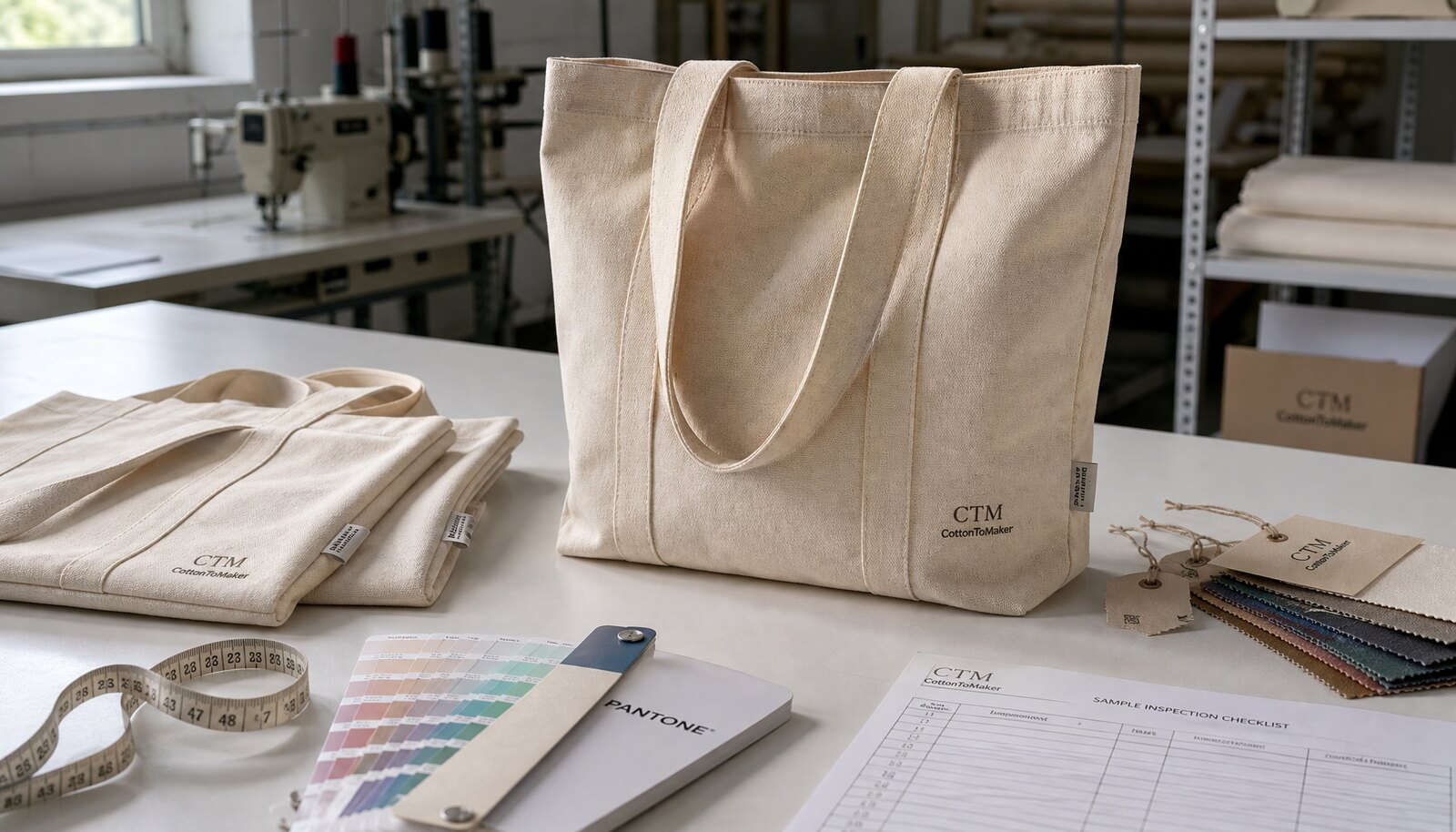
Why bulk reusable bag sourcing goes wrong
Most bulk order reusable bags problems do not come from the bag idea itself. They come from vague specifications and late decisions. One supplier quotes a lightweight cotton tote, another quotes a heavier canvas, and a third quietly changes handle construction to hit the target price. The buyer sees three similar unit prices, but the product, risk profile, and landed cost are not the same.
Procurement teams usually lose control in three places. First, the brief is too generic: "canvas tote" is not a production spec. Second, the sample is approved visually but not measured or tested. Third, the commercial quote is compared line by line without checking what is excluded. By the time the PO is issued, the supplier is building a different product than the one the buyer expected.
The fix is straightforward. Treat the bag like a manufactured item, not a promotional accessory. Lock the use case, dimensions, fabric, construction, print method, packing standard, and acceptance criteria before you compare suppliers. If those inputs are stable, the quote becomes useful. If they are loose, the cheapest offer is usually the most expensive order after corrections, delays, or freight waste.
- Define the end use first: giveaway, retail sale, grocery carry, conference pack, or subscription insert.
- Specify the bag as a measurable product, not a style description.
- Write packing, carton, and inspection requirements into the RFQ, not into later email follow-up.
Start with the use case and the sourcing constraints
A good tote sourcing brief starts with how the bag will be used, because the use case controls the construction. A conference bag only needs a clean front panel, enough strength for brochures, and a packing format that is fast and cost-effective. A retail tote needs cleaner stitching, better shape retention, and more consistent print presentation. A grocery bag needs stronger handles, more reliable seam reinforcement, and a higher load expectation.
Use case should be paired with sourcing constraints. If the buyer needs a fast launch, stock cloth or stock blank bodies may be the right option. If the bag must match brand color closely, then custom-dyed fabric, tighter shade control, and pre-production approval matter more than the lowest unit price. If the order is going into a retail channel, document requirements, carton marking, and print durability become part of the product spec rather than optional extras.
The buyer-side rule is simple: do not ask the factory to optimize a problem you have not defined. A supplier can only quote the right construction if the brief includes expected load, target shelf life, decoration method, packing requirements, and any compliance testing you need for the channel. That level of clarity reduces both pricing noise and production drift.
- Promo use: optimize for cost, clean branding, and manageable packing.
- Retail use: optimize for appearance, consistency, and repeatability.
- Carry-use or grocery use: optimize for load path, reinforcement, and seam durability.
Choose the fabric and construction with buyer-side rules
Fabric weight is the first real quality decision. For simple promotional runs, 6 oz to 8 oz cotton canvas is often enough. For retail programs, repeated carrying, or a bag that needs to look substantial on shelf, 10 oz to 12 oz is a more reliable starting point. Heavier fabric generally improves drape, print appearance, and perceived value, but it also changes sewability, folding behavior, and shipping volume.
Do not rely on language like "thick," "strong," or "premium." Ask for the actual GSM and ounce weight, the weave type, and whether the cloth is natural, bleached, dyed, or washed. Then set a tolerance. For most standard runs, buyers often work with about plus or minus 5 percent on fabric weight, but tighter control may be justified for retail or repeat replenishment programs. If the supplier cannot measure or confirm the cloth before production, the quote is too loose to compare responsibly.
Construction should follow function, not visual preference. Flat bags are cheaper and easier to pack. Gusseted bags give more volume and better shape. Lined bags and pockets add retail value but increase sewing time and create more inspection points. Reinforcement at the handle joins and bottom corners matters more than decorative seams if the bag must survive repeated loading. Ask the supplier to state stitch density, seam allowance, reinforcement method, and any patch or bar-tack detail in the quotation.
- 6 oz to 8 oz: lighter promo packs and limited-use giveaways.
- 10 oz to 12 oz: retail, repeated carry, and stronger brand presentation.
- If the bag must hold weight, specify the reinforcement method and not just the style.
Decoration and print method change both the quote and the failure rate
The decoration method is one of the fastest ways to distort pricing. Screen printing is usually the cleanest fit for simple logos, solid color blocks, and stable bulk pricing. It handles canvas well and is relatively predictable once setup is approved. Heat transfer can support more complex artwork or short-run testing, but it brings more risk around edge lift, cracking, and feel. Embroidery creates a premium look on some tote designs, but it changes the QC standard and often the lead time.
The mistake many buyers make is comparing quotes without aligning the artwork load. A one-color logo on the front panel is not comparable to a multi-color design with precise registration, a larger print area, or a second print position. Every extra color, pass, or placement increases setup and inspection complexity. If you want quotes that are comparable, write the print size, placement in millimeters, Pantone references, color count, and file format into the RFQ.
For procurement, the question is not which print method is fashionable. It is which method fits the actual channel risk. If the bag will be folded, stacked, or washed, the decoration needs to survive the real use path. Ask for dry rub and wet rub behavior where relevant, and agree on how much cracking, edge lift, or color change is acceptable before bulk release.
- Screen print: best for simple branding and repeatable unit pricing.
- Heat transfer: useful for short runs or more complex artwork, but test for cracking and lift.
- Embroidery: use when premium appearance matters and the fabric weight can support it.
Read supplier quotes as production plans, not just price lines
A quote for canvas tote bags should be read like a production plan. The real comparison is not just unit price. It is fabric standard, print method, sewing scope, packing method, carton dimensions, lead time, and what is excluded. If one supplier includes polybag packing, barcode labels, and export cartons while another treats those as add-ons, the low quote is misleading.
The buyer-side discipline is to normalize the order before comparison. Use the same artwork, same body size, same handle spec, same packing count, and same carton target across suppliers. Then ask for a quote that separates material cost from setup cost and packing cost. This makes hidden price drivers visible, such as custom-dyed cloth, additional print colors, trim changes, or special carton labeling.
Landed cost matters more than the unit line alone. A cheaper tote with oversized cartons, inefficient folding, or loose packing can end up costing more to move than a slightly more expensive bag packed efficiently. Ask each supplier to estimate carton dimensions and CBM before you decide. For air freight or urgent replenishment, that small operational detail often changes the winner.
- Compare like-for-like specs only.
- Separate setup charges, material charges, packing charges, and export handling.
- Request carton dimensions and estimated CBM before final award.
Choose the right supplier type for the order pattern
Factory-direct sourcing usually gives the best control when you want repeatable quality, stable lead times, and direct visibility into fabric booking and line capacity. It is the better option when you expect reorders, need consistent print results, or want the same tote to be replenished across multiple seasons. The tradeoff is that the buyer has to be clearer and more disciplined at the specification stage.
Trading companies can be useful when the buyer needs easier communication, mixed-item coordination, or a first order that is intentionally small. The risk is that the commercial quote may not reflect the actual line capability unless the trading company can prove who is making the bag and who owns QC decisions. If the answer to that question is vague, you do not yet have a reliable sourcing route.
Stock blank suppliers and retail-pack specialists are both valid, but for different reasons. Stock blanks work when speed and lower MOQ matter more than custom construction. Retail-pack specialists are better when the buyer wants barcodes, SKU separation, fold format control, and warehouse-ready cartons. Those services improve downstream efficiency, but they should not be paid for unless the channel actually needs them.
- Use factory-direct for repeat orders and tighter control.
- Use a trading route only when the factory relationship and QC ownership are clear.
- Use stock blank sourcing only when the brand can accept limited control over size, color, and finish.
Compliance and documentation should be verified, not assumed
For a bulk order reusable bags program, compliance is not just a certificate on a sales slide. It is evidence that the bag materials, print inks, labels, and production process match the channel you are buying for. The exact requirements vary by market and by customer policy, so the right question is not whether the supplier "has compliance." The right question is which tests apply and what documentary proof is available for this order.
At a minimum, buyers should ask for material composition evidence, dye or ink safety evidence where relevant, and any required country-specific reports tied to the bag body or decoration. If the bag is going to retail, request lot traceability, test reports for the actual material used, and confirmation that the factory can identify the approved batch if a downstream issue appears. If the bag is being bought for a brand or distributor with its own policy, ask for those policy checks before production starts, not after shipment.
Documentation should be tied to the sample and the PO. A generic factory certificate does not prove the specific tote you are ordering was made from the same cloth, ink, or trim that passed approval. Buyers reduce risk when they ask for fabric swatches, sample photos, test reports, and batch identifiers that map to the actual production run.
- Request material composition proof for the actual fabric used on the order.
- Ask whether print inks, labels, and trims need additional test evidence for your channel.
- Keep sample photos, test documents, and batch identifiers tied to the PO.
Control the sample-to-bulk handoff
A sample is only useful if it can be reproduced in bulk. The safest approval path is usually a sequence: initial sample, material confirmation, pre-production sample, first-piece check, then bulk run. The pre-production sample should use the actual fabric, actual print method, and final packing format. Approving a sales sample or a hand-finished prototype is not enough if the bulk order will be made on a different line or with different materials.
The approved sample should become the golden reference. Measure it, photograph it, and record the exact size, handle drop, seam construction, print placement, carton count, and fold method. If the supplier proposes any change after approval, that change should be written as a deviation and accepted by the buyer before production continues. This is where many orders slip: the supplier makes a small substitution because it is easier operationally, then assumes the buyer will not notice.
The buyer should also define who owns any deviation decision. If the factory sees a fabric shortage, trim substitution, or packing change, the order should stop until the buyer signs off. Without a named owner and a hard approval gate, sample control becomes informal and the bulk order drifts away from the approved version.
- Approve a pre-production sample made from real materials.
- Measure and photograph the golden sample before bulk starts.
- Do not accept material, print, or packing substitutions without written buyer approval.
Set a QC standard that catches real defects
QC for canvas tote bags should be measurable. Start with size tolerance, seam quality, print registration, handle symmetry, stain control, odor, and packing consistency. For dimensions, many buyers use plus or minus 3 mm to 5 mm on key body measurements and handle length, but the acceptable range should depend on the bag style and the channel. For seam strength, write a minimum expectation into the order rather than asking for "strong stitching." If the bag is a light promo item, a lower handle pull target may be acceptable; if it is a carry bag, the target should be higher and validated by the test method you and the factory agree to use.
Use defect categories so acceptance is not subjective. Critical defects should stop release entirely: wrong size, wrong artwork, open seams, major contamination, or a bag that cannot function as intended. Major defects are issues that reduce usability or brand presentation: print misregistration beyond the approved range, weak handle attachment, or obvious shade problems. Minor defects are cosmetic, but they still need a threshold. Many buyers manage this with an AQL structure, but the exact numbers should be written into the PO or QC appendix so the supplier knows the standard before production begins.
Testing should match the decoration and fabric. For printed bags, request dry rub and wet rub checks, plus tape adhesion or fold-crack review where applicable. For sewn construction, inspect bar tacks, seam finish, and load behavior at the handle joins and bottom corners. For the carton level, check carton grade, moisture condition, pack count, marks, and whether the outer cartons are crushed, wet, or mislabeled. If a lot fails, define the action in advance: hold, rework, sort, or replace. That prevents disputes from becoming open-ended negotiations.
- Set numeric tolerances for size and handle length.
- Use defined critical, major, and minor defect categories.
- Write the rejection path in advance: hold, rework, sort, or replacement.
Packing, freight, and PO wording should protect the order
Packing is not an afterthought in tote sourcing. Because reusable bags are light but bulky, carton design and fold method can move freight cost materially. A tighter, repeatable fold can reduce CBM and prevent print damage. A loose or inconsistent pack can save a little labor at the factory but create rework at the warehouse and more damage in transit. For retail orders, the folding method, barcode placement, and insert cards become part of the buying spec.
Carton inspection should be as practical as product inspection. Check that master cartons match the agreed dimensions, gross weight target, and pack count. Confirm that corners are not crushed, tape closure is secure, and cartons are dry and legible. If you are shipping by sea, ask whether the factory adds moisture protection or desiccant where appropriate. If you are shipping into a distribution center, make sure carton marks and SKU labels match the receiving rules exactly.
The PO should reflect the final agreement, not just the quote. Include the approved sample reference, the final fabric spec, print method, tolerance rules, packing format, carton standard, test evidence required, and what happens if the bulk order deviates. That written control is what gives procurement leverage if the factory tries to substitute materials or delivery format later.
- Agree the fold method before production.
- Lock carton size, carton count, and carton mark format in the PO.
- Tie the approved sample to the final order reference.
Specification comparison for buyers
| Supplier option | What to verify | Commercial advantage | Buyer risk to control |
|---|---|---|---|
| Direct sewing factory | fabric swatch, approved sample, seam close-ups, logo test photos, packing pilot, and final inspection evidence | Better sample-to-bulk control and faster production feedback | May be weaker on export paperwork or branded packing unless checked early |
| Trading company | Factory name, production photos, trim-source proof, and who owns QC decisions | Can coordinate small mixed orders and extra services | Markup can hide real factory capability and slow defect decisions |
| Specialized bag workshop | bag size, gusset, handle drop, seam allowance, stitch density, reinforcement patch, and loading expectation | More practical for detailed construction, trims, and repeat programs | Capacity may be limited during peak seasons |
| Low-price general supplier | 8-12 oz cotton canvas, 120-220 gsm cotton, recycled cotton, or blended fabric selected by use case and target price | Useful for simple promotional runs with loose specs | Material downgrades, weak packing, and vague inspection scope can erase savings |
| Retail-ready supplier | fold method, inner bundle, carton count, carton mark, moisture protection, SKU separation, and warehouse receiving needs | Can handle labels, SKU separation, carton marks, and receiving rules | Higher unit cost must be compared against reduced warehouse work |
| Compliance-focused supplier | Fabric records, labeling review, test plan, and production traceability | Safer for retail programs and repeat brand orders | Documentation claims need evidence, not only sales language |
| Local sample room plus bulk factory | Signed sample, bulk factory handoff, first-piece photos, and deviation owner | Good for complex branding before large production | Sample room quality may not match bulk line unless handoff is controlled |
Buyer checklist before sampling
- Final bag size in mm, including acceptable cut variance and any shrinkage after finishing or washing
- Target fabric weight in GSM and oz, plus whether the cloth is natural, bleached, dyed, washed, or recycled
- Weave type, fabric composition, and whether the supplier is quoting stock cloth or custom-bulk cloth
- Handle length, handle width, attachment method, reinforcement type, and expected carrying load
- Body structure: flat, gusseted, lined, pocketed, zipped, or open top
- Logo method, print size, Pantone reference, color count, placement in mm, and artwork file format
- Required test evidence: fabric composition, colorfastness, print durability, seam strength, and any market-specific safety needs
- Packing format: flat fold, retail fold, individual polybag or no polybag, insert card, and carton count
- Carton details: master carton dimensions, gross weight target, carton mark format, barcode placement, and moisture protection
- Order plan: target quantity, mix by size or color, accepted MOQ, and whether any future replenishment is expected
Factory quote questions to send
- What exact fabric composition, weave, and weight will you use, and can you state it in both GSM and oz on the quote?
- Is the quoted price based on stock cloth or custom-produced cloth, and what changes if the shade or weight is adjusted?
- What is included in the unit price: sewing, printing, labels, packing, inner polybag, carton marks, and export carton cost?
- What is the MOQ by color, print version, and fabric type, and what happens to MOQ if we change the handle, lining, or pocket?
- What sample sequence do you follow, and will you make a pre-production sample using the actual fabric and actual print method?
- What size and construction tolerances do you work to for body dimensions, handle length, seam allowance, and print position?
- What inspection standard do you use for critical, major, and minor defects, and who approves a hold, rework, or rejection decision?
- What test evidence can you provide for fabric composition, print durability, seam performance, and any required safety or compliance checks?
- How do you control carton counts, carton dimensions, and gross weight, and can you share a packing sample photo before shipment?
- What lead time do you need after artwork approval, sample approval, and deposit, and which step most often delays production?
Quality-control points to confirm
- Fabric weight is within the agreed tolerance, typically around plus or minus 5 percent for standard runs unless a tighter retail spec is written into the PO
- Body dimensions, gusset depth, and handle length are within the agreed cut and finished tolerances, usually about plus or minus 3 mm to 5 mm on key dimensions
- Handle joins, bottom corners, and side seams show no skipped stitches, broken thread, open seams, or uneven bar tacks
- For lighter promo bags, set a handle and seam pull target in advance, often around 15 N to 20 N at stress points, and raise it for heavier carry use
- Print alignment is centered and consistent, with no visible bleeding, pinholes, ghosting, cracking on fold lines, or edge lift after folding
- Print durability is checked with a dry rub and wet rub test, plus tape adhesion or fold-crack review where the decoration method makes that relevant
- If the bag is marketed as washable or reusable in a wet-use setting, request wash or wipe durability evidence before bulk release
- No visible stains, oil marks, odor issues, frayed edges, loose threads, shade banding that exceeds the approved range, or weave holes in the body fabric
- Cartons arrive undamaged, correctly taped, dry, and marked with the right SKU, size, color, quantity, and gross weight information
- Carton pack count matches the packing list exactly, with no mixed SKUs unless the order specifically allows mixed packing