The Buying Problem: Simple Bag, Many Quote Variables
A bulk cotton drawstring backpack order is often treated as a low-risk promotional item. In production, it is closer to a small sewn bag project with several cost drivers: fabric weight, cutting yield, cord system, print coverage, packing style, and final carton cube.
The main buying problem is that suppliers may quote different versions of the product while using the same general name. One quote may be based on thin 5 oz cotton, stock natural fabric, polyester cord, single-color screen print, and bulk packing. Another may include heavier canvas, dyed fabric, cotton cord, reinforced corners, individual polybags, and stronger export cartons. The unit price difference is not useful until the spec is locked.
- Use finished dimensions, not only a reference photo.
- State fabric weight in GSM or oz, not just cotton or canvas.
- Define the cord and bottom reinforcement because they affect durability.
- Confirm print method and print size before asking for best price.
- Ask for carton data early if freight cost matters to the landed cost.
Fabric Weight: Where Cost, Feel, and Durability Meet
For cotton drawstring backpacks, fabric weight is one of the fastest ways to create price confusion. A 5 oz cotton bag can look acceptable in a photo but feel thin when loaded. An 8 oz to 10 oz cotton canvas gives better handfeel and print support, but it increases material cost, sewing time, carton weight, and freight.
If the bag is for a one-day event, a lighter fabric may be acceptable. If it is for retail resale, school merchandise, sports kits, or brand programs where the user may carry shoes, bottles, catalogues, or apparel, the RFQ should usually start around 8 oz cotton canvas and move upward only if the brand needs a more structured look.
- 5 oz to 6 oz cotton: low-cost giveaway, lighter load, less structure.
- 8 oz cotton canvas: common balance for branded bulk orders.
- 10 oz to 12 oz canvas: stronger handfeel, higher freight, more sewing stress.
- Natural cotton: easier MOQ and shorter material lead time than custom dyed colors.
- Dyed cotton: better brand color control but needs lab dip, shrinkage review, and higher MOQ.
Size and Construction Specs Buyers Should Lock
A common adult drawstring backpack size is around 35 x 45 cm, but buyers should not assume this is standard across factories. Cutting width, seam allowance, hem depth, and bottom construction can all reduce usable internal space. If the bag must fit A4 documents, a shoebox insert, sportswear, or retail packaging, test the actual item inside the sample.
Construction details matter more than many RFQs show. The lower corners carry most of the load when the cord becomes shoulder straps. If the RFQ only says drawstring backpack, a supplier may choose a basic folded seam without proper reinforcement. That can pass visual inspection and still fail during use.
- State finished size with tolerance, such as 35 x 45 cm +/- 1 cm.
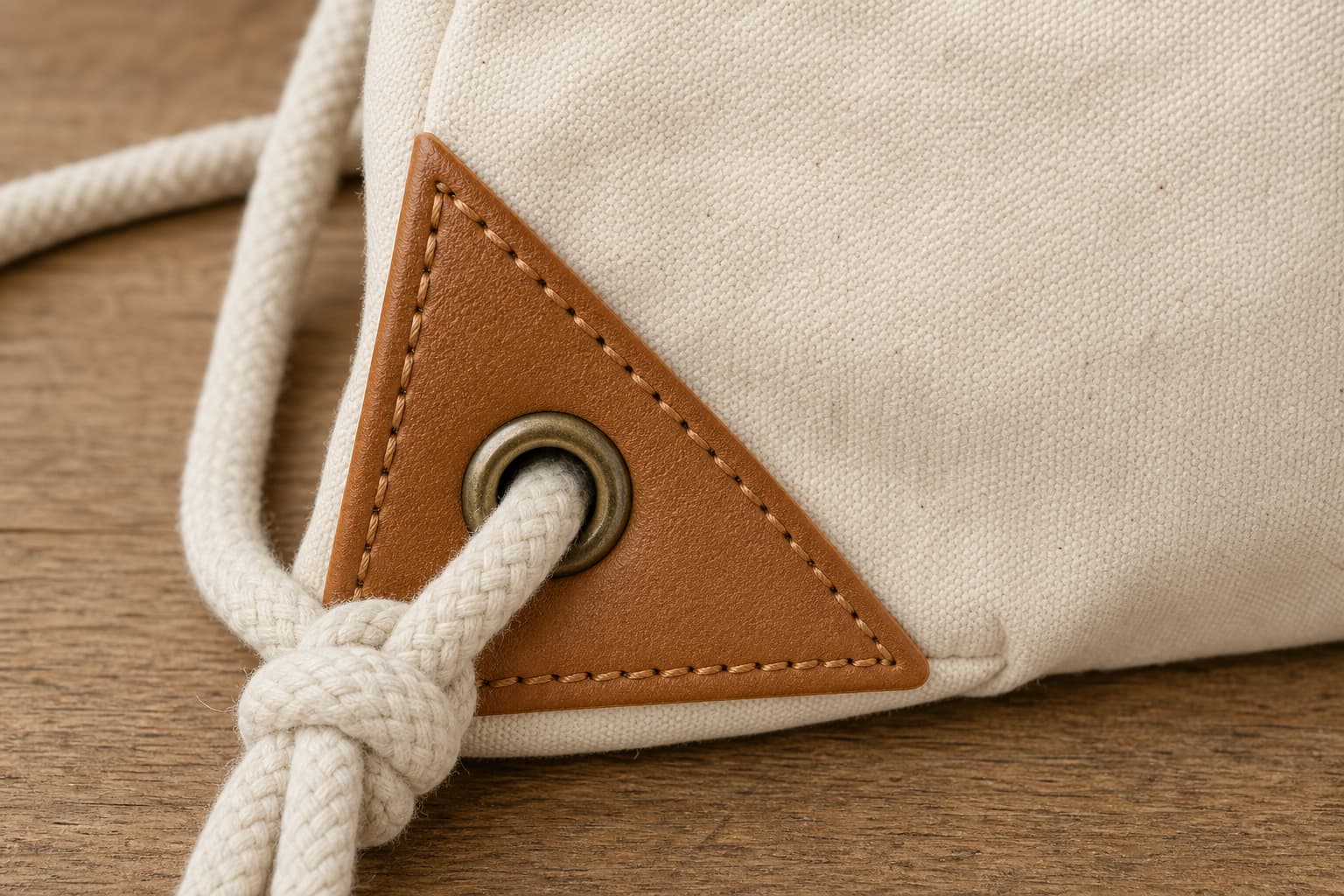
- Specify whether corners use metal eyelets, stitched fabric tabs, or reinforced bartacks.
- Ask for seam type and stitch density at the side seams and bottom seam.
- Confirm drawstring channel width so the cord can move smoothly.
- Check whether the bag has a flat bottom, simple two-panel construction, or gusseted base.
Cord Choice Is a Durability and Comfort Decision
Cord is not only an accessory. It controls user comfort, opening smoothness, and stress at the bottom attachment points. Cotton cord matches a natural cotton bag visually, but it can be bulkier and may show dirt faster. Polyester cord is often stronger and smoother, but it changes the product feel.
For procurement comparison, ask the factory to quote the cord material, diameter, color, and length. A small change from 5 mm to 8 mm cord can affect price, carton space, and perceived quality. For heavier fabric or larger bags, very thin cord is a common mistake because it cuts into shoulders and puts concentrated stress on eyelets.
- Use thicker cord for bags expected to carry heavier contents.
- Match cord color to fabric or print only after checking dye and MOQ limits.
- Request pull testing at cord exits and bottom corners.
- Avoid comparing quotes if one supplier includes cotton cord and another includes cheaper polyester cord.
- Check if cord ends are knotted, heat-sealed, tipped, or left raw.
Print Method: Match Artwork to Cotton Texture
Most bulk cotton drawstring backpack orders use screen printing because it is stable, economical, and suitable for solid brand logos. The buyer should provide vector artwork, Pantone references, print dimensions, and placement from the top edge or side seams. Without these details, a factory may quote a small chest-size logo while the buyer expects a large front-panel print.
Cotton canvas has texture and absorbency. Fine lines, small reversed text, and large solid ink blocks need sampling. Heat transfer can work for gradients or photographic artwork, but the handfeel and wash behavior may not suit every retail program. Embroidery is possible for small logos, but dense stitches can pucker lighter cotton and raise cost.
- Screen print: best for solid logos, slogans, and simple artwork.
- Heat transfer: useful for gradients, full-color graphics, or short runs with many colors.
- Embroidery: premium look for small logos, not ideal for huge front graphics.
- Water-based ink: softer handfeel but needs curing control and fabric compatibility.
- Plastisol or thicker ink: stronger coverage but may feel heavier on large print areas.
MOQ Logic: Why the Same Quantity Can Price Differently
MOQ is not only the sewing quantity. It is linked to fabric roll availability, dye lot minimums, print setup, cord color, labels, packing, and carton preparation. A factory may accept a lower quantity for natural stock fabric with one-color print, but require higher MOQ for custom dyed cotton, matched drawcords, woven labels, or retail barcode packing.
When comparing supplier quotes, ask whether the MOQ applies to the full order, each color, each artwork, or each size. This is especially important for distributors and retail buyers who may split one order across several brand colors or store programs.
- Lowest MOQ: stock natural cotton, standard cord, simple screen print, bulk packing.
- Medium MOQ: stock dyed fabric, custom print colors, individual polybags.
- Higher MOQ: custom dyed fabric, matched cord, woven label, retail insert card, multiple SKUs.
- Cost risk: splitting one order into many artwork versions increases setup cost and inspection complexity.
- Planning tip: group colors and artworks early so the supplier can quote realistic production batches.
Sample Checks Before Approving Bulk Production
A sample should not only be judged by appearance. It should prove that the chosen fabric, cord, printing, construction, and packing can work together. For a serious bulk cotton drawstring backpack order, request a pre-production sample using the intended bulk materials, not a similar stock bag with your logo added.
If the factory cannot make the exact material sample immediately, separate the approval stages. First approve size and construction, then approve fabric swatch or lab dip, then approve print strike-off, then approve the final pre-production sample. This prevents one attractive sample from hiding unresolved production details.
- Measure finished size after ironing or finishing, not before.
- Load the bag with realistic contents and pull the cord repeatedly.
- Fold and rub the printed area to check curing and ink adhesion.
- Check cord movement in the top channel for sticking or uneven length.
- Review label, hangtag, barcode, and polybag placement if the order is retail packed.
Packing and Carton Data Affect Landed Cost
Packing should be decided before the quote is considered final. Bulk packing is efficient for event distribution or warehouse kitting. Individual polybags protect each bag and support retail or online fulfillment, but they add labor, material cost, carton volume, and sometimes compliance labeling requirements.
Buyers should ask for pieces per carton, carton dimensions, gross weight, net weight, and estimated CBM. A cheap unit price can lose its advantage if the bag is packed loosely, cartons are oversized, or the export carton is too weak for stacking.
- Bulk pack: lower cost, faster packing, best for simple distribution.
- Individual polybag: cleaner handling, better for retail, higher material and labor cost.
- Inner carton or bundle: useful when distributors need controlled counts per store or event site.
- Carton marks: include PO number, SKU, color, quantity, gross weight, and destination if needed.
- Moisture control: important for cotton goods shipped in humid seasons or long ocean routes.
Specification comparison for buyers
| Spec decision | Recommended option | When it fits | Buyer risk to check |
|---|---|---|---|
| Fabric weight | 8 oz to 10 oz cotton canvas, roughly 270-340 GSM | Retail giveaways, school kits, brand merchandise, light daily carry | Too light fabric may sag after printing; too heavy fabric increases freight and cord stress |
| Bag size | Around 35 x 45 cm with tolerance stated in RFQ | Standard adult promotional backpack and event distribution | Small size saves cost but may not fit A4 folders, shoes, or retail insert cards |
| Cord type | 6-8 mm cotton cord or polyester cord matched to load use | Cotton cord for natural look; polyester cord for higher abrasion resistance | Thin cord cuts into shoulders and may fail pull testing at eyelets or bottom loops |
| Bottom construction | Reinforced lower corners with metal eyelets or stitched cord tabs | Orders expected to carry bottles, catalogues, or sport items | Weak reinforcement can tear even if the main fabric GSM looks acceptable |
| Print method | Screen print for solid logos; heat transfer for gradients; embroidery only for limited areas | Brand logos, event artwork, retail graphics, or multi-color marks | Large ink coverage on loose cotton texture can crack, bleed, or feel stiff if not sampled |
| Packing format | Flat bulk pack or individual polybag with warning text as required | Bulk pack for events; individual bag for retail or kitting operations | Wrong packing can add repacking cost, barcode issues, or carton cube changes |
| MOQ logic | Set MOQ by fabric color, print color count, and accessory customization | Best for comparing factory quotes on the same basis | A low headline MOQ may exclude dyed fabric, custom cord, woven labels, or retail packing |
Buyer checklist before sampling
- Confirm finished bag size, measurement tolerance, and whether size is measured flat before or after washing.
- Specify fabric composition, weight in oz or GSM, color, shrinkage expectation, and whether fabric must be dyed or stock greige/natural.
- Define cord material, diameter, color, length, and bottom attachment method, including eyelet or stitched loop requirement.
- Send vector artwork with Pantone references, print size, placement from seams, and acceptable color tolerance on cotton fabric.
- State packing method: bulk pack quantity, individual polybag, barcode label, carton marks, carton weight limit, and pallet requirement if any.
- Request pre-production sample approval before mass production, especially for dyed fabric, large print coverage, or custom accessories.
- Ask for quoted lead time by sample stage, material preparation, printing, sewing, packing, and final inspection.
- Require quote breakdown for fabric, printing, accessories, packing, mold or screen charges, sample fee, and freight-ready carton data.
Factory quote questions to send
- What fabric weight are you quoting in GSM or oz, and is it stock fabric or custom dyed fabric?
- What is the minimum order quantity for this exact fabric color, cord color, print method, and packing style?
- What finished size tolerance can you hold after cutting, sewing, and any washing or ironing process?
- Which print method do you recommend for this artwork on cotton canvas, and what is the maximum stable print area?
- How will the cord be attached at the bottom corners, and what load or pull test do you normally use?
- Can you provide one pre-production sample using bulk fabric, bulk cord, and the correct print process before mass production?
- What are the carton dimensions, gross weight, pieces per carton, and estimated CBM for the quoted packing method?
- Which quote items are excluded, such as screen setup, barcode labeling, export cartons, testing, inspection, or inland trucking?
Quality-control points to confirm
- Check fabric GSM against the approved sample using a cut swatch or lab measurement, not only supplier description.
- Measure finished width, height, and drawstring opening on random pieces from production cartons.
- Pull test cord exits, bottom eyelets, and stitched tabs because these fail before the main fabric fails.
- Inspect print registration, ink coverage, color match, curing, rubbing resistance, and cracking on folded areas.
- Review stitch density, loose threads, seam allowance, and reinforcement at stress points.
- Confirm packing count, carton marks, barcode placement, moisture control, and carton strength before shipment release.