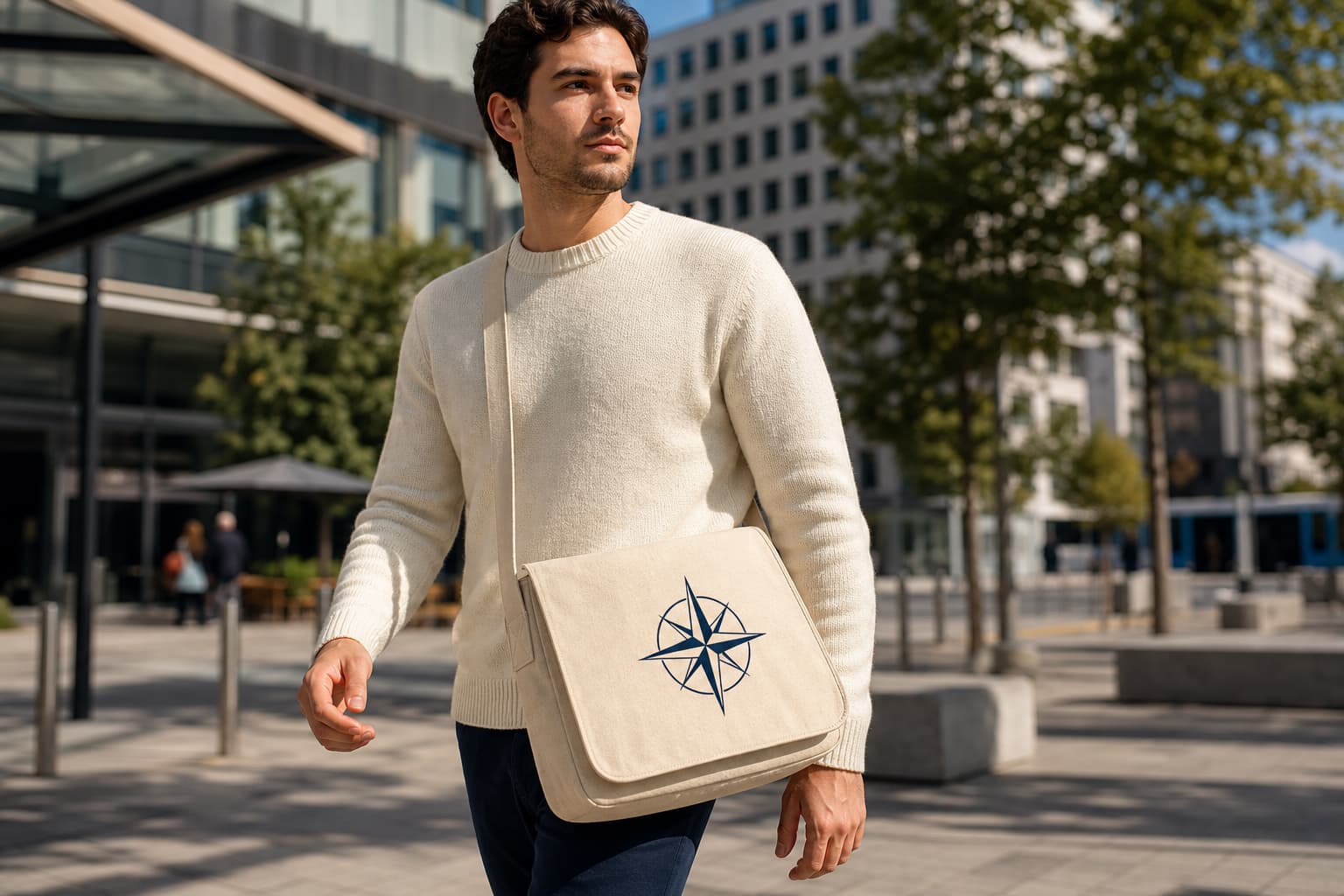
Why MOQ and Lead Time Change So Much
Branded messenger bag MOQ and lead time are not fixed numbers pulled from a catalog. They are built from fabric availability, color selection, logo process, hardware, sewing complexity, packing, and how many approval steps your team requires.
For procurement teams, the common mistake is asking only, "What is your MOQ and delivery time?" without showing the full specification. A factory may quote a low MOQ for a stock natural canvas bag with one-color print, but the same bag in custom dyed canvas with a woven label, magnetic snaps, lining, and retail barcode packing will follow a different production path.
- Stock natural or black canvas usually supports lower MOQ than custom dyed fabric.
- One-color screen print is normally faster than embroidery, woven patch, or multi-position branding.
- Hardware and label suppliers may impose their own minimums even when the sewing line can accept a smaller order.
- Lead time should start after sample approval and deposit, not from the first inquiry date.
Set the Fabric Spec Before Asking for MOQ
For canvas messenger bags, fabric weight affects structure, sewing speed, print result, and freight cost. A thin canvas may look acceptable in a photo but feel weak when loaded with documents, catalogues, or a tablet. A heavy canvas gives better body but may need stronger needles, slower sewing, and more careful seam handling.
Most buyer RFQs should state canvas weight as either oz or GSM. If your internal spec uses ounces, include an approximate GSM conversion so suppliers do not quote different materials under the same description.
- 8 oz canvas, about 270 GSM: suitable for lightweight promotional messenger bags and simple event use.
- 10 oz canvas, about 340 GSM: common middle option for branded corporate messenger bags.
- 12 oz canvas, about 410 GSM: better structure for retail-style bags, heavier giveaways, or longer reuse.
- 14 oz canvas and above: stronger hand-feel but higher cost, more difficult sewing, and heavier cartons.
- Washed canvas, dyed canvas, organic cotton canvas, and recycled cotton canvas may require separate confirmation of MOQ and shade tolerance.
MOQ Logic: Total Quantity Is Not Enough
When a supplier gives an MOQ for branded messenger bags, ask what the number is tied to. MOQ can apply to fabric purchasing, dyeing, printing setup, label weaving, hardware, or sewing line efficiency. A total order of 1,000 pieces may still be difficult if split into five colors, four logos, and three packing versions.
A clean RFQ should separate order quantity by body color, logo artwork, print position, and destination. This lets the factory calculate setup loss, fabric cutting efficiency, and packing workflow without guessing.
- One fabric color plus one logo version is the easiest MOQ structure.
- Multiple body colors increase fabric sourcing and shade-control work.
- Multiple logos create more print screens, setup time, and inspection points.
- Retail packing by SKU may reduce packing efficiency and increase carton labeling work.
- If the order is below factory MOQ, ask whether stock fabric, simplified trim, or shared label options can reduce the barrier.
Lead Time Should Be Built in Stages
A realistic lead time for a branded messenger bag should be broken into approval and production stages. If a supplier only states one delivery number, clarify whether it includes sample making, artwork revision, fabric procurement, mass production, final inspection, and packing.
For planning, the most important date is the approved pre-production sample date. Bulk fabric cutting should not start before final approval if your order has strict brand color, logo placement, or retail packing requirements.
- Artwork checking and digital layout: usually a short stage, but delays happen when vector files or Pantone codes are missing.
- Sample making: depends on whether the sample uses existing fabric and stock trims or final bulk materials.
- Material purchasing: stock canvas is faster; custom dyed canvas, special webbing, woven labels, and custom hardware add time.
- Bulk sewing: affected by bag structure, number of pockets, lining, flap shape, and strap construction.
- Inspection and packing: retail barcode packing, inner cartons, hangtags, and mixed carton instructions require extra control.
Logo Method Affects Both MOQ and Schedule
Logo selection is one of the fastest ways to change cost and lead time. For many branded messenger bag orders, screen printing is the practical first choice because it works well on flat canvas panels and supports clean brand artwork. But the print must be tested on the actual fabric weight and color.
Embroidery, woven labels, leather patches, rubber labels, and metal plates can improve perceived value, but each method brings extra sampling and supplier coordination. If the buying team needs a premium look, request the branding upgrade in the first RFQ instead of adding it after price negotiation.
- Screen print: best for clear logos, event branding, and cost-controlled bulk orders.
- Heat transfer: useful for detailed artwork but needs adhesion and washing tests on canvas.
- Embroidery: durable but may pucker lighter canvas and is slower on large designs.
- Woven label: good for retail identity and repeat programs, but label MOQ may be independent.
- PU or leather patch: premium look, but embossing, stitching, and color matching need sample approval.
Sample Approval Must Match Bulk Production
Do not approve only a photo if the bag will carry your brand in retail, distributor channels, or corporate programs. A physical sample helps your team check fabric hand-feel, strap comfort, logo scale, flap alignment, and whether the bag stands or collapses as expected.
For accurate bulk production, the pre-production sample should use the final canvas weight, final color, final logo method, final hardware, and final packing. If the sample uses substitute fabric or temporary hardware, record that clearly and require a second confirmation before bulk cutting.
- Measure finished size with the bag laid flat and with gusset opened.
- Check logo position from seam, flap edge, and center line, not by eye only.
- Load the bag with a realistic weight such as documents, catalogues, or a tablet to check strap comfort.
- Review inside seams, lining, pocket depth, and closure alignment.
- Confirm whether shrinkage, washing, or ironing will affect final dimensions and print appearance.
Packing Details Can Delay Shipment
Many delays happen after sewing is finished because packing instructions were not confirmed early. Messenger bags are bulkier than flat tote bags because of flaps, gussets, straps, hardware, and possible padding. If the strap is not folded consistently, carton size and appearance can vary.
Packing requirements also affect quote comparison. One supplier may quote loose bulk packing while another includes individual polybags, hangtags, barcode stickers, desiccants, and export cartons. These are not the same commercial offer.
- Confirm whether each bag is packed in a polybag, paper band, cotton pouch, or without individual packing.
- Specify if straps must be folded inside, wrapped, or secured to avoid hardware scratching.
- Provide barcode, SKU label, carton mark, and country of origin label requirements before quotation.
- Ask for carton quantity, carton dimensions, gross weight, and net weight for freight planning.
- If you need plastic-free packing, confirm moisture protection and carton strength for sea shipment.
Quote Data You Need for Fair Supplier Comparison
A useful quotation should allow your team to compare suppliers on the same technical basis. If one factory quotes 8 oz stock canvas with one-color print and another quotes 12 oz dyed canvas with woven label and retail packing, the lower price may not be the better offer.
Ask each supplier to quote against a controlled specification sheet. The more complete the RFQ, the fewer pricing surprises will appear after sample approval.
- Finished bag size, gusset, flap style, strap width, strap length, and pocket layout.
- Canvas weight in oz and GSM, fabric color, dye method, and tolerance.
- Logo method, logo size, print color count, Pantone references, and logo position.
- Hardware material, color, thickness, closure type, and buckle or slider specification.
- MOQ by color and logo version, plus sample cost and sample lead time if applicable.
- Bulk production lead time after sample approval, packing details, carton data, and quote validity.
Specification comparison for buyers
| Spec decision | Recommended option | When it fits | Buyer risk to check |
|---|---|---|---|
| Canvas fabric weight | 10 oz to 12 oz cotton canvas, about 340-410 GSM | Corporate merchandise, retail gift bags, lightweight laptop-style documents | Very light canvas may collapse; very heavy canvas increases sewing difficulty, freight weight, and lead time |
| Logo method | 1-2 color screen print on flap or body panel | Most branded messenger bag orders with clear artwork and controlled cost | Large solid ink areas can crack if fabric is not tested; confirm print hand-feel and curing |
| Branding upgrade | Woven label, cotton label, or PU leather patch | Retail programs, distributor catalogs, or premium gifting | Patch and label MOQ may be separate from bag MOQ; color matching and placement need sample approval |
| Closure style | Velcro or magnetic snap under flap | Velcro for budget and secure closure; magnetic snap for cleaner retail appearance | Magnets need reinforcement; Velcro can pull fabric or collect lint if low grade |
| Strap construction | 38 mm cotton webbing with slider adjuster | Most adult unisex messenger bags and conference bags | Check strap length, hardware strength, and whether metal parts trigger extra testing for your market |
| Packing format | 1 pc per polybag or paper band, carton packed by export master carton | Distributor warehousing, retail fulfillment, and brand inventory control | Individual packing changes labor time, carton size, barcode handling, and final landed cost |
Buyer checklist before sampling
- Define bag size in finished dimensions, not flat fabric cutting size, including flap depth and gusset.
- Specify canvas weight by oz or GSM, and state whether you accept tolerance after washing or finishing.
- Send logo artwork in vector format and confirm Pantone references for every print color.
- Confirm the exact MOQ you need by colorway, logo version, and delivery destination, not only total quantity.
- Ask whether trim items such as buckles, sliders, magnets, labels, and zippers have their own MOQ.
- Approve a pre-production sample with final fabric, final print, final lining, final hardware, and final packing.
- State carton marking, barcode, hangtag, polybag warning, and any retail packing requirements in the RFQ.
- Build your shipment schedule around sample approval date, not only purchase order date.
Factory quote questions to send
- What is your MOQ for this branded messenger bag by fabric color, logo design, and packing method?
- Is the quoted MOQ based on stock canvas, custom dyed canvas, or fabric ordered from a mill?
- What fabric weight in oz and GSM are you quoting, and what tolerance should we expect in bulk?
- Which logo method is included in the quote, and what is the maximum print size covered?
- Are woven labels, metal hardware, magnetic snaps, zipper pulls, or custom webbing subject to separate MOQ?
- How many days are needed for artwork proof, sample making, sample revision, bulk production, inspection, and packing?
- What sample type will be provided: existing sample, blank sample, logo sample, or full pre-production sample?
- What packing method, carton quantity, carton size, gross weight, and net weight are included in the quotation?
- Which quote items are excluded, such as mold cost, label cost, barcode sticker, inner carton, testing, or freight?
Quality-control points to confirm
- Measure finished bag width, height, gusset, flap length, strap length, and strap adjustment range against approved sample.
- Check canvas GSM, color shade, shrinkage risk, and visible weaving defects before cutting.
- Test logo placement, ink coverage, edge sharpness, curing, rubbing resistance, and color match under normal light.
- Pull-test shoulder strap joints, box stitches, bar-tacks, D-rings, sliders, and any handle attachment points.
- Open and close Velcro, magnetic snaps, zippers, and buckles repeatedly to check alignment and strength.
- Inspect seam allowance, loose threads, skipped stitches, flap symmetry, lining attachment, and inside pocket size.
- Confirm every unit has correct label, hangtag, barcode, polybag, carton mark, and packing quantity before sealing cartons.
- Record AQL findings separately for fabric defects, printing defects, sewing defects, hardware defects, and packing errors.