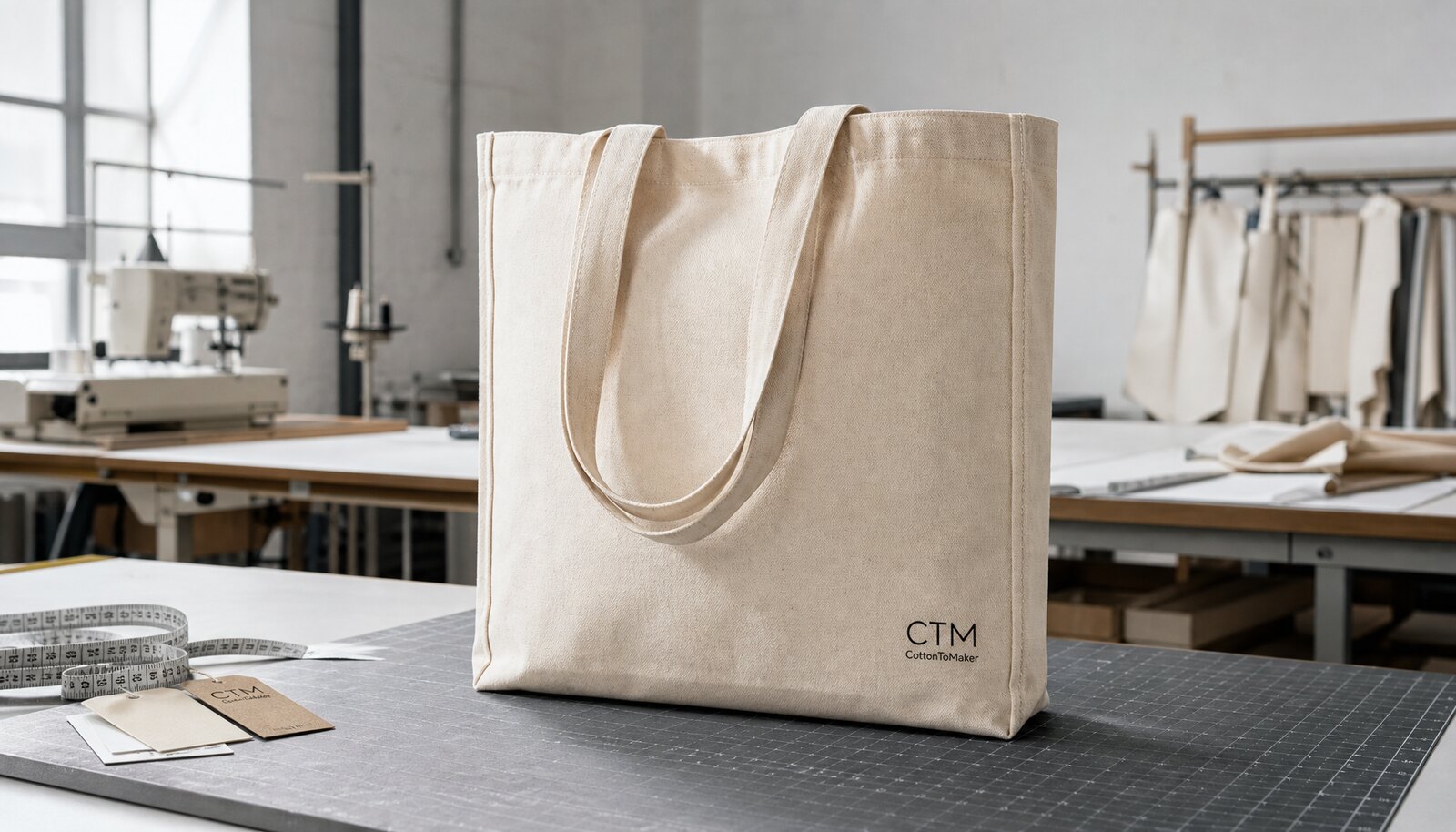
What procurement teams actually need to solve with branded cotton shoppers
The tote itself is rarely the real buying problem. The actual issue is that branded cotton shoppers are often sourced as if they were a single commodity, when they are really a bundle of decisions: fabric weight, weave, handle construction, print method, finishing, packing, and QC. If those parts are not locked before supplier comparison, the buyer ends up comparing products that only look similar in a mockup.
For procurement teams, the first question should be what the bag must do in the market. A shopper used for an event handout has a very different cost and risk profile from one sold on retail shelves or used as a branded carry bag in-store. A giveaway bag can often be lighter, simpler, and packed in bulk. A retail bag needs cleaner appearance, more stable dimensions, and a finish that looks intentional in shelf or e-commerce photography.
That use case also determines how much risk the buyer can tolerate. A promotional bag that carries brochures once or twice can accept more variation in cloth shade and a simpler stitch pattern. A bag that will be resold, reused, or attached to a brand experience needs tighter tolerances, stronger handle attachment, and more disciplined inspection. The buyer should decide this up front, because each extra feature changes cost, lead time, and carton cube.
The most useful internal brief is usually not “we need a cotton tote.” It is “we need a branded shopper that carries x type of contents, presents well enough for y sales channel, and lands at a target cost without claims.” That framing helps purchasing, marketing, and quality teams speak the same language. It also reduces the chance that someone approves a visually appealing sample that is too light, too loosely stitched, or too expensive to repeat.
A good rule is to define the product in this order: function, construction, decoration, packing, then price. If the order is reversed, the quotation often becomes the product specification by accident. Once that happens, the lowest bidder may simply be the supplier who removed the most value from the bag without saying so.
- Start with the end use: giveaway, resale, internal store carry, or event distribution.
- Separate appearance requirements from load-bearing requirements.
- Treat a tote that will be sold or reused often as a durability purchase, not only a marketing item.
- Do not compare quotes until the use case, pack format, and decoration scope are fixed.
Fabric weight, weave, and finish: the real foundation of bag performance
Fabric weight is one of the most visible pricing variables, but it should never be read on its own. For many branded cotton shoppers, 140–150 gsm is the practical lower band for light promotional use. It keeps cost and carton weight down, but it is less forgiving if the bag carries books, apparel, or other dense items. Around 160–180 gsm is often the most balanced band for general branded use because it offers better body, less transparency, and a more substantial hand feel without moving too far up the cost curve. At 200 gsm and above, the bag starts to suit heavier retail use, repeated carry, or a more premium private-label position.
The weave matters just as much as the weight. Plain weave is common because it prints cleanly and is usually the most economical. Twill can give a more premium appearance and may hide some surface irregularity better, which is useful when the shopper is sold as a nicer retail item. A loose weave can create a softer feel but may also make the bag look less stable or more see-through. Buyers should ask for the actual construction, not just the headline GSM.
Finish affects both appearance and repeatability. Bleached cotton gives a brighter print base and is often preferred when the logo needs crisp contrast. Natural unbleached cotton is popular for eco positioning and can look more authentic, but it often shows shade variation more clearly from lot to lot. Washed or softened cloth may feel better in hand, but it can also create shrinkage, wrinkles, or lot variation if the process is not controlled. That matters when the bags must stack neatly or match a previous order.
A buyer comparing two quotes should ask for the exact fabric description in writing: GSM, weave, finish, and whether the fabric is bleached, dyed, washed, or left natural. If the supplier cannot define the cloth clearly, the quote is not yet procurement-ready. The same named product can look cheaper simply because the cloth is thinner, the weave is less stable, or the finishing step is different.
For repeat programs, consistency across fabric lots is often more important than an ambitious spec. A slightly lighter but stable fabric can be easier to reorder than a heavier cloth that varies from batch to batch. If the bags are part of a brand system, the buyer should care not only about strength but about how repeatable the look will be on the next order.
- 140–150 gsm: suitable for light promo use and low-cost campaigns.
- 160–180 gsm: usually the most balanced band for branded shoppers.
- 200+ gsm: better for heavier carry, retail resale, or premium positioning.
- Ask whether the cloth is bleached, unbleached, dyed, washed, or shrink-controlled.
- Request the fabric basis in writing before you compare unit price.
Handles, seams, and stress points: where failure usually starts
Most bag failures do not start in the middle of the panel; they start at the stress points. Handle joins, top corners, and bottom seams take the load every time the bag is lifted. A cheaper quote that saves labor on reinforcement can look attractive on paper and then fail in use. Buyers should treat those details as commercial features, not optional sewing extras.
Self-fabric handles are common on cotton shoppers because they match the bag body and keep the look simple. Webbing handles can be stronger and more consistent but may change the aesthetic and cost. Whatever the handle type, the buyer should confirm width, length, folding method, and how the handle is attached. Thin handles may twist or elongate under weight, while overly short handles can make the bag awkward to carry, especially when packed with apparel or printed literature.
Reinforcement is worth specifying precisely. Box-x stitching or bar-tack reinforcement at the handle attachments is usually preferable to vague wording like “strong stitching.” The buyer should also confirm the stitch density or stitch count where possible, especially if the bag is intended for repeated use. If the supplier can provide a stitch specification, that should be included in the spec sheet. If not, at least require a sample to show the exact construction before bulk.
Seam quality should be judged on more than appearance. A seam can look neat from the outside and still be weak if the allowance is too narrow or if the stitches are uneven. Open ends, loose thread tails, skipped stitches, and seam puckering all create quality risk. Buyers should define which issues are cosmetic and which are reject-level. That saves arguments later when an inspector finds a bag that is visually acceptable but not structurally sound.
When the shopper will carry books, samples, or mixed retail goods, it is smart to ask for a simple load test on the sample. The goal is not laboratory certification; the goal is to catch obvious weakness before bulk. If a handle or side seam begins to distort under a normal practical load, the buyer has already learned something useful before production starts.
- Treat handle joins and bottom seams as critical control points.
- Ask for box-x or bar-tack reinforcement at stress points.
- Confirm handle width and length on the physical sample, not only on the drawing.
- Define which seam issues are cosmetic and which are rejects.
- If the bag will carry heavy goods, request a practical load check on the sample.
Print method, artwork limits, and color control
Decoration is where many tote programs drift off spec. A logo may look simple in artwork form and then require multiple screens, tighter placement control, or a more expensive print method in production. For solid logos with one to three colors, screen print is usually the most efficient route because it is cost-effective, durable, and widely understood by factories. For small runs, highly detailed artwork, gradients, or photo-like graphics, heat transfer or digital methods may be more suitable even if the unit cost is higher.
The critical mistake is to approve a mockup and assume the factory can reproduce it exactly. A digital file does not tell the buyer whether the artwork will sit cleanly on cotton texture, whether fine lines will fill in, or whether the print will still look good near a seam or fold. Procurement should ask the supplier whether the design is print-ready as shown or whether it will need simplification. That one question often saves time and avoids price surprises.
The best approval tool is a strike-off or print sample on the actual fabric, not only a PDF proof. The strike-off shows saturation, edge sharpness, placement, and hand feel. If brand color matters, the buyer should ask how the supplier measures it and what viewing light is used for approval. A shopper printed on natural cotton can look slightly different from the same artwork on bleached cloth, so the buyer should approve the real substrate, not a generic reference.
It is also worth asking about print coverage. A small chest logo and a full-panel print are not the same job. More coverage means more labor, more risk of misalignment, and in some cases slower drying or curing. Buyers often see “print included” in a quote without realizing the size or location of the decoration changes the labor model. The RFQ should state side, size, colors, and whether the reverse side is blank or branded.
If the brand uses multiple colors across campaigns, it helps to decide whether color matching must be exact or simply close. In promotional programs, a limited tolerance may be acceptable if it is written down. In retail resale, the requirement is usually tighter. Either way, the supplier should not be left to interpret brand color on their own. That is a recipe for expensive rework.
- Screen print suits bold logos and repeat volume.
- Heat transfer or digital print can make sense for smaller runs or detailed artwork.
- Use a strike-off on actual fabric when color or placement matters.
- State print size, location, and whether one or both sides are branded.
- Ask whether the artwork needs to be simplified for the chosen print method.
MOQ, reorder logic, and why a low minimum can still be expensive
MOQ is rarely just a production number. It is a proxy for how much of the spec is custom and how much of it can be made from stock materials. A supplier can often offer a lower MOQ when the bag uses standard fabric, a simple shape, and limited decoration. Once the buyer asks for custom dyeing, special label application, unusual handle length, or retail-style packing, the minimum usually rises because more material and labor have to be reserved for one program.
The real procurement question is whether the MOQ matches the actual buying plan. A small test order can be useful if the buyer is testing a market or checking reception in stores. But the order only makes sense if the supplier can repeat it later without changing the bag’s look or changing the cost structure too much. A low first-order MOQ that cannot be repeated at the same spec is not really a flexible solution; it is a one-time exception.
Ask the supplier what drives the MOQ. Does it apply per color, per size, per logo variant, or per label type? A buyer who thinks they are ordering one product family may actually be creating several separate minimums. This is especially true when the team wants one base bag but multiple branding versions for different campaigns or channels. Standardizing the bag body and varying only the decoration is often the easiest way to reduce commercial complexity.
It can also help to separate pilot volume from scale volume. A 1,000-piece test order may be perfectly valid if the buyer understands that the follow-on order will be priced differently once the spec is locked. What should be avoided is pretending the pilot is a full commercial benchmark. If the goal is to secure a long-term supply path, the buyer should ask the supplier whether the same fabric, print screen, and packing method can be held for reorder.
A low MOQ quote is not automatically a better quote. If the supplier is underquoting to win the order and then plans to recover margin through hidden pack charges, upgraded freight assumptions, or reduced fabric weight, the buyer pays later. The safest comparison is not “who can make the fewest pieces?” but “who can repeat the required spec without changing the commercial basis?”
- MOQ often changes by fabric, print, label, and packing complexity.
- Ask whether MOQ is per artwork, per color, per size, or per label style.
- A pilot order only helps if the follow-on reorder can match the same spec.
- Watch for hidden changes in cloth weight or packing when the minimum looks unusually low.
Sourcing route comparison: cost, lead time, control, and risk
The best sourcing route depends on what your team needs control over. Direct factory sourcing is usually strongest when the order is repeatable and the buyer can manage the spec clearly. Trading companies are useful when you need one point of contact for multiple items, want easier communication, or are managing a broader sourcing program. Local converters can be valuable for speed and flexibility, especially on smaller orders or urgent replenishment. None of these routes is always right; the real decision is which risk you want to own.
Direct factory sourcing often gives the cleanest line of sight into production. The buyer can ask who makes the bags, who prints them, and who packs them. That helps when the order is technical or likely to repeat. The trade-off is that the buyer must be disciplined on sampling and inspection, because the factory will usually expect the buyer to know what it wants. If the spec is vague, factory-direct can become a negotiation over assumptions rather than a commercial quote.
Trading companies can make procurement easier when the buyer is managing many SKUs or does not have the time to coordinate with several factories. The cost is usually higher, but the quote may include more administrative support and better consolidation. The risk is visibility: the buyer may not know whether the bag is being made in-house, by a sister plant, or by a subcontractor. That matters when the order needs tight quality control or when the buyer wants to reorder the exact same item later.
Local converters are often chosen for speed. If the order is modest, the artwork is simple, and the deadline is tight, this route can reduce logistics friction. The weakness is that the buyer may pay more per piece and may have less leverage over material choice and process control. For a rush order, that may still be the right decision, but the buyer should not confuse speed with lower total cost.
There is also a hybrid route worth considering: a factory makes the base bag and a local partner adds labels, inserts, or retail packing. That can be efficient if the buyer needs market-specific packaging or last-mile flexibility. It also introduces handoff risk, so the PO should clearly define where responsibility changes. If the order moves through two sites, both sites need to be visible in the quality plan.
- Direct factory is best when the spec is clear and repeat orders matter.
- Trading company is useful for consolidation and simpler communication.
- Local converter can be the fastest option for small or urgent orders.
- If production is split across sites, define responsibility for each step in writing.
Sample approval: the checkpoint that stops most bulk problems
A sample should be treated as a production reference, not as a nice-looking one-off. If the buyer approves only the logo appearance, the bulk order can still drift on dimensions, handle length, fold pattern, or seam strength. For branded cotton shoppers, the sample needs to lock the minimum set of facts that the factory must repeat exactly: cloth, size, handle construction, print placement, label position, and packing format.
The most useful sample is a pre-production sample or signed reference sample. That sample should be measured physically, not only reviewed in photos. Check width, height, gusset or flat depth if relevant, handle length, and the fold pattern used for packing. If the shopper will sit on a shelf or in a retail display, also check whether it hangs or stands the way you expect. A bag can look good flat and still fail in presentation when folded or filled.
If the program depends on color consistency, the sample should be based on a strike-off on the actual cloth. A digital proof cannot tell you how the ink sits on cotton texture. Buyers should also decide who gives final approval. In many organizations, marketing should sign off on artwork, purchasing should confirm the commercial terms, and quality or supply chain should sign off on construction. That split is useful because it prevents one person from approving a bag that looks right but is built wrong.
Changes after sample approval are a major schedule and quality risk. Even minor edits can mean new screens, new placement checks, or a new pack configuration. If the team cannot approve the sample because the brief is still open, the better decision is to pause the order than to force a weak approval. A late correction almost always costs more than a deliberate delay before bulk starts.
A good sample review is practical and fast. Rub the print lightly, check the seams, inspect the handle joins, open and refold the bag, and pack it the way the warehouse will receive it. Those simple checks catch more issues than an aesthetic review alone. If the sample passes those tests, the buyer has a strong basis for bulk approval.
- Measure the physical sample, not just the drawing.
- Approve artwork, construction, and packing as separate sign-offs if different teams own them.
- Use a strike-off on actual fabric when color matters.
- Do not start bulk if the sample still needs speculative interpretation.
- Keep a dated photo record of the approved reference sample.
QC thresholds to write into the PO, not leave to interpretation
Quality control on cotton shoppers is most effective when the acceptance rules are written before production starts. Buyers should not rely on vague phrases like “good workmanship” or “export quality.” Those phrases are too subjective to be useful on a warehouse floor. Instead, state the measurable items: fabric weight tolerance, finished dimensions, handle length, seam integrity, print placement window, pack count, and carton marks.
For fabric, a tolerance band is usually enough if the buyer accepts normal cotton variation. For dimensions, the buyer should set a practical window based on the approved sample and the intended use. A retail bag needs tighter consistency than a giveaway bag. For stitching, define the obvious rejects: open seams, missing reinforcement, broken stitches, or loose ends beyond the agreed limit. For print, define whether misregistration, patchiness, or smudging is acceptable only for rework or is a hard reject.
It helps to distinguish between reworkable defects and non-reworkable defects. A loose thread can often be trimmed. A missing box-x stitch on a handle cannot be fixed without rework and may indicate line inconsistency. A slight cotton shade variation may be acceptable on a natural promo bag if the buyer has already approved that risk. A visible mismatch across cartons on a retail order is a different matter. Writing that distinction into the PO helps the factory understand what gets repaired and what gets held.
Final inspection should be tied to the approved sample and the PO revision, not just to a generic AQL statement. If your team uses AQL, that is fine, but it should be linked to the specific bag spec. The most important point is that the supplier knows what the buyer will reject before cartons are sealed. If the inspection standard is shared too late, the factory often ships goods that were never built to the same acceptance basis.
For branded cotton shoppers that are resold, display quality matters as much as function. That means straighter print placement, cleaner trim, less puckering, and more consistent folding. Retail buyers should not use the same defect tolerance they might use for a purely internal giveaway. The commercial channel should shape the QC bar.
- Write measurable tolerances into the PO or quality appendix.
- Separate cosmetic issues from structural defects.
- Define what is reworkable and what is a rejection.
- Tie final inspection to the approved sample and the correct PO revision.
- Use a stricter appearance standard if the bag is sold at retail.
Packing, carton size, and landed-cost impact
Packing is one of the easiest places for a quote to look good and the landed cost to move up later. Bulk packing is usually the cheapest option because it minimizes handling and keeps cube efficiency high. If the order needs individual polybags, barcode stickers, retail insert cards, or shelf-ready presentation, those additions increase labor and carton volume. A buyer comparing quotes should always confirm that the packing basis is identical before judging price.
Carton design matters more than many buyers expect. Overpacked cartons can compress cotton fabric and create creasing, especially if the bags have print or labels. Underfilled cartons waste space and raise freight cost. The buyer should ask for the quantity per carton, carton dimensions, gross weight, net weight, and any carton mark requirements. Those details help both procurement and warehouse teams understand the landed cost and the receiving process.
If the bags are for retail resale or store replenishment, barcode and SKU accuracy matter just as much as visual presentation. Ask who applies the stickers, where they are placed, and whether the pack configuration is verified after final packing. A bag that is correct in sewing can still create receiving problems if the carton mark does not match the SKU or if a last-minute pack change is not reflected on the shipping documents.
For remote buyers, packing photos are more useful than polished product shots. Ask for a photo of the folded bag, the inner pack if applicable, the filled carton, the carton label, and the finished pallet or shipping stack if one is used. Those images provide shipping evidence that is actually useful if a dispute arises later. A short packing video can be even better when the order is complex or when the buyer wants to confirm that the line is really packing the product as agreed.
Good packing is not about adding more packaging. It is about aligning the pack format with the channel. Wholesale distribution wants cube efficiency and count accuracy. Retail display wants neat presentation and barcode consistency. If the pack format is wrong, the savings achieved earlier in the sourcing process can disappear in freight or warehouse handling.
- Compare quotes only on the same packing basis.
- Ask for carton dimensions, weight, and pack count before award.
- Use bulk pack for wholesale unless the market genuinely requires retail presentation.
- Request packing photos or a short video before dispatch when you cannot inspect on site.
Lead time planning and the schedule risks buyers underestimate
Lead time for branded cotton shoppers is usually shaped by four things: fabric availability, artwork complexity, sample approval, and packing requirements. A simple stock-fabric order with a basic logo can move quickly. A custom-dyed, retail-packed program with multiple print locations will move more slowly. The most common planning mistake is starting the clock at PO date instead of at approved sample date. That makes the schedule look safer than it is.
Artwork changes are one of the biggest reasons orders slip. A revised logo after strike-off approval can require new print setup, new checks, and sometimes rework on the bulk line. Packing changes can also consume time if the factory must switch from bulk cartons to individual retail packaging. Those are not minor admin updates; they are production events. Buyers should treat them that way in the schedule.
A practical timeline should name the stages separately: sample submission, sample approval, bulk material release, cutting, sewing, printing, packing, inspection, and dispatch. Each stage needs an owner. Purchasing owns commercial sign-off, the supplier owns production updates, and quality owns inspection booking and defect response. If no one owns a step, that step is where the schedule slips unnoticed.
It is also smart to ask the supplier where the bottleneck usually sits. Some orders are held by fabric sourcing. Some stall in print because color matching needs extra passes. Some lose time in packing because retail labeling is not ready. You do not need every internal detail, but you do need the likely pinch point before you promise a ship date to internal stakeholders or customers.
A small buffer is usually worth having, especially for first orders or seasonal campaigns. The tighter the deadline, the less margin there is for a rework cycle. If the order only works when every step goes perfectly, the lead time is probably too aggressive. It is better to set a realistic date than to chase an impossible one after the bags are already in production.
- Count lead time from sample approval, not from inquiry date.
- Treat artwork changes as schedule-critical events.
- Assign an owner to every milestone from sample to dispatch.
- Ask the supplier where delays usually happen: fabric, printing, sewing, or packing.
- Add a buffer if the order is seasonal, retail-facing, or first-time.
Specification comparison for buyers
| Buying route | Typical commercial profile | Best use case | Main buyer risk | What to verify before award |
|---|---|---|---|---|
| Direct factory | Lower unit price on repeatable specs; stronger control if your team can manage sampling and QC | Repeat orders, standardized tote programs, retail/private-label runs with stable artwork | Spec drift if the factory interprets details loosely; slower if the supplier is busy or weak on export coordination | Confirm who makes, prints, and packs the bags; ask for a sample timeline, inspection method, and evidence of prior similar construction |
| Trading company | Slightly higher unit price but easier communication, consolidation, and multi-item sourcing | Mixed-category purchases, buyers who need one commercial contact, programs that combine bags with other branded items | Margin layering can hide the real factory cost; you may get less visibility on process control | Ask for factory name, process ownership, sample source, and whether the quote includes all packing and labeling steps |
| Local converter | Fastest for small or urgent runs; can be practical for short lead times | Event deadlines, low-volume tests, domestic distribution, or last-minute replenishment | Higher piece price and less leverage on material cost; carton cube can be less optimized | Check production capacity, exact fabric source, stitch quality, and whether they can repeat the same spec on reorder |
| Overseas broker with stock fabric | Can hit lower MOQ and faster start if the design is simple | Pilot launches, market tests, low-risk promotional giveaways | The quote may depend on available stock cloth and may not repeat cleanly on reorder | Verify fabric lot, color availability, print setup limits, and whether MOQ changes by color or pack format |
| Factory-direct with custom fabric | Best for distinct brand look and controlled repeatability once proven | Private-label shoppers, retail programs, and long-term branded ranges | Longer lead time, higher MOQ, and more production risk if the first sample is not tight | Lock weave, GSM, dye standard, and acceptance tolerances before approving bulk |
| Hybrid sourcing: custom bag, local decoration | Useful when a buyer wants one site to make the bag and another to add print or labels | Programs that need faster decoration turnaround or local compliance steps | Split responsibility can create blame gaps if quality fails between steps | Name the owner for each stage: sewing, print, labels, carton packing, and final inspection |
Buyer checklist before sampling
- Define the use case first: giveaway, retail resale, store carry, or sample distribution. Then set the spec.
- State bag size, fabric GSM, weave type, handle width and length, seam allowance, and finished fold size in the RFQ.
- Specify decoration clearly: print method, print location, number of colors, Pantone targets, and whether both sides are branded.
- Confirm whether the order includes custom fabric color, woven label, care label, barcodes, insert cards, or retail polybags.
- Ask suppliers to price the same packing basis: bulk pack, inner pack, retail pack, or shelf-ready carton.
- Request a pre-production sample or signed reference sample before bulk cutting starts.
- Ask for a line-item quote that separates unit price, setup, sample charges, packaging, and freight basis.
- Verify lead time from sample approval, not from purchase order date.
- Ask for in-process photos plus packed-carton photos before shipment if you cannot inspect on site.
- Write the acceptable defect rules into the PO or quality appendix so acceptance is not decided informally later.
Factory quote questions to send
- What exact fabric GSM, weave, and finish are included in the quoted price?
- Is the handle self-fabric or webbing, and what reinforcement stitch is included at the handle join?
- How many print colors and print locations are included, and what is the setup charge for each?
- What color tolerance do you work to for the fabric and the print, and how is it checked on the approved sample?
- Does the MOQ change if we add custom fabric color, woven label, care label, barcode sticker, or retail packing?
- What lead time do you commit to after sample approval, and what steps are included in that timeline?
- Which parts are made in-house, and which parts are subcontracted?
- Can you share stitched-seam photos, print close-ups, and packed-carton evidence from an actual current run?
- What carton quantity, carton dimension, and gross weight are included in the quote?
- What happens to the price if we change the order from bulk packing to individual polybags or insert cards?
Quality-control points to confirm
- Fabric weight should be within an agreed tolerance, typically ±5% for controlled programs and up to ±10% only when the buyer accepts normal cotton variation on promotional goods.
- Bag dimensions should remain within a practical tolerance window of the approved sample; as a rule, width and height should not drift enough to affect retail display, folding, or carton count.
- Handle length should be consistent within a narrow tolerance so end users do not notice uneven carry length from bag to bag.
- Handle joins should use reinforcement such as box-x or bar-tack at both attachment points, with no skipped stitches, broken threads, or loose tails longer than the agreed limit.
- Seams should be closed cleanly with no open ends, seam pop, or puckering that distorts the bag shape.
- Print placement should stay inside the approved placement window; visible misregistration near seams or folds should be treated as a defect, not a cosmetic preference.
- Print color should match the approved strike-off or reference sample under agreed viewing light; a small cotton-lot shade shift may be acceptable only if it was pre-approved.
- Carton count should match the packing list exactly, with carton marks and shipping labels placed in the agreed position.
- If the bag includes labels, barcode stickers, or insert cards, they should match the approved layout and not cover the logo or interfere with folding.
- For retail programs, define a clear defect threshold in advance: for example, no open seams, no missing reinforcement, no wrong logo placement, and only limited minor thread trimming issues allowed in final pack.