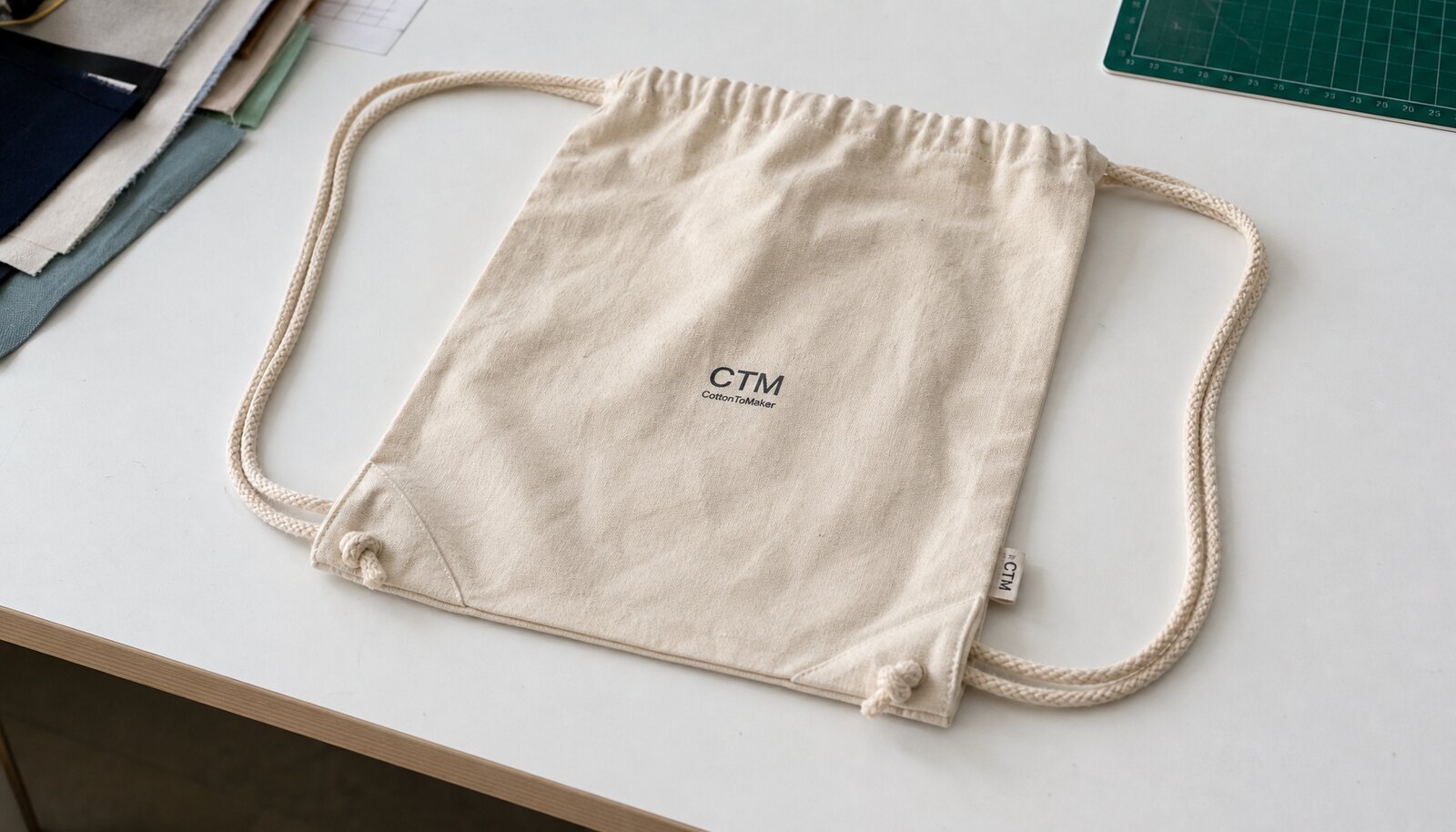
Why this bag needs a winery-specific spec
A cotton drawstring backpack for a boutique winery is rarely a simple giveaway. It may be sold in the tasting room, bundled with a bottle purchase, handed out at events, or packed into a seasonal gift set. Those uses create different failure points. A bag that looks clean in a product photo can still fail if the cord cuts into the top seam, the base loses shape after repeated packing, or the print wears away during normal handling.
The buyer should define the use case before asking for price. If the bag only carries brochures and a card, the spec can stay lighter. If it may carry one bottle, a small gift item, or a mixed retail kit, then the bottom, cord anchor, and seam construction matter much more than decorative finish alone. This is where procurement teams save money by being precise instead of broad.
For boutique wineries, presentation still matters. The bag sits next to bottles, labels, tags, and gift packaging, so the weave, fold, and print quality affect perceived value. The right decision is the one that balances durability, shelf appearance, lead time, and landed cost for the specific channel.
A practical way to start is to assign the bag to one of four uses: retail merchandise, tasting-room gift, event giveaway, or bottle-related kit. Once that is fixed, the supplier can quote the right fabric weight and construction instead of guessing at a generic promo bag.
- Retail merchandise needs the cleanest finish and the least visible defect tolerance.
- Bottle-related use needs stronger bottom support and cord reinforcement.
- Event giveaways can stay lighter, but the top seam still needs to survive repeated handling.
- If the bag will be resold, buyer acceptance should include appearance after folding and unpacking, not just strength.
RFQ baseline: fabric, cord, reinforcement, and print
For most boutique winery orders, 10 oz to 12 oz cotton canvas or heavy cotton twill is the most practical starting point. That range usually gives enough body for a retail look without making the bag overly stiff. Below 10 oz can work when the contents are light and the bag is not expected to hold shape on a shelf. Above 12 oz makes sense when the bag must stand up better, carry heavier items, or survive repeated event use.
Do not stop at the word 'cotton'. Ask for gsm or oz/yd², weave type, whether the fabric is pre-shrunk, and whether the lot has a defined shade tolerance. For natural or unbleached cotton, specify how much tonal variation is acceptable. Otherwise, the buyer may receive a lot that looks patchy even though it technically matches the material name.
Cord specification is just as important. Thin cord can look neat, but it can also cut into the top channel or feel weak when the bag is loaded. Ask for cord material, diameter or finished thickness, and the way it is anchored. A stronger cord paired with weak stitching still fails; the load path needs to be reinforced as a system, not as separate parts.
Print method should follow the artwork and the volume, not habit. Screen print is usually the best option for simple winery logos because it is durable and cost-effective at repeat volumes. Heat transfer can work for low quantities or complex art, but it needs a rub and fold check. Embroidery can look premium, but it changes the hand of the bag and adds cost. If the brand wants subtlety, a woven label or side label may be enough.
- Use 8 oz to 9 oz only for light collateral and short-term giveaway use.
- Use 10 oz to 12 oz for most retail, gift-with-purchase, or light bottle-carry use.
- Reserve 12 oz and above for premium retail, heavier content, or bags that must hold shape better.
- Ask for the reinforcement method at the top seam, bottom corners, and any cord hole or channel.
- Approve the artwork size and placement on a physical sample before the bulk run starts.
Durability tests that buyers can actually use
The point of testing is to prevent repeat failures, not to create lab theater. For this product, the most useful checks are a loaded handle test, seam inspection, cord pull resistance, print rub resistance, and a simple filled-load review. These tests should mirror how the bag will be used in the winery, not some extreme condition nobody will ever repeat in real life.
Use buyer-side acceptance criteria and keep them simple. A practical first-article process is to inspect 5 pre-production units, then test them under the intended load plus a modest handling margin. If one sample fails on a major issue, hold the order until the factory explains the cause and sends a corrected sample. If two or more fail, treat it as a process problem, not a cosmetic issue.
A workable test sequence is: load the bag to its intended contents weight, lift and set it down 20 times, check the top seam and cord channel, then rub the print with a dry white cotton cloth 10 times. After that, inspect the bottom for twist, collapse, or seam opening. The bag should still look acceptable for a customer receiving it at retail or at an event.
For bottle-related use, test with the actual bottle weight or a close equivalent. A bag that holds brochures well may still fail when the weight shifts downward. If the use case includes a bottle, the bottom panel and load points should be the focus of approval, not just the logo surface.
- Pre-production sample size: 5 units minimum.
- Loaded handle test: 20 lift-and-set cycles at intended load plus a small handling margin.
- Cord pull check: no visible tearing, slippage, or channel distortion after repeated lifting.
- Rub check: 10 dry cloth rubs without heavy transfer, peeling, or cracking.
- Filled-load check: the base should remain usable and the bag should not collapse or twist badly.
How to compare quotes without missing hidden cost
A low unit price is not useful if the bag arrives with lighter fabric, weak reinforcement, or a decoration method that wears out too quickly. Compare quotes only after every supplier is working from the same spec. That means the same fabric weight, same cord type, same print method, same packing format, and the same load expectation. If one supplier is pricing a lighter construction, the quote is not comparable.
The cleanest way to compare suppliers is by route. Direct factory sourcing usually gives the best control over construction and the lowest unit cost once setup is spread over enough units. Trading companies can simplify procurement when the order involves multiple styles or your team does not want to manage factory communication directly. Stock blank plus local decoration can reduce lead-time risk when volume is small or the design changes often. Premium retail builds cost more because the fabric, finishing, and packing standards rise together.
Hidden cost drivers are usually setup, decoration, and packing. One-color screen print usually scales well. Multiple colors, embroidery, individual polybags, and retail folding each add labor. Freight also changes with fold size and carton dimensions. A quote that looks slightly higher can still be cheaper after freight and repacking if it reduces damage or warehouse handling.
The buyer should ask every supplier to name the exact factory, exact materials, exact decoration method, and exact packing format. If those details are missing, there is no real way to compare landed cost or failure risk.
- Direct factory is best when you want the least ambiguity on fabric and reinforcement.
- Trading company is best when you need one point of contact across multiple SKUs.
- Stock blank plus local branding is best for small seasonal programs or urgent replenishment.
- Premium retail builds are best when the bag is part of a sellable gift item, not just a giveaway.
- Never compare unit price without comparing freight, packing, and inspection ownership.
MOQ, price breaks, and lead time: where the quote actually changes
MOQ on this product is usually driven by fabric cutting efficiency, print setup, and packing labor. If the bag is standard natural cotton with a simple logo, the price can improve quickly as quantity rises. If the artwork changes often, the setup cost may stay high even when the bag itself is simple. That is why the buyer should ask for pricing at the target volume and at the next tier, not just one number.
A useful quote sheet separates blank bag cost, decoration cost, packaging cost, and freight assumptions. Once those are split apart, you can see whether the supplier is charging more because of material, because of labor, or because of small-run inefficiency. That matters for wineries because many programs are seasonal. A harvest campaign, club shipment, or holiday bundle may justify a smaller order if the design will not repeat.
Lead time should be broken into sample approval, material arrival, production, and dispatch. Buyers often hear one short number and assume the order is moving faster than it really is. If a supplier is waiting on fabric or a print screen, the schedule can slip even when the sewing line is available. For repeat orders, ask which part of the timeline is actually variable and which part is stable.
For low-volume programs, consider whether a blank-stock bag with local printing is safer than a fully custom run. It may cost more per unit, but it can reduce the risk of overbuying a seasonal design that will not repeat.
- Ask for price at the entry quantity, the next tier, and the volume where setup is fully absorbed.
- Ask whether each artwork version has a separate MOQ.
- Require the supplier to break out decoration, packing, and freight instead of bundling everything together.
- If the design is seasonal, compare the cost of custom production against blank stock plus local branding.
- Make the lead time explicit for sample approval, bulk production, and shipping separately.
Sample approval and change control
A sample is only useful if it matches the bulk run. That means the same fabric, same cord, same print method, and same reinforcement. A showroom sample made from a nicer lot is not a reliable approval reference. Buyers should keep one signed physical sample on file, labeled with date, artwork version, fabric spec, and packing format.
The sample review should be functional, not just visual. Check the stitch lines, cord movement, logo placement, opening width, and bottom shape. Then do the loaded check using the actual contents or a close equivalent. If the bag is going into a winery retail channel, look at it as a shopper would: does it fold neatly, does the print sit centered, and does the cotton tone look intentional on a shelf?
Change control matters because suppliers sometimes treat a fabric swap or cord swap as a minor adjustment. For the buyer, those changes can alter feel, load behavior, and print performance. Any change in material source, print process, or packing method should trigger a fresh sample review. If the buyer does not require that, the bulk order can drift away from the approved reference without anyone noticing until cartons arrive.
For repeat orders, the approved sample should remain the production reference unless the buyer signs a revision. If the supplier proposes a new lot, new cord, or new fold pattern, the burden is on them to show that the new version matches the approved standard.
- Keep one physical approved sample, not only a digital proof.
- Label the approved sample with date, artwork version, fabric weight, and packing method.
- Require a new approval if the fabric lot, cord, print, or fold method changes.
- If the supplier offers a revised sample, compare it directly against the approved reference before release.
Production QC points that matter before shipment
Most failures in this category are easy to catch if the buyer knows what to inspect. The first screen is construction quality. Look for straight seams, trimmed thread tails, consistent stitch spacing, and clean load points. The second screen is print and finish. Look for readable artwork, correct placement, and no obvious cracking or heavy color transfer. The third screen is packing consistency. If the fold varies from carton to carton, warehouse handling becomes slower and carton counts are easier to miss.
Set defect classes before production starts. Major defects should include seam opening, cord slippage, torn channels, incorrect artwork placement, and a bottom that fails the load test. Cosmetic defects can include minor cotton flecking or slight tonal variation if the brand accepts natural fabric variation. This distinction keeps inspections practical and avoids rejecting good product for issues that do not affect use.
For the pre-shipment check, pull product from multiple cartons, not only the top carton. A supplier can make the first carton look perfect and still ship mixed quality deeper in the run. If the order is large, inspect enough pieces to see whether the sewing, print, and packing look consistent across the lot. The goal is not a lab report. It is confidence that the shipment matches the approved sample and will not create avoidable returns or complaints.
If the winery is using the bag in retail resale, inspection should be stricter on appearance and fold consistency. If the bag is a giveaway, function matters most. Either way, zero tolerance should apply to seam failures and cord failures because those are the defects customers notice first.
- No skipped stitches in visible load seams.
- Loose thread tails trimmed to 3 mm or less on visible edges.
- Major defects should include seam opening, cord slip, artwork misplacement, and bottom failure.
- Pull samples from more than one carton during pre-shipment inspection.
- Use separate rules for cosmetic variation and functional failure so the inspection is consistent.
Packing, carton count, and warehouse handling
Packing affects cost and customer perception. A good bag can be damaged by a bad fold. If the fold pattern is inconsistent, print areas crease differently, cartons become harder to count, and retail presentation suffers. For wholesale shipments, a stable bulk fold usually works best as long as it protects the printed area and keeps carton volume under control.
Individual polybags are not always necessary. They make sense when the bags need shelf-ready presentation, dust protection, or an extra layer of scuff prevention. They are less useful when the bags are being unpacked and repacked quickly in the winery warehouse. Ask for a packing method that matches the real receiving process, not a generic retail assumption.
Before confirming the order, ask for carton dimensions, units per carton, gross weight, and carton labels. This helps with freight planning and receiving. If the bag is soft and bulky, a small change in fold pattern can change the cubic volume enough to affect shipping cost. A clear carton spec also reduces errors when the winery distributes inventory to multiple locations or event teams.
The buyer should also ask for carton markings that make sense in the receiving area: style, color, quantity, pack count, and whether the carton is master or inner pack. That saves time and reduces miscounts at arrival.
- Use a repeatable fold that protects the print area from hard creasing.
- Lock carton quantity before bulk production starts.
- Ask whether the cartons are single-SKU or mixed-SKU.
- Request a folded sample photo before approving mass packing if shelf appearance matters.
- Make carton labels readable enough for warehouse staff to receive without opening every box.
How the winery use case changes the spec
Retail merchandise, tasting-room gifts, event giveaways, and bottle kits all push the bag in different directions. Retail merchandise needs the cleanest finish because the bag is being sold as part of the brand. That usually means better print placement, tighter fold consistency, and a more polished natural cotton look. The buyer should be more strict on appearance and less willing to accept obvious lot variation.
Tasting-room gifts sit between retail and giveaway. They need to look good enough to feel intentional, but they do not always justify the heaviest fabric or most expensive decoration. In that use case, a durable but not overbuilt bag is often the right answer. The key is making sure the load points survive normal handling and that the bag still looks neat after being moved around the shop.
Event giveaways are more volume-driven. The bag may need to carry brochures, small inserts, and a few extras, but not much more. Here, you can often keep the fabric in the middle of the range if the load is predictable. The problem is not usually the fabric itself; it is weak sewing or a poor cord anchor that fails after repeated handling during a busy event.
Bottle kits are the strictest use case because weight is concentrated and shift-prone. If the bag is expected to carry a bottle, write that into the RFQ and test it that way. Do not rely on a bag that only passed a light collateral test.
- Retail resale: prioritize finish, fold consistency, and logo placement.
- Tasting-room gift: prioritize balanced cost and a clean shelf look.
- Event giveaway: prioritize predictable load handling and fast packing.
- Bottle kit: prioritize bottom support, cord reinforcement, and a real load test.
Specification comparison for buyers
| Buying route | What the quote should specify | Typical cost driver | Main failure risk | Best fit |
|---|---|---|---|---|
| Direct factory custom | Exact fabric weight, cord type, reinforcement method, print method, carton count, and which QC steps the factory owns | Setup plus material cost; the quote improves only when setup is spread across more units | Spec drift if the factory swaps fabric lot, cord, or print process without notice | Repeat orders, medium to high volume, and buyers who need direct control over construction |
| Trading company or sourcing agent | Actual factory name, whether markup is disclosed, and who performs pre-shipment inspection | Broker margin plus coordination overhead | Accountability gaps if the agent and factory disagree on who owns a defect | Mixed-SKU programs, low internal procurement bandwidth, or buyers consolidating multiple items |
| Stock blank plus local decoration | Blank bag spec, local print or embroidery spec, and who is responsible for matching the blank stock | Blank inventory, local decoration, and extra transit or handling | Blank-to-blank variation and slower replenishment if the local decorator is not aligned to the factory spec | Small seasonal runs, urgent promotions, or very low MOQ launches |
| Premium retail build | Heavier fabric, stronger bottom, woven label or cleaner finish, retail fold, and packaging format | Heavier fabric, finishing labor, and more careful packing | Over-specifying the bag into a price point the winery cannot sell through profitably | Gift shop retail, premium membership kits, and branded resale |
| Material | 6-10 oz cotton canvas, 210D polyester, rPET, or blended cotton with shrinkage and colorfastness expectations set before sampling | Before price comparison | Different cloth weights, backing, or certification claims make quotes hard to compare | |
| Construction | cord diameter, eyelet or reinforced channel, bottom corner reinforcement, seam allowance, bar-tack position, and load target | Before sampling | Weak stress points create returns and failed inspections | |
| Decoration | screen print, transfer, embroidery, woven label, or drawstring tag tested against folding and abrasion | Before artwork approval | The wrong method can crack, bleed, pucker, or fail on the chosen fabric | |
| MOQ | Base MOQ plus change drivers | During quote review | Custom colors, trims, and packing can change minimums |
Buyer checklist before sampling
- State the actual use case in the RFQ: empty giveaway, brochure bag, tasting kit, one-bottle carry, or retail merchandise.
- Quote fabric in gsm or oz/yd², not just 'cotton' or 'canvas', and include an acceptable tolerance band.
- Define the target load in pounds or kilograms and say whether the bag must hold a bottle, paper goods, or both.
- Specify cord material, cord diameter, and the top-channel or eyelet reinforcement method.
- Require a pre-production sample made with the same fabric, cord, print method, and reinforcement as the bulk run.
- Write buyer-side pass/fail criteria for seam opening, cord slip, print rub resistance, and bottom support.
- Ask for pricing at your target quantity and at the next higher tier so the setup cost curve is visible.
- Separate unit price, decoration cost, packing cost, and freight assumptions instead of accepting one all-in figure.
- Confirm whether the quote is direct factory pricing or includes a trading-company margin.
- Lock carton count, fold pattern, and whether each unit is bulk packed or individually bagged before approval.
Factory quote questions to send
- What exact fabric weight are you quoting, and can you state it in gsm or oz/yd² with a tolerance band?
- Is the fabric pre-shrunk, washed, or otherwise treated to reduce size drift after handling?
- What is the cord material, finished diameter, and how is it anchored at the top opening?
- Which reinforcement is included at the top seam, bottom corners, and load points?
- What is the print method, how many colors are included, and what is the setup charge per color?
- Can you quote the same spec at three quantity tiers so we can see the real MOQ break?
- Will the pre-production sample use the same fabric lot, cord, and print method as the bulk order?
- What is the packing method: bulk fold, inner pack, retail polybag, or another format?
- What are the carton dimensions, quantity per carton, and gross weight per carton?
- Who performs in-process QC and final inspection, and what defects are treated as major versus minor?
Quality-control points to confirm
- Fabric weight should match the agreed spec within the stated tolerance band; if the supplier quoted only a generic 'cotton' description, stop and re-specify before production.
- For a one-color logo, the print should have clean edges with no obvious feathering, pinholes, or patchy coverage; for multi-color art, set a register tolerance of no more than 2 mm.
- Seam lines should be straight and consistent, with no skipped stitches in any 10 cm seam section and no loose thread tails longer than 3 mm on visible edges.
- The top opening, cord channel, or eyelet area should survive 20 lift-and-set cycles at the intended load without tearing, slipping, or visible deformation.
- The bag should pass a simple load check at the intended contents weight plus a modest handling margin; reject any piece that opens at the seam, twists badly, or loses shape enough to fail retail presentation.
- The bottom should sit flat enough for normal handling; reject bags with corner puckering, obvious seam waviness, or a base that collapses under normal fill.
- After 10 dry rubs with a white cotton cloth, the logo should remain readable with no peeling, cracking, or heavy color transfer.
- Natural cotton tone variation is acceptable only if the lot looks intentional; reject patches that look mismatched or poorly blended on a shelf.
- Carton counts should match the packing list exactly, and the carton label should state style, color, quantity, and pack format clearly.
- Any change in fabric lot, cord type, print method, or packing method should trigger fresh buyer approval before bulk production continues.