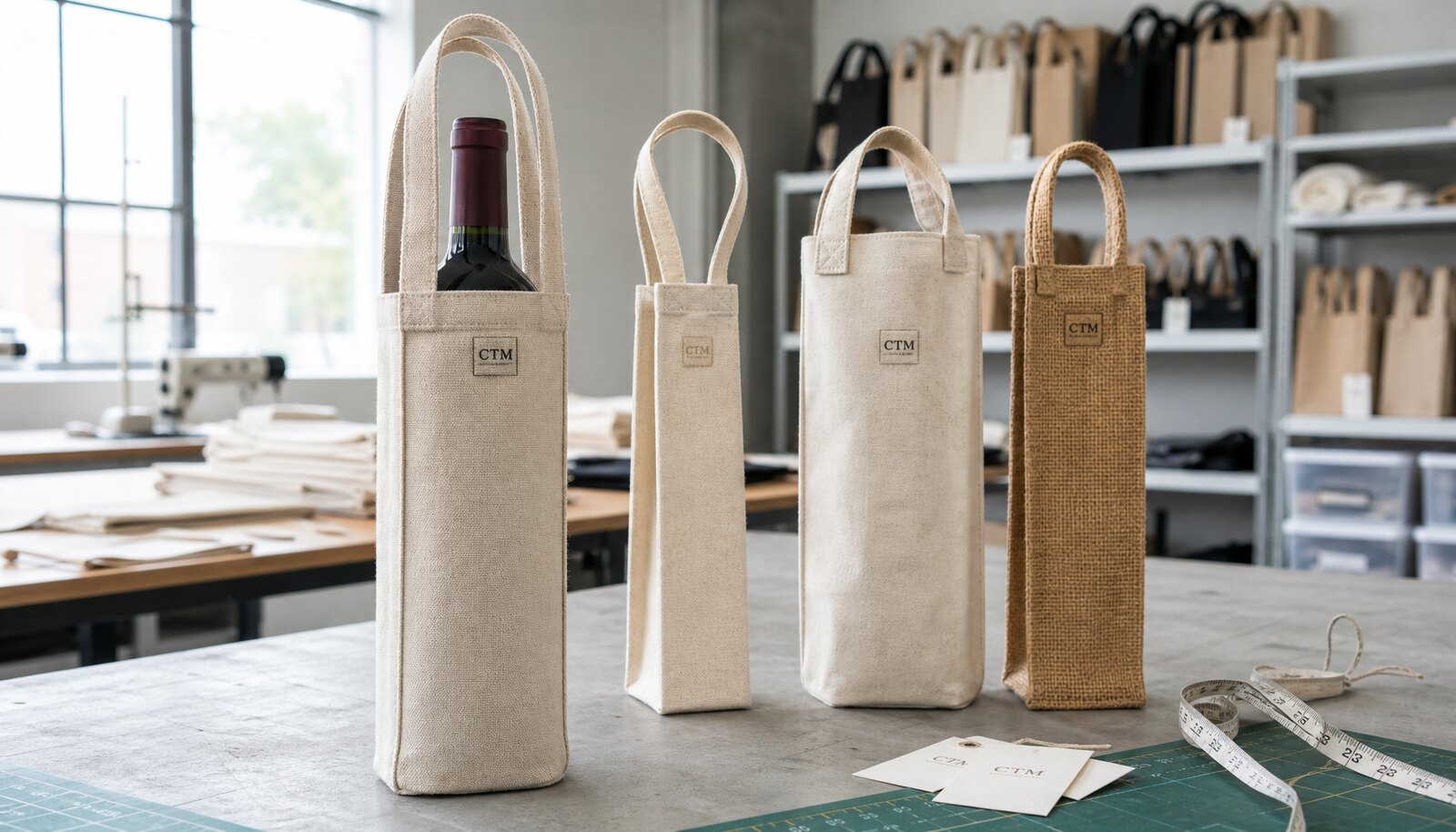
What bottle gift bags need to solve at events
Bottle gift bags for events look simple, but the buying problem is specific: the bag has to present well, hold a bottle safely, and survive handling from packing table to venue to guest takeaway. A good event bag does not need luxury construction in every case, but it does need the right balance of stiffness, bottle fit, and decoration quality. If the bottle slides around, the handle stretches, or the logo looks weak on the fabric, the whole gift loses value before the bottle is even opened.
For procurement, the first decision is not artwork. It is the use case. A private-label brand launch, trade-show gift, winery tasting event, and premium corporate dinner each need a different spec. A 140 gsm cotton bag can work for light event gifting, while a 12 oz canvas or jute option makes more sense when the presentation needs to feel heavier and more permanent. Start with the bottle type, event format, and target perceived value, then build the spec around that.
- Standard wine bottles usually fit a single-bottle bag with a gusseted base and 30-35 cm usable height.
- Spirits bottles, wider shoulders, or foiled necks may need extra width and a deeper base fold.
- If guests will carry the bottle for a long distance, the handle or drawstring needs more reinforcement than a display-only gift bag.
Choose the construction first, not the print
The most common sourcing mistake is treating all bottle bags as the same blank canvas. They are not. Cotton and canvas give a cleaner brand impression and usually print better than rough jute, while nonwoven keeps cost down for high-volume giveaways. Each route changes how the bag hangs, how it folds, and how the logo reads from a short distance. A heavy fabric can look premium even with simple one-color print, while a thin fabric can make a detailed logo look cheap no matter how good the artwork is.
For most event programs, a sensible starting range is 140-200 gsm cotton for a better hand feel, 10-12 oz canvas for a sturdier premium look, or 80-120 gsm nonwoven if the goal is volume distribution with controlled spend. Jute works when the brand wants a natural, rustic image, but it needs sharper spec control because the weave is uneven and print clarity is harder to maintain. The right construction depends on whether the buyer values lower unit cost, stronger reuse, or a more polished presentation.
- Cotton: better print clarity, softer hand feel, good for branded event gifting.
- Canvas: stronger structure, better base support, higher perceived value.
- Jute: natural appearance, less refined surface, more variation in print appearance.
- Nonwoven: lowest cost route, best for short-term promotions and large counts.
Size and fit should be written against the bottle, not the bag
Quotes often fail because the buyer asks for a size without defining the bottle. A supplier can make a bag that is technically correct on paper and still wrong in use if the neck catches on the top seam or the bottle sits too low in the base. For bottle gift bags for events, internal height, gusset width, and top opening matter more than the nominal outside size. This is where a physical sample beats a spreadsheet every time.
Write the RFQ around the actual bottle profile: wine, champagne, spirit, or specialty bottle. Include bottle height, body diameter, shoulder shape, and whether a cap, foil, or stopper increases the overall height. If the bag will be packed with tissue, a card, or a small accessory, that insert space should be stated up front. This avoids the common production issue where the bag fits the bottle but not the final gift set.
- Use internal dimensions for fit approval and keep a real bottle sample in the factory approval process.
- Ask the supplier to confirm seam allowance, gusset depth, and top edge finish in millimeters.
- If the bottle is heavy, require a stronger base panel and reinforced stress points near the handle or cord opening.
Decoration choices drive both cost and rejection risk
Print method changes more than just appearance. Screen print is usually the practical choice for 1-2 solid colors and larger quantities because it gives stable cost and decent opacity on cotton or canvas. Heat transfer can work for short runs or more detailed graphics, but it can look less integrated on rough fabrics and may not age as well. Embroidery and woven labels feel premium, but they add setup time and are not the best route for small text or fast-moving campaigns.
For event programs, the cleanest buyer decision is usually one of three options: a single-color screen print, a woven label sewn to the side seam, or a restrained two-color print paired with a simple bag structure. Complex gradients, small legal text, and thin lines are where production errors show up. If the logo needs to be sharp at arm's length, simplify the artwork before quoting instead of trying to rescue it later with a more expensive print method.
- Use screen print when the artwork is bold, flat, and volume is meaningful.
- Use woven labels when the brand wants a cleaner premium finish without large ink coverage.
- Use embroidery only when the fabric and artwork size can support stitch clarity.
- Avoid tiny reverse text on textured materials unless you have a proven sample.
What drives the quote beyond the bag itself
A good supplier quote should separate material cost, decoration cost, packing, and any setup fees. Buyers often compare unit prices that are not actually comparable because one quote includes a finished polybag and carton marking while another excludes everything except the blank bag. For bottle gift bags for events, the biggest hidden cost drivers are fabric weight, decoration complexity, handle or cord structure, and whether the bag needs a custom pattern or can use an existing base pattern.
MOQ logic usually follows two layers: material efficiency and decoration setup. A stock base bag with one-color print can often start lower than a fully custom size with multi-color print and sewn label details. If the event is annual, a buyer can reduce unit cost by locking a repeatable base size and ordering decoration in predictable volumes. If the event is one-time, it may be smarter to keep the base simple and spend the budget on cleaner print and packing rather than a fully custom build.
- Ask for pricing at multiple quantities so you can see the real MOQ curve.
- Separate blank bag cost from decoration cost to understand where the savings are.
- Check whether the quote includes sample charges, plate fees, or extra color surcharges.
- Compare landed cost, not just ex-works price, because carton size and weight can shift freight materially.
Use supplier evidence to reduce sample drift
Before bulk approval, the supplier should show that the production method is repeatable. That does not mean asking for marketing promises. It means reviewing the actual material spec, thread count or GSM data where relevant, decoration method, and a sample from the same or similar construction. For factory buying, a plain blank sample is useful only if it matches the intended base structure. The decorated sample is what confirms logo placement, ink density, and overall balance.
A practical approval path is blank sample, decorated sample, then pre-production sample if the order has higher value or tighter branding requirements. If the supplier changes fabric lot, ink batch, or print location after approval, the buyer should require fresh sign-off. This is especially important for event programs with multiple stakeholders, because the first approved sample often becomes the baseline for every later quality discussion.
- Request reference photos taken in daylight, not only studio shots.
- Ask for the exact fabric color code or a physical shade card if the bag is dyed.
- Confirm whether the sample is hand-finished or made on the same line as bulk production.
- Keep one approved sample sealed and dated on the buyer side for comparison during receipt.
QC thresholds that actually catch problems
For bottle gift bags, QC should focus on the points that fail in real use. Stitch density, handle attachment, print clarity, seam strength, and bottle fit matter more than cosmetic perfection alone. A bag with a nice logo but a weak base is a poor purchase. A practical QC target is one that allows some natural fabric variation while rejecting defects that affect function, branding, or retail presentation.
Use an acceptance rule that matches the order value and event visibility. For a high-visibility client event, inspection should be stricter on print consistency and trim cleanliness. For a volume giveaway, the tolerance can be broader as long as every bag still passes basic fit and integrity checks. The point is to define what counts as a failure before production starts, not after the first carton arrives.
- Reject holes, skipped stitches, loose cords, and misaligned print that breaks the logo shape.
- Set a clear tolerance for bag width and height so the bottle does not bind in assembly.
- Check for ink rub-off on white tissue or pale packaging components.
- Inspect carton count and packing sequence so event kits do not require re-sorting on arrival.
Packing and carton planning matter more than most buyers expect
Event orders fail quietly when the bag is right but the packing method is wrong. If bottle bags are bundled too tightly, the surface creases and the print can crack on fold lines. If they are packed loosely, carton count becomes unstable and freight dimensions become inefficient. For retail or distributor programs, the buyer should define whether each bag needs an individual polybag, a size sticker, a barcode label, or a master carton only.
Carton planning should also reflect how the buyer will receive and distribute the goods. A venue team may want smaller inner packs for faster distribution, while a distributor may prefer stable master cartons with clear label data. If the order includes multiple colors or event versions, pack them in a way that prevents mix-up at the receiving dock. This is one of the simplest ways to avoid expensive rework that no one budgeted for.
- State the target pack count per carton and whether counts can mix by color or artwork version.
- Ask for gross weight and carton dimensions before booking freight.
- Specify whether each bag should be folded flat, rolled, or inserted with tissue.
- Require carton markings that match the purchase order and item code system.
Lead time risk is usually in artwork, material, and packing
Production schedules for bottle gift bags are often longer than buyers expect because the order depends on several serial steps: artwork approval, fabric reservation, cutting, decoration, stitching, packing, and inspection. A delay in any one step can hold the shipment. If the event date is fixed, the buyer should get a schedule that separates sample approval time from bulk production time, then adds a realistic buffer for correction. The wrong assumption is that the quoted lead time starts only after the PO; in practice it usually starts after all approvals are complete.
The fastest route is not always the lowest-risk route. A stock color with simple print can save time, but only if the supplier has that base in hand and the packing method is already known. Fully custom fabric color, custom labeling, or special carton specs add risk even when the bag itself is straightforward. If the event calendar is tight, it is better to simplify construction than to gamble on a compressed production schedule that leaves no room for rework.
- Build the schedule around approval milestones, not just factory promises.
- Treat special dye lots, custom labels, and multi-location packing as schedule risk.
- Request a production Gantt or step-by-step timeline if the event date is fixed.
How to compare sourcing routes without wasting quote rounds
The best comparison is not only between suppliers, but between sourcing routes. A direct factory can usually give tighter control over size, print, and packing, which matters if the event bag is part of a branded program. A trading route may be useful when the buyer needs smaller order flexibility, but the quote can include hidden markup or less direct control over QC. A stock-base route with custom decoration sits in the middle and often works best for repeat event programs with modest variation.
To compare routes properly, ask each supplier to quote the same spec sheet and the same packing instructions. If one supplier proposes a different size or fabric weight, the quote is not comparable. The buyer should also compare the sample path, not just the price. If a lower-cost quote requires multiple revision rounds and adds days of delay, the real cost may be higher than the quote line suggests. The table below gives a practical way to compare options before you commit.
- Use one spec sheet across all quotes.
- Require the same packing configuration in every offer.
- Compare sample time, not just bulk price.
- Ask who owns the print and packing decisions: the factory or an intermediary.
Specification comparison for buyers
| Spec decision | Recommended option | When it fits | Buyer risk to check |
|---|---|---|---|
| Fabric route | 140-200 gsm cotton or 12 oz canvas | Event gifting where the bag is reused and the bottle needs a cleaner presentation | Light fabric can look cheap and sag at the base; confirm the actual bottle weight and seam strength |
| Budget route | 80-120 gsm nonwoven with stitched or heat-sealed finish | Large-volume giveaway programs where unit cost matters more than long-life reuse | Nonwoven can feel flimsy; check if the brand accepts a softer hand and lower perceived value |
| Premium route | jute or heavy canvas with lined build | Corporate events, premium wine sets, and retail-ready gifting | Rough fibers and higher weight can increase print waste, carton weight, and freight cost |
| Closure style | Open-top with gusset or drawstring closure | Fast pack-out for standard bottles and mixed event kits | Drawstring bags need cord strength and stopper consistency; open-top bags need bottle neck retention in transit |
| Decoration method | Screen print for 1-2 solid colors, woven label for restrained branding, embroidery for premium feel | When artwork is simple and the order size supports the setup | Fine lines, gradients, and small text can fail at production scale; approve artwork against the real fabric texture |
| Bottle fit | Single-bottle format with 750 ml wine bottle dimensions confirmed by sample | Most event gifting and promotional wine programs | Tall Burgundy bottles, square spirits, or foiled necks may not fit; verify internal height and gusset width |
| Supplier route | Direct factory with packaging control | Orders that need custom size, print, and carton marking without middleman markup | Factory quotes can hide accessory or carton costs; require an itemized breakdown |
| Turnaround route | Stock base bag with custom decoration | Short timelines and repeat annual events | Color choice and size flexibility are limited; confirm the exact base stock available before you commit |
| Compliance route | Supplier with documented material and ink specs plus pre-shipment photos | Import programs where procurement needs traceability and fewer receiving surprises | Documentation alone is not quality; require physical sample approval and AQL-based inspection targets |
Buyer checklist before sampling
- Confirm the bottle size range the bag must fit: standard 750 ml wine, magnum, spirits, or non-glass gift set.
- Lock fabric weight, handle type, and base structure before asking for pricing.
- Send flat artwork in vector format and state the print area, number of colors, and target color match.
- Ask for a pre-production sample or approved reference sample before bulk cutting.
- Specify carton pack count, polybag use, hang tags, and any retail barcode needs.
- Request lead time split by sample, material reservation, production, and inspection booking.
- Require a quote that separates bag cost, decoration cost, packing cost, and freight-ready carton data.
Factory quote questions to send
- What is the exact bag size, fabric weight, and tolerance you are quoting?
- Which decoration method is included in the base price, and what is the surcharge for extra colors or a second print position?
- Can you quote both stock-base and fully custom size options so we can compare MOQ and unit cost?
- What is the minimum order quantity by color and by artwork version?
- What sample type will you provide first: blank sample, decorated sample, or pre-production sample?
- What packing method is standard, and what is the cost impact of individual polybags, inserts, or barcode stickers?
- What are the main risks to lead time, and which production step usually causes delays?
- What inspection report or photo set can you share before shipment?
- What carton dimensions and gross weight will you declare for freight planning?
Quality-control points to confirm
- Check usable internal dimensions, not just outer size; the bottle must slide in without tearing the seam or stretching the fabric too hard.
- Measure GSM or oz weight on the actual bulk fabric, not only on the quote sheet.
- Inspect stitch density, seam alignment, and top edge reinforcement at the handle or drawstring channel.
- Verify print registration, ink opacity, and edge sharpness on textured fabric.
- Pull-test the handle or cord on sampled bags to detect weak attachment points.
- Confirm odor, lint, and dye transfer risk if the bags will touch labels, tissue, or food gift sets.
- Check carton count, carton strength, and whether the bag shape collapses during packing.
- Review sample-to-bulk color tolerance under daylight and warm indoor lighting.