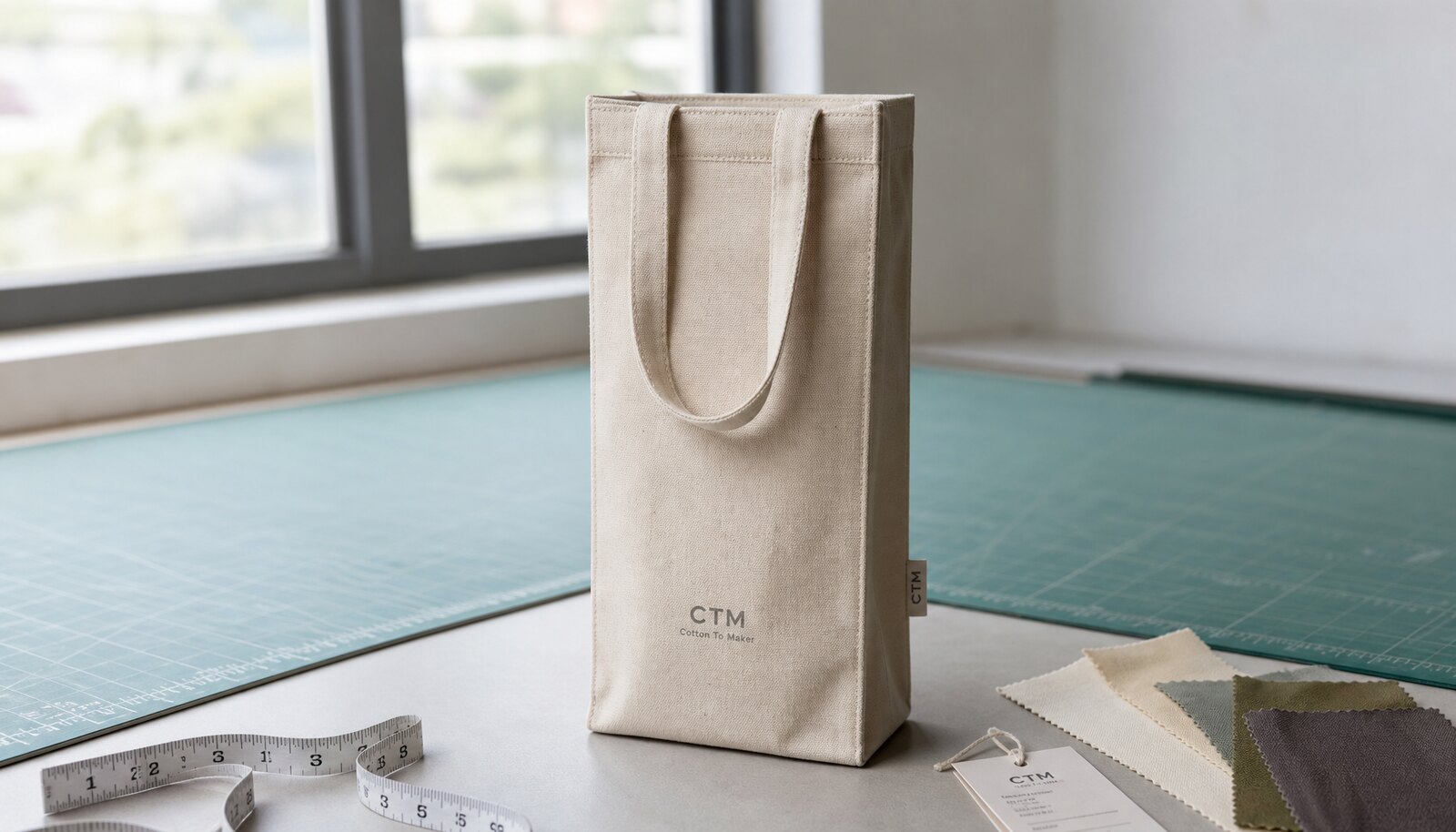
1. Start With the Bottle and the Launch Channel
Bottle gift bags fail when the bag is designed before the bottle is measured. A 750 ml wine bottle, a spirits bottle with a tall neck, and a cosmetic or oil bottle all create different fit problems. The useful starting point is the real bottle, including closure height, shoulder width, and any label or embossing that adds bulk. For most single-bottle launch programs, the bag should allow enough room for the product to slide in without forcing the seam open, while still keeping the bottle upright and visually centered when handed over at retail or an event.
The sales channel matters just as much as the bottle. A bag for a retail gift set needs cleaner stitching, better print registration, and a more structured presentation than a simple giveaway bag for an expo. If the bag is going into a mailer or a secondary gift box, flatness and carton efficiency matter more than shelf display. For a launch, buyers usually want enough perceived value to support the brand story without moving into the cost range of a rigid box. That is why bottle gift bags sit in the middle: better than plain wrapping, cheaper and faster than hard packaging, and easier to reorder across markets.
- Use the actual bottle sample, not a drawing, to set bag width and height.
- Allow extra room for a cork, cap, or stopper if the bottle neck is tall.
- Decide whether the bag is for hand gifting, retail display, or shipping inside another pack.
- If the bag must carry more than one bottle, the seam placement and bottom construction need a separate spec.
2. Choose Fabric Weight and Construction First
For bottle gift bags, fabric weight is a real commercial decision, not a decorative one. Cotton canvas in the 6 oz to 10 oz range, roughly 170 to 340 GSM depending on weave and finish, is a common starting point for a single-bottle bag. Lighter cotton can work for low-cost launches or slim bottles, but the bag may collapse visually and show print show-through. Heavier canvas gives a better premium feel, holds shape, and tolerates repeated handling, but it increases unit cost and carton weight. If the brand wants a more natural look, unbleached cotton or jute can work, but the surface texture should be checked against the logo detail before committing.
Construction drives performance as much as fabric weight. A top hem that is too narrow can distort the drawstring channel. Side seams need enough allowance to avoid tearing when the bottle is inserted or removed repeatedly. For a 750 ml bottle, a bag around 120 to 140 mm wide and 340 to 400 mm high is common, but the exact size should come from the bottle diameter and the finish desired on shelf. If the bag is meant to be reused, add reinforcement at the base and choose a tighter weave. For a one-time launch handout, a simpler construction can save cost, but the buyer should be clear that the bag is not being sold as a long-life accessory.
- Use around 170 to 220 GSM for lighter launch programs and 240 to 340 GSM for a more premium feel.
- Select a tighter weave if the logo includes thin type or small line work.
- Specify seam allowance and hem depth so the factory does not optimize away strength.
- If the bottle is narrow and tall, ask for extra height rather than a looser width that looks baggy.
3. Pick the Branding Method Around the Artwork, Not the Other Way Round
The best print method depends on how the brand mark behaves on fabric. For most bottle gift bags, one-color screen print is the most reliable option because it is cost-effective, durable, and easy to reproduce at scale. If the logo uses fine type, gradients, or several colors, heat transfer can carry more detail, but the handfeel may be less natural and the finish can look more promotional than premium. Woven labels, sewn patches, or embroidery work well when the brand wants a tactile finish and the logo area is small, but these methods need more setup and can add cost quickly.
The print area should be sized from the front panel, not from the artwork file. Buyers often send a logo that looks fine on a screen but becomes too small once the seam allowance and top hem are accounted for. A practical way to brief the supplier is to define the maximum print width, the allowable placement offset, and the acceptable color range under daylight. For launch packaging, a clean one-color mark placed high on the body often performs better than a crowded design. It reads faster in hand, costs less to sample, and gives the brand a usable template for future orders without reworking the bag structure.
- Screen print is usually the safest default for a single-color launch logo.
- Heat transfer suits fine detail but needs testing for adhesion and finish quality.
- Embroidery or sewn labels work best when the logo area is small and premium.
- Lock the print placement to the approved sample so bulk production does not drift.
4. Compare Supplier Routes Before You Ask for a Quote
The supplier route changes the whole project. A direct factory is usually the best option when the bag needs custom sizing, a stable fabric spec, and repeat production after the launch. The factory can control weave, stitching, print setup, and packing more tightly, which matters when a brand wants the same look across multiple markets. A trading company can be useful when the buyer needs one contact for several bag types or wants easier coordination across mixed packaging items, but the buyer should be alert to factory switching and less direct control over workmanship.
Stock-plus-print routes are attractive when the launch date is close and the bag is simple. They reduce development time because the base item already exists, but the dimensions may not suit the bottle perfectly and the visual result can look generic. Local decoration is useful when volume is low or freight costs are high, especially if the bags are imported blank and finished near the market. For larger launch programs, a hybrid approach can work: import the blank bag from a factory with good sewing quality, then add final campaign decoration locally if artwork changes often. The right route is the one that gives you the fewest hidden compromises on fit, print quality, and schedule.
- Use a direct factory when dimensions, GSM, and stitching need strict control.
- Use a trading company when you need mixed packaging items under one purchase order.
- Use stock plus print only when the base bag already fits the bottle well.
- Use local decoration when freight, duty, or campaign changes make import finishing inefficient.
5. Make the Quote Comparable, Not Just Cheap
A useful quote for bottle gift bags should be broken into pieces. The buyer needs to see the base bag cost, the print setup or plate cost, any extra charge for more colors, sample fees, packing charges, and the freight basis. If the supplier gives only one unit price, the comparison is weak because the lowest number may hide expensive setup charges or unlisted packaging extras. For launch orders, ask for tiered pricing at realistic quantities such as 1,000, 3,000, and 5,000 pieces, because the fabric consumption and sewing efficiency usually change as the run gets larger.
MOQs are often driven by three different constraints: fabric minimums, print setup, and line efficiency. A factory may accept a small order for a plain bag but require a much higher MOQ once a custom print screen or woven label is added. Buyers should not negotiate MOQ only on the final unit price; that usually leads to a weak sample stage or a rushed bulk run. A better approach is to ask the supplier which cost element is locking the MOQ and whether color variants can share the same base fabric order. That gives you a real lever. Sometimes the right answer is to reduce the number of print colors, not to force the factory into a number it cannot produce efficiently.
- Request pricing at three quantity tiers so you can see where the curve flattens.
- Separate bag cost, print cost, packing cost, and freight basis in the quote.
- Identify which part of the MOQ comes from fabric, print setup, or sewing efficiency.
- If the quote is a single number, treat it as incomplete until the exclusions are listed.
6. Approve the Sample for Fit, Finish, and Brand Accuracy
The sample stage should prove the bag can hold the bottle without looking stretched, skewed, or underbuilt. Put the actual bottle in the prototype and check whether the shoulder sits cleanly, whether the drawstring or opening closes evenly, and whether the bag still looks presentable when lifted by the top edge. A sample that fits in the hand but looks tight in the base is not ready for bulk. If the bag is intended as a gift, the first impression matters as much as the technical fit, so the sample should be evaluated under the same lighting and handling conditions the end customer will see.
Brand approval should include the print and the physical bag at the same time. Many problems show up only when the artwork is placed on the actual cloth grain, especially with natural cotton or jute. Check logo placement, color, edges, and any distortion caused by the seam. The most useful approval method is a sealed reference sample or signed golden sample that the factory must match in bulk. That reference should include the acceptable tolerances for print position, seam quality, and fabric shade. Once bulk starts, changes are expensive and usually compromise the schedule, so the approval stage is the place to make the hard decisions.
- Test the bag with the real bottle and the real closure, not a blank sample bottle.
- Approve a golden sample that combines fabric, construction, and print.
- Look for print distortion at seams and around curved bottle shoulders.
- Treat a sample that passes visually but fails fit as a rejected sample, not a soft approval.
7. Write Packing Requirements That Protect the Order
Packing is where a lot of launch orders lose money. Bottle gift bags are not fragile like glass, but they can still arrive creased, dusty, or miscounted if the packing method is loose. For export orders, the normal pattern is a flat-fold bag in a polybag or tied bundle, packed into a 5-ply or stronger master carton. The buyer should define how many pieces go into each inner pack, whether a desiccant is required, and whether the carton must carry a barcode, SKU label, or destination mark. These details matter when the bags are handed to a co-packer or warehouse that expects a clean receiving process.
If the bag has a printed surface, packing pressure can damage the finish before the product ever reaches the store. Overstuffed cartons crush the print area and create fold lines that are hard to remove. Underfilled cartons waste freight and increase the chance of transit damage because the contents shift around. For launch programs with several bottle sizes or market-specific graphics, separate carton markings help prevent mis-shipments. The best packing spec is simple enough for the factory to follow without interpretation and specific enough that the receiving team does not have to re-count or sort the product on arrival.
- Define inner pack count, master carton count, and carton strength before bulk starts.
- Use flat folding if the bag can recover without damaging the print or seam shape.
- Add desiccant for humid routes or natural-fiber bags stored in damp warehouses.
- Require clear SKU marks on cartons when multiple launch versions are packed together.
8. Build the Lead Time Around the Real Risk, Not the Promise
A realistic lead time for custom bottle gift bags depends on fabric availability, print method, and how fast the artwork is approved. A simple stock bag with a one-color logo may move quickly, while a custom cotton bag with dyed fabric, woven label, or embroidery can take much longer. The schedule usually has four steps: sample approval, fabric or trim sourcing, bulk production, and packing. If any one of those steps slips, the whole launch date moves. Buyers should ask the factory for a timeline that separates each stage instead of accepting one total number without context.
The biggest schedule risks are easy to name. Artwork revisions after sample signoff, fabric shade mismatch, and late approval of print placement all create avoidable delays. Peak season also matters because sewing capacity and carton supply tighten at the same time. A launch order should carry a buffer, especially if the product is tied to a trade show, retail window, or distributor rollout. If the order is critical to a campaign, ask the supplier where the bottleneck normally appears. A factory that understands its own constraints will tell you whether the risk sits in weaving, printing, sewing, or packing. That answer is more valuable than a confident delivery promise.
- Separate sample time, bulk time, and packing time in the schedule.
- Build a buffer for artwork changes, shade approval, or supplier congestion.
- Treat custom dyeing, embroidery, and woven labels as longer lead-time items.
- Ask which process step is most likely to slow the order before you commit the launch date.
9. Compare Landed Cost Before You Lock the Launch Format
The lowest factory price is not always the lowest landed cost. Bottle gift bags are usually low in unit weight, but a premium fabric, tight packing, or oversized carton can increase shipping cost more than expected. Buyers should compare the price at the factory gate, the carton volume, the print setup, the expected duty, and the destination handling cost before choosing the final format. A slightly higher unit price can still win if it reduces carton size, lowers damage, or removes a local finishing step. This is especially important for launch programs where margins are already committed to the bottle itself and the bag is there to improve presentation, not to carry the margin.
A practical way to compare options is to model three scenarios: a direct factory bag with full print, a blank imported bag with local branding, and a stock bag with minimal customization. Each scenario changes freight, setup cost, and schedule risk. For a single launch, the cheapest route may be the one that reduces coordination rather than the one that saves a few cents per piece. For repeat launches, the best route is often the one that gives stable artwork and a repeatable spec. The buyer should optimize for the total program cost, not the line item that looks lowest on a quote sheet.
- Compare factory price, freight volume, duty, and destination handling together.
- Use a landed-cost model when the launch bag will be reordered or sold across markets.
- Do not overpay for a decorative finish that does not improve the buyer experience.
- Choose the route that lowers rework and reordering, not only the printed unit price.
Specification comparison for buyers
| Spec decision | Recommended option | When it fits | Buyer risk to check |
|---|---|---|---|
| Direct factory sourcing | Use a factory that cuts, prints, and sews in-house | You need control over GSM, sizing, print registration, and repeat orders | Confirm the factory is not outsourcing sewing or changing materials between samples and bulk |
| Trading company route | Use when you want one contact for several bag styles or mixed SKUs | You are buying launch packaging across multiple items and need consolidation | Check whether the quoted factory is stable or only a temporary source for the order |
| Stock bag plus print | Start with an existing blank bottle bag and add one-color branding | You have a fixed launch date and a simple logo application | Stock dimensions may fit the bottle poorly or look generic on shelf |
| Local decorating partner | Print or embroider locally on imported blanks | Your volume is small or your market is close to the warehouse | Unit cost can rise fast once freight, decoration, and local handling are added |
| Hybrid sourcing | Import blank bags and finish branding at destination | Artwork changes often or different markets need different campaign names | Color match and print adhesion must be controlled across two vendors |
| Cotton canvas specialist | Choose a bag maker with strong sewing and textile control | You want a premium launch gift with good handfeel and durability | Fine logo detail can suffer if the fabric texture is too open or rough |
| Jute or natural-fiber specialist | Use for rustic, premium, or eco-positioned bottle gifting | The brand wants a textured, natural look on wine or spirit bottles | Surface inconsistency can affect print clarity and seam appearance |
| Integrated packaging supplier | Buy bag, label, insert, and outer carton from one source | The launch kit must arrive aligned in size, branding, and packing format | A packaging-led supplier may not have the same sewing discipline as a bag factory |
Buyer checklist before sampling
- Bottle size is fixed in writing: diameter, overall height, closure height, and whether the bag must fit a cork, cap, or stopper.
- Target fabric is stated in GSM or oz, with the acceptable range and whether the material is bleached, dyed, or natural.
- Print method is selected by artwork complexity, with the number of colors, print area, and logo placement approved before sampling.
- MOQ is tied to material and print setup, not just a single headline number, so the quote can be compared fairly.
- Sample approval covers fit, stitching, print color, logo position, shrinkage, and handfeel before bulk production starts.
- Packing requirements are written down, including polybag use, carton qty, carton test strength, and shipping marks.
- Lead time includes sample, bulk, inspection, and packing, with a buffer for artwork changes or fabric delays.
- The quote breaks out unit price, setup fee, sample fee, packing extras, and freight basis such as EXW, FOB, or DDP.
Factory quote questions to send
- What bottle dimensions did you use to set the bag size, and what fit allowance did you build in?
- What is the exact fabric spec, including GSM, weave or construction, color base, and shrinkage expectation?
- Which print method are you quoting, what is the maximum logo size, and how many colors are included in the base price?
- Is the MOQ driven by fabric order, print screen setup, or sewing line efficiency, and can mixed colors share one run?
- What sample stages are included, and do you provide a pre-production sample before bulk cutting starts?
- How are the bags packed for export, how many pieces per inner pack and carton, and are cartons drop-tested?
- What is the full production lead time from artwork approval, and what events could add days to the schedule?
- Which costs are excluded from the quote, such as plates, screens, color matching, cartons, labels, or destination delivery?
Quality-control points to confirm
- Measure the finished internal width and height against the approved spec, with a practical tolerance of plus or minus 5 mm unless the style is highly structured.
- Fit-check the bottle with its closure installed, not just an empty bottle, to confirm headroom and neck clearance.
- Inspect stitch quality for skipped stitches, loose thread tails, and seam puckering at stress points like side seams and hem folds.
- Verify print position, ink density, and edge sharpness using the approved sample as the reference, not a screen preview.
- Check color against the approved fabric strike-off or lab dip under daylight and warehouse light, since natural fibers can shift visually.
- Review odor, dust, and surface contamination before packing, especially for natural cotton, jute, or bags stored in humid conditions.
- Confirm shrinkage after a wash or steam test if the bag will be handled repeatedly or packed with a tight fit.
- Inspect carton count, inner pack configuration, and shipping marks so the warehouse receives the same count the factory packed.