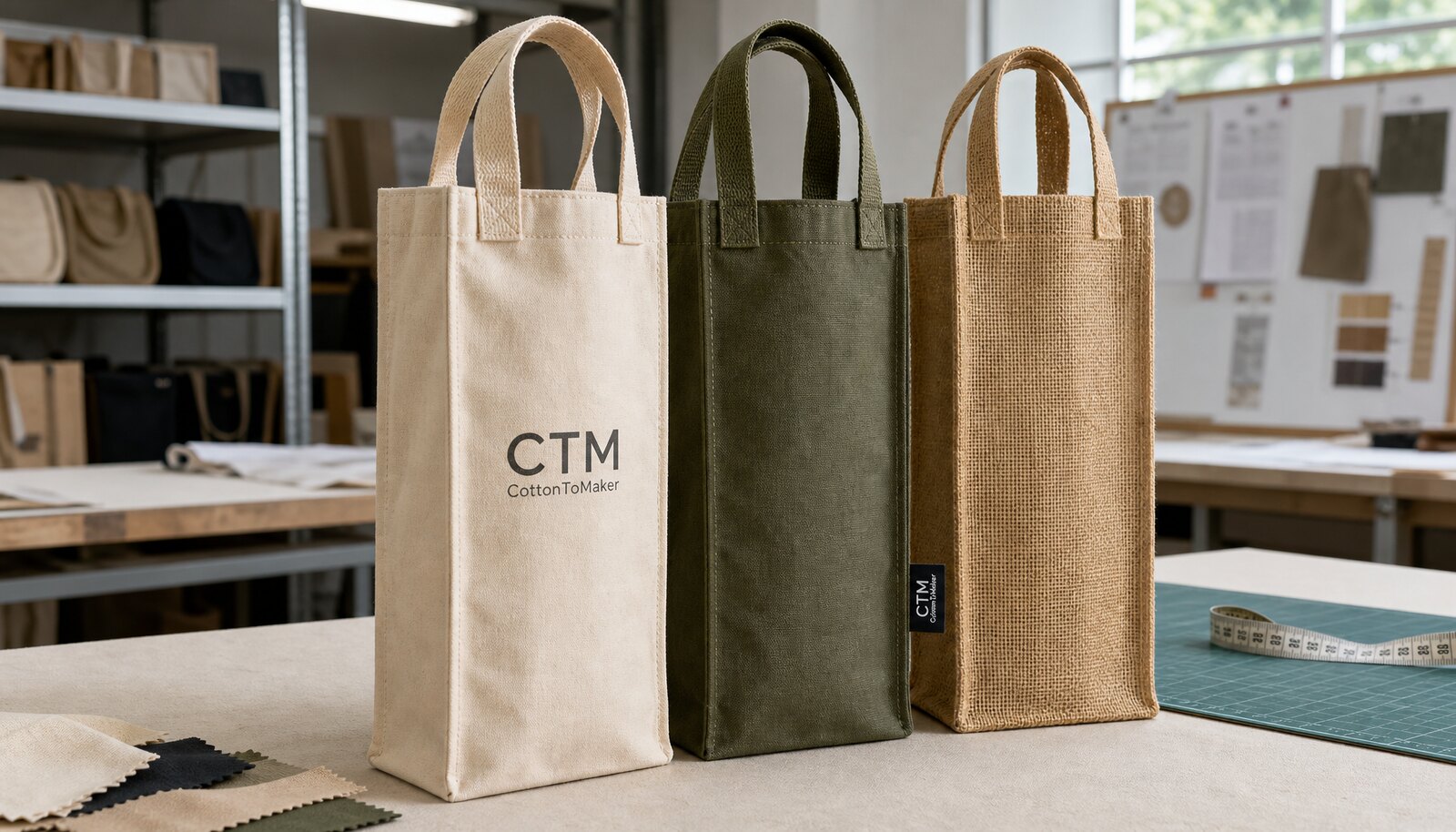
Why bottle gift bags are a different sourcing job
Bottle gift bags look straightforward until the first pre-production sample arrives with a narrow throat, weak handle joins, or a base that leans once a glass bottle is inserted. Buyers often source them like ordinary small totes, but a bottle bag has a different load path. The dimensions, seam structure, neck opening, and decoration area all work together. If one element is off, the bag may still look acceptable empty but fail the moment a full bottle goes into it.
For procurement teams, the real job is not simply finding a low unit price. It is matching the bag to the bottle, the brand story, and the fulfillment route. A strong RFQ should tell the factory what bottle shape it must fit, how the handles should be reinforced, whether the bag will be flat-packed or retail-packed, and what decoration methods are allowed. That information is what separates a usable quote from a placeholder price. In practice, bottle gift bags are a patterning and packing problem as much as a print or fabric problem.
The sourcing decision is also commercial. A light promo bag may be acceptable if it will move through a campaign quickly and never re-enter inventory. A reusable retail bag needs stronger sewing, cleaner finishing, and more consistent fit. Buyers who define the end use upfront usually get better quotes because the supplier can choose the right fabric body, stitch density, and pack method instead of guessing. That reduces sample churn and keeps landed cost more predictable.
- A bottle bag that looks right empty can still fail once a filled bottle is inserted.
- Most issues come from poor fit, weak handles, or decoration placed on a narrow panel.
- The best RFQ starts with bottle dimensions, target fabric weight, reinforcement method, and packing format.
Start with the bottle, not the bag
The first sourcing decision is the bottle itself: standard wine, champagne, spirits, olive oil, or a bundled gift set. A narrow 750 ml wine bottle behaves differently from a wider sparkling bottle or a square decanter. If the bag is intended for retail shelves, the bottle should slide in with enough clearance to avoid scuffing labels, but not so much slack that the bottle swings, tilts, or collapses the bag visually. That balance is the core of bottle gift bags specification.
A useful spec sheet should include bottle height, shoulder width, body diameter, neck diameter, and whether the bag needs to fit with a cork protector, foil capsule, topper, or insert card. The factory should build the pattern around an actual bottle sample or a controlled dimension set. If you leave this vague, the supplier will usually default to its stock pattern and you may receive a bag that is too tall, too short, too loose at the base, or too tight at the neck. A few millimeters matter more here than in general tote sourcing.
For procurement, the best practice is to define the fit function in plain terms. Is the bag meant to hold the bottle upright on a table, protect it during gifting, or act as a retail carrier with repeated use? If the answer is “all of the above,” the bag must be engineered more carefully. In that case, ask the supplier to disclose the pattern basis: bottle sample, CAD pattern, or a stock tote adapted for bottle use. That one question often reveals whether the factory truly understands bottle packaging or is just quoting from a generic template.
- Provide bottle dimensions in millimeters, not only volume.
- State whether the bag should fit single-bottle retail display or gifting with filler.
- If the bottle has a special closure or wide shoulder, share a sample, die-line, or dimensioned photo.
Material choices that change value, durability, and freight
For many branded bottle gift bags, cotton canvas sits in the practical middle between cost and presentation. A range of 240-280 gsm is common for reusable gifting, while 10-14 oz natural canvas is often selected for a sturdier hand feel and better load resistance. That said, the right weight depends on how often the bag will be reused, whether the bottle is standard or heavy, and whether the brand wants a soft natural look or a firmer retail silhouette. Lightweight cotton can work, but it should be treated as a gift accessory rather than a durable carrier.
Jute gives a rustic look and a high perceived gift value, but it also brings tradeoffs: rougher hand feel, more lint, more dimensional variation, and a greater chance of label abrasion if the interior is unlined. Buyers often underestimate this. A premium bottle label can be rubbed during insertion if the inside seam tape is coarse or the raw jute edge is exposed. For that reason, many retail buyers prefer a lined, bound, or taped interior when the bottle is high-value or the bag is displayed next to polished packaging.
Nonwoven can be useful for promotions, but it is usually the least forgiving material for bottle weight, seam quality, and brand presentation. It may lower unit price, yet it also raises the risk of a floppy bag, printed distortion, and a short useful life. If you use nonwoven bottle gift bags, ask for a clear load rating and inspect bottom seam strength carefully. A cheap bag that fails on arrival has a much higher true landed cost than a midweight canvas option that ships safely and avoids complaints.
- Cotton canvas: better print clarity, softer hand feel, easier retail branding.
- Jute: stronger rustic positioning, but requires careful edge finishing and interior protection.
- Nonwoven: lowest cost, but only for short promotional use with controlled bottle weight.
Spec the construction: seams, handles, and reinforcement
Construction details decide whether bottle gift bags feel solid or flimsy. The most important issue is not just the fabric body; it is the load-bearing construction at the handle joins, side seams, and bottom seam. On bottle bags, the weight is concentrated lower and closer to the centerline than on a general tote, so a pattern that is fine for folded apparel can fail when it carries glass. Ask the supplier to state the seam allowance, thread type, and reinforcement method in the quote, not only the finished size.
As a buyer, you should also ask for the exact stitch structure. For example, a higher stitch density around the handle attachment, bar tacks at stress points, or a box-X reinforcement can make a noticeable difference on heavier bottle formats. A simple single-line stitch may be acceptable for light promo use, but reusable retail bags typically benefit from double stitching or reinforcements at the top load points. If the supplier cannot specify stitch count or reinforcement type, the quote is too vague for meaningful comparison.
Handle style matters as well. Flat handles are common when the bag is meant to feel like a compact gift item, while rope handles, webbing handles, and fabric self-fabric loops each create different cost and comfort profiles. A narrow self-fabric loop may look neat but can cut into the hand if the bottle is heavy. Rope handles often improve comfort and perceived value, but they add material and labor cost. Webbing handles can be a strong middle ground if the buyer wants durability without a premium embroidery package. For procurement, the key is to match the handle style to the bottle weight and the expected retail price point.
- Ask for seam allowance, stitch type, and reinforcement method in the quote.
- Request the handle attachment style: self-fabric loop, webbing, rope, or reinforced tape.
- For heavier bottles, require bar tack or box-X reinforcement at stress points.
- Check whether the bottom is single-layer, double-layer, or reinforced with interfacing.
Comparison table: choosing the right bottle gift bag construction
The table below is meant to help buyers compare tradeoffs by use case, not just by material name. In bottle gift bags sourcing, the cheapest option is often the most expensive after freight, scrap, or returns. Read the cost, weight, and lead-time implications together so the quote reflects the actual commercial outcome.
If two suppliers look similar on unit price, compare construction depth: stitch density, reinforcement, pattern method, and packing labor. Those details often explain why one supplier delivers stable production while another sends samples that look fine but fail in use.
- Use this matrix as a shortlist filter, not as a final technical spec.
- Ask suppliers to quote the same pattern basis and packing format before comparing unit price.
- Treat any quote that omits reinforcement or pack labor as incomplete.
Print methods and what they really cost
On bottle gift bags, decoration is constrained by the available panel width and the curvature near the bottle shoulder. A logo that works well on a tote can look crowded on a narrow bag, especially if it sits too close to the top seam or side stitch. That is why the print method is a sourcing decision, not just a branding choice. The decoration has to survive folding, handling, and in some cases repeated reuse.
For most bulk runs, one- or two-color screen print remains the most practical option. It usually gives the best balance of cost, clarity, and repeatability. It also lets procurement compare suppliers more cleanly because the setup is easy to separate from the body cost. However, buyers should still ask whether the ink is water-based, plastisol, or another system, because print hand feel, opacity, and crack resistance differ. A print that looks sharp on day one can still fail after repeated fold cycles if the ink is too stiff for the fabric weight.
Premium branding methods can work well when the bag itself is part of the gift. Woven labels, stitched patches, embroidery, and small leatherette tags can elevate presentation without covering the fabric surface. The tradeoff is labor and lead time. Embroidery needs enough fabric body to avoid puckering, and fine-gauge or thin fabrics can distort around dense stitching. Woven labels are often the cleanest option when the buyer wants repeatable branding and low risk of print cracking. If the supplier suggests a decorative option, ask for a cost split that shows the base bag, decoration labor, and any tooling separately. That is the only way to understand the true delta.
- Screen print: best for bold logos and repeatable bulk runs.
- Woven label: useful when the fabric surface should stay clean or minimal.
- Embroidery: premium look, but needs enough fabric body to prevent distortion.
- Sewn patch or leatherette tag: good for branding without heavy ink coverage.
- Ask for decoration placement tolerance and fold-test durability before approval.
MOQ logic and quote structure buyers should insist on
Bottle gift bags often hide their MOQ penalty in setup costs. The factory may quote a low body price, then add screens, label setup, embroidery file preparation, carton printing, or special packing labor. If you split the order into multiple colorways or multiple bottle sizes, the unit cost can rise quickly because each variation needs its own setup and QC attention. For that reason, the first order should usually be kept tight: one bag size, one or two colors, one decoration location, and one packing standard.
A clean RFQ should ask for the base price, decoration price, and packing price separately. This is not just good procurement discipline; it exposes whether the factory is truly manufacturing the product or simply blending everything into a single lump sum. If a supplier will not separate these items, ask again. You need to know the exact cost of fabric, thread, print, label, labor, carton, and internal packing because freight and landed cost are affected by more than the unit price. For bottle gift bags, packing labor can be a bigger issue than many buyers expect, especially if the product is retail-folded or packed with inserts.
The right MOQ question is not only 'what is your minimum?' but 'what is the minimum by color, by decoration, and by pack format?' A supplier may be flexible on total quantity but strict on variation. That matters if your product team wants a seasonal color range or localized market launch. Ask for two lower breakpoints below your target quantity so you can see how the price moves. This helps you decide whether to consolidate the PO or phase the order in a way that protects cash flow and inventory risk.
- Ask for pricing at your target quantity plus two lower breakpoints.
- Separate body cost from print, label, packing, and setup cost.
- Clarify whether MOQ is by color, by artwork, by material, or by total order.
- Request exact packing labor charges if the bags are retail-folded or paired with inserts.
Sample approval: what to test before you release bulk
A pre-production sample should not just look good on the table. It needs to be tested with the actual bottle, the intended insert if any, and the final folding method. The neck opening should not snag, the bottle should sit upright, and the handles or carrier loop should not feel fragile when the bag is lifted. If the bag will be sold as a gift item, the sample should also be reviewed with any card, swing tag, tissue, or inner wrap that will ship with it. Otherwise, the approved sample may not represent the real packed unit.
Measure the sample after pressing, folding, and inserting a bottle because some fabrics relax or distort after handling. Print placement must be checked against the center line and top edge. On a narrow bag, a small error is visible immediately. If the sample shows loose threads, crooked seams, uneven handle lengths, or an off-center logo, do not assume bulk will improve. Bulk production usually repeats the same weakness unless the factory changes the pattern or sewing method.
A good sample review should be written down in simple, measurable terms. Note the finished dimensions, bottle fit, handle drop, reinforcement type, print size, and carton pack. If you expect a certain retail look, take sample photos from the same angles every time: front, side, top opening, seam close-up, and packed carton. That creates a clean approval record and makes it easier to hold the factory to the approved version if issues appear later.
- Test with the actual bottle weight and shape.
- Measure finished dimensions after pressing and packing, not only flat on the table.
- Review print alignment, seam quality, and handle balance before approval.
- Capture photos of the approved sample from standard angles for later QC comparison.
Packing choices and carton data that affect freight
Packing affects both damage rate and freight cost. Flat-packed bulk cartons are usually the most efficient for importers because they reduce carton volume and make warehouse receiving easier. But the factory must fold the bag consistently, or the front decoration may crease in a way that hurts retail presentation. Individually packed retail units make sense when the bag is sold as a standalone gift item, yet this usually increases labor, material cost, and carton volume. For bottle gift bags, even a small change in fold method can alter how many pieces fit in a carton and how much air you pay to ship.
The quote should show carton size, carton count, net weight, gross weight, and pack count for each packing option. That information is needed to estimate freight accurately and to avoid surprises when the shipment is booked. If your bag includes a hanging loop, side label, or insert card, ask how it will be positioned in the carton so it does not press into the print area during transit. Also confirm whether the carton is export-grade corrugated board, whether corner protection is used, and whether the master carton has a clear size and SKU marking system for warehouse receiving.
For cost comparison, it helps to ask for two versions of the same quote: one with flat bulk packing and one with retail packing. That lets you see the incremental labor and volume increase clearly. In many cases, the retail pack looks attractive on paper but adds hidden freight and fulfillment cost that outweigh the shelf benefit. For warehouse teams, bulk-packed bottle gift bags are easier to count, inspect, and store. For premium gifting programs, the retail pack may still be justified, but the cost delta should be explicit rather than assumed.
- Use flat pack for wholesale and warehouse distribution whenever possible.
- Use retail pack only when shelf presentation justifies the extra cost.
- Confirm carton marks, barcode placement, and master carton count before shipment.
- Ask for carton dimensions and gross weight for each pack option to estimate freight.
Lead time risks that slow bottle bag orders
Bottle gift bags are not usually long-cycle products, but lead time can still slip if the order includes custom labels, special dye lots, or artwork approvals that take too long. The biggest delay points are sample confirmation, material matching, and packing finalization. If the factory is waiting on a logo file, Pantone decision, or pack instruction, the order can stall before production begins. This is why a clean RFQ package matters: it reduces back-and-forth and helps the supplier reserve the right fabric, thread, and cartons earlier.
A realistic schedule should separate sample time from bulk lead time. Buyers often hear only the bulk window and forget the sample round plus material reservation. For seasonal promotions, the safe assumption is that any change after sample approval will cost time. If the bag uses a custom woven label or a special embroidery setup, expect a longer critical path because the decoration tool and the body production may not move in parallel. Even modest changes, like a different handle style or pack format, can push the schedule if they are decided late.
The most practical lead-time control is to freeze the spec before sampling. That means one bottle size, one reinforcement method, one decoration method, and one pack format. If the market team wants variations, phase them into later POs after the first style is validated. This approach may feel slower on paper, but it usually reduces total project delay because it avoids re-sampling and re-approving a product that has already been technically settled.
- Plan separate time for sample approval and bulk production.
- Reserve extra days for custom labels, color matching, or special packing.
- Avoid changing bottle dimensions, handle style, or packing format after sample approval.
- Freeze the spec before sample sign-off if the order is seasonal.
Specification comparison for buyers
| Spec decision | Recommended option | When it fits | Buyer risk to check | Cost / weight / lead-time tradeoff |
|---|---|---|---|---|
| Sourcing route | Direct factory with bottle-bag pattern experience | Best for branded runs where bottle fit, handle strength, and decoration placement matter | Confirm they have a dedicated bottle-bag pattern library, not just tote patterns resized for bottles | Usually best landed cost at scale; moderate sample time; lower rework risk if fit is proven |
| Material | 240-280 gsm cotton canvas or 10-14 oz natural canvas | Reusable retail gifting, hospitality, DTC wine accessories, and premium seasonal promotions | Check shrinkage, weave consistency, and whether fabric is pre-shrunk or only heat-set | Midweight freight; strong hand feel; slightly higher unit cost than thin cotton but fewer returns |
| Alternative material | 250-350 gsm jute with lining or binding | Rustic gifting, farm-to-table brands, and heavier perceived value | Check linting, odor, rough edges, and whether the bottle neck rubs through unlined interiors | Heavier and bulkier than cotton; often higher freight and more labor in finishing |
| Low-cost route | Nonwoven or thin cotton with simple screen print | Short promo campaigns or price-sensitive giveaways | Check load rating, bottom seam strength, and whether the bag twists under glass bottle weight | Lowest unit cost but higher failure risk; usually shorter lifecycle and weaker shelf presentation |
| Pattern method | Bottle-specific sample pattern with measured internal clearance | Any order where fit matters and bottle diameters vary by market | Ask for the actual pattern basis: bottle sample, CAD pattern, or manual grade rules | A better pattern reduces returns and sample iterations; small setup cost can save bulk waste |
| Print method | 1-2 color screen print or woven label | Best for clean logos, repeat orders, and stable artwork | Check print cracking after folding and whether ink blocks the fabric hand feel | Screen print is usually the best price-to-quality option; label adds cost but keeps hand feel cleaner |
| Premium branding | Embroidery, woven patch, or sewn-on leatherette tag | Gift sets and higher-margin retail packaging | Check added cost, needle distortion on thin fabrics, and embroidery density on narrow panels | Higher decoration cost and longer lead time; often worth it only when branding value is visible |
| Packing route | Flat-packed in bulk cartons with size labels and carton marks | Best for import efficiency and warehouse receiving | Check folding consistency and whether packed pieces create permanent creases in printed areas | Lowest freight volume and easier counting; labor-light if folding standard is clear |
| Quote structure | Separate line items for base bag, decoration, packing, and setup | Needed to compare true landed cost across suppliers | Check for hidden charges such as sample plates, color matching, woven label setup, and export carton upgrades | Most useful for procurement; exposes real cost drivers and makes supplier comparison cleaner |
Buyer checklist before sampling
- Confirm bottle size, bottle shape, and whether the bag must fit a corked wine bottle, champagne bottle, or narrow spirits bottle.
- Lock the target fabric weight, handle length, stitch count, and bottom construction before asking for a quote.
- Decide print method and artwork count: screen print, woven label, embroidery, patch, or no decoration.
- Request a sample against the actual bottle and packaging insert, not only a bag-only sample.
- Specify packing format, carton pack count, and any retail hangtag or barcode requirements.
- Ask for MOQ by color, by print, and by material so you can see the real setup penalty.
- Request carton dimensions and gross weight for each packing option to estimate freight accurately.
- Set acceptance criteria for seam strength, print placement tolerance, odor, size deviation, and color consistency.
- Ask whether fabric is pre-shrunk or finished only after weaving/knitting, and request the expected shrinkage range.
- Confirm whether the bag will be supplied with a hanging loop, side label, drawstring, gusset, or insert card.
Factory quote questions to send
- What bottle size, bottle diameter, and shoulder profile did you use to build the pattern, and can you share the finished internal dimensions in mm?
- Is the quoted fabric weight pre-shrunk, measured after finishing, or only mill nominal GSM/oz?
- What is included in the price: fabric, thread, print, label, carton, inner packing, and export mark?
- What is the MOQ by color, by print method, and by material, and what happens to unit price if we reduce quantity?
- Can you provide separate pricing for screen print, woven label, embroidery, patch, and no decoration?
- What seam allowance, bottom reinforcement, and handle attachment method are standard on this quote?
- How many stitches per inch or stitches per seam are used on the side seams and handle joins?
- Is the fabric pre-shrunk, washed, or heat-set, and what dimensional change should we expect after first use?
- Can you disclose the pattern method: bottle sample pattern, CAD grading, or stock tote adaptation?
- What reinforcement do you use at load points: bar tack, box-X, double stitch, binding tape, or interlining?
Quality-control points to confirm
- Finished size tolerance should be defined per bag type and applied to width, height, gusset depth, and neck opening; a practical starting point is ±5 mm for small bottle bags and ±8 mm for larger styles, unless the design is intentionally loose-fitting.
- Handle or loop stitching must be centered and symmetrical so the bag hangs upright; check handle drop consistency within ±3 mm and verify both handle lengths match within 2-3 mm.
- Use a real bottle-weight load test: for a standard 750 ml glass bottle, hold for 30-60 minutes and inspect for seam creep, handle stretch, or bottom sag; for heavier formats, specify the intended bottle weight and test above that target.
- Bottom seam must support the intended bottle weight without twisting or sagging; require double stitching or reinforced seam construction, and verify that the base remains flat after repeated insertion/removal.
- Decoration must stay within the agreed print boundary and not crowd the top seam or side stitch; typical print placement tolerance should be within ±3 mm on narrow panels and ±5 mm on wider panels.
- Bag should pass a real bottle fit test with no label abrasion during insertion and removal; the bottle should slide in without forcing, but should not rattle excessively inside the bag.
- Fabric and jute should be free of strong odor, excessive lint, oil spots, or visible contamination; set a reject rule for any smell that is clearly noticeable at arm’s length after unpacking.
- Carton packing must match the approved count and folded orientation; check that the fold line does not crease the print or deform the handle attachment.
- All loose threads should be trimmed before packing; long thread tails, skipped stitches, and needle marks around load points should be treated as defects, not cosmetic noise.
- Decoration durability should be checked after fold/unfold cycles: rub test the print, inspect for cracking after repeated flexing, and confirm that woven labels or patches do not lift at the edges.