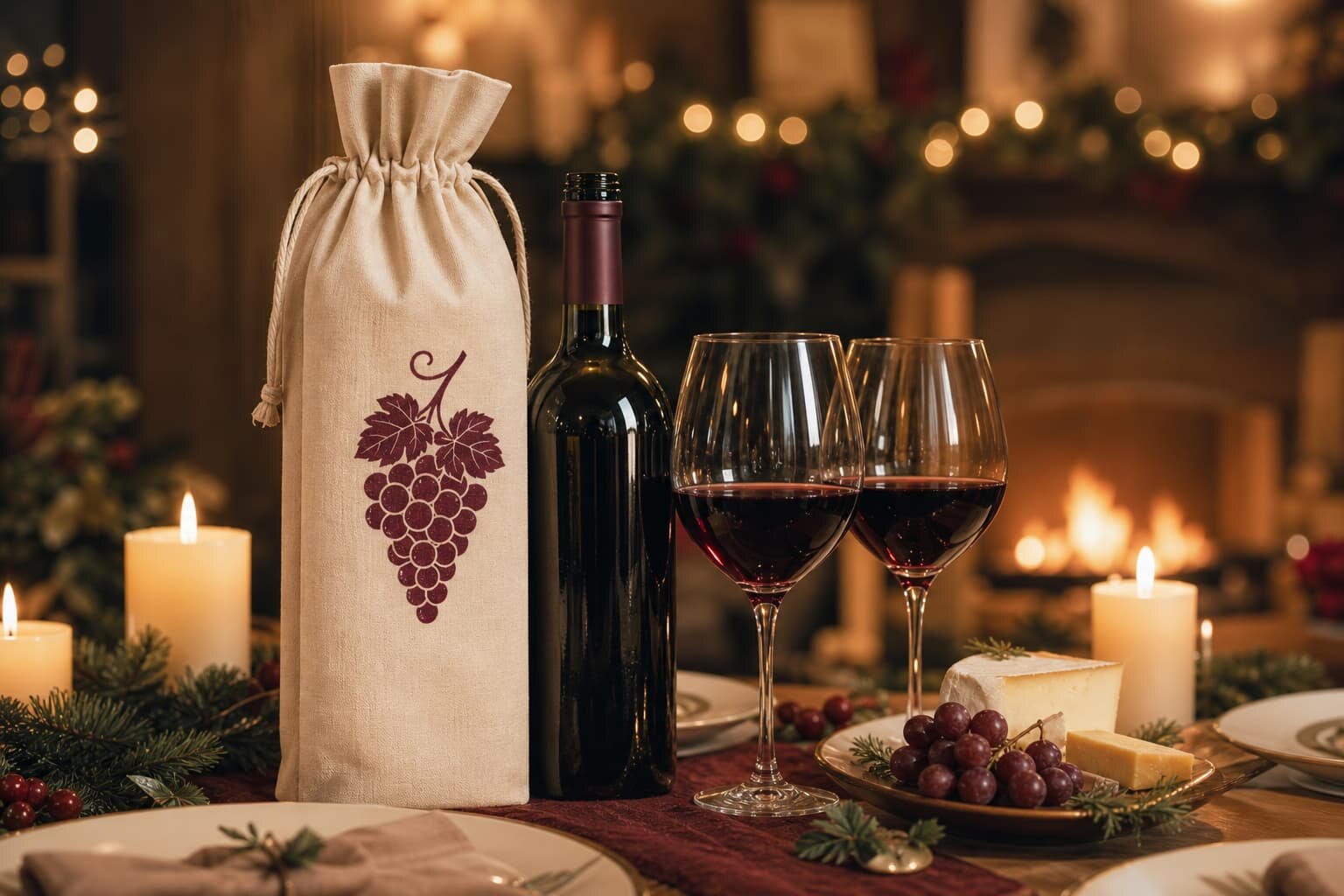
Why carton packing belongs in the first RFQ
Bottle gift bags look simple, but carton packing can decide whether the order arrives as presentable retail packaging or as a pile of creased fabric. Many RFQs describe fabric, logo, and quantity clearly, then leave packing as supplier standard. That creates a quoting gap. One factory may pack 200 light non-woven bags into a large carton. Another may pack 50 structured jute bags with dividers. The unit price comparison is not fair unless the packing method, carton size, gross weight, and CBM are visible.
For wine bags, packing is also linked to the buyer's sales channel. A distributor may accept flat bulk bundles if the bags are used for repacking in a warehouse. A retail chain may need each bag clean, flat, barcode-labeled, and easy to count at the distribution center. A gift program may need cartons sorted by color, logo version, and destination. If the carton plan is discussed after production, changes can cause repacking cost, label mistakes, shipment delay, or damaged print.
- Put carton packing requirements in the RFQ, not only in the purchase order.
- Ask suppliers to quote unit price together with carton quantity and CBM.
- Make packing approval part of the pre-production sample process.
- Compare suppliers on total receiving condition, not only ex-factory unit cost.
Start with the bottle, not the bag drawing
A bottle gift bag should be specified around the bottle it will carry. A standard 750 ml Bordeaux bottle is narrower than many Burgundy or Champagne bottles. Spirits bottles can be square, tall, or heavy. If the RFQ only says 10 x 35 cm or 15 x 40 cm, the factory may quote a bag that matches the drawing but is tight after sewing. A tight bag slows packing at the buyer's warehouse and can rub the bottle label during insertion.
For carton packing, the bottle type affects whether the bag must stand upright, fold flat, or keep a boxed shape. A gusseted cotton canvas bag for a premium wine bottle may need a wider base and stiffer fabric, so it cannot be compressed like a thin non-woven sleeve. A drawstring bottle pouch can be packed flatter, but the cord ends and knot position can create lumps that transfer pressure marks if cartons are overfilled.
- Send bottle height, base diameter, shoulder diameter, and filled weight.
- Confirm whether the bag carries one bottle, two bottles, or a bottle plus insert card.
- State whether bottles are inserted by the factory, by the buyer, or by a downstream packer.
- Allow practical clearance so the bottle can be inserted without stressing seams.
Fabric weight choices that affect packing and damage risk
Fabric GSM is not only a quality label; it changes how the bag folds, stacks, and survives compression. For cotton bottle bags, 220-280 GSM or roughly 10-12 oz canvas is a common range for reusable wine gifting. It gives better structure than thin cotton but still packs efficiently when folded. Below that range, the bag may feel promotional rather than retail. Above that range, the bag becomes bulkier and can increase carton CBM sharply.
Jute is often selected for a natural wine or hamper look, but it needs more packing control. A 260-320 GSM jute fabric can hold shape well, especially with lamination, but rough fibers can rub against neighboring bags. If the print sits on a textured surface, pressure during carton stacking may cause uneven contact. Non-woven PP at 80-120 GSM is easier for high-volume budgets, but it can crease permanently if cartons are overloaded or stored under weight.
- Use lighter cotton for drawstring bottle pouches and heavier canvas for handled retail bags.
- Use laminated jute when shape retention and moisture resistance matter, but check odor.
- Avoid over-specifying fabric weight if freight cost and carton storage are major constraints.
- Request a packed sample carton photo when using stiff fabric or bulky handles.
Print method decisions before stacking printed bags
Logo printing must be chosen with packing in mind. Screen print is usually efficient for solid one to three color logos on cotton, canvas, non-woven, and some jute surfaces. Heat transfer can handle gradients and small details, but buyers should check hand feel, edge adhesion, and performance after folding. Woven labels or sewn patches work well on rough jute or canvas when the logo needs a premium tactile finish, but they add sewing steps and can create raised pressure points in carton stacks.
The common production mistake is packing printed bags before the ink or transfer has fully cured. When bags are stacked face to face, ink can transfer, stick, or show gloss marks. This is more likely on dark fabric, large solid print areas, and humid production days. The RFQ should ask how long the supplier allows for curing and whether printed panels are separated or stacked with print-to-back contact during production.
- Define logo size and position tolerance, for example plus or minus 5 mm if acceptable.
- Ask for print rub testing on the actual fabric, not only on a smooth lab swatch.
- Avoid very fine lines on coarse jute unless the factory confirms print clarity.
- Confirm whether printed sides face inward, outward, or are protected during packing.
Inner packing options and when to use them
Inner packing protects cleanliness, counting accuracy, and presentation. For many bulk bottle bag orders, 25 or 50 pieces per inner polybag is practical. It keeps the carton organized and reduces dust exposure after the carton is opened. For retail-ready programs, each bag may need an individual OPP bag, recycled polybag, belly band, barcode sticker, or hangtag. These items sound small, but they affect labor time, material cost, carton volume, and inspection scope.
Buyers should avoid asking for unnecessary individual packing if the bags will be removed and filled in a warehouse immediately. It adds plastic waste and can slow operations. On the other hand, skipping inner bags for light-colored cotton or printed retail bags can lead to dust marks, moisture exposure, and receiving complaints. The best packing method depends on whether the bag goes directly to retail shelves, to a kitting line, or to a distributor's bulk storage.
- Use bulk inner bundles for warehouse filling and distributor handling.
- Use individual packing for retail shelves, online kits, or multi-location allocation.
- Use tissue or slip sheets only when print or fabric surface needs extra protection.
- Confirm suffocation warning requirements if individual polybags are used.
Export carton specification that makes quotes comparable
A useful bottle gift bag quote should include carton quantity, carton dimensions, gross weight, net weight, and estimated CBM per 1,000 pieces. Without this data, procurement cannot compare freight impact. A cheaper bag that packs poorly may cost more after ocean freight, air shipment, storage, and manual handling. For fabric bottle bags, a reasonable gross weight target is often below 16-18 kg per carton so cartons remain manageable and less likely to burst.
Carton strength should match the route. For full container shipments with stable pallets, a standard export carton may be enough. For LCL shipments, e-commerce replenishment, or mixed cargo, cartons can be stacked, turned, and pressed by other goods. In those cases, stronger cartons, better tape, corner protection, or smaller carton quantity may reduce damage. Buyers should also specify carton marks clearly so receiving teams can identify SKU, color, PO number, carton number, and quantity without opening every box.
- Ask for carton size in centimeters and inches if your logistics team uses both.
- Compare CBM per 1,000 pieces across suppliers before awarding the order.
- Avoid cartons that are too tall and loosely filled; they collapse more easily.
- Require carton marks to match the packing list and inspection report.
MOQ logic for bottle gift bags and packing materials
MOQ is not only about sewing capacity. For bottle gift bags, MOQ can be driven by fabric dyeing, stock fabric availability, print setup, handle material, label production, hangtags, and carton printing. A supplier may accept a lower MOQ if the buyer chooses natural cotton, black cotton, or stock jute. A custom dyed fabric or custom woven label usually raises the MOQ because the upstream mill or label supplier has its own minimum.
Packing materials also have MOQ. Custom printed inner bags, special size cartons, barcode labels, insert cards, and retail bands may each carry a minimum order. If the buyer plans multiple logo versions or colorways, the RFQ should ask whether MOQ applies per total order, per color, per artwork, or per packing style. This prevents a quote that looks acceptable at total quantity level but becomes difficult when divided into small SKU batches.
- Ask for MOQ per fabric color, per print design, and per bag size.
- Separate product MOQ from custom packing material MOQ.
- Use stock fabric and standard export cartons when testing a new campaign.
- Consolidate small color runs if custom labels or printed cartons are required.
Sample checks before approving bulk packing
A loose sample can pass approval while the packed product still fails in real handling. Buyers should request a pre-production sample that includes the final fabric, print, handle, label, drawstring, and proposed packing method. If individual polybags, barcode labels, or carton marks are part of the order, they should be shown before bulk production. This gives procurement, marketing, and warehouse teams a chance to catch practical problems before cartons are sealed.
The sample check should include bottle insertion and removal. Put the target bottle inside the bag, lift it by the handles, set it down, and check whether seams pull, the base distorts, or the drawstring closes properly. Then fold or pack the bag as the factory plans to pack it. Some bags look excellent when standing, but the handles create hard creases when folded into a tight carton. A small sample carton or packing simulation is worth requesting for structured jute and heavy canvas orders.
- Check finished measurements after sewing, not only flat fabric dimensions.
- Test the sample with the actual bottle weight and shape.
- Review the logo after folding and light rubbing.
- Approve a packing photo or video before the factory packs the full order.
Lead time planning for production and carton readiness
Lead time should be broken into stages: artwork confirmation, material sourcing, sample making, sample approval, bulk cutting, printing, sewing, trimming, QC, inner packing, export carton packing, and shipment handover. When a supplier gives one total number, ask what assumptions are included. A simple natural cotton bottle bag with one-color screen print may move quickly if fabric is in stock. A custom dyed jute bag with sewn labels, hangtags, and printed cartons needs more coordination.
Packing can become a bottleneck when there are many SKUs or retail labels. For example, six colors with two logo versions and destination-specific carton marks require careful sorting. If the final allocation list arrives late, the factory may finish sewing but wait to pack. Procurement teams should provide SKU codes, carton mark files, label files, and destination split early. This is especially important before seasonal gifting periods, wine festivals, holiday retail programs, or distributor launch dates.
- Request lead time by milestone instead of one vague production period.
- Provide final artwork and packing allocation before material cutting if possible.
- Allow extra time for custom labels, printed cartons, or multi-SKU sorting.
- Schedule final inspection after packing is complete but before shipment handover.
Quote data that separates a usable offer from a rough estimate
A practical quote for bottle gift bags should show more than unit price. It should state fabric type and GSM, finished size, handle type, print method, number of print positions, MOQ, sample cost if any, bulk lead time, packing method, carton quantity, carton dimensions, gross weight, and trade term. If the quote leaves these fields blank, procurement will spend time clarifying later and may discover that suppliers were not quoting the same product.
To compare offers fairly, create a simple cost view that includes product cost, print setup, label or tag cost, individual packing cost, carton packing cost, inspection cost if applicable, freight CBM, and risk of repacking. The lowest unit price is not always the lowest program cost. A slightly higher quote with correct carton weight, clean packing, and clear labeling may save labor at the destination and reduce complaints from retail or distributor teams.
- Ask suppliers to show all optional packing costs as separate lines.
- Request CBM per 1,000 pieces for freight comparison.
- Confirm whether sample cost is refundable or separate from bulk production.
- Check that the quoted Incoterm matches your logistics plan.
Specification comparison for buyers
| Spec decision | Recommended option | When it fits | Buyer risk to check |
|---|---|---|---|
| Main fabric for standard wine gifting | 10-12 oz cotton canvas or 220-280 GSM cotton | Brand gift sets, retail wine promotions, reusable bottle packaging | Confirm bag can stand with a 750 ml bottle and handles do not distort after packing |
| Main fabric for rustic or premium natural look | Jute 260-320 GSM with laminated or unlaminated finish | Wine shops, hamper suppliers, natural product brands | Jute fibers shed; request clean cutting, inside seam control, and odor check before carton packing |
| Budget event giveaway option | 80-120 GSM non-woven PP | Short campaign use, high-volume distributor packs, low unit cost orders | Heat-cut edges and handle strength vary; check loading test and print scuffing inside cartons |
| Logo print method | Screen print for 1-3 solid colors; heat transfer for gradients; woven label for textured jute | Most bottle bag RFQs where logo visibility and cost control both matter | Match print method to fabric texture; fine logo lines may break on jute or coarse canvas |
| Individual packing | Flat packed in OPP or recycled polybag, 25-50 pcs per inner bundle | Clean warehouse receiving, barcode application, retail allocation | Too tight polybags crease handles and transfer ink if bags are packed before curing |
| Export carton arrangement | Vertical or flat stack by bag structure, carton under 16-18 kg gross weight | LCL shipment, mixed SKU consolidation, distributor storage | Overweight cartons crush bottom bags and increase manual handling damage |
| Carton identification | SKU, PO, color, size, quantity, carton number, gross/net weight, carton dimensions | Multi-destination programs, retail DC receiving, importer inspection | Missing carton marks cause receiving delays and make AQL sampling harder |
Buyer checklist before sampling
- State the bottle type and dimensions, not only the bag size; include 750 ml Bordeaux, Burgundy, Champagne, spirits, or custom bottle if relevant.
- Confirm the finished bag internal size after sewing, not just the fabric cutting size.
- Specify fabric composition, GSM or ounce weight, color standard, handle material, and whether the bag must stand upright with a bottle inside.
- Define the print method, logo size, Pantone references, print position tolerance, and whether both sides or gussets need artwork.
- Request a packing layout showing pieces per polybag, pieces per carton, carton size, gross weight, and whether cartons need dividers.
- Set acceptance criteria for creasing, odor, print rubbing, loose threads, seam strength, handle pull, and carton compression.
- Ask for pre-production sample photos packed in the proposed inner bag and export carton, not only loose product photos.
- Confirm whether retail barcode labels, suffocation warnings, carton marks, and destination-specific labels are included in the quote.
- Check that lead time includes artwork approval, material booking, printing, sewing, final QC, packing, and export carton production.
- Compare quotes using landed packing efficiency: units per carton, CBM per 1,000 pcs, carton weight, and rework risk.
Factory quote questions to send
- What finished bag size do you recommend for our exact bottle dimensions, including seam allowance and easy insertion clearance?
- Which fabric GSM or ounce weight will prevent the bottle shape from showing too sharply while still folding cleanly into cartons?
- Can you quote screen print, heat transfer, and woven label options separately so we can compare logo durability and unit cost?
- What is your MOQ by fabric color, print design, and bag size, and does the MOQ change if we use stock fabric?
- How many pieces will be packed per inner polybag and per export carton, and what are the estimated carton dimensions and gross weight?
- Will bags be packed only after print curing, and what rub test or curing time do you use before stacking printed panels?
- Can you provide a photo or diagram of the carton packing method for approval before bulk packing starts?
- Are carton marks, retail labels, barcode stickers, care labels, hangtags, or insert cards included, or quoted as separate line items?
- What AQL standard do you use for final inspection, and which defects are considered critical for bottle gift bags?
- How many days are required for sample making, pre-production sample approval, bulk production, final inspection, and shipment handover?
Quality-control points to confirm
- Measure finished internal width, height, and gusset after sewing against the approved sample, especially for thicker bottles.
- Load test handles with the target bottle weight plus safety margin; check stitching holes, bartacks, and handle elongation.
- Inspect print adhesion after rubbing and folding, because bottle bags are often compressed in cartons before distribution.
- Check fabric GSM or ounce weight against the approved swatch and confirm color under normal daylight and warehouse lighting.
- Review inside seams for loose threads, fraying, jute shedding, exposed laminate, or sharp seam ends that can scratch labels.
- Confirm each bag is clean, dry, odor-controlled, and free from oil marks before inner packing.
- Verify inner polybag quantity, carton quantity, carton mark content, carton number sequence, and barcode readability.
- Perform carton drop or compression checks when cartons are heavy, tall, or shipped by LCL with mixed cargo.
- Open cartons from the top, middle, and bottom during inspection to check crushing, creasing, and print transfer.
- Compare final packed carton CBM with the quoted CBM before shipment booking.