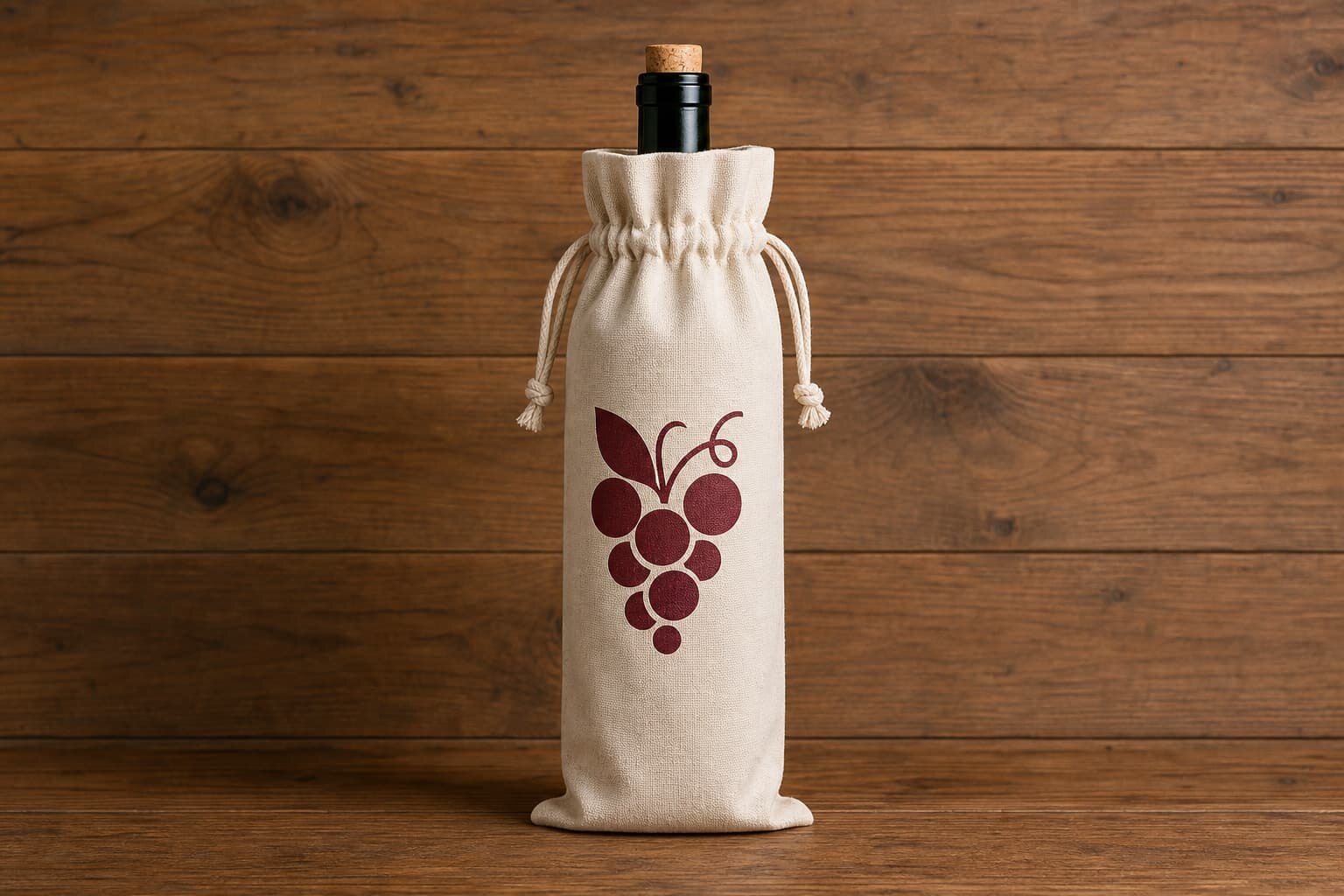
Why Print Proofing Decides the Order
For custom logo bottle bags, the proof is not a decoration formality. It is the buyer's control point before fabric cutting, printing setup, sewing, and packing become expensive to correct. A bottle bag has a narrow front panel, curved contents, stress at the handle or drawstring, and often a textured fabric surface. These details make logo proofing more sensitive than on a flat shopping tote.
The main buying problem is simple: the quote may look correct, but the bulk product can still arrive with the logo too low, too small, too close to the gusset, or printed in a color that does not match the brand guide. Procurement teams should use the proof stage to lock measurable acceptance criteria, not just to approve a pretty picture.
- Treat the proof as a production document, not a visual suggestion.
- Approve logo size in millimeters, not only as a percentage on a PDF.
- Confirm the proof on the same fabric weight and color as bulk production.
- Check the logo after a bottle is inserted because the front panel changes shape.
- Record print method, ink color, placement, and packing method in the final spec.
Start With the Bottle, Not the Artwork
A practical bottle bag custom logo print proof guide starts with the bottle size. Standard 750 ml wine bottles, tall Riesling bottles, champagne bottles, square spirits bottles, and olive oil bottles do not sit the same way inside a bag. If the bottle is wider or heavier than expected, the front panel curves more and the logo can stretch, tilt, or fall into the side fold.
When sending an RFQ, do not only request a bag size such as 15 x 35 cm. Tell the factory the bottle diameter, bottle height, filled weight, shoulder shape, and whether the bag must close at the top. If the same bag must fit several bottle types, ask for a fit range and decide which bottle will be used for proof approval.
- For standard wine: confirm whether the bag must cover only the bottle body or also allow drawstring closure above the neck.
- For champagne or sparkling wine: allow more width and gusset depth because the bottle base is larger.
- For spirits: check square or short bottle formats before accepting a narrow wine-bag pattern.
- For retail gifting: insert the actual bottle during sample review and photograph front, side, and filled profile.
- For freight planning: filled-bottle fit tests are separate from empty-bag carton packing tests.
Choose Fabric Weight Before Print Method
Fabric weight affects print clarity, bag structure, cost, and MOQ. Cotton bottle bags often use 6 oz, 8 oz, 10 oz, or 12 oz canvas. For most branded retail and promotional wine bags, 8 oz to 10 oz cotton canvas is a balanced range because the surface is printable while still folding and packing efficiently. A lighter 6 oz cotton bag can work for short-term giveaways, but it may wrinkle around the bottle and reduce logo sharpness.
Jute bottle bags are usually selected for natural texture and gifting value, but the open weave can break fine logo lines. A 280-350 GSM jute fabric is common for bottle packaging, with laminated jute offering more body and moisture resistance. However, lamination changes surface behavior. Screen ink, transfer adhesive, and curing conditions should be tested on the real laminated or unlaminated material before approving the proof.
- 6 oz cotton: budget promotional use, lighter hand feel, more wrinkling risk.
- 8 oz cotton: good balance for simple one-color logos and reusable bottle bags.
- 10 oz cotton: stronger retail feel, better structure, higher material and freight cost.
- 12 oz cotton: premium feel but may be bulky for drawstring channels and folding.
- 280-350 GSM jute: strong natural look but requires artwork adjusted for coarse texture.
Match the Logo to the Right Print Method
Screen print remains the practical default for many custom logo bottle bags. It is suitable for solid logos, brand names, simple icons, and one to three spot colors. It gives good opacity on cotton canvas when the ink and mesh are selected correctly. On darker fabrics, the factory may need a base layer or higher-opacity ink, which can change the hand feel and cost.
Heat transfer and digital print are useful for full-color graphics, gradients, small seasonal designs, or detailed retail artwork. They are not automatically better. Transfers can have an edge, may crack if poorly matched to fabric, and can look too smooth on rustic jute. Embroidery, woven labels, leather patches, and embossed patches can be excellent for premium bottle bags, but they require different proof standards than printed ink.
- Use screen print for simple logos, larger quantities, and strong spot-color branding.
- Use heat transfer for full-color artwork only after checking edge feel and adhesion.
- Use digital print when detail matters more than traditional ink coverage, subject to fabric compatibility.
- Use woven labels when the fabric texture is too rough for fine printed details.
- Use embroidery only after checking puckering, backing, and whether the bottle shape distorts the stitch area.
Build a Proof That a Factory Can Actually Follow
A useful proof includes more than a logo placed on a bag outline. It should show finished bag dimensions, logo size, logo position from fixed reference points, print color, print method, fabric color, seam position, gusset, drawstring channel, handle type, and packing fold direction. If these items are missing, the factory production team may interpret the artwork differently from the sales team.
For bottle bags, the safest placement reference is usually measured from the finished top edge or bottom seam and the finished center line of the front panel. Avoid references based only on cut panel size because sewing allowance can change the visible front panel. If the bag has a side gusset, the visible logo area becomes narrower after the bottle is inserted.
- Show logo width and height in millimeters.
- Mark distance from top edge, bottom seam, and side seam or center line.
- Identify whether the logo is printed before sewing or after sewing.
- Include Pantone code, ink type, and whether a white underbase is needed.
- Attach the approved artwork file name and version number to the proof sheet.
- Include a tolerance line such as logo placement plus or minus 5 mm if acceptable.
Digital Proof, Strike-Off, or Full Sample
A digital proof is fast and useful for confirming layout, spelling, logo scale, and approximate placement. It is not enough to approve ink coverage, fabric texture, logo distortion, or color on natural cotton and jute. Buyers who approve bulk production from a digital proof alone take on more risk, especially when the order uses dyed fabric, dark fabric, jute, laminated jute, or detailed artwork.
A fabric strike-off is a printed test on the actual fabric, usually before sewing. It is efficient when print color and ink behavior are the main concern. A full pre-production sample is stronger because it confirms sewing, handle or drawstring, logo placement on the finished bag, and packing compatibility. For large orders, retail programs, or first-time suppliers, the full sample is normally worth the extra time.
- Digital proof: approve layout and text only, not final production color.
- Fabric strike-off: approve ink color, opacity, line clarity, and hand feel.
- Full sample: approve complete bag construction, logo position, fit, and finish.
- Photo approval: useful for speed but weaker than holding the actual sample.
- Signed sample: best control point when several production teams or subcontracted processes are involved.
Set Acceptance Criteria Before Bulk Printing
Many disputes happen because the buyer says the logo is wrong while the factory says it is within normal production variation. Avoid this by defining acceptance criteria before printing starts. Natural cotton and jute are not plastic; slight slubs, weave variation, and small shade differences can occur. The question is which variation affects the brand presentation and which is acceptable for the product category.
For logo printing, acceptance criteria should cover size, position, color, coverage, edge sharpness, registration, and curing. If the artwork includes small text, QR codes, thin lines, or legal marks, print a test at actual size. A proof that looks good enlarged on screen may fail on a 90 mm wide printable area.
- Logo position tolerance: define acceptable movement, for example plus or minus 5 mm from approved placement.
- Logo size tolerance: confirm whether plus or minus 2-3 mm is acceptable for the finished print.
- Color tolerance: reference Pantone and approved physical sample, not only monitor color.
- Ink coverage: reject obvious pinholes, weak opacity, or broken lines on key brand elements.
- Registration: define tolerance for multi-color artwork to avoid visible color shift.
- Curing: check rubbing, blocking, odor, and transfer marks before packing.
MOQ and Cost Logic Behind Logo Proofing
MOQ for custom logo bottle bags is not only about how many bags the factory can sew. It depends on fabric availability, dyeing or bleaching, print setup, screen making, cutting efficiency, packing materials, and SKU splits. A simple one-color print on stock natural cotton may allow a lower practical MOQ than a dyed jute bag with two logo colors and retail barcode sleeves.
When comparing supplier quotes, ask which costs are included. A low unit price may exclude screen charges, sample freight, setup cost, special carton labeling, or inner polybag packing. If you request several artwork versions, the factory may need separate screens or setup time for each logo even when the bag body is identical.
- One bag style with one logo color usually has the cleanest MOQ and price structure.
- Multiple fabric colors can raise MOQ because cutting and sewing are separated by color lot.
- Multiple logo colors can add screen charges and longer print setup time.
- Retail packing can increase labor and carton volume even when bag cost is unchanged.
- Small split shipments can create extra carton marks, warehouse handling, and documentation work.
- Ask for setup charges shown separately so repeat order pricing is easier to compare.
Lead Time Planning for Proof and Production
Lead time should be separated into artwork check, material preparation, proof making, proof approval, bulk production, final inspection, packing, and shipment handover. If these steps are combined into one vague delivery promise, the buyer cannot see where delays may happen. Bottle bags with stock fabric and one-color screen print are faster than custom-dyed fabric, laminated jute, patch labels, or assorted retail packs.
A realistic RFQ asks the factory to quote sample lead time and bulk lead time separately. The buyer should also include internal approval time. A factory may make a sample in several working days, but if the brand team takes two weeks to approve color or placement, the production schedule moves. For seasonal gifting, late proof approval is one of the most common causes of rushed printing and higher defect risk.
- Artwork review: check file quality, logo scale, Pantone, and print method before sample starts.
- Material preparation: confirm stock fabric or custom fabric lead time.
- Proof stage: allow time for physical sample, buyer review, and possible revision.
- Bulk printing: start only after written approval of final proof and specification sheet.
- Sewing and finishing: confirm capacity for bottle bag shape, drawstring, handle, or base sewing.
- Packing and inspection: include time for carton labeling, SKU sorting, and final AQL inspection if required.
Packing Choices That Protect the Logo
Packing is part of the print proof because a good logo can be damaged by a poor fold. If the printed front panel is folded tightly, stacked under heavy pressure, or packed before ink is fully cured, the order can arrive with creases, blocking, transfer marks, or carton-shaped pressure lines. Natural fabrics also absorb moisture, so export packing should consider humidity and container conditions.
For retail buyers and distributors, packing must also support receiving operations. Mixed SKUs, unlabeled cartons, or bags folded differently from the approved sample can slow warehouse work. Include packing instructions in the proof file so the sample reflects what bulk production will do, not just how one sample was hand-packed for approval.
- Flat packing protects front-panel logos better than tight rolling for many cotton bottle bags.
- If folding is required, avoid fold lines directly across the printed logo when possible.
- Use inner bundles by SKU, color, or logo version to prevent warehouse mixing.
- Confirm carton quantity and carton strength based on fabric weight and bag volume.
- Consider moisture control for jute, cotton, long ocean freight, or humid storage conditions.
- Ask for packed-carton photos before shipment when logo appearance is critical.
Specification comparison for buyers
| Spec decision | Recommended option | When it fits | Buyer risk to check |
|---|---|---|---|
| Cotton fabric weight | 8 oz to 10 oz cotton canvas, approx. 270-340 GSM | Retail gift bottle bags needing a clean print surface and reusable feel | Too light may show bottle shape and wrinkle the logo; too heavy increases freight and drawstring bulk |
| Jute fabric weight | Approx. 280-350 GSM laminated or unlaminated jute | Wine, olive oil, spirits, and natural-positioned gifting programs | Open weave can break fine logo lines; lamination changes ink adhesion and hand feel |
| Single-color logo method | Screen print with factory-made film or digital screen output | Most wholesale logo bottle bags with solid brand marks under three colors | Ink coverage must be checked over seams, folds, and textured fabric before bulk approval |
| Full-color artwork | Heat transfer or digital print after fabric compatibility test | Photo-style artwork, gradients, small seasonal quantities, or detailed retail graphics | Transfer edge, wash resistance, and cracking must be approved on the real bag fabric |
| Logo placement | Centered on front flat panel, minimum 20-25 mm away from seam or gusset fold | Standard wine bottle bags and promotional bottle sleeves | Artwork too close to side folds may distort after packing or when bottle is inserted |
| Proof approval format | Physical pre-production sample plus marked digital proof | Import orders where color, logo size, handle, drawstring, and packing all matter | Digital proof alone cannot confirm ink penetration, fabric shrinkage, or actual logo position |
| MOQ logic | MOQ based on fabric stock, print setup, and packing material, not only bag quantity | Mixed designs, assorted colors, or distributor orders with several SKUs | Small split lots can create multiple screen charges, color matching issues, and longer setup time |
| Export packing | Flat packed or folded by SKU with inner carton label and moisture control if needed | Warehouse, Amazon-style prep, retail distribution, or kitting operations | Over-compressed cartons can crease logo panels and deform bottle bag bases |
Buyer checklist before sampling
- Confirm bottle size, fill weight, and whether the bag must fit standard wine, champagne, spirits, olive oil, or mixed bottle shapes.
- Specify finished bag dimensions, gusset, base construction, handle or drawstring style, and seam allowance tolerance.
- State fabric type and target weight, such as 8 oz cotton canvas, 10 oz cotton canvas, 280 GSM jute, or 320 GSM laminated jute.
- Send vector artwork in AI, EPS, or PDF with Pantone references, logo dimensions, and placement measured from finished bag edges.
- Decide whether proof approval requires a digital layout, fabric strike-off, physical sample, or full pre-production sample.
- Define acceptable print color tolerance, logo position tolerance, and whether minor fabric slubs are acceptable.
- Ask the factory to show the print on the actual production fabric, not only on paper or a different cotton panel.
- Check whether the logo crosses folds, seams, drawstring channels, side gussets, or bottom stitching.
- Confirm inner packing, carton quantity, carton marks, barcode label needs, moisture control, and pallet limits if any.
- Request quote lines for sample charge, print setup, screen charge, unit price, packing cost, and estimated sample and bulk lead time.
Factory quote questions to send
- What fabric weight and construction are you quoting, and is it stock fabric or greige fabric to be dyed or printed?
- Which print method do you recommend for our artwork on this fabric, and what limitation should we expect for fine lines or small text?
- Can you provide a physical print proof on the actual bag fabric before bulk production, and what is the sample lead time?
- What is the maximum printable area on the finished bottle bag before seams, gussets, or drawstring channels affect the logo?
- How many screens or setup steps are required for our artwork, and are setup charges included or separate?
- What logo size, Pantone color, and placement tolerance will be written into the production specification sheet?
- Will the bags be printed before sewing or after sewing, and how does that affect logo alignment and cost?
- What MOQ applies if we split the order by fabric color, logo color, or retail packing method?
- How will you pack the bags to prevent logo creasing, moisture absorption, and carton crushing during export shipment?
- What quality checks will be done during printing, sewing, final inspection, and packing, and can photos be shared before shipment?
Quality-control points to confirm
- Verify finished bag size against the approved sample after sewing, not only against cut panel size.
- Check fabric GSM, weave density, coating or lamination, and color shade against the approved swatch.
- Measure logo width, height, and distance from top edge, side seam, bottom seam, or drawstring channel.
- Compare print color to the approved Pantone or signed sample under consistent lighting.
- Check ink coverage on textured cotton or jute, especially broken edges, pinholes, and uneven pressure marks.
- Rub test the printed area by hand and with a dry white cloth to screen for poor curing or transfer.
- Insert the intended bottle shape to confirm the logo does not distort badly after filling.
- Pull test handles, drawstrings, and side seams because bottle bags carry concentrated weight.
- Inspect packing method for logo-facing folds, carton compression, moisture risk, and mixed SKU errors.
- Confirm carton labels, SKU labels, and quantity per carton match the buyer's receiving requirement.