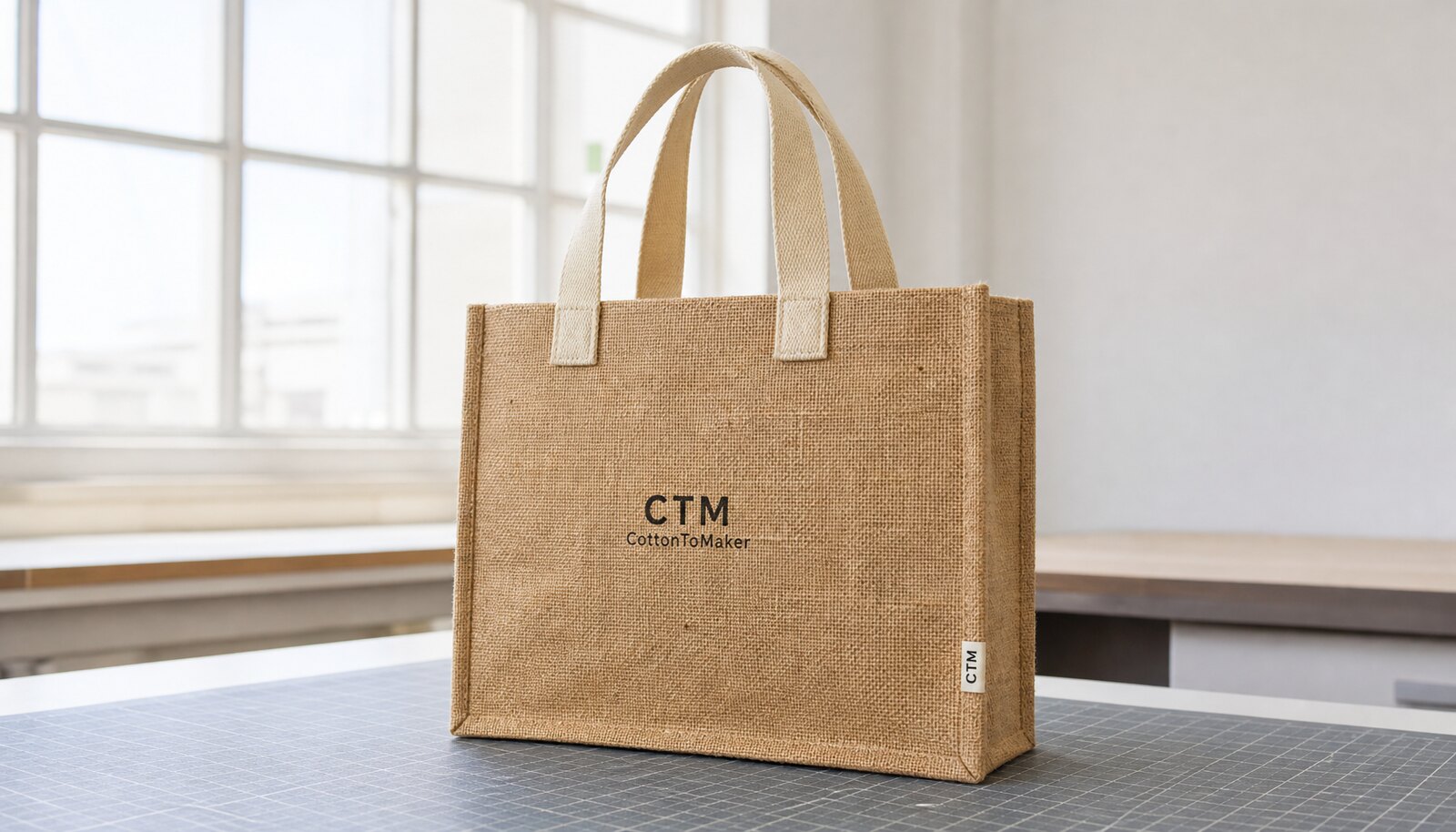
1. Start With The Buying Decision, Not The Logo
Bespoke jute bags are often treated as a decoration project when they should be treated as a procurement project. If the only instruction is “custom logo on a jute bag,” suppliers will fill in the gaps with their closest stock structure, their preferred fabric weight, and whatever packing method they already use. That can create quote comparisons that look clean but are not commercially equivalent.
A strong RFQ begins with the business decision the bag must support. Is the program for retail shelf use, a gift-with-purchase, a trade show giveaway, a grocery-style carry bag, or a premium branded shopper? The answer changes the fabric weight, handle style, reinforcement, closure, labeling, and pack-out. A buyer who knows the end use can tell the factory what must be fixed and what can be flexible.
The most practical rule is to separate the bag into cost modules: body construction, decoration, handles, closures or trim, and packing. Once each module is defined, the supplier can price the same product instead of a rough idea. That is the difference between an RFQ that produces usable quotes and one that produces a pile of “apples to oranges” responses.
For procurement teams, this also reduces rework later. If the size, print method, and pack count are already approved in writing, the factory can prepare the correct material flow, and QC can inspect against a single reference point. In other words, a clear spec is not just a design preference; it is a production control tool.
- Name the end use: retail, promotional, gift, trade show, or grocery-style carry.
- Separate the quote into body, print, handles, trim, and packing.
- Freeze the version number of the spec before sampling starts.
- Do not mix premium and economy versions in one vague request.
2. Choose A Construction That Matches The Load, Shelf Life, And Brand Position
The phrase bespoke jute bags covers a wide range of builds, from light promotional totes to structured, lined shoppers. Buyers should decide on construction based on how the bag will be used, how long it must hold its shape, and whether it will be handled once or repeatedly. A tote that leaves a retail shelf has different requirements from a short-run conference bag that is filled once and discarded.
Fabric GSM is the first technical choice most buyers should lock. For a general-purpose bag, 320-360 GSM is a practical starting point. It usually balances cost, weight, and a natural jute appearance without becoming too soft or too expensive. For a more premium presentation, 380-450 GSM may be appropriate, especially if the bag needs more body, a stronger hand-feel, or a more structured profile.
That said, heavier is not automatically better. As fabric weight rises, the bag can become stiffer, more difficult to fold, and more expensive to ship. If the style includes lamination, lining, or a board base, the bulk can increase quickly. This matters for wholesale buyers because freight cost, carton count, and warehouse handling all rise with volume even when the bag itself looks compact in a product photo.
A procurement buyer should also decide whether the bag needs a natural, rustic look or a cleaner retail finish. Open weave and natural color read differently from laminated, lined, or dyed constructions. There is no universal “best” jute build; there is only the best build for the target selling price and use case.
- 320-360 GSM: sensible for general retail, supermarket-style carry, and promotions.
- 380-450 GSM: better for premium retail, corporate gifting, and more structured formats.
- Lamination can improve shape and wipeability but may add odor, stiffness, and folding issues.
- Lining can improve internal finish but increases labor and should be justified by the use case.
3. Compare Supplier Routes Before You Compare Prices
Not every quote comes from the same kind of supplier, and procurement risk changes depending on the route. A direct factory is usually the best option when you need repeatable quality, clear cost structure, and better control of cutting, stitching, and print approval. The factory route is also easier to manage when the bag will be reordered seasonally or when the buyer expects small design changes over time.
A trading company or sourcing agent can still be useful, especially if the buyer wants multiple material options or prefers one point of communication. The downside is that the actual production site may not be obvious from the quotation. If the buyer does not confirm the real maker, sample responsibility, and QC ownership, then delay and blame-shifting become more likely when problems arise.
A local converter or specialist printer can be attractive for fast-turn programs or lower volumes, but the unit cost is often higher and the material options may be narrower. This route can be sensible if speed matters more than absolute price, but it is not the best benchmark for a long-term retail program.
The key procurement lesson is simple: supplier route affects price structure. A factory quote may separate body, print, handles, and packing clearly, while an intermediary may give a simpler all-in number that hides margin or hides spec compromises. Buyers should normalize all quotes to the same specification before making a decision.
- Ask who actually makes the bag, not only who sells it.
- Request photos or video of cutting, sewing, printing, and packing.
- Check whether the supplier controls lamination, labels, and carton packaging in-house.
- Use the same spec version for every supplier you compare.
4. Quote On The Details That Move Cost, Not Just On The Bag Size
Two jute bags with the same dimensions can have very different costs once the construction is fully defined. Price is typically driven by six variables: fabric weight, bag size, decoration method, handle material, structure or lining, and packing. Buyers who only ask for a “custom tote” often receive quotes that cannot be compared because each supplier made different assumptions about these six variables.
Fabric weight affects not only material cost but also cutting waste and sewing effort. Handle material can be a major cost point as well. Cotton webbing, jute webbing, jute rope, and self-fabric handles are not interchangeable from a costing or comfort standpoint. Similarly, a bag with a simple open top is easier to produce than one with a zipper, magnetic snap, or internal pocket. Those additions may seem minor, but they create extra components and more line operations.
Decoration deserves the same discipline. A one-color screen print on the front panel is usually the simplest route for a natural jute surface, but text size and line thickness matter because the weave is textured. A woven label or sewn patch can create a cleaner premium look, yet it adds trim and labor. If the buyer wants embroidery, debossing, or multiple print positions, the supplier should price each position separately rather than folding everything into one loose unit rate.
The most useful quote format breaks the bag into body, decoration, handle, trim, packing, and carton. That gives the buyer a place to compare cost drivers and make tradeoffs. For example, if the premium look matters more than the lowest price, you can keep the body simple but upgrade the handle and label. If freight cost matters more than shelf presence, you can reduce carton volume and simplify packing. The point is to make cost a design choice, not a surprise.
- Ask for pricing by body, decoration, handle, trim, packing, and carton.
- Treat closures, lining, and labels as separate cost drivers.
- Clarify whether the quoted price includes sampling, tooling, or print setup.
- Compare cost per unit only after the spec is normalized.
5. Build A Supplier Validation Checklist That Goes Beyond A Website
A polished website does not prove production capability. For bespoke jute bags, buyers should validate the factory with evidence that is specific to this product category. Ask for recent production photos that show the actual sewing line, the print area, the cut panels, and the packed cartons. A useful supplier should be able to show the same style or at least a similar construction, not only generic bag photography.
The first proof point is process control. Does the factory cut, sew, print, and pack in-house, or are those steps spread across multiple subcontractors? If a supplier uses outside printers or a different packing site, then the schedule and QC chain become more fragile. The buyer should know where each step happens because every handoff increases the risk of lost detail or undocumented changes.
The second proof point is spec discipline. Ask whether the factory keeps a written sample record, who signs off the golden sample, and how production matches that sample. If the supplier cannot explain its internal approval chain, the buyer should assume that the production floor may interpret the order loosely. In jute goods, that often shows up as slightly different handle placement, inconsistent stitch reinforcement, or a different fold pattern.
The third proof point is capacity and line fit. A factory may be capable of making jute bags but not necessarily your style of bag at your required volume. Ask how many machines are dedicated to bag sewing, whether the line has experience with lining or lamination, and how they manage peak-season work. For procurement, capacity is not just output; it is the factory’s ability to keep the same quality standard when volume rises.
- Request product-specific photos of cutting, sewing, printing, inspection, and packing.
- Confirm which steps are in-house and which are outsourced.
- Ask who approves the golden sample and who signs off bulk production.
- Check whether the line has relevant capacity for your exact bag construction.
6. Sample Approval Should Prove Fit, Print, And Build Quality
A pre-production sample is only useful if it answers the right questions. It should confirm more than appearance. The buyer needs to know whether the bag opens and folds correctly, whether the handles sit evenly, whether the print holds clean edges on textured material, and whether the seam reinforcement is strong enough for the intended load.
For dimensional control, measure the finished bag against the drawing and set tolerance before bulk approval. A practical approach is to define acceptable variation for top width, body width, gusset depth, and handle drop. The tolerance should be tight enough to control shelf consistency but realistic enough for a natural fiber product. The important thing is that the factory knows the acceptable range before production starts.
The sample also needs a loading check. Fill the bag with a representative product weight or a test load similar to the real use case, then inspect handle pull, body distortion, and seam behavior. This is especially important for retail shoppers and reusable carry bags. A bag can look perfect empty and still fail as a usable item if the handle entry point opens up or the body bows excessively under load.
If the order includes lining or lamination, turn the sample inside out or inspect the inside finish carefully. Buyers often focus on the logo side and miss uneven trimming, frayed seam allowance, or poor internal finishing. If the product will be displayed or resold, that internal quality still matters because it can affect odor, feel, and perceived workmanship when the bag is handled by the end customer.
- Approve a measured sample, not only a visual sample.
- Test the bag with a realistic load before final sign-off.
- Record tolerance for top width, gusset, and handle drop.
- Inspect both the exterior and the inside finish.
7. Specify Print, Stitching, And Reinforcement Like A Production Buyer
Many jute bag problems come from vague decoration instructions. A buyer may approve a logo image on a screen, but the factory needs print size, placement, color count, line thickness, and acceptable shift. Natural jute texture can soften fine detail, so artwork that looks crisp digitally may print too lightly or blur at the edges. For that reason, buyers should ask the supplier to confirm the smallest readable line and text size on the actual fabric type.
Screen print remains the most common and cost-effective choice for bold branding. It works best when the design is simple and the buyer wants a solid visual mark rather than photographic detail. If the brand standard is cleaner and more premium, a sewn patch, woven label, or PU tag may be more appropriate. Those options cost more but can improve durability and reduce the risk of cracking or abrasion over time.
Stitching is where many lower-cost bags fail first. Buyers should ask how the top edge is finished, how many reinforcement passes are used at the handle root, and what stitch pattern is applied at the load point. Box-X reinforcement or a similar heavy-duty pattern is often preferable to a minimal tack if the bag is intended for repeated carry. If the supplier will not specify reinforcement clearly, the buyer should assume the construction is basic until proven otherwise.
The same logic applies to trims and closures. Zippers, snaps, piping, and internal pockets are not simply style choices; they change labor time and may affect the fold and pack size. A procurement buyer should approve these features only if they are tied to a clear commercial reason, such as premium shelf positioning or destination handling needs.
- Define print size, position, color count, and acceptable shift.
- Approve the artwork on the actual jute texture, not only on paper or screen.
- Ask for reinforcement details at the top edge and handle root.
- Use heavier reinforcement when the bag must carry meaningful weight repeatedly.
8. Packing, Cartons, And Export Readiness Are Part Of The Spec
Packing can make or break the economics of bespoke jute bags. The same bag can ship efficiently or inefficiently depending on how it is folded, stacked, and cartonized. If the carton count is too loose, freight volume rises and the pallet footprint becomes wasteful. If the packing is too tight, the bag body may crease, the print may take pressure marks, and laminated surfaces may show permanent flattening.
For wholesale and import programs, the buyer should request a packing drawing or packing description that includes inner pack count, master carton count, carton dimensions, net and gross weight, and carton marks. If the bags are retail-ready, add barcode placement, hangtag position, and any individual bag polybag requirement. These details are easy to overlook during quoting but expensive to correct after production.
A good packing plan also respects the product finish. Natural unlined jute may tolerate more compression than a structured laminated bag, but even plain styles can pick up dust, moisture, or odor during warehouse storage. If the goods will sit in a distribution center before retail delivery, ask the supplier how they protect the shipment from humidity and dirt during packing and palletization.
Buyers should also think about destination handling. A bag that arrives flat-packed may be efficient for freight, but if the end customer expects a strong shelf shape, the fold method should preserve the profile. For premium orders, ask for carton opening photos or even a packed sample photo before bulk release. That is a simple way to avoid discovering creases, crushed corners, or misaligned stacks only after the shipment is in transit.
- Confirm pack count, carton size, and gross weight before production.
- Match the fold method to the actual finish of the bag.
- Add barcode and hangtag instructions early if retail-ready packing is needed.
- Check protection against dust, moisture, and pressure marks.
9. Put QC In Sequence: Incoming, In-Process, And Final Inspection
Quality control is stronger when it is sequenced instead of treated as one final check. For bespoke jute bags, start with incoming material verification, then in-process checks, and finally finished-goods inspection. If the fabric roll is wrong, there is no point waiting until packing to discover it. If the print registration drifts during production, the line should know before the whole lot is sewn.
At incoming stage, confirm the fabric GSM, weave consistency, color shade, and any laminate or lining quality before cutting begins. A buyer or third-party inspector should be looking for obvious defects such as thin spots, visible contamination, dye inconsistency, or damaged rolls. For natural fiber goods, some variation is expected, but it should be bounded by the approved sample and written tolerance.
In-process inspection should focus on the features that are expensive to fix later: print position, handle alignment, seam reinforcement, and top-edge finish. This is also the right time to verify that the first cartons are being packed correctly. If the folding method or carton count is wrong, the problem should be caught while the line can still adjust. Waiting until the shipment is complete usually turns a fixable issue into a costly repack.
Final inspection should use clear acceptance criteria. A practical buyer standard may include: no visible seam opening, no handle pull failure, no major print misalignment, no off-spec dimensions beyond tolerance, and no cartons that are crushed, wet, or mislabeled. If the order is retail-facing, the acceptable defect rate should be stricter for cosmetic faults in visible areas than for hidden inner trim. The important point is to define defect severity before inspection starts, not after a problem appears.
- Check fabric and trim before cutting, not only after sewing.
- Inspect print and reinforcement during production, when correction is still possible.
- Use a clear tolerance for size and visible defects.
- Separate cosmetic defects from functional defects in your inspection plan.
10. A Cleaner RFQ Structure Makes Quotes Easier To Compare
The most effective RFQ for bespoke jute bags is short, but it must be precise. Start with finished size, target use, construction type, artwork, handle spec, packing plan, and order volume by SKU. Add one drawing or mockup with dimensions, then attach the approval notes for fabric, print, and packaging. That gives the factory a single reference document and reduces the chance that a sales rep interprets the brief one way while the production team understands it another way.
A useful RFQ also clarifies what can change and what cannot. For example, you might allow the supplier to propose a different handle material if it improves durability, but not allow any change to the body size or print position. That kind of instruction helps suppliers offer alternatives without drifting away from the required commercial target.
It also helps to define the quote version. If a quote is based on a sample, the supplier should say whether the sample cost is included, whether tooling or print setup is extra, and whether the quoted lead time starts from sample approval or from PO receipt. These small clarifications matter because they affect landed cost and shipping planning more than many buyers expect.
A good buyer guide is not a template full of empty phrases. It is a working document that lets procurement, merchandising, QC, and the factory talk about the same bag. The stronger the RFQ, the less time spent correcting misunderstandings later.
- Attach a dimensioned drawing or approved mockup to the RFQ.
- State which elements are fixed and which are open to supplier suggestion.
- Clarify whether sample charges, tooling, and setup are included.
- Tie the quote version to a specific spec revision and approval date.
Specification comparison for buyers
| Buying route / product choice | Best fit | Cost and lead-time implications | Tradeoffs and what to validate |
|---|---|---|---|
| Direct factory, simple tote | Best for repeat orders, stable artwork, and controlled QC | Usually strongest on unit price and easier on reorders once the spec is locked | Validate whether cutting, sewing, print, and packing are truly in-house; ask for line photos, QC checkpoints, and ownership of print screens or plates |
| Trading company or sourcing agent | Useful when you need multiple material options or a small supplier search burden | Can add margin and sometimes slower clarification, but may reduce your internal sourcing time | Confirm the actual factory, the spec conversion process, and whether sample changes are communicated without loss of detail |
| Standard 320-360 GSM tote | Good for general retail, promotional, and shopping use | Lower material cost, lighter shipping weight, and easier folding | Check if the bag feels too soft for shelf presentation and whether seams still hold shape after filling |
| Heavy 380-450 GSM or lined tote | Better for premium retail, wine, corporate gift, or structured shopper programs | Higher fabric and labor cost, often more carton volume, and longer handling time | Ask whether the supplier can keep weave consistency, avoid excessive stiffness, and maintain neat corner finishing |
| One-color screen print | Best for bold logos, clear brand marks, and medium-to-high quantity runs | Most economical decoration route when artwork is simple and line thickness is forgiving | Approve print on the actual fabric texture, not only on artwork proof; ask for registration and edge tolerance |
| Woven label, sewn patch, or PU tag | Best for a cleaner premium brand presentation | Often adds labor and trim cost, but can improve durability and perceived value | Check if the label placement affects seam strength, packing stack height, or fold appearance |
| Cotton webbing handles | Best for retail carry comfort and better perceived quality | Usually adds cost over basic jute handles, but often improves hand-feel and repeat use | Validate handle width, bar-tack length, stitch count, and comfort at the shoulder or hand |
| Bulk carton pack | Best for wholesale import efficiency and lower freight waste | Keeps unit cost down when the carton plan is efficient | Confirm carton dimensions, stack height, moisture protection, and whether printed faces will crease in transit |
| Polybagged retail-ready pack | Best for shelf presentation or dust-sensitive destinations | Increases labor and packing material cost, but reduces handling damage and dirt exposure | Check barcode placement, suffocation warnings where relevant, and whether polybagging changes carton count |
Buyer checklist before sampling
- Finished size in millimeters with tolerance for width, gusset, and handle drop
- Target fabric GSM, weave type, color standard, and whether the body is lined or laminated
- Decoration method, artwork file format, Pantone or visual reference, and print position dimensions
- Handle material, handle width, reinforcement style, and minimum stitch count or stitch pattern at stress points
- Closure, pocket, base board, piping, or trim options that change labor or packing
- Packing method, inner pack count, carton marks, barcode label, and destination labeling requirements
- Order volume by SKU, color, and variant so MOQ and price breaks can be priced correctly
- Inspection standard covering size, seam quality, print placement, odor, moisture, and carton condition
Factory quote questions to send
- What exact GSM is being used for each panel, and is there any permitted variation between rolls or production lots?
- Who is the actual manufacturer, and which steps are done in-house versus outsourced, including printing, lamination, and packing?
- What is included in the quoted unit price: body, handles, lining, closure, labels, packing, and export carton?
- How many colors are included in the quote, and what is the surcharge for a second print position or a different decoration method?
- What are the MOQ, price breaks, and setup charges by color, size, handle type, and trim variation?
- Can you share photos of the factory line, in-process QC, comparable finished bags, and final packed cartons before PO release?
- What sample charges apply, how many revision rounds are included, and what changes trigger a new sample or new tooling cost?
- What is the confirmed lead time after approval, and which step is the usual bottleneck: fabric booking, printing, sewing, inspection, or export booking?
- What packing configuration is quoted, and how many pieces are in each inner pack and master carton?
- What is the defect handling process if a shipment arrives with size, print, seam, odor, or packing issues?
Quality-control points to confirm
- Measure finished dimensions on at least five pieces per sample lot: top width, body width, gusset depth, and handle drop. Set the tolerance before bulk production, not after.
- Define acceptance criteria for weave consistency: no obvious thin spots, no major slubs in visible logo areas, no broken yarn clusters, and no irregular dye or laminate coverage on the front panel.
- Set a print acceptance standard for placement shift, color density, edge crispness, and registration. On textured jute, allow only the amount of distortion that the approved sample shows.
- Inspect stitching at the top hem, side seams, handle roots, and any pocket or closure attachments. Require reinforcement where stress concentrates, especially on heavy-load styles.
- Pull-test handles and reinforcement points on a small production sample. Fail the lot if handles tear, stitches open, or the bag body distorts excessively at the seam entry point.
- Check odor, moisture, dust, and fiber shedding after packing. Jute can absorb warehouse conditions, so the final packed condition matters as much as the sewn sample.
- Open cartons from the top, middle, and bottom of the pallet or stack to verify consistent folding, carton fill, and whether pressure marks are appearing on printed or laminated panels.
- Verify barcode, carton mark, and country-of-origin placement before shipment so the order does not need repacking at destination or at the port.
- Require photo evidence of the sealed golden sample, first production inspection, and packed goods for any order where the artwork, size, or structure is critical.