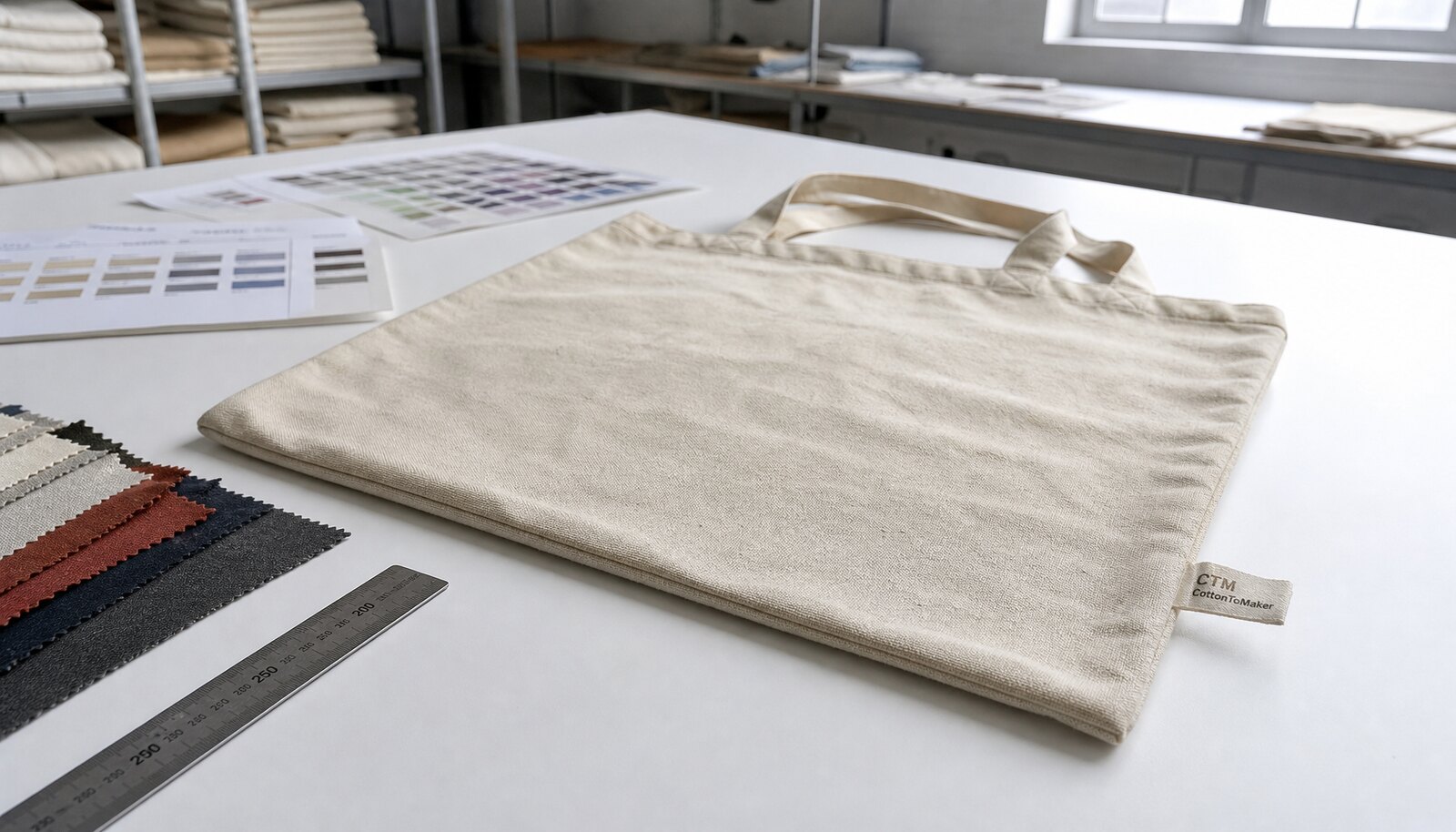
Start With the Use Case, Not the Tote
The fastest way for a bespoke cotton bags project to go wrong is to start with the logo and treat everything else as decoration. Procurement should begin with the actual job the bag has to do. A retail shopper bag, an event handout, a subscription insert, a grocery carry bag, and a gift presentation bag all need different levels of stiffness, print durability, handle comfort, and pack efficiency. If the brief does not name the use case, suppliers will fill in the blanks themselves, and those assumptions often show up later as hidden cost or avoidable quality issues.
For organic cotton bag buyers, the use case matters even more because the material promise can limit the available fabric finishes, dye choices, and certification requirements. A natural or unbleached appearance may be part of the brand story, but it can also affect color accuracy and print contrast. A bag intended for shelf resale has to look finished from five feet away, while an event bag can tolerate more functional simplicity. The right brief is specific enough to let the supplier decide construction method, but narrow enough to prevent interpretation drift.
The practical test is simple: if a factory can quote only after guessing the bag’s purpose, the brief is still too loose. A good procurement spec tells the supplier whether the bag should stand upright, fold flat, carry bottles, fit inside a gift carton, or survive repeated use. That is what drives fabric weight, handle geometry, reinforcement, and packing format. Once the use case is clear, the rest of the buying process becomes a lot easier to compare and control.
- Define the job first: retail carry, event handout, grocery use, gift packaging, or subscription packaging.
- State whether the bag must be visually premium, structurally strong, or simply low-cost and functional.
- Include expected load, repeat-use expectations, and shelf presentation requirements if applicable.
- If the bag is for organic cotton branding, say whether natural color, certified fiber, or lower-chemistry processing is part of the requirement.
Choose Cotton Weight, Weave, and Finish With the End Use in Mind
GSM is the first number buyers compare, but it is not the whole story. Bespoke cotton bags can be made from plain cotton, canvas, or heavier woven structures, and each behaves differently in sewing, printing, and day-to-day use. A 160 gsm fabric may be perfectly acceptable for a lightweight promotional tote, while a 220 gsm canvas bag can feel much more substantial for retail or grocery use. Two fabrics with similar GSM can still feel very different if one is tightly woven and the other is looser or more prone to distortion.
That matters commercially because fabric choice affects far more than hand feel. Heavier cloth costs more to buy and sew, increases freight weight, and can create more seam stress at corners and handles. Lighter cloth reduces cost and shipping volume, but the bag may lose shape, show print show-through, or feel too flimsy for a consumer-facing product. A procurement team should ask the supplier for the actual roll sample, not just a quote line that says 200 gsm, because the visual and tactile difference often becomes obvious only when the cloth is in hand.
For organic cotton bags, buyers should also ask how the fabric is finished before sewing. Was it pre-shrunk, bleached, or left natural? Was it washed or calendered? Any of those choices can affect size stability, print contrast, and the final look of the bag. If the product will be washed, steamed, or pressed after manufacture, shrinkage needs to be treated as a spec item, not a surprise. Ask the factory how much dimensional change they expect after the first wash or press cycle and what tolerance they can control in production.
A useful way to think about cotton weight is to match it to the load and the customer expectation. A light giveaway bag should not be priced like a reusable carrier, and a premium branded tote should not be built like a throwaway mailer. If the factory suggests a heavier fabric than you expected, ask why. Sometimes the answer is legitimate: more structure, better print support, or more durable carry performance. Sometimes it is simply a default quote that pushes the buyer into a more expensive category without a clear need.
- Use lighter cotton for short-life promotional use, but only if the bag will not carry heavy items.
- Use medium-weight canvas when the bag needs a better shelf look and moderate durability.
- Use heavier canvas only when load, durability, or premium presentation justifies the extra cost and freight.
- Ask whether the fabric is pre-shrunk, calendered, bleached, dyed, or left natural, because each finish changes the final result.
Construction Details Decide Whether the Bag Feels Cheap or Credible
Many buyers focus on the print and leave construction vague, but construction is what customers feel when they pick the bag up. Handle width, handle drop, top hem, seam allowance, corner treatment, and reinforcement all influence whether the bag carries weight comfortably and still looks neat after use. A bag with a fine logo but weak seam work will read as a poor-quality product the moment the handles twist or the corners collapse. If the bag is meant to sit on a retail shelf, structural neatness is part of the brand presentation.
Reinforcement should be selected based on actual use, not as a generic upgrade. Cross-stitch or box-stitch reinforcement is more durable than a decorative single pass, especially where the handles join the body. Wider handles can improve comfort and distribute weight better, but they also change sewing time and cutting requirements. A neat top hem can improve appearance, while overlocked or clean-finished internal seams reduce fraying. These choices are small individually, but together they determine the final cost profile and failure risk.
When reviewing a supplier’s answer, do not just ask whether the bag is reinforced. Ask where, how, and with what stitch density. Ask how the factory handles seam allowance consistency and whether there is a standard machine setting for the chosen fabric weight. If the supplier cannot explain the construction sequence in plain language, that is a warning sign. Good factories can describe how the bag is sewn because they actually make it that way every day.
There is a cost trade-off here that procurement teams should make explicit. A simpler construction may be acceptable for a campaign bag that will be used once or twice. A retail bag may need the more expensive construction because returns, complaints, or shelf rejection cost more than the extra sewing. The right answer depends on the bag’s life cycle, not on which option sounds more premium in a quote.
- Specify handle width, handle drop, and whether the handles need reinforcement at the attachment point.
- Require a seam allowance standard so the factory cannot shrink the bag dimensions without notice.
- State whether the internal seams should be overlocked, turned, or clean finished.
- If the bag carries weight, ask for box-stitch or cross-stitch at the handle joins rather than a generic “reinforced” note.
Print Method, Artwork Control, and Brand Finish
Print decisions should follow the artwork and the use case, not the other way around. Screen print is usually the most economical route for a simple logo, bold block color, or a short color count on cotton. It gives strong opacity when applied correctly and can look crisp on a natural textile. But it is not ideal for fine detail, tonal shading, or tiny type. If the supplier pushes screen print for a design that really needs gradient accuracy, the buyer should challenge that recommendation before approving the route.
Digital transfer and heat transfer can solve complex artwork problems, especially on smaller orders or fast-turn campaigns. However, procurement should evaluate them as distinct finishes rather than interchangeable alternatives. A transfer may deliver the right image but feel more plastic or sit differently on the cotton surface than a direct print. That matters on premium cotton bags where touch, drape, and brand perception are part of the purchase decision. Ask for a sample on the same fabric base that will be used in bulk, because cotton shade and weave density change how the print appears.
Artwork control should be measured, not described vaguely. Placement should be stated in millimeters from the bag top, side seam, or center line. Color should be referenced by Pantone or another controlled standard, with the understanding that cotton absorbs color differently than coated paper. Fine lines, reversed text, and small legal marks should be checked carefully because they are the first elements to fill in or lose sharpness during print. A good supplier will point out risks before production; a weak supplier will say yes to everything and sort it out later on the line.
For buyers of bespoke cotton bags, the safest approval process includes a printed strike-off or sample on actual stock before the bulk run. That step catches artwork scaling errors, misaligned placement, and weak opacity. It also gives procurement a chance to decide whether a slightly softer print, a darker ink, or a larger logo is better for the end use. This is where supplier answers matter: if they can explain why one method suits the artwork better than another, they are evaluating the job rather than just selling a process.
- Use screen print for simple logos, high-opacity needs, and better unit economics at scale.
- Use transfer or digital methods when the artwork has many colors, tonal detail, or small-run requirements.
- Lock placement in millimeters and approve the print on the actual cotton base, not only on a design file.
- Check whether the supplier can keep fine type, small marks, and reverse-out text legible at the chosen print size.
MOQ, Supplier Type, and the Real Cost of the Ordering Route
MOQ is not just a factory rule; it tells you how the supplier makes money and how stable the process will be. Direct cut-and-sew factories usually want enough volume to cover fabric booking, setup, cutting, and stitching efficiency. Trading companies may offer more flexibility on order size, but the buyer should be clear about who is actually producing the bags and who is accountable if the sample and bulk differ. Stock blank suppliers can move quickly, but the moment the brief includes exact sizing, label placement, or controlled packing, the order becomes less like a stock buy and more like a bespoke production job.
The best sourcing route depends on the risk profile of the launch. If the bag is a branded retail item or part of a private-label range, direct factory sourcing usually gives better control. If the procurement team wants support comparing multiple factories, a trading partner may be useful, but only if the factory identity, production site, and inspection route are transparent. If the priority is speed and the bag can be standard, a blank route may be acceptable, but buyers should not confuse “available fast” with “fit for a custom specification.”
When reading MOQ numbers, look beyond the headline. A low MOQ can look attractive until the quote reveals higher sample fees, color setup charges, or premium packing charges that make the small order expensive. In other words, small quantity orders do not simply scale down the same way a larger order does. Setup and handling costs often sit outside the unit price in subtle ways. Ask the factory to show the price ladder at 3,000, 5,000, and 10,000 pieces, and compare what really changes. That usually exposes whether the supplier is genuinely flexible or just using a low-entry figure to win the inquiry.
A supplier’s response also reveals whether they understand procurement reality. Good suppliers will explain where the cost drops as volume increases: fabric booking efficiency, print setup amortization, line balancing, and carton optimization. Weak suppliers simply quote a number without showing how it behaves as the order changes. For bespoke cotton bags, the best partner is the one that can explain the economics clearly and still stay disciplined on quality.
- Use direct factory sourcing when print repeatability, construction control, and repeat orders matter.
- Use a trading company only if you can still identify the actual manufacturer and production line.
- Use stock blanks only when the brief is truly standard and the customer will accept less customization.
- Ask for a price ladder at multiple volumes to see whether the supplier’s economics are real or just promotional.
How to Read a Quote Line by Line and Compare It Fairly
A usable quote for bespoke cotton bags should be more than a single unit price. Procurement needs visibility into fabric cost, cutting, sewing, printing, labels, packing, and any special handling. If the quote bundles everything together, it becomes difficult to see where the price is coming from and which assumptions will change if the brief changes. That matters because cotton bag projects often move after the first sample: a buyer may enlarge the logo, change the handle, or upgrade the packing. If the supplier cannot break the price apart, those changes become guesswork.
The fairest comparison is like-for-like. Normalize the quotes to the same fabric GSM, same size, same print method, same packing format, same Incoterm, and same sample assumption. A low ex-works price may not beat a slightly higher FOB quote once freight, cartons, inland movement, and handling are included. Likewise, one supplier may include reinforcement, labels, and polybags while another charges separately. If the procurement team does not normalize those differences, the “cheapest” quote may simply be the least complete one.
Supplier answers should be evaluated, not just collected. A good response explains what is included, what is optional, and what will trigger a revision. A weak response sounds confident but stays vague: “standard quality,” “best price,” or “good sample” without any measurable basis. Ask how the supplier would revise the price if you changed the handle length, increased print coverage, or upgraded the GSM. That question quickly shows whether the quote is grounded in actual manufacturing logic or is just a placeholder number.
When a quote looks too low, look for omissions before you look for negotiation room. Missing sample charges, omitted packing materials, unpriced printing setup, or unclear cartonization are common reasons a low number later expands. You are not just buying cotton bags; you are buying a controlled manufacturing result. The more transparent the quote, the lower the chance that production drift will be passed back to procurement as a surprise.
- Compare only normalized quotes with the same GSM, size, print method, packing, and shipping basis.
- Separate material, labor, decoration, packing, and logistics so price changes can be explained clearly.
- Ask what happens if the artwork changes, the sample needs rework, or the carton spec changes.
- Treat very low quotes as a prompt to inspect omissions, not as a reason to celebrate.
Sampling That Actually Prevents Rework
Sampling is where the buyer discovers whether the supplier can make the bag that was imagined. For bespoke cotton bags, the first sample should confirm shape, seam behavior, handle proportion, and print placement. It should not be used as the final approval of production quality if the fabric or print process is still uncertain. Once the first sample is directionally correct, request a pre-production sample built from the actual fabric, actual thread, actual print method, and actual packing plan that will be used in the bulk order. That is the sample that should anchor bulk release.
The approval record should be practical and controlled. Keep one signed golden sample, one photo set, and one short note summarizing every approved deviation. If the buyer accepts a slightly different fold, a shifted label, or a small print position change, that must be written down. Otherwise the factory may assume the change is acceptable across the order, even if the buyer intended it to apply only to the sample. Drift often begins with unclear approvals, not bad intent.
This is also the right moment to evaluate supplier responsiveness. Strong suppliers will point out when artwork details are too small for the chosen process, when a handle length looks awkward, or when a spec would be difficult to sew consistently. Weak suppliers tend to say yes to everything until the order is in production. If a factory cannot give a credible pre-production sample path, or keeps moving the goalposts between sample rounds, that is a reason to pause rather than push forward.
For procurement teams managing multiple launches, the sample file becomes a control document. It should show the approved dimensions, fabric, print placement, packing, and any exceptions to the original brief. If that record is clean, future reorders are easier to manage and quote. If it is messy, every repeat order becomes a new investigation. The objective is not more paperwork; it is less ambiguity in bulk production.
- Use the first sample for fit, shape, and visual direction; use the pre-production sample for final bulk truth.
- Keep a signed golden sample on both buyer and supplier sides.
- Write down every approved exception, however small, before release to bulk.
- Do not approve bulk if the sample uses a different fabric, print process, or packing method from the intended order.
QC Standards: Tolerances, AQL Thinking, and Defect Severity
Quality control for cotton bags should be specific enough to stop arguments at inspection. Start with measurable tolerances for dimensions, handle length, print position, and carton count. For higher-value procurement, that means stating how much deviation is acceptable before an item becomes a defect. A bag that is slightly off-center may be minor if the brand mark still reads correctly, but a missing reinforcement stitch or wrong size is a different matter. QC should separate appearance issues from functional failures so the factory understands what truly matters.
AQL-style thinking is useful here even if the buyer is not writing a full inspection manual. In practical terms, the order should define critical, major, and minor defects. A critical defect is a failure that makes the bag unusable or non-conforming: wrong size beyond tolerance, missing print where required, hole in fabric, or serious seam failure. A major defect is one that affects saleability or function but may still be reworked: crooked print, weak reinforcement, open stitch line, stain, or wrong label placement. A minor defect is cosmetic and may be acceptable within a controlled limit: loose thread, slight fold inconsistency, or small pressing mark.
Good procurement teams also ask for specific defect examples in the supplier’s own language. What does the factory consider acceptable? What will it rework? What will it scrap? If the supplier cannot answer that clearly, inspection problems will be handled case by case under pressure. For bespoke cotton bags, that is risky because a large shipment can contain only a small percentage of visible defects and still create a very expensive sorting problem at destination.
Inspection should be based on the signed sample and the spec sheet, not on verbal agreement. Measure a random sample from multiple cartons, not only the top carton. Check that the GSM matches the agreed range, the print sits in the approved location, and the bag is consistent across the shipment. Ask for a clear action plan if the lot fails: rework, replacement, downgrade, or hold. The purpose of QC is not to catch every possible issue; it is to make the supplier accountable for the issues that matter most to the buyer.
- Set tolerance bands for body size, handle length, and print placement before production starts.
- Classify defects as critical, major, or minor and tie each category to a clear action.
- Use multiple-carton sampling so one neat carton does not hide a mixed lot.
- Require the supplier to explain what gets reworked, what gets scrapped, and what gets shipped only with buyer approval.
Packing, Cartons, and Shipping Risk Are Part of the Product
Packing often decides whether the landed order still looks good when it arrives. Cotton bags are light, but they are bulky, so the packing format has a big effect on freight efficiency and warehouse handling. Flat bulk packing usually works well for export and cost-sensitive programs, but the buyer needs to check whether the folds will crease the print or flatten the bag too much. Individual polybags improve presentation and can protect retail-ready pieces, but they add labor, plastic use, and volume. The right choice depends on whether the buyer is shipping straight into a warehouse or selling through a shelf-ready channel.
Carton spec should be written into the order, not left to the factory’s habit. Buyers should know the carton dimensions, the count per carton, whether sizes are segregated or mixed, and how the outer marks will be written. A low unit price can be offset by poor packing efficiency if cartons are oversized, underfilled, or inconsistent. If the shipment is going through a distribution center, carton consistency matters because receiving teams need to verify counts quickly. Mixed cartons and unclear labeling often cost more in handling than any minor unit-price saving.
Shipping risk also starts with the production schedule. A realistic timeline should separate fabric booking, cutting, printing, sewing, packing, final inspection, and dispatch. If the supplier gives only one ship date, that is not enough for procurement planning. Ask where the time is most exposed. Is the fabric sourced externally? Is the print line shared? Is packing done in-house or subcontracted? Those details show where delays are likely to happen. The buyer does not need a perfect timetable; the buyer needs a schedule that makes the risks visible before the PO is released.
In many bespoke cotton bags projects, the packaging decision is the difference between a product that arrives ready to ship and one that needs extra handling at destination. The more the buyer clarifies up front, the less the warehouse team has to discover later. That is a procurement problem as much as a logistics one.
- Choose flat bulk pack when freight efficiency and warehouse speed matter most.
- Choose retail-ready packing only when the channel justifies the added labor and volume.
- Specify carton dimensions, piece count, label format, and whether sizes may be mixed.
- Ask for a step-by-step schedule so fabric, print, sewing, packing, and loading risks are visible early.
A Procurement Workflow That Reduces Drift on Repeat Orders
The cleanest way to manage bespoke cotton bags is to run the project in three stages: define, sample, and release. In the define stage, procurement locks the measurable spec, commercial terms, and packing standard. In the sample stage, the buyer checks whether the factory can reproduce the brief physically and records any approved exceptions. In the release stage, the supplier receives one clean instruction set and no longer has to interpret what the buyer means by premium, eco-friendly, or good enough. That structure reduces rework and makes future quote comparison much easier.
This workflow also helps buyers avoid the common trap of comparing supplier personalities instead of capabilities. One factory may be strong in sewing discipline but less flexible on artwork complexity. Another may be fast on sampling but slower on bulk because of line capacity. A third may offer very competitive pricing but only if the buyer accepts loose packing or simplified finishing. Procurement should choose the supplier whose strengths match the program’s risk, not just the one with the lowest first quote. A lower unit price is not a bargain if the order needs repeated corrections or destination sorting.
For repeat orders, the file should be treated as a controlled product record. Keep the spec sheet, artwork, signed sample photos, quote basis, QC standard, and packing instructions in one place. That makes reorders faster and protects the buyer from silent changes. If the supplier updates a material source, changes a sewing method, or suggests a new packing style, those changes should be flagged as revisions, not quietly absorbed. The less ambiguity in the record, the easier it is to buy the same bag twice and get the same result.
Ultimately, the best buyer guide for bespoke cotton bags is not one that just lists questions. It helps procurement decide what matters, how to judge the answer, and when to pause. If the supplier can speak clearly about fabric behavior, construction logic, print limitations, tolerance control, and packing discipline, that is usually a strong sign. If the answers are vague, inconsistent, or overly promotional, the safest move is to slow down before the order is released.
- Use one controlled spec pack for all quotes and reorder discussions.
- Store sample notes, artwork files, and approval photos together so nothing is lost between rounds.
- Release bulk only after the spec, quote basis, sample, and QC rules are all aligned.
- Choose the supplier that matches the program risk, not simply the one with the lowest quoted unit price.
Specification comparison for buyers
| Decision area | Option / spec | Best fit / trade-off | Buyer decision impact |
|---|---|---|---|
| Sourcing route | Direct cut-and-sew factory with in-house printing | Best when you need control over fabric, stitching, artwork placement, and packing discipline; usually the cleanest route for repeat orders | Lower ambiguity, faster spec alignment, less chance of middleman interpretation, but confirm the factory is the actual producer |
| Sourcing route | Trading company or buying office | Best when you need help collecting multiple factory options or when internal procurement wants one commercial contact | Can simplify coordination, but inspect margin, factory identity, and whether sample quality comes from the real production line |
| Sourcing route | Stock blank bag plus local decoration | Best for short lead times, small campaigns, or when the base tote can be standard | Lowest setup burden, but limited control over size, GSM, shrinkage, and finished presentation |
| Fabric weight | 140–170 gsm plain cotton | Light promotional use, event handouts, low-load applications | Cheaper and lighter to ship, but more likely to feel translucent, crease, or show print distortion |
| Fabric weight | 180–240 gsm canvas or heavy cotton | Retail bags, subscription packs, and reusable carry bags with moderate load | Better hand feel and structure, but higher sewing effort, freight weight, and carton volume |
| Fabric weight | 250–280 gsm heavy canvas | Premium merchandising, grocery carry, or higher-load programs | Stronger and more substantial, but increased labor, seam stress, and transport cost |
| Print method | Screen print | Best for one to three solid colors, strong opacity, and larger runs | Strong cost efficiency at scale, but less suitable for gradients, fine detail, or very small text |
| Print method | Digital transfer / heat transfer | Best for complex artwork, small runs, short campaigns, or multi-color images | More flexible artwork-wise, but check hand feel, edge lift, and wash or rub durability |
| Construction | Basic open tote with simple top hem | Low-cost promotional or event bags where load is limited | Lowest unit cost, but weakest shelf presence and lowest durability |
Buyer checklist before sampling
- Final finished size with seam allowance, handle drop, and gusset depth if used
- Fabric composition, weave style, and target GSM with an acceptable tolerance band
- Print method, artwork size, placement drawing, Pantone references, and minimum line thickness
- Stitching standard, seam allowance, thread color, and reinforcement at handle joins
- Labeling, hangtag, barcode, and branding requirements if the bag is retail-facing
- Packing format, inner pack count, carton size, outer marks, and pallet needs if applicable
- Sample path: prototype, pre-production sample, signed golden sample, and approval owner
- Lead-time breakdown covering fabric booking, printing, sewing, packing, inspection, and dispatch
- Inspection standard, defect classification, and what triggers rework, downgrade, or rejection
Factory quote questions to send
- Are you quoting as the direct manufacturer or through a trading company, and who is responsible for production quality?
- What exact fabric GSM, weave, and composition did you price, and what tolerance do you allow on incoming rolls?
- Which print method is included, how many colors are covered, and what setup charges apply per screen or plate?
- Does the price include cutting, sewing, reinforcement, labels, packing, and cartonization, or are any items extra?
- What MOQ applies at this exact spec, and how does unit price change at 3,000, 5,000, and 10,000 pieces?
- What sample stages are included, what is paid, and what gets credited back against the bulk order if approved?
- What carton size, pack ratio, and outer label format are you pricing, and are those fixed in the quote?
- What is the true lead time after sample approval, and which steps are most exposed to fabric, print, or packing delays?
- What inspection standard do you use, and do you accept third-party inspection or buyer QC on final production?
Quality-control points to confirm
- Measure random samples for body size, handle length, handle drop, and gusset depth against the approved spec.
- Confirm fabric GSM and composition against the agreed requirement, not only the supplier description on the invoice or quote.
- Inspect stitch lines, bar tacks, seam allowance, and reinforcement for skipped stitches, puckering, or loose thread.
- Check print placement, registration, opacity, edge sharpness, and color match against the signed golden sample.
- Perform a rub test on printed surfaces and check for ink transfer, scuffing, or tacky finish on dark or dense prints.
- Check for shrinkage, skew, or twist if the bag will be washed, steamed, or pressed before use.
- Open cartons to verify piece count, fold consistency, carton condition, labeling accuracy, and lot separation.
- Reject mixed lots where one carton or pallet contains a different fabric lot, size, print version, or packing standard without approval.