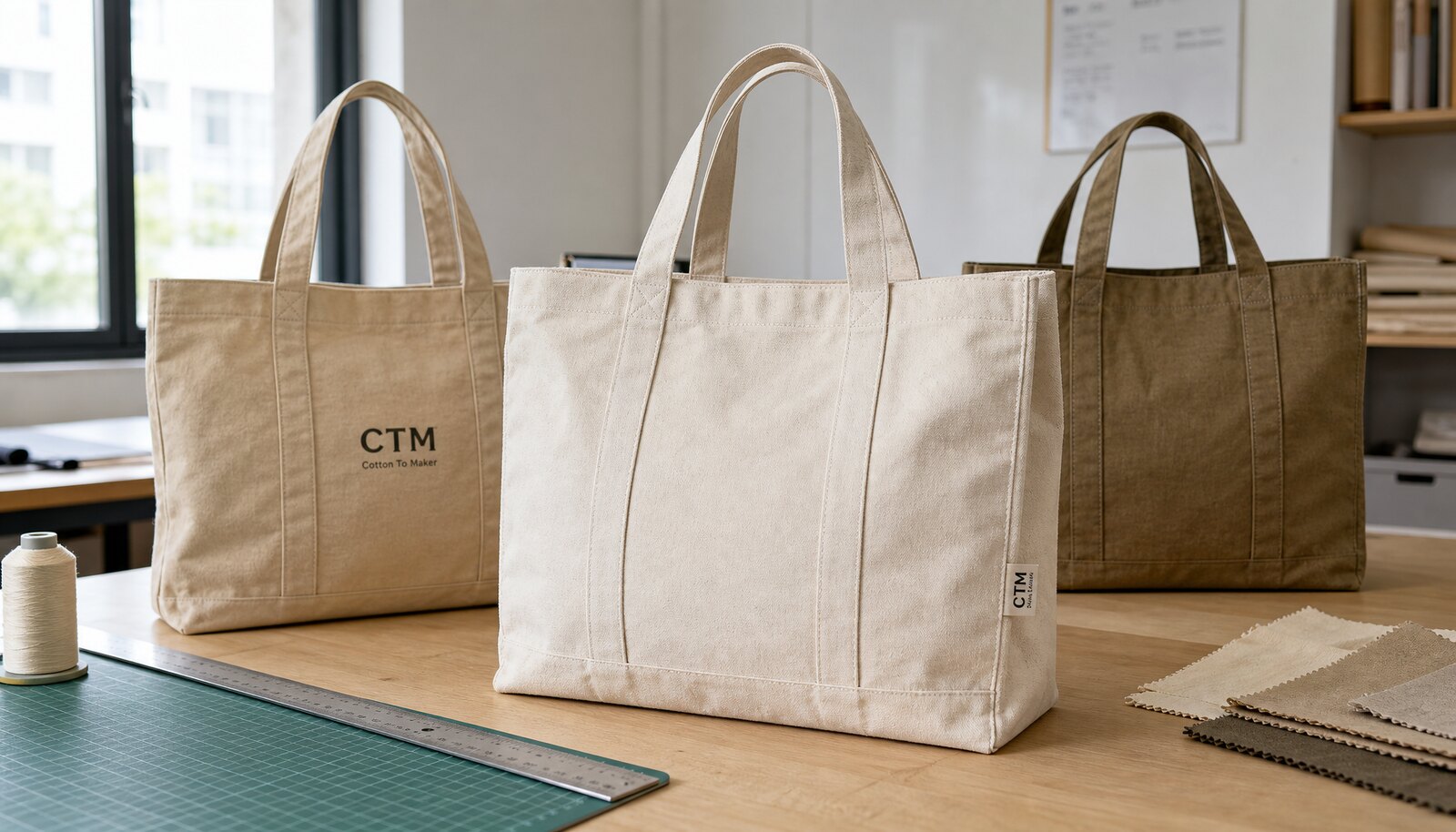
What makes bespoke canvas bags hard to buy well
Most procurement problems with bespoke canvas bags do not start with the print. They start with a vague spec. If the buyer only says “canvas tote with logo,” suppliers will quote different fabrics, different constructions, and different finishing levels, then the quotes become impossible to compare. One factory may include 10 oz unbleached canvas with a simple single-stitch hem, while another may price 12 oz bleached canvas with reinforced handles and a cleaner inside finish. Both can sound correct until the sample arrives.
The better approach is to define the bag as a functional product, not a design idea. State what it must carry, where it will be sold, how much shelf presentation matters, and whether the buyer cares more about cost, durability, or premium feel. That one decision affects fabric weight, handle choice, closure, print method, and packaging. For retail buyers, the difference between a bag that looks acceptable on screen and one that survives store handling is usually in the hidden construction details.
- Do not compare quotes unless fabric weight, size, print method, and packing are identical.
- A low unit price can hide lighter fabric, thinner webbing, or weaker stitch reinforcement.
- If the bag is going into a set or retail pack, the inside finish matters as much as the front print.
Choose the canvas spec before you price the artwork
For bespoke canvas bags, fabric weight is the first commercial decision. In practical buying terms, 8–10 oz works for light promotional use, event giveaways, and short-life retail campaigns. 10–12 oz is the common middle ground for everyday tote use, bookstore bags, and brand merchandise. If the bag must feel structured, carry heavier product, or justify a premium retail price, 12–16 oz is the safer range. The higher the fabric weight, the stronger the body and the better the bag stands on shelf, but you also pay in raw material cost, sewing time, and shipment weight.
Weight alone does not tell the whole story. Canvas weave quality, shrinkage, and dye consistency change the final result. A 12 oz bag with poor weave uniformity can still look cheap, especially after printing. If your brand cares about presentation, ask for the fabric hand feel, weave density, and whether the fabric is pre-shrunk or finished after weaving. For unbleached canvas, also confirm whether natural flecks and tone variation are part of the approved look or considered defects.
- 8–10 oz: promotional, light gifting, event use, lower landed cost.
- 10–12 oz: best all-round range for retail and everyday carrying.
- 12–16 oz: premium, structured, heavier contents, stronger shelf presence.
- Ask whether shrinkage is measured before or after printing and sewing.
Print method changes the quote more than most buyers expect
Artwork complexity should be matched to the print process, not the other way around. Screen printing is usually the best route for one to three spot colors on medium or larger runs. It gives strong color, good opacity on natural canvas, and predictable unit economics once setup is covered. Heat transfer is useful for short runs, complex artwork, or multiple SKUs, but buyers should treat it as a different durability profile. Embroidery and woven labels elevate the product, but they are not the cheapest path and they create more time per piece.
The most common sourcing mistake is giving the same artwork to every supplier and assuming the print result will match across processes. It won’t. Fine lines, tonal shading, and small reverse type can vanish on rough canvas or distort near seams. Put the artwork in writing with the exact print size, position from edge, and acceptable color tolerance. If the bag has natural canvas, state whether you want a soft ink look or a high-opacity print that covers the fabric grain more aggressively.
- Screen print: best for simple, repeatable branding and larger quantities.
- Heat transfer: useful for short runs but can be weaker under abrasion and heat.
- Embroidery: premium feel, but heavier thread build can distort light fabric.
- Woven or sewn labels: good for subtle branding and more controlled color matching.
How to read supplier quotes without getting fooled by unit price
A quote for bespoke canvas bags should be broken into the same cost blocks across suppliers: fabric, cutting and sewing, print setup, print application, packaging, and any special finishing. If one supplier gives a single number, ask for the basis. You need to know whether they are quoting blank bags, one-color printed bags, or packed retail units with labels and barcodes. Without that breakdown, the cheapest quote is usually the least complete one.
MOQ also needs context. Some factories quote a low MOQ but charge heavily for setup, which makes the effective unit cost unattractive until volume increases. Others have a higher MOQ but better efficiency on fabric cutting and printing, which makes them more competitive at scale. A useful comparison is the landed cost per sellable unit, not the ex-factory price alone. Include carton quantity, carton size, and gross weight because canvas bags can become freight-heavy fast, especially when packed with inserts or headers.
- Ask for the base bag cost, print setup, print run, and packaging as separate lines.
- Confirm whether the quoted MOQ is for the exact fabric and construction or just the same artwork.
- Compare landed cost with packing and freight assumptions, not only ex-factory unit price.
Factory sourcing routes: direct factory, trading company, or local converter
The right sourcing route depends on order size, timeline, and how much control you want over construction. A direct factory is usually the best option when you need consistent bulk production, clear process visibility, and lower unit cost at volume. The factory can often advise on stitch methods, fabric sourcing, and print limits more accurately because they control the line. This is the cleanest route when the bag is part of a long-term program or a retail line with recurring replenishment.
A trading company can help when the buyer needs broader coordination, mixed product programs, or lower MOQs across many SKUs. The tradeoff is that the actual production site may vary, so spec control matters even more. A local converter is useful for urgent replenishment or final-stage customization, but the buyer usually pays more because the product has already moved through multiple hands. For bespoke canvas bags, the source route should be chosen by risk tolerance, not habit.
- Direct factory: best for volume, transparency, and repeatability.
- Trading company: useful for mixed programs and lower start-up complexity.
- Local converter: fastest for replenishment, usually not the lowest cost.
- If you need consistent retail packaging, direct factory control is usually safer.
Construction details that separate a usable bag from a return risk
The handle and seam construction are the parts that fail when a tote is actually used. Self-fabric handles look neat and can lower cost, but they should be reinforced properly where they join the body. Cotton webbing handles are usually better for comfort and load-bearing, especially if the bag will carry books, groceries, or sampling kits. If you want a premium hand-feel, you can still use canvas handles, but the stitch pattern and bar-tack reinforcement need to be specified clearly.
The top edge finish matters more than many buyers expect. A clean hem improves appearance and helps keep the bag opening flat. Binding or lining improves the interior look and can hide print strike-through, but it adds cost and sewing time. If the bag includes a zipper, magnetic snap, gusset, or internal pocket, each extra part should be treated as a separate QC point. Avoid adding features unless they support the bag’s real use case.
- Use cotton webbing for heavier loads and better shoulder comfort.
- Specify reinforcement at all load points, not just the handle seam.
- Lining improves premium presentation and print coverage but increases labor.
- Extra features should support function, not just the design brief.
Sample approval: what to test before bulk production starts
A pre-production sample is not just for sign-off; it is the only chance to catch misunderstandings before fabric is cut in volume. Test the sample for size, hand feel, handle length, color, print position, and how the bag sits when empty and when loaded. If the product is for retail, put it on a shelf and see whether it looks balanced from the front. If it is for packaging or gifting, see whether it opens cleanly and folds back without creasing the print.
The golden sample should be the one that the factory uses as the bulk reference. Mark it clearly and make sure the production team has the same version. If your brand is sensitive to color, approve the sample under daylight and under the same lighting you expect in stores or warehouses. For natural canvas, note that minor fiber variation is normal, but placement, shape, and stitch quality should still be controlled tightly.
- Measure finished size, handle length, and print position on the actual sample.
- Load the sample with realistic weight to test handle strain and body shape.
- Seal the approved sample as the bulk reference and label it by order number.
- Do not rely on screen images for color approval; inspect a physical sample.
Packing, carton logic, and why freight can change your margin
Packing is often where a buyer loses margin without noticing. Flat-packed bespoke canvas bags are usually the best option for freight efficiency, but the folding method must be consistent or the bags can arrive creased and uneven. If the bag is retail-ready, an individual polybag and barcode label may be necessary. That protects shelf presentation, but it adds labor, plastic cost, and carton weight. For large-volume programs, even a small change in carton loading can shift the shipping budget.
Ask the factory for carton count, carton dimensions, and gross weight before confirming the order. That lets your freight forwarder estimate volume weight correctly and lets you compare suppliers on a real landed-cost basis. If the bag includes a thick insert card, swing tag, zipper pack, or individual barcode sticker, make sure the quote states whether those items are included. Missing packing details are a common source of surprise charges at the end of production.
- Flat-pack reduces freight cost but needs disciplined folding and carton control.
- Individual polybags improve retail readiness but add cost and plastic use.
- Carton size matters as much as unit cost when volume weight is high.
- Include packaging specs in the RFQ or the supplier will price differently.
Lead time planning and the schedule risks buyers usually underestimate
A realistic production schedule for bespoke canvas bags usually includes artwork confirmation, fabric booking, sample approval, bulk sewing, print curing, packing, and final inspection. The most common delay is not sewing; it is waiting for artwork approval, shade confirmation, or a corrected sample. If you are sourcing natural canvas with custom printing, build in time for color matching and drying or curing. If the bag uses hardware, a zipper, or a lining, there is more chance of component delay.
When a supplier says they can ship quickly, check where the clock starts. Does production begin after deposit, after sample approval, or after art confirmation? That single detail changes the schedule by days or weeks. Buyers with seasonal or retail launch deadlines should always ask for a dated production timeline with milestones. If the factory cannot give a believable schedule, the quote is not production-ready.
- Clarify the production start trigger: deposit, artwork approval, or sample sign-off.
- Add buffer time for print curing, rework, and carton labeling.
- Hardware, lining, and complex packing extend the schedule more than basic sewing does.
- Seasonal launches should never rely on a verbal lead time alone.
Landed-cost comparison: the right way to compare three supplier quotes
To compare supplier quotes fairly, use one line of assumptions for all offers. For example: same canvas weight, same finished size, same one-color print, same folding method, same carton count, and same delivery terms. Then convert each quote into a landed cost per sellable unit. That means including unit price, print setup, inner packing, master carton cost, and freight allocation. Once those numbers are aligned, the real differences become obvious: one supplier may be cheap on sewing but expensive on print setup, while another may be higher on unit price but lower in freight because the cartons are more efficient.
The best buying decision is not the cheapest bag; it is the lowest-risk bag that still meets the brand standard. For short runs, a supplier with a slightly higher unit price but stronger sampling discipline can save money by avoiding rejects. For recurring retail programs, stable sewing quality and repeatable print positioning are often more valuable than saving a few cents on the first order.
- Normalize quotes to the same spec before comparing price.
- Spread setup and packaging costs across the order quantity.
- Use landed cost per sellable unit, not raw ex-factory price.
- Treat rework risk as a cost, especially for retail and branded programs.
Specification comparison for buyers
| Spec decision | Recommended option | When it fits | Buyer risk to check |
|---|---|---|---|
| Fabric weight | 10–12 oz cotton canvas for retail; 8–10 oz for promo; 12–16 oz for premium structure | Choose by load requirement, price point, and whether the bag must stand upright on shelf | Light fabric can warp under heavy contents; heavy fabric can increase cost and reduce foldability |
| Bag construction | Single-layer with hemmed top for low cost; lined body with inner binding for premium presentation | Use lining for higher-end brands, darker prints, or when you want cleaner interior finishing | Unlined bags may show print strike-through, seam fray, or poor shape consistency |
| Print method | Screen print for 1–3 spot colors; heat transfer for short runs; embroidery or woven label for premium branding | Choose based on artwork complexity, order size, and abrasion resistance needed | Overly detailed art may blur in screen print; transfers can crack if substrate or curing is wrong |
| Handle style | Self-fabric handles for a clean retail look; cotton webbing for comfort and load-bearing | Use webbing for grocery, event, or heavier carry loads | Short handles make shoulder carry difficult; weak stitch reinforcement can fail at stress points |
| Closure | Open top for low-cost retail use; zipper or magnetic snap for travel, gifting, or document carry | Add closure when contents must stay secure or when the bag is part of a premium set | Closure hardware adds lead time, cost, and extra QC points |
| MOQ strategy | Start with a standard base bag and customize print, label, and packing before changing the pattern | Best for first orders, market testing, and managing tooling risk | Too many custom changes at low MOQ can create quote gaps and sample-only pricing |
| Sampling route | Pre-production sample after artwork approval, then sealed golden sample for bulk reference | Use when color accuracy, logo placement, or panel dimensions matter | Skipping a pre-production sample increases dispute risk on shade, placement, and finishing |
| Supplier route | Direct factory for volume and spec control; trading company for small mixed programs; local converter for urgent replenishment | Select based on volume, timeline, and your need for factory transparency | Trading quotes can hide production origin; local converters may price higher on fabric-heavy items |
| Packing format | Flat pack with insert sheet or bulk carton with size ratio control | Use flat pack for e-commerce or shelf-ready retail; bulk carton for cost-sensitive shipments | Incorrect folding or carton loading can create creases, deformation, and higher freight cost |
Buyer checklist before sampling
- Define target fabric weight in oz or GSM and state whether the bag must hold shape when empty.
- Specify finished size, handle length, seam allowance, and whether the top edge is hemmed or bound.
- Approve artwork in vector format and identify exact print position with measurements from seams.
- Set acceptance criteria for color variation, stitch density, and allowable size tolerance.
- Confirm packing style, carton quantity, barcode needs, and whether the bags are polybagged individually.
- Request a pre-production sample and a sealed golden sample before bulk approval.
Factory quote questions to send
- What is the exact fabric weight, weave count, and shrinkage assumption used in your quote?
- Is the quoted price based on blank bags, printed bags, or fully packed retail-ready units?
- Which print method is included, and what is the setup cost for each color or artwork location?
- What stitching reinforcement do you include at the handle anchor points and side seams?
- What is your MOQ for this exact construction, and what changes increase the MOQ or unit price?
- What is the sample lead time, bulk lead time, and what date is counted as the start of production?
- How do you package cartons, and what is the carton count, carton size, and gross weight?
- What defect rate or QC standard do you use for print alignment, seam strength, and size tolerance?
Quality-control points to confirm
- Fabric weight matches the agreed spec within a practical tolerance and does not feel underweight versus the approved sample.
- Cut size and finished size stay within agreed tolerance, with both handles matching length and symmetry.
- Stitching is even, with no skipped stitches, loose threads, open seams, or weak handle bar-tacks.
- Print color matches the approved sample under daylight and does not show blur, cracking, pinholes, or poor cure.
- Top hem, lining, zipper, or binding sits flat without puckering or twisting.
- Cartons are packed to the agreed count with clean folding, correct labels, and no moisture damage or compression marks.